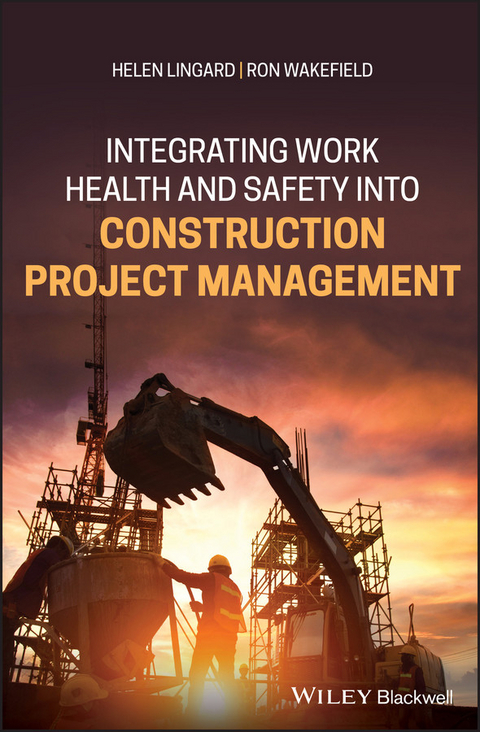
Integrating Work Health and Safety into Construction Project Management (eBook)
John Wiley & Sons (Verlag)
978-1-119-15995-7 (ISBN)
Provides insights into how health and safety can be more effectively integrated into the procurement, design, and management of construction projects
This book aims to explore the ways in which technological, organizational, and cultural strategies can be combined and integrated into construction project management to produce sustained and significant health and safety (H&S) improvements. It looks at design and safety practices, work organization, workforce engagement and learning, and offers ideas for producing systemic change.
Integrating Work Health and Safety into Construction Project Management addresses how best to achieve safety in design through the adoption of a stakeholder management approach. It instructs on how to drive H&S improvements through supply chain integration and responsible procurement and project management practices. It examines the components of a culture for health and safety and the development of a cultural maturity model. The book discusses the potential to improve H&S through the provision of conditions of work that afford workers a positive work-life balance. It also covers how advanced technologies and the application of techniques developed from health informatics can support real time analysis and improvement of H&S in construction. Lastly, it looks at the benefits associated with engaging workers and using their tacit H&S knowledge to inform work process improvements.
This text also:
- Provides new and non-traditional ways of thinking about H&S
- Focuses on technological, organizational, and cultural integration
- Offers a multi-disciplinary perspective provided by an internationally recognized research team from the social sciences, engineering, construction/project management, and psychology
- Presents, in detail, the collective analysis from a broad-ranging ten year program of collaborative research
- Contains a rich range of industry case studies
Integrating Work Health and Safety into Construction Project Management is an excellent resource for academics and researchers engaged in research in construction H&S, as well as for postgraduates taking construction project management and H&S courses. It will also be beneficial to consultants, policy advisors, construction project managers and H&S professionals.
HELEN LINGARD, PHD, is RMIT Distinguished Professor in construction work health and safety. She leads the Construction Work Health and Safety @ RMIT research group in the School of Property, Construction and Project Management, RMIT University, Melbourne, Australia.
RON WAKEFIELD, PHD, is Professor of Construction, Dean, School of Property, Construction and Project Management and Deputy Pro-Vice Chancellor - International in the Design and Social Context Portfolio, RMIT University, Melbourne, Australia.
Provides insights into how health and safety can be more effectively integrated into the procurement, design, and management of construction projects This book aims to explore the ways in which technological, organizational, and cultural strategies can be combined and integrated into construction project management to produce sustained and significant health and safety (H&S) improvements. It looks at design and safety practices, work organization, workforce engagement and learning, and offers ideas for producing systemic change. Integrating Work Health and Safety into Construction Project Management addresses how best to achieve safety in design through the adoption of a stakeholder management approach. It instructs on how to drive H&S improvements through supply chain integration and responsible procurement and project management practices. It examines the components of a culture for health and safety and the development of a cultural maturity model. The book discusses the potential to improve H&S through the provision of conditions of work that afford workers a positive work-life balance. It also covers how advanced technologies and the application of techniques developed from health informatics can support real time analysis and improvement of H&S in construction. Lastly, it looks at the benefits associated with engaging workers and using their tacit H&S knowledge to inform work process improvements. This text also: Provides new and non-traditional ways of thinking about H&S Focuses on technological, organizational, and cultural integration Offers a multi-disciplinary perspective provided by an internationally recognized research team from the social sciences, engineering, construction/project management, and psychology Presents, in detail, the collective analysis from a broad-ranging ten year program of collaborative research Contains a rich range of industry case studies Integrating Work Health and Safety into Construction Project Management is an excellent resource for academics and researchers engaged in research in construction H&S, as well as for postgraduates taking construction project management and H&S courses. It will also be beneficial to consultants, policy advisors, construction project managers and H&S professionals.
HELEN LINGARD, PHD, is RMIT Distinguished Professor in construction work health and safety. She leads the Construction Work Health and Safety @ RMIT research group in the School of Property, Construction and Project Management, RMIT University, Melbourne, Australia. RON WAKEFIELD, PHD, is Professor of Construction, Dean, School of Property, Construction and Project Management and Deputy Pro-Vice Chancellor - International in the Design and Social Context Portfolio, RMIT University, Melbourne, Australia.
Preface
Chapter 1: The state of work health and safety in construction
Chapter 2: The client's role in improving workplace health and safety
Chapter 3: Designing safe and healthy products and processes
Chapter 4: Construction workers' health
Chapter 5: Cultures that enable work health and safety
Chapter 6: Understanding and applying health and safety metrics
Chapter 7: Managing work health and safety: Re-thinking rules and worker engagement
Chapter 8: An integrated approach to reducing the risk of work-related musculoskeletal disorders
Chapter 9: Considerations for the future of construction work health and safety
Index
1
The State of Work Health and Safety in Construction
1.1 The Construction Safety Problem
Most reports or articles about work health and safety () in construction begin with a statement about the industry's poor safety statistics. Irrespective of the part of the world in which a particular study has been conducted, it is common for authors to describe:
- high rates of injury and fatality in construction, relative to other industries, and
- disproportionate numbers of work‐related injuries or deaths compared to the size of the construction workforce.
The construction WHS problem is a global one. Indeed, the International Labour Organization () estimates at least 60 000 fatal accidents occur in construction each year, representing one fatal accident every 10 minutes. The ILO estimates the construction sector typically employs between 6% and 10% of the workforce, but accounts for between 25% and 40% of work‐related deaths.
The Center for the Protection of Workers' Rights Construction Chart Book (2013) provides information about the leading causes of work‐related fatalities and non‐fatal work injuries resulting in days away from work () in the construction industry in the USA. Between 1992 and 2010, the highest ranked causes of fatalities in construction were:
- falls to a lower level (6678 deaths);
- highway incidents (2707 deaths);
- contact with electric current (2443 deaths); and
- being struck by an object (2054 deaths).
In contrast, there were 74 950 reported non‐fatal injuries resulting in DAFW in the USA construction industry in 2010. Leading causes were:
- bodily reaction/exertion (33.6%);
- contact with objects (33.0%); and
- falls (24.2%).
In Australia, an industry profile compiled in 2018 found the most common types of incidents resulting in serious claims for workers' compensation between 2012–2013 and 2015–2016 were:
- muscular stress while lifting, carrying, or putting down objects (16%);
- muscular stress while handling objects (14%);
- falls on the same level (13%);
- falls from height (11%);
- being hit by a moving, or flying object (8%);
- hitting moving objects (6%); and
- other mechanisms (32%) (Safe Work Australia 2018).
Of the construction fatalities that occurred in Australia between 2013 and 2016, the majority involved:
- falls from height (30%);
- being hit by falling objects (15%);
- vehicle incidents (15%);
- being hit by moving objects (11%);
- contact with electricity (10%);
- being trapped between stationary and moving objects (9%); and
- other mechanisms (11%) (Safe Work Australia 2018).
The largest number of fatalities involved construction and mining labourers (22% or 27% fatalities over the four‐year period). Other occupations involved in fatalities were electricians (11% or 14% fatalities), bricklayers, carpenters, and joiners (8% or 10% fatalities), and mobile plant operators (8% or 10% fatalities) (Safe Work Australia 2018).
In the UK, there were 196 fatal injuries to workers in the construction sector between 2012–2013 and 2016–2017. Of these:
- 97 involved a fall from height;
- 19 involved someone being trapped by something collapsing or overturning;
- 19 involved someone being struck by a moving vehicle;
- 16 involved someone being struck by a moving, including flying, object;
- 14 involved contact with electricity or an electrical discharge; and
- 9 involved contact with moving machinery (Health and Safety Executive 2018a).
Non‐fatal injuries to construction workers in the UK in 2016–2017 that resulted in more than seven days off work involved:
- lifting/handling (29%);
- slips, trips, or falls on the same level (21%);
- falls from height (10%);
- struck by moving, including flying, object (12%);
- contact with moving machinery (6%); and
- struck by moving vehicle (1%) (Health and Safety Executive 2018a).
The evidence suggests safety performance of construction industries in developing countries is considerably poorer than in developed countries. This may be because institutional and governance frameworks regulating industrial activities are relatively weak and have little impact (Kheni et al. 2008) and because the construction industry in developing countries relies on an unskilled, mobile workforce, often drawn from agricultural backgrounds (Priyadarshani et al. 2013). The economic environment in many developing countries also creates challenges for WHS as construction businesses operate in a competitive, relatively unregulated, environment. Delayed payments, and the failure of contractor assistance programmes, dramatically reduce resources available for investment in improving workers' health and safety (Kheni et al. 2010).
In the USA, Australia, and the UK, recent decades have seen a steady downward trend in rates of non‐fatal injury in the construction industry. In contrast, projections for developing countries are for an increase in work‐related injuries and deaths as work becomes more industrialized (Kheni et al. 2008). In the UK, Australia, and the USA the numbers of work‐related fatalities in construction have also declined, although the rate of fatalities remains high relative to other industries. In the UK, the fatality rate of 1.62 per 100 000 workers per year is more than 3.5 times the average rate across all industries (0.46 per 100 000 workers) (Health and Safety Executive 2017). The Center for the Protection of Workers' Rights observes that reductions in fatalities have not occurred uniformly across all incident types. Thus, in the USA, fatalities due to contact with electric current decreased nearly 45% between 1995 and 2010, while the number of fatalities from falls to a lower level was similar at the two time points. Also, the total number of deaths due to highway incidents became the second leading cause of fatalities in construction over the period 1995–2010. Although deaths in some areas have reduced, in others they have remained fairly constant (CPWR 2013).
A detailed comparative analysis of international safety statistics is beyond the scope of this introductory chapter. However, the quick overview of statistics from the USA, Australia, and the UK reveals some important insights for preventing work‐related injury and fatalities.
First, the ways in which construction workers are injured and killed (at least in industrialized countries) are remarkably similar and have changed little over recent years. The same injury mechanisms and incident classifications are prevalent, meaning construction workers are still being killed and injured in ways that are well‐known and documented in national and international statistical reports.
Second, although work‐related injuries have decreased in many countries, on average the construction industry's fatality rate remains relatively high, and some types of incident have been resistant to change.
Third, the type of incident that results in a non‐fatal injury (albeit one that involves a workers' compensation claim) is generally quite different from the type of incident in which someone is killed.
The implications of these three observations will be considered briefly in turn.
The similarity between injuries and incident types, over time and across the globe, indicate that the kinds of activities and incidents that result in people being injured or killed are known and understood. Further, there is not a great deal of variation between these activities and incidents among construction industries (at least in industrialized countries). Fatal incidents are largely attributed to falls from height, contact with electricity, and being trapped or struck by a moving object. Body exertion, lifting/handling, falling, and being struck by an object were leading incident types resulting in non‐fatal injury. The consistency with which these types of incidents/injuries impact on construction workers indicates that strategies targeting these specific areas could significantly reduce the burden of injury or death in the construction industry.
Data from the USA suggest some types of fatal incidents have been reduced through targeted collective industry efforts. Most notably, the number of fatal incidents involving workers coming into contact with electricity reduced in recent years. However, in other areas, including falls and highway incidents, fatalities have not reduced to the same extent. The persistence of certain types of fatal incident suggests greater efforts need to be targeted to reducing work‐related deaths in these high‐risk, high‐consequence areas.
Finally, differences in the types of incident that produce low‐ versus high‐consequence outcomes can have implications for where resources and effort are focused.
Some writers on WHS have suggested a false sense of invulnerability in high‐risk organizational environments has resulted from the emphasis on lost time injury frequency rates, and consequent effort focused on preventing occupational injuries seen as being high in frequency but of low consequence. To evidence this argument, it is pointed out that serious incidents resulting...
| Erscheint lt. Verlag | 16.5.2019 |
|---|---|
| Sprache | englisch |
| Themenwelt | Technik ► Bauwesen |
| Wirtschaft | |
| Schlagworte | architecture OHS • Baubetrieb • Bauingenieur- u. Bauwesen • Business & Management • Civil Engineering & Construction • client safety leadership • Construction • Construction: Health & Safety • Construction Industry • Construction Management • construction projects • Construction Safety • designing safer construction projects • Gesundheits- u. Arbeitsschutz im Bauwesen • guide to H&S • H&S • H&S management methods • H&S strategies • health and safety • health and wellbeing</p> • improving OHS • integrating work health • Integrating Work Health and Safety into Construction Project Management • <p>occupational health and safety • make construction safer • occupational health and safety in construction • occupational health management systems • occupational risk management systems • occupational safety management systems • ohs • OHS in construction industry • Project Management • Projektmanagement • safe construction design • safer construction • Wirtschaft u. Management • Work health • work-life balance |
| ISBN-10 | 1-119-15995-4 / 1119159954 |
| ISBN-13 | 978-1-119-15995-7 / 9781119159957 |
| Informationen gemäß Produktsicherheitsverordnung (GPSR) | |
| Haben Sie eine Frage zum Produkt? |
 EPUB (Adobe DRM)
Kopierschutz: Adobe-DRM
Adobe-DRM ist ein Kopierschutz, der das eBook vor Mißbrauch schützen soll. Dabei wird das eBook bereits beim Download auf Ihre persönliche Adobe-ID autorisiert. Lesen können Sie das eBook dann nur auf den Geräten, welche ebenfalls auf Ihre Adobe-ID registriert sind.
Details zum Adobe-DRM
Dateiformat: EPUB (Electronic Publication)
EPUB ist ein offener Standard für eBooks und eignet sich besonders zur Darstellung von Belletristik und Sachbüchern. Der Fließtext wird dynamisch an die Display- und Schriftgröße angepasst. Auch für mobile Lesegeräte ist EPUB daher gut geeignet.
Systemvoraussetzungen:
PC/Mac: Mit einem PC oder Mac können Sie dieses eBook lesen. Sie benötigen eine
eReader: Dieses eBook kann mit (fast) allen eBook-Readern gelesen werden. Mit dem amazon-Kindle ist es aber nicht kompatibel.
Smartphone/Tablet: Egal ob Apple oder Android, dieses eBook können Sie lesen. Sie benötigen eine
Geräteliste und zusätzliche Hinweise
Buying eBooks from abroad
For tax law reasons we can sell eBooks just within Germany and Switzerland. Regrettably we cannot fulfill eBook-orders from other countries.
aus dem Bereich