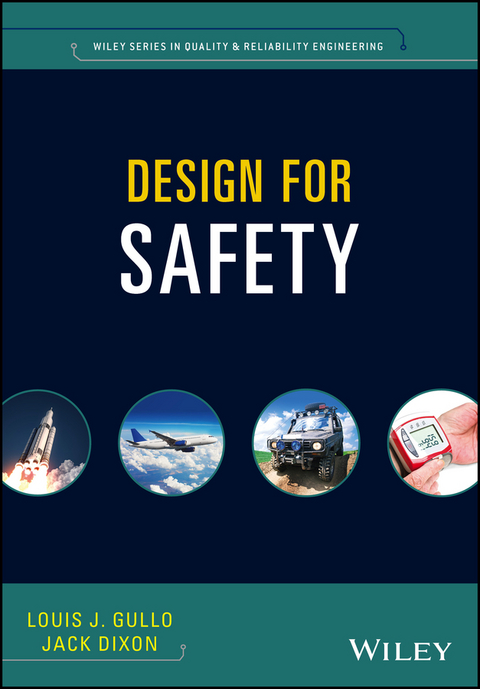
Design for Safety (eBook)
John Wiley & Sons (Verlag)
978-1-118-97431-5 (ISBN)
A one-stop reference guide to design for safety principles and applications
Design for Safety (DfSa) provides design engineers and engineering managers with a range of tools and techniques for incorporating safety into the design process for complex systems. It explains how to design for maximum safe conditions and minimum risk of accidents. The book covers safety design practices, which will result in improved safety, fewer accidents, and substantial savings in life cycle costs for producers and users. Readers who apply DfSa principles can expect to have a dramatic improvement in the ability to compete in global markets. They will also find a wealth of design practices not covered in typical engineering books-allowing them to think outside the box when developing safety requirements.
Design Safety is already a high demand field due to its importance to system design and will be even more vital for engineers in multiple design disciplines as more systems become increasingly complex and liabilities increase. Therefore, risk mitigation methods to design systems with safety features are becoming more important. Designing systems for safety has been a high priority for many safety-critical systems-especially in the aerospace and military industries. However, with the expansion of technological innovations into other market places, industries that had not previously considered safety design requirements are now using the technology in applications.
Design for Safety:
- Covers trending topics and the latest technologies
- Provides ten paradigms for managing and designing systems for safety and uses them as guiding themes throughout the book
- Logically defines the parameters and concepts, sets the safety program and requirements, covers basic methodologies, investigates lessons from history, and addresses specialty topics within the topic of Design for Safety (DfSa)
- Supplements other books in the series on Quality and Reliability Engineering
Design for Safety is an ideal book for new and experienced engineers and managers who are involved with design, testing, and maintenance of safety critical applications. It is also helpful for advanced undergraduate and postgraduate students in engineering.
Design for Safety is the second in a series of 'Design for' books. Design for Reliability was the first in the series with more planned for the future.
LOUIS J. GULLO works for Raytheon Missile Systems, Engineering Product Support Directorate (EPSD), in Tucson, AZ. He is a member of the technical staff and the technical leader for Software Reliability and Safety across Missile Systems. He has worked in the industry for 33 years. He retired as Lieutenant Colonel from the US Army Signal Corps.
JACK DIXON is President of JAMAR International, Inc., in Orlando, FL. He has worked in the defense industry for over 45 years in the areas of system safety, human factors engineering, logistics support, program management, and business development.
A one-stop reference guide to design for safety principles and applications Design for Safety (DfSa) provides design engineers and engineering managers with a range of tools and techniques for incorporating safety into the design process for complex systems. It explains how to design for maximum safe conditions and minimum risk of accidents. The book covers safety design practices, which will result in improved safety, fewer accidents, and substantial savings in life cycle costs for producers and users. Readers who apply DfSa principles can expect to have a dramatic improvement in the ability to compete in global markets. They will also find a wealth of design practices not covered in typical engineering books allowing them to think outside the box when developing safety requirements. Design Safety is already a high demand field due to its importance to system design and will be even more vital for engineers in multiple design disciplines as more systems become increasingly complex and liabilities increase. Therefore, risk mitigation methods to design systems with safety features are becoming more important. Designing systems for safety has been a high priority for many safety-critical systems especially in the aerospace and military industries. However, with the expansion of technological innovations into other market places, industries that had not previously considered safety design requirements are now using the technology in applications. Design for Safety: Covers trending topics and the latest technologies Provides ten paradigms for managing and designing systems for safety and uses them as guiding themes throughout the book Logically defines the parameters and concepts, sets the safety program and requirements, covers basic methodologies, investigates lessons from history, and addresses specialty topics within the topic of Design for Safety (DfSa) Supplements other books in the series on Quality and Reliability Engineering Design for Safety is an ideal book for new and experienced engineers and managers who are involved with design, testing, and maintenance of safety critical applications. It is also helpful for advanced undergraduate and postgraduate students in engineering. Design for Safety is the second in a series of Design for books. Design for Reliability was the first in the series with more planned for the future.
LOUIS J. GULLO works for Raytheon Missile Systems, Engineering Product Support Directorate (EPSD), in Tucson, AZ. He is a member of the technical staff and the technical leader for Software Reliability and Safety across Missile Systems. He has worked in the industry for 33 years. He retired as Lieutenant Colonel from the US Army Signal Corps. JACK DIXON is President of JAMAR International, Inc., in Orlando, FL. He has worked in the defense industry for over 45 years in the areas of system safety, human factors engineering, logistics support, program management, and business development.
Introduction: What You Will Learn
Chapter 1 Design for Safety Paradigms (Raheja, Gullo, and Dixon)
This chapter introduces the concept of design for safety. It describes the technical gaps between the current state of the art and what it takes to design safety into new products. This chapter introduces ten paradigms for safe design that help you do the right things at the right times. These paradigms will be used throughout the book as guiding themes.
Chapter 2 The History of System Safety (Dixon)
This chapter provides a brief history of system safety from the original “fly‐fix‐fly” approach to safety, to the 1940s’ hints at a better way of doing aircraft safety, to the 1950s’ introduction of the term “system safety,” and to the Minuteman program that brought the systematic approach to safety to the mainstream. Next, the development of and history of MIL‐STD‐882 is discussed. The growth of system safety and various hazard analyses techniques over the years are covered in detail. The expansion of system safety into the nonmilitary, commercial arena is discussed along with numerous industry standards. Tools of the trade, management of system safety, and integration of system safety into the business process are summarized.
Chapter 3 System Safety Program Planning and Management (Gullo and Dixon)
This chapter discusses the management of system safety in detail. It describes how system safety fits into the development cycle, how it is integrated into the systems engineering process, and what the key interfaces are between system safety and other disciplines. The System Safety Program Plan is described in detail as well as how it is related to other management plans. Another important document, the Safety Assessment Report, is also outlined in detail.
Chapter 4 Managing Risks and Product Liabilities (Gullo and Dixon)
In this chapter, the importance of product liability is emphasized beginning with some financial statistics and numerous examples of major losses due to bad design. The importance of risk and risk management is described. This chapter includes a brief summary of product liability law and what it means to the safety engineer and the organization developing the product or system.
Chapter 5 Developing System Safety Requirements (Gullo)
This chapter’s main emphasis is on developing safety requirements including why we need them and why they are so important. We discuss what requirements are and how they enter into various types of specifications. This chapter covers in detail how to develop good safety requirements and provides examples of both good and bad requirements.
Chapter 6 System Safety Design Checklists (Dixon)
This chapter introduces various types of checklists and why they are an important tool for the safety engineer. It covers procedural, observational, and design checklists and provides examples of each type. The uses of checklists are also discussed, and several detailed checklists are provided in the appendices of the book.
Chapter 7 System Safety Hazard Analysis (Dixon)
This chapter introduces some terminologies and discusses risk in detail as an introduction to hazard analyses. After that, it covers several of the most widely used hazard analysis techniques including preliminary hazard list, preliminary hazard analysis, subsystem hazard analysis, system hazard analysis, operating and support hazard analysis, and health hazard analysis. The chapter ends with a discussion of hazard tracking and its importance.
Chapter 8 Failure Modes, Effects, and Criticality Analysis for System Safety (Gullo)
This chapter describes how the Failure Modes and Effects Analysis (FMEA) and Failure Modes, Effects, and Criticality Analysis (FMECA) are useful for system safety analysis. It discusses various types of FMEAs including Design FMECA, Software Design FMECA, and Process Failure Modes, Effects, and Criticality Analysis (PFMECA) and how they may be applied in a number of flexible ways at different points in the system, hardware, and software development life cycle.
Chapter 9 Fault Tree Analysis for System Safety (Dixon)
Fault Tree Analysis (FTA) is covered in this chapter. It is a very popular type of analysis used in system safety. It is a representation in tree form of the combination of causes (failures, faults, errors, etc.) contributing to a particular undesirable event. It uses symbolic logic to create a graphical representation of the combination of failures, faults, and errors that can lead to the undesirable event being analyzed. The purpose of FTA is to identify the combinations of failures and errors that can result in the undesirable event. This chapter provides a brief history of the development of FTA and provides a detailed description of how the analyst creates and applies FTA.
Chapter 10 Complementary Design Analysis Techniques (Dixon)
This chapter covers several additional popular hazard analysis techniques including event trees, sneak circuit analysis, functional hazard analysis, barrier analysis, and bent pin analysis. It also provides brief introductions to a few additional techniques that are less often used including Petri nets, Markov analysis, management oversight risk tree, and system‐theoretic process analysis.
Chapter 11 Process Safety Management and Analysis (Dixon)
This chapter introduces Process Safety Management (PSM). It is an effort to prevent catastrophic accidents involving hazardous processes that involve dangerous chemicals and energies. It applies management principles and analytic techniques to reduce risks to processes during the manufacture, use, handling, storage, and transportation of chemicals. A primary focus of PSM is on hazards related to the materials and energetic processes present in chemical production facilities, but it can also be applied to facilities that handle flammable materials, high voltage devices, high current load devices, and energetic materials, such as rocket motor propellants. In this chapter we discuss the regulatory requirement for PSM, elements of PSM, hazard analysis techniques, and related regulations and end with a discussion of inherently safer design.
Chapter 12 System Safety Testing (Gullo)
In this chapter we discuss the purpose and importance of safety testing. The different types of safety tests are described along with the test strategy and test architecture. The development of safety test plans is covered. This chapter contains a section on testing for regulatory compliance and discusses numerous national and international standards. The topic of Prognostics and Health Monitoring (PHM) is introduced along with a discussion of the return on investment associated with PHM. We also discuss how to leverage reliability test approaches for safety testing. Safety test data collection is covered along with what to do with test results. The chapter is ended with a discussion on designing for testability and test modeling.
Chapter 13 Integrating Safety with Other Functional Disciplines (Gullo)
In this chapter, we cover several ways of integrating safety with other engineering and functional disciplines. We discuss the many key interfaces to system safety engineering, and we define the cross‐functional teams. We have touched on modern decision‐making in a digital world and on knowing who are your friends and your foes. The importance of constant communication is emphasized. We talk about a code of conduct and values. This chapter introduces paradigms from several different sources and how they relate to system safety and how their application can make you a better engineer and help make you and your organization more successful.
Chapter 14 Design for Reliability Integrated with System Safety (Gullo)
The integration with all functional disciplines is very important for effectively and efficiently practicing system safety engineering, but the most important of these functional discipline interfaces is the interface to reliability engineering. This chapter builds on and applies the lessons from Chapter 13 to establish a key interface with reliability engineering. In this chapter we discuss what reliability is and how it is intertwined with system safety. Specifically we discuss how system safety uses reliability data and how this data is used to help determine risk. We conclude the chapter with examples of using reliability data to design for safety.
Chapter 15 Design for Human Factors Integrated with System Safety (Dixon and Gullo)
In starting this chapter, we refer back to the previous two chapters where we discussed the ways system safety engineers should integrate and interface with other types of engineers and functional disciplines and, in particular, with reliability engineering. Another important engineering interface for a system safety engineer is Human Factors Engineering (HFE). System safety benefits greatly from a well‐established and reinforced interface to HFE. In this chapter we define HFE and its role in design of both hardware and software. We discuss the Human–Machine Interface (HMI), the determination of manpower and workload requirements, and how they influence personnel selection and training. We detail how human factors analysis is performed and how the various tools are used. Also discussed is...
| Erscheint lt. Verlag | 7.12.2017 |
|---|---|
| Reihe/Serie | Quality and Reliability Engineering Series |
| Wiley Series in Quality and Reliability Engineering | Wiley Series in Quality and Reliability Engineering |
| Sprache | englisch |
| Themenwelt | Technik ► Bauwesen |
| Technik ► Elektrotechnik / Energietechnik | |
| Wirtschaft | |
| Schlagworte | Aerospace Engineering • commercial design safety • design and safety assessment • Design engineering • Design engineers • design for reliability • design for safety for space systems • Design for Safety</p> • design for safety techniques • design for safety tools • design safety for complex systems • DFSA • Electrical & Electronics Engineering • Elektrotechnik u. Elektronik • Engineering • engineering design for process safety • engineering design for safety • Engineering Management • engineering managers • hazard analysis • Industrial Design • Jack Dixon • Louis J. Gullo • <p>design safety • Management im Ingenieurwesen • Military engineers • principles of designing for safety • principles of design safety • Product Safety • Qualität u. Zuverlässigkeit • Quality & Reliability • Reliability Assessment • reliable design • safe design requirements • safe engineering • Safety critical applications • Safety-Critical Systems • System safety • Systems Engineering • Systems Engineering & Management • Systemtechnik u. -management |
| ISBN-10 | 1-118-97431-X / 111897431X |
| ISBN-13 | 978-1-118-97431-5 / 9781118974315 |
| Informationen gemäß Produktsicherheitsverordnung (GPSR) | |
| Haben Sie eine Frage zum Produkt? |
 EPUB (Adobe DRM)
Kopierschutz: Adobe-DRM
Adobe-DRM ist ein Kopierschutz, der das eBook vor Mißbrauch schützen soll. Dabei wird das eBook bereits beim Download auf Ihre persönliche Adobe-ID autorisiert. Lesen können Sie das eBook dann nur auf den Geräten, welche ebenfalls auf Ihre Adobe-ID registriert sind.
Details zum Adobe-DRM
Dateiformat: EPUB (Electronic Publication)
EPUB ist ein offener Standard für eBooks und eignet sich besonders zur Darstellung von Belletristik und Sachbüchern. Der Fließtext wird dynamisch an die Display- und Schriftgröße angepasst. Auch für mobile Lesegeräte ist EPUB daher gut geeignet.
Systemvoraussetzungen:
PC/Mac: Mit einem PC oder Mac können Sie dieses eBook lesen. Sie benötigen eine
eReader: Dieses eBook kann mit (fast) allen eBook-Readern gelesen werden. Mit dem amazon-Kindle ist es aber nicht kompatibel.
Smartphone/Tablet: Egal ob Apple oder Android, dieses eBook können Sie lesen. Sie benötigen eine
Geräteliste und zusätzliche Hinweise
Buying eBooks from abroad
For tax law reasons we can sell eBooks just within Germany and Switzerland. Regrettably we cannot fulfill eBook-orders from other countries.
aus dem Bereich