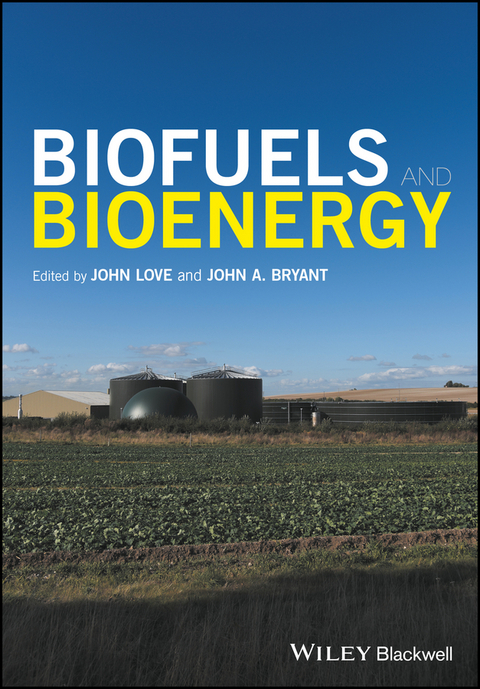
Biofuels and Bioenergy (eBook)
John Wiley & Sons (Verlag)
978-1-118-35053-9 (ISBN)
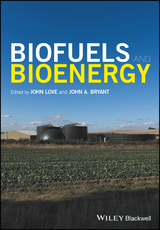
With increased public and scientific attention driven by factors such as oil price spikes, the need for increased energy security, and concerns over greenhouse gas emissions from fossil fuels, the production of fuels by biological systems is becoming increasingly important as the world seeks to move towards renewable, sustainable energy sources.
Biofuels and Bioenergy presents a broad, wide-ranging and informative treatment of biofuels. The book covers historical, economic, industrial, sociological and ecological/environmental perspectives as well as dealing with all the major scientific issues associated with this important topic.
With contributions from a range of leading experts covering key aspects, including:
• Conventional biofuels.
• Basic biology, biochemistry and chemistry of different types and classes of biofuel.
• Current research in synthetic biology and GM in the development and exploitation of new biofuel sources.
• Aspects relating to ecology and land use, including the fuel v food dilemma.
• Sustainability of different types of biofuel.
• Ethical aspects of biofuel production.
Biofuels and Bioenergy provides students and researchers in biology, chemistry, biochemistry and chemical engineering with an accessible review of this increasingly important subject.
About the Editors
John Love and John A. Bryant, Biosciences, College Of Life and Environmental Sciences, University of Exeter, UK
About the Editors John Love and John A. Bryant, Biosciences, College Of Life and Environmental Sciences, University of Exeter, UK
1
Biofuels: The Back Story
John A. Bryant and John Love
College of Life and Environmental Sciences, University of Exeter, Exeter, UK
Summary
This chapter looks at the history of the use of fossil and non‐fossil fuels and of environmental energy sources from the earliest phases of human society right up to the present day. Factors, especially climate change, which affect the use of particular fuels are discussed. The chapter ends with an overview of biofuels, thus setting the scene for the rest of the book.
1.1 Introduction
The earliest recorded use of the word biofuel was in 1970 when it was defined as ‘a fuel (such as wood or ethanol) composed of or produced from biological raw materials.’ Use of the term gradually became more frequent but it is only in last 15 years or so that it has entered into everyday speech. The definition has also widened: the Oxford Dictionary On‐line now simply states ‘a fuel derived immediately from living matter’. This clearly covers much more than wood and ethanol; the range will be apparent from the chapters in this book. The purpose of this chapter is to provide the context for, and to discuss the reasons behind, this increased interest in biofuels. It is an unfolding story of human ingenuity and inventiveness in the search for sources of light and heat and of energy for industry, transport, commerce and domestic appliances. It is a fascinating story that sets the scene for the rest of the book.
1.2 Some History
1.2.1 Wood and Charcoal
Although the first recorded use of the word was relatively recent, the use of biofuels actually goes back much further. Biological materials have been used as energy sources throughout human existence; indeed it is likely that the Neanderthals had discovered fire and the use of wood as a fuel. On a small local scale, burning of wood as a fuel may be regarded as having a very small ‘ecological footprint’, especially since, reflecting our modern concerns, it releases only recently fixed CO2 into the atmosphere.
Pyrolysis of wood in the absence of air produces charcoal, a form of carbon that burns at a higher temperature than wood and can thus be used in metal smelting. The use of charcoal as a fuel dates back at least 6,000 years (and probably longer). Initially it was confined to Egypt and what is now known as the Middle East. Its use soon spread across Europe so that by the Middle Ages, charcoal production was very widespread and resulted in extensive deforestation over large areas. It thus had an ecological/environmental impact that today we would regard at least as undesirable.
With the invention of a method for making coke from coal (i.e. a fossil fuel), charcoal production declined dramatically, especially from 1900 onwards (although one of us can remember seeing charcoal burners in woods in Surrey in the middle years of the 20th century). Today the use of charcoal as a fuel1 in developed countries is largely confined to domestic barbecues. However, across the world, wood and charcoal are still the mostly widely used fuels. This includes the use of wood‐burning stoves in people’s homes and wood‐burning power stations, often regarded as environmentally friendly because, as noted before, it is recently fixed CO2 that is released. This CO2 release may be further mitigated by the planting of replacement trees in managed forestry systems. However, there is no universal agreement on this; some think that growing wood just for burning is not wise when the wood could have so many other uses2. Furthermore, in many parts of the world where emissions are less stringently controlled, burning of wood often causes serious smoke pollution and damaging effects on human health.
1.2.2 Dung as Fuel
Evidence for use of dried animal dung as fuel dates back about 9,000 years to Neolithic communities in which cattle, sheep, goats and pigs had been domesticated. It is still used today in many less‐developed countries. There is also evidence for use by Native Americans of dung from wild bison in the prairies where wood fuel was very scarce or non‐existent. There is undoubtedly today support for increased use of dung as fuel, both in what we might call traditional or semi‐traditional methods and by anaerobic digestion (see Chapter 3).
1.2.3 Oils and Fats
The use of natural oils for lighting dates back to about 15,000 years. Most ancient oil lamps ran on plant oils. Thus the lamps referred to in the Old and New Testaments of the Bible and in the Qur’an were fuelled with olive oil. Both plant and animal oils were also used for lighting in ancient Egypt, dating back to about 3000 BC: rushlights, precursors to candles, were made by dipping rolled‐up papyrus into oil or into melted beeswax or melted animal fat. The Romans are generally credited with invention of the true candle containing a wick that ran through the length of a cylinder of bees’ wax (other solid animal fats may also be used).
Another animal‐based biofuel is whale oil, which was used for lighting from the 17th until the second half of the 19th century, when it was finally displaced by kerosene and by coal gas (see also Sections 1.3.2 and 1.3.3). It was noted that ‘sperm oil’ (from the head of the sperm whale) gave a much cleaner and less odoriferous flame than whale blubber oil and this was one of the factors that led to intensive hunting of sperm whales in the 18th and 19th centuries. Thus, in the period between 1770 and 1775, the northeastern United States produced about 7.16 million litres of sperm oil per year. At least 6,400 sperm whales would have been killed annually to supply this amount of oil. Hunting at this intensity continued until the second half of the 19th century and of course was not confined to US‐based whaling fleets. It is estimated that the world population of sperm whales declined by about 235,000 in the 18th century alone and it seems very likely that they would have been hunted to extinction3 had petroleum oil and oil‐based products not displaced sperm oil as fuels of choice.
1.2.4 Peat
The last traditional biological fuel we wish to consider is peat. This occurs in the wetter areas of the world, covering between 2% and 3% of the global land area, and consists of compressed and partly rotted remains of plants, especially Sphagnum moss. It may thus be regarded as being part way to forming lignite, a form of coal. Peat is cut from the bog in slices, known in Ireland and Scotland as turves (singular turf), which are left to dry before being burned as fuel. One of the problems with peat is that it takes a long time to form, growing at a mean rate of 1 mm/year in a typical peat wetland. It is thus regarded as a semi‐renewable fuel. However, in many areas, the rate of exploitation far exceeds the rate of re‐growth, resulting in denudation of the peat bog and increased run‐off of water, leading to flooding.
Peat is a less efficient fuel than coal and natural gas, which means that per unit of energy, peat releases twice as much CO2 as natural gas and 15% more than coal. This difference is only partly mitigated by the slow renewal of peat fuel (as mentioned above). Large‐scale peat fires, sometimes initiated by lightning strikes and sometimes by illegal ‘slash and burn’ activities, in addition to releasing large amounts of CO2 into the air, also cause very extensive particulate pollution. One of us was working in Singapore during the notorious 1997 Southeast Asia haze, caused by illegal burning of forest trees and subsequent out‐of‐control peat fires in Indonesia. Visibility was very poor, the air smelt of smoke and we were advised not to exercise outside. Right across the region there were deleterious effects on human and animal health. Similar hazes have occurred several times since 1997, as exemplified in Figure 1.1.
Figure 1.1 Haze over Singapore 2013.
Peat may be regarded as being on its way to becoming a fossil fuel. However, the true fossil fuels are coal (including lignite), oil and natural gas. We thus move on to discuss the history of their use.
1.3 Fossil Fuels
1.3.1 Coal
On Caerphilly Common, between Cardiff and Caerphilly in South Wales, are some shallow depressions and some small mounds. These are the remains of bell pits and their associated spoil tips, providing evidence of coal mining in the area dating from the 14th century. However, use of coal as a fuel for heating, cooking and even smelting metals actually goes back several thousand years. Its use was recorded in China at around 1000 BC and in Ancient Greece at around 350 BC. In Britain, surface or outcrop coal has been used since the Bronze Age (2000–3000 BC). In Roman times, houses and baths were heated by burning coal and a brazier of coal was kept permanently alight in the Temple of Minerva in Aquae Sulis (now known as Bath). The Romans also used coal for smelting iron.
However, it was not until the end of the 18th century that coal mining became really organised. Those simple bell pits at Caerphilly Common were tapping into the enormous South Wales coalfield and it was coal mined from this field that fuelled the Industrial Revolution in that part of Britain. Indeed, the Industrial...
| Erscheint lt. Verlag | 28.2.2017 |
|---|---|
| Sprache | englisch |
| Themenwelt | Naturwissenschaften ► Biologie ► Mikrobiologie / Immunologie |
| Naturwissenschaften ► Chemie ► Technische Chemie | |
| Technik ► Elektrotechnik / Energietechnik | |
| Technik ► Umwelttechnik / Biotechnologie | |
| Wirtschaft | |
| Schlagworte | attention • Bioenergie • bioenergy • biological • Biotechnologie i. d. Biowissenschaften • Biotechnology • Biowissenschaften • broad • Concerns • Driven • Emissions • Energie • Energy • Factors • Fossil • fuels • Gas • greenhouse • increasingly important • Life Sciences • Oil • price • Production • Public • renewable • Scientific • spikes • Sustainable • Systems • towards • World |
| ISBN-10 | 1-118-35053-7 / 1118350537 |
| ISBN-13 | 978-1-118-35053-9 / 9781118350539 |
| Informationen gemäß Produktsicherheitsverordnung (GPSR) | |
| Haben Sie eine Frage zum Produkt? |
 EPUB (Adobe DRM)
Kopierschutz: Adobe-DRM
Adobe-DRM ist ein Kopierschutz, der das eBook vor Mißbrauch schützen soll. Dabei wird das eBook bereits beim Download auf Ihre persönliche Adobe-ID autorisiert. Lesen können Sie das eBook dann nur auf den Geräten, welche ebenfalls auf Ihre Adobe-ID registriert sind.
Details zum Adobe-DRM
Dateiformat: EPUB (Electronic Publication)
EPUB ist ein offener Standard für eBooks und eignet sich besonders zur Darstellung von Belletristik und Sachbüchern. Der Fließtext wird dynamisch an die Display- und Schriftgröße angepasst. Auch für mobile Lesegeräte ist EPUB daher gut geeignet.
Systemvoraussetzungen:
PC/Mac: Mit einem PC oder Mac können Sie dieses eBook lesen. Sie benötigen eine
eReader: Dieses eBook kann mit (fast) allen eBook-Readern gelesen werden. Mit dem amazon-Kindle ist es aber nicht kompatibel.
Smartphone/Tablet: Egal ob Apple oder Android, dieses eBook können Sie lesen. Sie benötigen eine
Geräteliste und zusätzliche Hinweise
Buying eBooks from abroad
For tax law reasons we can sell eBooks just within Germany and Switzerland. Regrettably we cannot fulfill eBook-orders from other countries.
aus dem Bereich