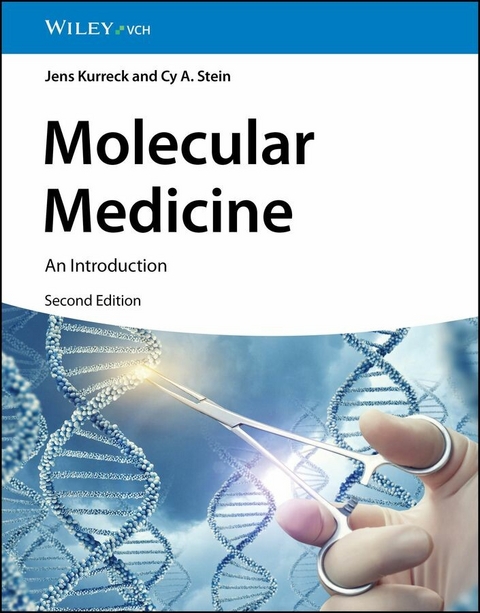
Molecular Medicine (eBook)
1300 Seiten
Wiley (Verlag)
978-3-527-84300-8 (ISBN)
Discover the future of medicine in this extensively updated edition of the pioneering textbook, reflecting the rapid progress in the field
Molecular medicine is a rapidly growing field, and the molecular basis of diseases can be used to develop therapeutic approaches in numerous other medical subfields. Research into molecular medicine has been used as the basis for gene therapy, precision medicine, and more. Molecular Medicine provides a fundamental overview of this cutting-edge, interdisciplinary field, incorporating modules from basic immunology to virology to new approaches. Now fully updated to reflect the exponential progress in biomedical research, it promises to put students on the leading edge of a revolution in the life sciences.
Readers of the second edition of Molecular Medicine will also find:
- Detailed discussion of cutting-edge topics including cancer stem cells, mRNA vaccines, organs-on-a-chip, and more
- Professional artwork throughout
- Chapter summaries, exercises, and study questions for each chapter
Molecular Medicine is ideal for graduate students in life sciences and medicine, as well as the lecturers and libraries that support them.
Jens Kurreck, PhD, is a full Professor for Applied Biochemistry at the Technische Universität Berlin (TUB), Germany. He studied biochemistry and philosophy at the Free University of Berlin (FUB) and completed his PhD at the TUB in 1998. His research focuses on 3D bioprinting, RNA technologies, and virology. He has received several awards for his research achievements and teaching activities.
Cy Aaron Stein, PhD, is Emeritus Professor of Oncology and Experimental Therapeutics and Chair of Medical Oncology at the City of Hope Medical Center in Duarte, CA, USA. He received a PhD in chemistry from Stanford University and an MD degree at the Albert Einstein College of Medicine, NY, in 1982. He has received numerous awards, among them the 2023 Life Achievement Award of the Oligonucleotide Therapeutics Society and a Clinical Career Development Award of the American Cancer Society.
Chapter 1
Introduction
Contents List
- 1.1 The Basics of Molecular Medicine
- 1.2 The Human Cell
- 1.3 DNA Replication and Gene Expression
- 1.4 Biological Communication
- 1.5 The Immune System
Summary
- Molecular medicine is a highly dynamic field of life science research that uses interdisciplinary approaches to understand normal and pathological cellular processes at the molecular level. The findings of basic research have entered clinical practice, as new diagnostic assays and novel therapeutic strategies focus not only on the symptoms but also on the causes of disease.
- The development of drugs is a long-term and expensive process that starts with basic and preclinical research. A candidate drug must then successfully pass through three types of clinical trials in humans before a novel agent can be approved for therapeutic purposes.
- The eukaryotic cell is compartmentalized into several cellular organelles by intracellular membranes. The nucleus harbors the genetic material, mitochondria are the cellular power plants, and the endoplasmic reticulum (ER) and the Golgi apparatus are responsible for the glycosylation and sorting of proteins.
- Cells follow a tightly regulated cycle of four phases. These include the two gap phases G1 and G2, the S phase in which new DNA is synthesized, and mitosis (M phase), during which the cell divides.
- Apoptosis is the process of programmed cell death, which is important as a normal physiological mechanism and for protection against infections and cancer. Apoptosis can be triggered by extrinsic or intrinsic signals.
- Genomic DNA is amplified by DNA polymerases in a process known as replication. The synthesis occurs in a semiconservative and semidiscontinuous way.
- Expression of genes requires two steps. In the first step, the DNA is transcribed into RNA. Most primary transcripts are posttranscriptionally processed. For mRNAs, this step includes the addition of a cap at the 5′ end and of a poly(A) tail at the 3′ end. Introns are spliced out to link the exons together. Several bases are modified in various types of RNAs. The second step in gene expression is the translation of the genetic information into proteins. This process is carried out by ribosomes. Posttranslational modifications of proteins include activation by proteolytic cleavage and covalent modification of amino acid side chains. This can occur, for example, by glycosylation or reversible phosphorylation.
- Sophisticated communication between cells is essential for the functioning of a multicellular organism. Neurons transmit signals at synapses. Hormones are molecules that induce physiological responses over a long distance or in adjacent cells. The extracellular signals are transmitted into the cell-by-cell surface receptors and induce a signaling cascade that leads to a biological response.
- The immune system protects an organism against (infectious) diseases. The innate immune response recognizes general patterns of pathogens, while the adaptive immune system is directed against specific targets. The adaptive immune system involves a cellular immune response (T cells) and a humoral immune response (B cells that produce antibodies).
1.1 The Basics of Molecular Medicine
1.1.1 Topics of Molecular Medicine
Molecular medicine is a discipline dedicated to understanding normal and pathological cellular processes at the molecular level. This approach requires the use of many physical, chemical, biological, biochemical, and medical techniques (some of which are introduced in Chapter 2) to understand fundamental molecular mechanisms and how they go awry in disease. Molecular medicine combines classical disciplines such as cell and molecular biology, biochemistry, and medicine. Knowledge is often acquired via interdisciplinary investigation and can be used to develop new forms of molecular diagnosis and therapeutic intervention.
Molecular medicine can be divided into basic research and applied clinical disciplines. The basic research component investigates molecular and genetic mechanisms of cellular function and identifies pathological processes. In many cases, this addresses a specific question with a hypothesis-driven approach and can lead to large-scale investigations of whole genomes and their function (Chapter 7). The discipline known as translational research then tries to apply the findings from basic science to the clinic, where it may provide new forms of diagnosis and therapy.
A report published by Linus Pauling in 1949 laid the basis for the establishment of the field of molecular medicine. In his seminal paper, he showed that hemoglobin from patients suffering from sickle-cell anemia had a different electrical charge than hemoglobin from healthy individuals. This study demonstrated that a disease could be traced to an alteration in the molecular structure of a protein. This new perspective opened the possibility of establishing novel forms of diagnosis and therapy at the molecular level. Sickle-cell anemia is not the only case in which a detailed understanding of the molecular etiology of the disease (e.g. of inherited genetic disorders, Chapter 3) has led to new diagnostic options (Chapter 8).
The field of oncology also illustrates the paradigm shift caused by a molecular perspective. While cancer treatment is still largely based on the removal of the tumor by surgery (followed by chemotherapy and/or radiation therapy), molecular oncology (Chapter 4) tries to elucidate those pathways that lead to cellular transformation. This knowledge also helps produce a comprehensive molecular diagnosis of the disease basis in a single patient so that the treatment can be adjusted accordingly, an approach that has come to be known as “personalized medicine.” Many modern anticancer drugs block specific pathways that lead to uncontrolled cellular proliferation. The development of checkpoint inhibitors and genetically modified T cells (CAR T cells) has revolutionized aspects of modern cancer therapy. Similarly, elucidation of the life cycles of pathogens has helped develop new drugs for the treatment of infections with viruses (Chapter 5) and bacteria or eukaryotic pathogens (Chapter 6). For example, advancements in the understanding of virus biology have led to the identification of novel targets for antiviral agents.
Most conventional drugs belong to the class of small molecular compounds. To achieve oral bioavailability and to promote rapid diffusion across cell membranes and intracellular trafficking to their sites of action, the majority of (oral) drugs have molecular weights below 550 Da (although some antibacterial agents fall in the 700–900 Da range). A prominent example is acetylsalicylic acid (trade name Aspirin, Figure 1.1a), a drug mainly used as an analgesic.
Figure 1.1 Small molecular drugs and biologics. (a) The chemical structures of acetylsalicylic acid (Aspirin) and (b) the crystal structure of an antibody, are shown for comparison. The two structures are not drawn to scale.
Source: Part (b) [1] / John Wiley & Sons.
Molecular medicine has broadened the spectrum of entities used as drugs. New medications are now often based on large molecules of biological origin (known as “biologics”). These include, for example, recombinant proteins such as monoclonal antibodies (Figure 1.1b; Chapter 10), short pieces of DNA or RNA (Chapter 13), entire genes that can be delivered by viral vectors (Chapter 11), or even complete cells (Chapter 12). Pharmacogenetic investigations aim at discovering why the efficacy and toxic side effects of a drug at a given dose vary between individuals (Chapter 9). However, molecular medicine not only develops new diagnostic and therapeutic approaches but can also pose heretofore unknown ethical issues, some of which will be introduced in Chapter 14.
1.1.2 Stages of Drug Development
The development of a new drug is a time-consuming and expensive process (Figure 1.2) that may take 12–15 years (and in some cases even longer). The cost calculus of developing a new drug is complex and controversial, but the average cost to bring a new molecular entity (NME) to the market has been estimated to range from US$318 million to US$2.8 billion. Drug development usually starts with the identification of a new target,...
| Erscheint lt. Verlag | 28.3.2025 |
|---|---|
| Sprache | englisch |
| Themenwelt | Naturwissenschaften ► Biologie ► Mikrobiologie / Immunologie |
| Schlagworte | Bacteria • DNA Replication • gene expression • gene therapy • Genetic disorder • Genetic Testing • genomics • Human cell • immune system • molecular oncology • Molecular Virology • pharmacogenetics recombinant protein drug • Proteomics • Stem Cell |
| ISBN-10 | 3-527-84300-0 / 3527843000 |
| ISBN-13 | 978-3-527-84300-8 / 9783527843008 |
| Informationen gemäß Produktsicherheitsverordnung (GPSR) | |
| Haben Sie eine Frage zum Produkt? |
 EPUB (Adobe DRM)
Kopierschutz: Adobe-DRM
Adobe-DRM ist ein Kopierschutz, der das eBook vor Mißbrauch schützen soll. Dabei wird das eBook bereits beim Download auf Ihre persönliche Adobe-ID autorisiert. Lesen können Sie das eBook dann nur auf den Geräten, welche ebenfalls auf Ihre Adobe-ID registriert sind.
Details zum Adobe-DRM
Dateiformat: EPUB (Electronic Publication)
EPUB ist ein offener Standard für eBooks und eignet sich besonders zur Darstellung von Belletristik und Sachbüchern. Der Fließtext wird dynamisch an die Display- und Schriftgröße angepasst. Auch für mobile Lesegeräte ist EPUB daher gut geeignet.
Systemvoraussetzungen:
PC/Mac: Mit einem PC oder Mac können Sie dieses eBook lesen. Sie benötigen eine
eReader: Dieses eBook kann mit (fast) allen eBook-Readern gelesen werden. Mit dem amazon-Kindle ist es aber nicht kompatibel.
Smartphone/Tablet: Egal ob Apple oder Android, dieses eBook können Sie lesen. Sie benötigen eine
Geräteliste und zusätzliche Hinweise
Buying eBooks from abroad
For tax law reasons we can sell eBooks just within Germany and Switzerland. Regrettably we cannot fulfill eBook-orders from other countries.
aus dem Bereich