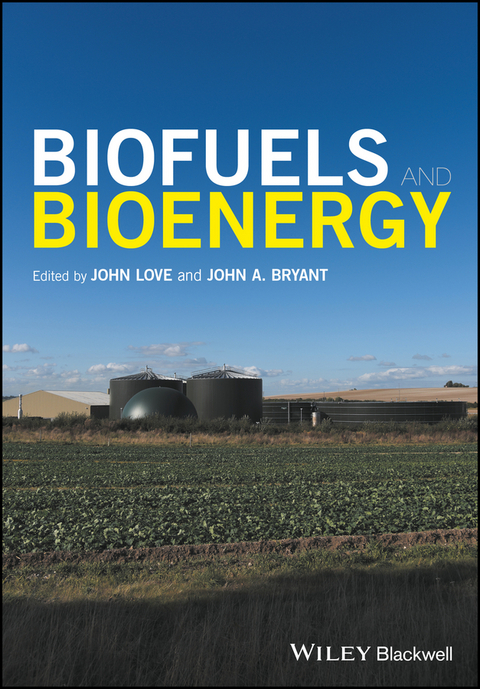
Biofuels and Bioenergy (eBook)
John Wiley & Sons (Verlag)
978-1-118-35054-6 (ISBN)
With increased public and scientific attention driven by factors such as oil price spikes, the need for increased energy security, and concerns over greenhouse gas emissions from fossil fuels, the production of fuels by biological systems is becoming increasingly important as the world seeks to move towards renewable, sustainable energy sources.
Biofuels and Bioenergy presents a broad, wide-ranging and informative treatment of biofuels. The book covers historical, economic, industrial, sociological and ecological/environmental perspectives as well as dealing with all the major scientific issues associated with this important topic.
With contributions from a range of leading experts covering key aspects, including:
• Conventional biofuels.
• Basic biology, biochemistry and chemistry of different types and classes of biofuel.
• Current research in synthetic biology and GM in the development and exploitation of new biofuel sources.
• Aspects relating to ecology and land use, including the fuel v food dilemma.
• Sustainability of different types of biofuel.
• Ethical aspects of biofuel production.
Biofuels and Bioenergy provides students and researchers in biology, chemistry, biochemistry and chemical engineering with an accessible review of this increasingly important subject.
About the Editors
John Love and John A. Bryant, Biosciences, College Of Life and Environmental Sciences, University of Exeter, UK
With increased public and scientific attention driven by factors such as oil price spikes, the need for increased energy security, and concerns over greenhouse gas emissions from fossil fuels, the production of fuels by biological systems is becoming increasingly important as the world seeks to move towards renewable, sustainable energy sources. Biofuels and Bioenergy presents a broad, wide-ranging and informative treatment of biofuels. The book covers historical, economic, industrial, sociological and ecological/environmental perspectives as well as dealing with all the major scientific issues associated with this important topic.With contributions from a range of leading experts covering key aspects, including: Conventional biofuels. Basic biology, biochemistry and chemistry of different types and classes of biofuel. Current research in synthetic biology and GM in the development and exploitation of new biofuel sources. Aspects relating to ecology and land use, including the fuel v food dilemma. Sustainability of different types of biofuel. Ethical aspects of biofuel production. Biofuels and Bioenergy provides students and researchers in biology, chemistry, biochemistry and chemical engineering with an accessible review of this increasingly important subject.
About the Editors John Love and John A. Bryant, Biosciences, College Of Life and Environmental Sciences, University of Exeter, UK
Title Page 5
Copyright Page 6
Contents 7
List of Contributors 15
Preface 17
List of Abbreviations 21
Chapter 1 Biofuels: The Back Story 27
Summary 27
1.1 Introduction 27
1.2 Some History 27
1.2.1 Wood and Charcoal 27
1.2.2 Dung as Fuel 28
1.2.3 Oils and Fats 28
1.2.4 Peat 29
1.3 Fossil Fuels 30
1.3.1 Coal 30
1.3.2 Petroleum Oil 31
1.3.3 Natural Gas 32
1.4 Fossil Fuels and Carbon Dioxide 32
1.4.1 The Club of Rome 32
1.4.2 Climate Change 33
1.5 Alternative Energy Sources 35
1.5.1 Introduction 35
1.5.2 Environmental Energy Sources 35
1.5.3 Nuclear Power 41
1.5.4 Hydrogen 43
1.6 Biofuels 44
Selected References and Suggestions for Further Reading 45
Chapter 2 Biofuels in Operation 47
Summary 47
2.1 Fuels for Transport 47
2.2 Future Trends in Fuels Requirements and Technology 50
2.3 Engines and Fuels – Progress vs Inertia 52
2.4 Engine Constraints, Fuel Specifications and Enhanced Performance 54
2.5 Biofuels – Implications and Opportunities 58
2.5.1 Introduction 58
2.5.2 Ethanol 58
2.5.3 Biodiesel 59
2.6 Advanced Biofuels as Alternatives to Ethanol and FAME 63
2.7 Biofuels for Aviation ‘Biojet’
2.8 Impact of Future Trends in Engine Design on Retail Biofuels 68
2.9 Conclusion 69
Selected References and Suggestions for Further Reading 69
Chapter 3 Anaerobic Digestion 71
Summary 71
3.1 History and Development of Anaerobic Digestion 71
3.1.1 Introduction 71
3.1.2 Mixtures of Micro?Organisms 72
3.2 Anaerobic Digestion: The Process 73
3.2.1 General Biochemistry 73
3.2.2 Design Types 73
3.2.3 Complete Mix Design 73
3.2.4 Plug Flow Digesters 74
3.2.5 High Dry Solids AD Systems 75
3.2.6 Upflow Anaerobic Sludge Blanket (UASB) 76
3.2.7 Anaerobic Filters 76
3.3 Commercial Applications and Benefits 77
3.3.1 In the United Kingdom 77
3.3.2 In the USA 77
3.3.3 In Germany 78
3.3.4 Overall Benefits 78
3.4 Ethanol Production Linked with Anaerobic Digestion 79
3.5 Financial and Economic Aspects 80
3.6 UK and US Government Policies and Anaerobic Digestion – An Overview 81
3.7 Concluding Comments 82
Selected References and Suggestions for Further Reading 83
Chapter 4 Plant Cell Wall Polymers 85
Summary 85
4.1 Nature and Biological Roles of Primary and Secondary Cell Walls 85
4.2 Polysaccharide Composition of Primary and Secondary Cell Walls 86
4.2.1 Typical dicots 86
4.2.2 Differences in Certain Dicots 93
4.2.3 Differences in Monocots 93
4.2.4 Differences in Gymnosperms 94
4.2.5 Differences in Non?seed Land?plants 94
4.2.6 Differences in Charophytes 94
4.3 Post-synthetic Modification of Cell?wall Polysaccharides 96
4.3.1 Cross-linking of cell-wall polysaccharides 96
4.3.2 Hydrolysis of Cell-wall Polysaccharides 98
4.3.3 ‘Cutting and Pasting’ (Transglycosylation) of Cell-wall Polysaccharide Chains 101
4.4 Polysaccharide Biosynthesis 103
4.4.1 General Features 103
4.4.2 At the Plasma Membrane 103
4.4.3 In the Golgi System 104
4.4.4 Delivering the Precursors – sugar Nucleotides 105
4.5 Non-polysaccharide Components of the Plant Cell Wall 106
4.5.1 Extensins and Other (Glyco)Proteins 106
4.5.2 Polyesters 109
4.5.3 Lignin 110
4.5.4 Silica 110
4.6 Conclusions 111
Acknowledgements 111
Appendix 111
Selected References and Suggestions for Further Reading 111
Chapter 5 Ethanol Production from Renewable Lignocellulosic Biomass 115
Summary 115
5.1 Brief History of Fuel-Ethanol Production 115
5.2 Ethanol Production from Sugar Cane and Corn 118
5.3 Lignocellulosic Biomass as Feedstocks for Ethanol Production 119
5.3.1 The Organisms 119
5.3.2 Lignocellulosic Biomass 122
5.3.3 Pretreatment of Lignocellulosic Biomass 125
5.3.4 Effect of Inhibitory Compounds on Fermenting Microorganisms 126
5.4 Summary 128
5.5 Examples of Commercial Scale Cellulosic Ethanol Plants 129
5.5.1 Beta Renewables/Biochemtex Commercial Cellulosic Ethanol Plants in Italy, Brazil, USA and Slovak Republic 129
5.5.2 Poet-DSM ‘Project Liberty’ – First Commercial Cellulosic Ethanol Plant in the USA 129
5.5.3 Abengoa Hugoton, Kansas Commercial Plant and MSW to Ethanol Demonstration Plant, Salamanca 129
Selected References, Suggestions for Further Reading and Useful Websites 130
Chapter 6 Fatty Acids, Triacylglycerols and Biodiesel 131
Summary 131
6.1 Introduction 131
6.2 Synthesis of Triacylglycerol 133
6.2.1 The Metabolic Pathway 133
6.2.2 Potential for Manipulation 136
6.3 Productivity 137
6.4 Sustainability14 140
6.5 More Recently Exploited and Novel Sources of Lipids for Biofuels 140
6.5.1 Higher Plants 140
6.5.2 Algae 141
6.5.3 Prokaryotic Organisms 142
6.6 Concluding Remarks 143
Selected References and Suggestions for Further Reading 143
Chapter 7 Development of Miscanthus as a Bioenergy Crop 145
Summary 145
7.1 Introduction 145
7.2 Developing Commercial Interest 148
7.3 Greenhouse Gas Mitigation Potential 153
7.4 Perspectives for ‘now’ and for the Future 154
Selected References and Suggestions for Further Reading 155
Chapter 8 Mangrove Palm, Nypa fruticans: ‘3-in-1’ Tree for Integrated Food/Fuel and Eco-Services 159
Summary 159
8.1 Introduction: The ‘Food vs Fuel’ and ‘ILUC’ Debates 159
8.2 Integrated Food-Energy Systems (IFES): A Potential Solution 160
8.2.1 Main Features of IFES 160
8.2.2 Baseline Productivity 162
8.3 Land Use: The Importance of Forest Ecosystem Services 163
8.4 Sugar Palms: Highly Productive Multi-Purpose Trees 164
8.5 Nipa13 (Nypa fruticans): A Mangrove Sugar Palm with Great Promise 166
8.6 Conclusion 167
Selected References and Suggestions for Further Reading 167
Chapter 9 The Use of Cyanobacteria for Biofuel Production 169
Summary 169
9.1 Essential Aspects of Cyanobacterial Biology 169
9.1.1 General Features 169
9.1.2 Photosynthesis and Carbon Dioxide Fixation 170
9.1.3 Nitrogen Fixation 172
9.2 Commercial Products Currently Derived from Cyanobacteria 172
9.3 Cyanobacteria Culture 173
9.4 Cyanobacterial Genomes and Genetic Modification for Biofuel Production 174
9.5 Industrial Production of Biofuels from Cyanobacteria 178
9.6 Conclusion 180
Selected References and Suggestions for Further Reading 180
Chapter 10 Third-Generation Biofuels from the Microalga, Botryococcus braunii 183
Summary 183
10.1 Botryococcus braunii 183
10.2 Microbial Interactions 186
10.3 Botryococcus braunii as a Production Platform for Biofuels or Chemicals 187
10.3.1 Hydrocarbons, Lipids and Sugars 187
10.3.2 Controlling and Enhancing Productivity 189
10.3.3 Alternative Culture Systems 191
10.3.4 Harvesting Botryococcus Biomass and Hydrocarbons 192
10.3.5 Processing Botryococcus into an Alternative Fuel 192
10.4 Improving Botryococcus 193
10.5 Future Prospects and Conclusion 195
Selected References and Suggestions of Further Reading 196
Chapter 11 Strain Selection Strategies for Improvement of Algal Biofuel Feedstocks 199
Summary 199
11.1 Introduction 199
11.2 Lipids in Microalgae 200
11.3 Starch in Microalgae 201
11.4 Metabolic Interconnection Between Lipid and Starch Biosynthesis 202
11.5 Strategies for the Selection of Microalgae Strains with Enhanced Biofuel Feedstock Traits 203
11.5.1 Manipulation of Growth Conditions 203
11.5.2 Genetic Mutagenesis 203
11.5.3 Flow Cytometry 204
11.5.4 Fluorescence-Activated Cell Sorting 207
11.5.5 Buoyant Density Centrifugation 209
11.6 Conclusions 211
Acknowledgements 211
Selected References and Suggestions for Further Reading 211
Chapter 12 Algal Cultivation Technologies 217
Summary 217
12.1 Introduction 217
12.2 Lighting 218
12.3 Mixing 220
12.4 Control Systems and Construction Materials 222
12.5 Algal Production Systems at Laboratory Scale 223
12.6 Algal Production in Open Systems 224
12.6.1 Pond-Based Systems 224
12.6.2 Membrane Reactors 226
12.7 Algal Production in Closed Systems 227
12.7.1 Introduction 227
12.7.2 Plate or Panel Based Systems 227
12.7.3 Horizontal Tubular Systems 229
12.7.4 Bubble Columns 231
12.7.5 Airlift Reactors 233
12.8 Concluding Comments 235
Selected References and Suggestions for Further Reading 235
Chapter 13 Biofuels from Macroalgal Biomass 239
Summary 239
13.1 Macroalgal resources in the UK 239
13.2 Suitability of macroalgae for biofuel production 240
13.3 Biofuels from Macroalgae 243
13.3.1 Introduction 243
13.3.2 Ethanol from laminarin, mannitol and alginate 243
13.3.3 Ethanol from cellulose 245
13.3.4 Butanol 246
13.3.5 Anaerobic digestion 247
13.3.6 Thermochemical conversions 249
13.4 Future prospects 249
13.5 Conclusion 250
Acknowledgements 250
Selected References and Suggestions for Further Reading 250
Chapter 14 Lipid-based Biofuels from Oleaginous Microbes 253
Summary 253
14.1 Introduction 253
14.2 Microalgae 255
14.3 Oleaginous Yeasts 257
14.4 Feedstocks for Heterotrophic Microbial Cultivation 257
14.5 The Biochemical Process of Lipid Accumulation in Oleaginous Yeast 258
14.6 Lipid Profile of Oleaginous Microbes 262
14.7 Lipid Extraction and Processing 263
14.8 Concluding Comments 263
Selected References and Suggestions for Further Reading 265
Chapter 15 Engineering Microbial Metabolism for Biofuel Production 267
Summary 267
15.1 Introduction 267
15.2 Designer Biofuels 268
15.2.1 Introduction 268
15.2.2 Isoprenoid-Derived Biofuels 269
15.2.3 Higher Alcohols 271
15.2.4 Fatty Acid-Derived Biofuels 273
15.2.5 Petroleum Replica Hydrocarbons 275
15.3 Towards Industrialisation 277
15.3.1 Introduction 277
15.3.2 Bioconsolidation 277
15.3.3 Molecular and Cellular Redesign 281
15.3.4 Biofuel Pumps 282
15.3.5 Synthetic Biology and Systems Engineering 283
15.4 Conclusion 284
Selected References and Suggestions for Further Reading 285
Chapter 16 The Sustainability of Biofuels 287
Summary 287
16.1 Introduction 287
16.2 Bioenergy policies 288
16.3 Economics of bioenergy markets 289
16.4 Environmental issues 290
16.5 Life Cycle Assessment 292
16.5.1 General features 292
16.5.2 OECD Copenhagen workshop, 2008 293
16.6 Conclusions 296
Selected references and suggestions for further reading 297
Chapter 17 Biofuels and Bioenergy – Ethical Aspects 299
Summary 299
17.1 Introduction to ethics 299
17.1.1 How do we Make Ethical or Moral Decisions? 299
17.1.2 Environmental ethics 301
17.2 Biofuels and Bioenergy – Ethical Background 302
17.3 The Key Ethical Issues 302
17.3.1 Biofuel production and the growth of Food Crops 302
17.3.2 Is growth of Biofuel Crops Sustainable? 304
17.3.3 Biofuel Production, Land Allocation and Human Rights 305
17.4 Concluding comment 309
Selected references and suggestions for further reading 309
Chapter 18 Postscript 311
Selected References and Suggestions for Further Reading 313
Index 315
EULA 326
| Erscheint lt. Verlag | 28.2.2017 |
|---|---|
| Sprache | englisch |
| Themenwelt | Naturwissenschaften ► Biologie ► Mikrobiologie / Immunologie |
| Naturwissenschaften ► Chemie ► Technische Chemie | |
| Technik ► Elektrotechnik / Energietechnik | |
| Technik ► Umwelttechnik / Biotechnologie | |
| Wirtschaft | |
| Schlagworte | attention • Bioenergie • bioenergy • biological • Biotechnologie i. d. Biowissenschaften • Biotechnology • Biowissenschaften • broad • Concerns • Driven • Emissions • Energie • Energy • Factors • Fossil • fuels • Gas • greenhouse • increasingly important • Life Sciences • Oil • price • Production • Public • renewable • Scientific • spikes • Sustainable • Systems • towards • World |
| ISBN-10 | 1-118-35054-5 / 1118350545 |
| ISBN-13 | 978-1-118-35054-6 / 9781118350546 |
| Informationen gemäß Produktsicherheitsverordnung (GPSR) | |
| Haben Sie eine Frage zum Produkt? |
 PDF (Adobe DRM)
Kopierschutz: Adobe-DRM
Adobe-DRM ist ein Kopierschutz, der das eBook vor Mißbrauch schützen soll. Dabei wird das eBook bereits beim Download auf Ihre persönliche Adobe-ID autorisiert. Lesen können Sie das eBook dann nur auf den Geräten, welche ebenfalls auf Ihre Adobe-ID registriert sind.
Details zum Adobe-DRM
Dateiformat: PDF (Portable Document Format)
Mit einem festen Seitenlayout eignet sich die PDF besonders für Fachbücher mit Spalten, Tabellen und Abbildungen. Eine PDF kann auf fast allen Geräten angezeigt werden, ist aber für kleine Displays (Smartphone, eReader) nur eingeschränkt geeignet.
Systemvoraussetzungen:
PC/Mac: Mit einem PC oder Mac können Sie dieses eBook lesen. Sie benötigen eine
eReader: Dieses eBook kann mit (fast) allen eBook-Readern gelesen werden. Mit dem amazon-Kindle ist es aber nicht kompatibel.
Smartphone/Tablet: Egal ob Apple oder Android, dieses eBook können Sie lesen. Sie benötigen eine
Geräteliste und zusätzliche Hinweise
Buying eBooks from abroad
For tax law reasons we can sell eBooks just within Germany and Switzerland. Regrettably we cannot fulfill eBook-orders from other countries.
aus dem Bereich