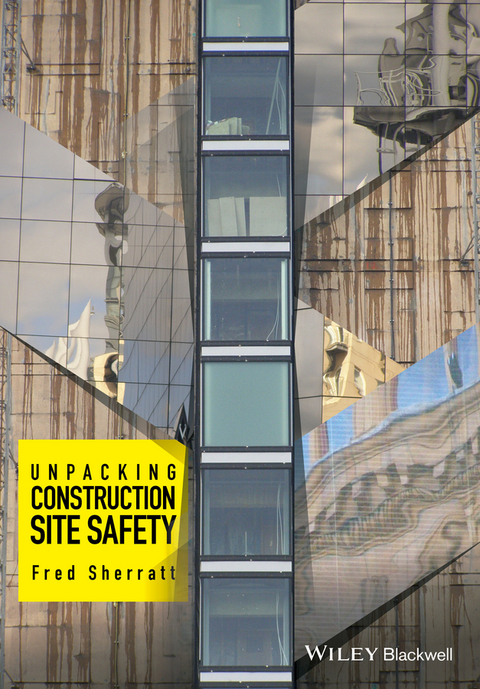
Unpacking Construction Site Safety (eBook)
John Wiley & Sons (Verlag)
978-1-118-81725-4 (ISBN)
Fred Sherratt PhD MCIOB C.BuildE MCABE FHEA has worked in the UK construction industry for over 13 years, starting as a site secretary and working up through the ranks, via the planning function, to site management. She is now a researcher and Senior Lecturer in Construction Management at Anglia Ruskin University.
Unpacking Construction Site Safety provides a different perspective of safety in practice. examines how useful the concept of safety actually is to the development of effective management interventions providing new insights and information to the audience, and assist in a more informed development of new approaches in practice aimed at safety and construction management practitioners as well as academics
Fred Sherratt PhD MCIOB C.BuildE MCABE FHEA has worked in the UK construction industry for over 13 years, starting as a site secretary and working up through the ranks, via the planning function, to site management. She is now a researcher and Senior Lecturer in Construction Management at Anglia Ruskin University.
Preface xi
Acknowledgements xv
1 Introduction 1
References 4
2 Construction Site Contexts 5
Winning Work 6
Subs of Subs of Subs 8
The Workforce 9
Working Conditions 13
Never work a day in your life ... 13
Construction Site Life 14
References 17
3 Safety and Society 21
The Media and its Myths 22
(Mis?])Interpreting the Legislation 25
Where there's blame ... 28
Safety and Society and Construction Sites 31
Understanding People 32
References 42
4 Safety in Construction 47
Measuring Safety: Accidents and Statistics 48
Cause and Effect 51
Safety Management Systems 55
Competence 58
Training 61
Personal Protective Equipment 66
References 73
5 Just a Bit Unsafe? 77
The Legislative Lexicon 77
Safe/Unsafe 83
Safety and Unsafety 88
Safety and Risk 94
Acknowledgements 104
References 104
6 Safety versus Work and Work versus Safety 107
The Non?]Productive 107
Segregation and Integration 111
Problems of Production 114
Production in Practice 116
References 121
7 Engagement and Enforcement 123
Engaging with Safety 124
Safety Propaganda 129
Enforcing Safety 134
Rules Made to be Broken? 138
A Hierarchy of Safety: Responsibility and Ownership 142
Acknowledgements 148
References 148
8 Counting Down to Zero 151
Target Zero: Theories and Thinking 152
Brand Zero 156
Zero in Practice 159
Measuring Zero: Non?]Accident Statistics 161
Achieving Zero 163
Acknowledgements 169
References 169
9 Constructing Safety on Sites 171
What is Safety on Site? 172
Site Safety Culture 177
Putting it into Practice 181
References 187
10 Reflections 189
Index 191
Chapter Two
Construction Site Contexts
Our job, they say, is to get stuck in and get the job done, not to fill in forms. In time this macho approach becomes the local custom and practice.
Kletz 2012: 765
Although Kletz was not specifically talking about the UK construction industry when he made this statement, he might as well have been. Getting stuck in and getting the job done can be seen as one of our industry’s most positive characteristics – nothing can’t be done! – but it has also arguably contributed to one of the worst safety records in UK occupational safety.
The Health and Safety Executive (2014) report that the UK construction industry only employs approximately 5% of the UK workforce, but disproportionately accounts for 31% of fatal injuries, 10% of reported major/specified injuries and 6% of over-7-day injuries to employees. In the period 2013/14 there were 42 fatal injuries to workers in the construction industry and 592 000 working days were lost due to workplace injury, a total of 1.1 days lost per worker. All these statistics make for unpleasant reading, and also make construction one of the most dangerous industries to work in within the UK.
Often accidents happen because of changes to planned work, something pretty much inevitable in the construction industry. We build our own work environments around us and so bring change to our workplaces on a daily basis – if we didn’t we wouldn’t be doing our job – but this is something no other industry really has to contend with. For example, the management of access routes around a construction site can be a very complex and time-consuming task – if the stairs used to access the third floor yesterday are being screeded today and so everyone needs to go round outside to the door at the bottom of the next staircore, but not round the east as the curtain walling is going up and there’s no access through, but that will change next week when they drop onto the west … and so on. And change is not limited to the physical workspace; change to programme, to sequence, to design, to work practices and methods can also occur on a fairly regular basis as labour and plant become available or unavailable, or our clients simply change their minds. As a result the construction industry is highly accepting of change, and sees it as an inherent part of work.
But changes in work environments can also make significant changes to the hazards and risks of a task, and in such cases change means safety should be reconsidered and re-planned and reprogrammed. But these safety aspects can go unnoticed or even ignored, because getting the job done is our top priority. And that is when accidents can occur.
This flexible and fluid work context is also influenced by other aspects of the industry: the motivations behind getting the job done, the people who carry out the work, the way work is allocated and paid for and even the working conditions. Understanding of this wider context provides the groundwork for understandings of how safety itself works on sites, and the contextual influences that have shaped it within this construction site environment.
Winning Work
Winning work in construction can be a complex process, not least because of significant variations in work availability. Demand for construction work is directly derived from the needs of other industries or the public sector (Morton and Ross 2008). Given the nature of the product and the need for capital expenditure or investment for its production, this demand is closely linked to the overall health of the UK economy, and the industry goes through boom and bust periods as the economy fluctuates between growth and recession (Dainty et al. 2007). As the economic downturn of 2010 has demonstrated, the construction industry can be hit hard in terms of workload reduction and job losses during recession, only to be short of materials, labour and skills to carry out projects once the workload picks up. Lengthy project timescales can also mean that work priced and won in a time of recession can also hit problems when the start on site coincides with a recovering market – labour and material prices rise and so place a squeeze on profit margins that may well have been tight to begin with.
Construction work is traditionally won through competitive tendering processes with the award of work usually going to the lowest bidder. This makes organisational workloads highly uncertain, and means companies are under pressure to keep their bids low to increase their chance of winning. This can inevitably lead to a focus on cost rather than other project considerations, such as quality, sustainability and of course safety (Lingard and Rowlinson 2005). This can even be the case in more ‘balanced’ tenders such as those found in partnering agreements or frameworks; although quality or sustainability or safety are more likely to be acknowledged here, price often remains the factor with most influence when work is awarded.
In addition to cost, time is also critical – not least to ensure construction companies do not overrun the agreed contract duration and incur additional costs themselves (Loosemore et al. 2003). Clients will also consider project duration when awarding their work, and so companies also frequently bid for work with promises of delivery within very short timescales.
As a result, productivity is king and the two driving forces of time and money filter down from clients, through the project and site management teams, to the operatives carrying out work on site. Speed is of the essence; there is a constant pressure to meet daily or weekly targets on sites, be it real or perceived, which forms an ingrained aspect of construction site life (Health and Safety Executive 2009a). The tight profit margins necessitated by competitive tendering can lead to complex value engineering and a reliance on inexpensive working methods. In essence, work must be carried out as quickly and cheaply as possible. Although change has been forthcoming with the advent of partnering and other collaborative working practices, it is the two factors of time and money that still form the bottom line of the vast majority of construction projects. It is therefore unsurprising that these two elements have arguably become ingrained as dominant ‘truths’ within the site community.
These pressures have also contributed to the perception of construction sites as places of antagonism, with conflict described as ‘institutionalised’ within the industry (Loosemore et al. 2003). Many reports have berated the adversarial and antagonistic aspects of the industry which have led to an aggressive, conflict-ridden environment (Watts 2007). Several reasons have been presented for this. The project-based nature of the work has been blamed, as organisations come together on a project-by-project basis, with differing and occasionally competing objectives and demands (Fryer et al. 2004). The payment processes of the industry have also been cited as problematic – that our payment practices have even required a law (The Construction Act) to ensure fairness is more than a little embarrassing – and that the competitive tendering process simply leads to a ‘claims culture’ seeking variations and additional payments from the client, once the work has been won on a low tender price (Rooke et al. 2004). At the site level, the use of differing trades within the supply chain also results in competing objectives; each trade wants to complete its work efficiently, but a reliance on the success of the previous trade, competition with others to complete their work first in an area, and disagreements in the proposed planning of the work can all result in conflict on sites.
Subs of Subs of Subs
As a result of the inherent uncertainties in work winning and subsequent variations in workload, construction companies require a high degree of flexibility to be able to cope with fluctuations. Consequently, subcontracting of work is prolific and has become the dominant organisational structure for large construction projects (Dainty et al. 2007). Main contractors win the work through the tendering process, and then assign packages of work dependent on trade or skill to many different subcontractors in their supply chain, again through a competitive tendering process. These subcontractors can also subcontract work, resulting in elongated supply chains and highly fragmented delivery systems, often with the pressures and risks of time and cost being cascaded down to the levels below. Main contractors are unlikely to have any direct authority over the subcontractors’ operatives (Fryer et al. 2004), which often results in hierarchical systems of management; from the main contractors’ management to their supervisors to the subcontractors’ supervisors to the subcontractors’ operatives, with levels of responsibility and accountability all clearly defined (Watts 2007). Yet this potentially beneficial flexibility has also been criticised as it creates conflicting interests on site by subdividing the project (Ankrah et al. 2007), as well as increased health and safety concerns due to poor housekeeping and a lack of effective safety training, which can increase accidents on sites (Lingard and Rowlinson 2005).
The need for flexibility also translates to the workforce, with a significant amount of construction...
| Erscheint lt. Verlag | 15.3.2016 |
|---|---|
| Sprache | englisch |
| Themenwelt | Technik ► Bauwesen |
| Wirtschaft | |
| Schlagworte | accidents • Arbeitssicherheit • Baubetrieb • Bauingenieur- u. Bauwesen • Baustelle • behaviourism • brand zero • Civil Engineering & Construction • Cognitive theory • Construction: Health & Safety • Construction Management • Construction sites • Enforcement • Engagement • Gesundheits- u. Arbeitsschutz im Bauwesen • Hierarchy • legal context • Legislation • media • PPE • Risk-taking • Safety education • safety interventions • Safety management • Safety Management Systems • safety practice • safety programmes • Safety Training • Social constructionism • social context • Subcontracting • UK construction industry • Utopian Thinking • Zero |
| ISBN-10 | 1-118-81725-7 / 1118817257 |
| ISBN-13 | 978-1-118-81725-4 / 9781118817254 |
| Informationen gemäß Produktsicherheitsverordnung (GPSR) | |
| Haben Sie eine Frage zum Produkt? |
 EPUB (Adobe DRM)
Kopierschutz: Adobe-DRM
Adobe-DRM ist ein Kopierschutz, der das eBook vor Mißbrauch schützen soll. Dabei wird das eBook bereits beim Download auf Ihre persönliche Adobe-ID autorisiert. Lesen können Sie das eBook dann nur auf den Geräten, welche ebenfalls auf Ihre Adobe-ID registriert sind.
Details zum Adobe-DRM
Dateiformat: EPUB (Electronic Publication)
EPUB ist ein offener Standard für eBooks und eignet sich besonders zur Darstellung von Belletristik und Sachbüchern. Der Fließtext wird dynamisch an die Display- und Schriftgröße angepasst. Auch für mobile Lesegeräte ist EPUB daher gut geeignet.
Systemvoraussetzungen:
PC/Mac: Mit einem PC oder Mac können Sie dieses eBook lesen. Sie benötigen eine
eReader: Dieses eBook kann mit (fast) allen eBook-Readern gelesen werden. Mit dem amazon-Kindle ist es aber nicht kompatibel.
Smartphone/Tablet: Egal ob Apple oder Android, dieses eBook können Sie lesen. Sie benötigen eine
Geräteliste und zusätzliche Hinweise
Buying eBooks from abroad
For tax law reasons we can sell eBooks just within Germany and Switzerland. Regrettably we cannot fulfill eBook-orders from other countries.
aus dem Bereich