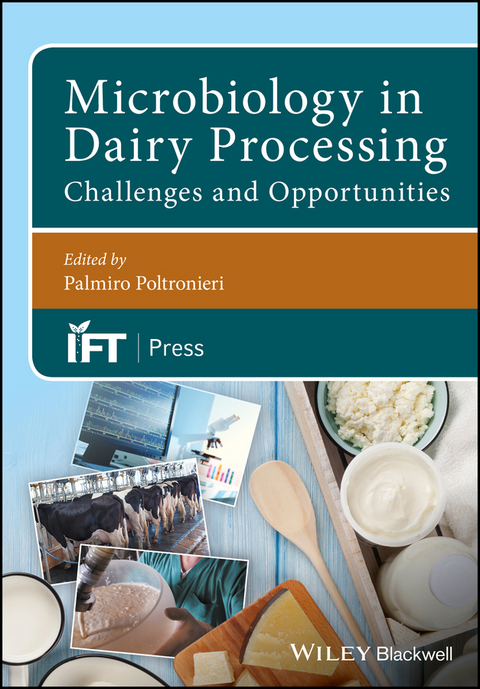
Microbiology in Dairy Processing (eBook)
John Wiley & Sons (Verlag)
978-1-119-11498-7 (ISBN)

An authoritative guide to microbiological solutions to common challenges encountered in the industrial processing of milk and the production of milk products
Microbiology in Dairy Processing offers a comprehensive introduction to the most current knowledge and research in dairy technologies and lactic acid bacteria (LAB) and dairy associated species in the fermentation of dairy products. The text deals with the industrial processing of milk, the problems solved in the industry, and those still affecting the processes. The authors explore culture methods and species selective growth media, to grow, separate, and characterize LAB and dairy associated species, molecular methods for species identification and strains characterization, Next Generation Sequencing for genome characterization, comparative genomics, phenotyping, and current applications in dairy and non-dairy productions.
In addition, Microbiology in Dairy Processing covers the Lactic Acid Bacteria and dairy associated species (the beneficial microorganisms used in food fermentation processes): culture methods, phenotyping, and proven applications in dairy and non-dairy productions. The text also reviews the potential future exploitation of the culture of novel strains with useful traits such as probiotics, fermentation of sugars, metabolites produced, bacteriocins. This important resource:
- Offers solutions both established and novel to the numerous challenges commonly encountered in the industrial processing of milk and the production of milk products
- Takes a highly practical approach, tackling the problems faced in the workplace by dairy technologists
- Covers the whole chain of dairy processing from milk collection and storage though processing and the production of various cheese types
Written for laboratory technicians and researchers, students learning the protocols for LAB isolation and characterisation, Microbiology in Dairy Processing is the authoritative reference for professionals and students.
Palmiro Poltronieri, PhD, is a Researcher at the Institute of the Sciences of Food Productions (CNR-ISPA), National Research Council of Italy. He obtained his Ph.D. in Cellular and Molecular Biology and Pathology in 1995 at the Institute of Chemical Biology, Medical Faculty of Verona University. Working in the Microbiology laboratory since 1999, he has established collaboration with the principal laboratories working in the field of food microbiology.
An authoritative guide to microbiological solutions to common challenges encountered in the industrial processing of milk and the production of milk products Microbiology in Dairy Processing offers a comprehensive introduction to the most current knowledge and research in dairy technologies and lactic acid bacteria (LAB) and dairy associated species in the fermentation of dairy products. The text deals with the industrial processing of milk, the problems solved in the industry, and those still affecting the processes. The authors explore culture methods and species selective growth media, to grow, separate, and characterize LAB and dairy associated species, molecular methods for species identification and strains characterization, Next Generation Sequencing for genome characterization, comparative genomics, phenotyping, and current applications in dairy and non-dairy productions. In addition, Microbiology in Dairy Processing covers the Lactic Acid Bacteria and dairy associated species (the beneficial microorganisms used in food fermentation processes): culture methods, phenotyping, and proven applications in dairy and non-dairy productions. The text also reviews the potential future exploitation of the culture of novel strains with useful traits such as probiotics, fermentation of sugars, metabolites produced, bacteriocins. This important resource: Offers solutions both established and novel to the numerous challenges commonly encountered in the industrial processing of milk and the production of milk products Takes a highly practical approach, tackling the problems faced in the workplace by dairy technologists Covers the whole chain of dairy processing from milk collection and storage though processing and the production of various cheese types Written for laboratory technicians and researchers, students learning the protocols for LAB isolation and characterisation, Microbiology in Dairy Processing is the authoritative reference for professionals and students.
Palmiro Poltronieri, PhD, is a Researcher at the Institute of the Sciences of Food Productions (CNR-ISPA), National Research Council of Italy. He obtained his Ph.D. in Cellular and Molecular Biology and Pathology in 1995 at the Institute of Chemical Biology, Medical Faculty of Verona University. Working in the Microbiology laboratory since 1999, he has established collaboration with the principal laboratories working in the field of food microbiology.
1
Milk fat components and milk quality
Iolanda Altomonte, Federica Salari and Mina Martini
Department of Veterinary Sciences, University of Pisa, Pisa, Italy
1.1 INTRODUCTION
From a physico‐chemical point of view, milk is an emulsion of lipid globules and a colloidal suspension of protein and mineral aggregates in a solution of carbohydrates (mainly lactose). In Western countries, milk and dairy products, and in general food of animal origin, are often accused of causing adverse health effects, especially with regard their food lipid intake, since lipids have been implicated in several diseases such as obesity, insulin resistance and atherosclerosis (Olofsson et al., 2009). For these reasons, the number of studies on the physical and chemical structure of fat in several edible products of animal origin have increased. Although milk and dairy products contain saturated fatty acids, they also provide specific beneficial components for human health and also lipid components (phospholipids, some individual fatty acids (FAs) and fat‐soluble vitamins) that have a role in health maintenance. In addition, milk is a major source of dietary energy, especially in developing countries, where there is shortage of animal‐source food (FAO, 2013), and in childhood.
Milks of different origins have long been used, and they have been processed to dairy products for their longer shelf life. Due to the wide natural variability from species to species in the proportion of milk macronutrients and to variations along lactation, milk represents a flexible source of nutrients that may be exploited to produce a variety of dairy products.
Ruminant milk is the main source available for humans to use to manufacture dairy products and fermented milk. Besides cow’s milk and milk from other ruminants (such as buffalo, goat and sheep), research on milk from other species is still poorly exploited (FAO, 2013). More recently, equine milks have been suggested for use in children with severe IgE‐mediated cow milk protein allergy (CMPA) (Monti et al., 2007, 2012; Sarti et al., 2016), and local producers have established a niche for the application of donkey products with well‐characterised profile of its constituents (Martini et al., 2014a).
1.1.1 Milk fat globules
Milk lipids are composed of milk fat globules (MFGs) made up of triglycerides enveloped by a biological membrane. MFGs are responsible and/or contribute to some properties and phenomena in milk and dairy products and may affect milk fatty acid composition and the way in which fat is digested (Baars et al., 2016; Huppertz and Kelly, 2006; Martini et al., 2017). For the dairy industry it is of interest that changes in the morphometry of the MFGs lead to changes in milk quality, yields, and ripening and the nutritional quality of cheeses (Martini et al., 2004).
In milk of different species there are MFGs of various sizes, ranging from a diameter smaller than 0.2 µm to a maximum of about 15 µm, with an average diameter that varies as a function of endogenous (species, breed), physiological (parity, stage of lactation), and exogenous factors (feeding) (Martini et al., 2010a).
Different average diameters have been reported in the literature for ruminant species (3.5–5.5 µm for cows; 2.79–4.95 µm for sheep; 2.2 and 2.5–2.8 µm for goats and 2.96–5.0 µm for buffalos) (Table 1.1) (Martini et al., 2016b). However average diameter of globules in equids is considerably lower than other dairy species (about 2 µm in donkey) (Martini et al., 2014b), while regarding human MFGs, larger dimensions have also been found (4 µm) (Lopez and Ménard, 2011).
Table 1.1 Average values in literature for fat content, milk fat globules characteristics and fatty acid composition of milk from different species.
| Cow | Buffalo | Goat | Sheep | Donkey | Horse | Human |
| Fat | % | 3.70 | 8.14 | 3.90 | 6.50 | 0.36 | 1.48 | 3.34 |
| Average diameter of the fat globules | µm | 3.5–5.5 | 2.96–5.0 | 2.2–2.8 | 2.79–4.95 | 2 | 2–3 | 3.3 |
| SFA | g/100g fat | 71.24 | 65.9 | 70.42 | 71.85 | 55.55 | 45.18 | 41.77 |
| MUFA | g/100g fat | 25.56 | 31.4 | 25.67 | 26.04 | 22.21 | 31.88 | 38.73 |
| PUFA | g/100g fat | 3.20 | 2.70 | 4.08 | 2.10 | 21.08 | 22.93 | 16.96 |
| UFA | g/100g fat | 28.76 | 34.1 | 29.75 | 28.14 | 43.29 | 54.81 | 55.29 |
| UFA:SFA ratio | 0.40 | 0.52 | 0.42 | 0.39 | 0.78 | 1.20 | 1.32 |
| SCFA | g/100g fat | 10.52 | 9.72 | 17.51 | 17.13 | 12.29 | 10.79 | 1.87 |
| MCFA | g/100g fat | 52.81 | 53.70 | 48.28 | 45.87 | 40.08 | 42.47 | 37.94 |
| LCFA | g/100g fat | 34.38 | 32.73 | 32.64 | 35.87 | 47.64 | 46.75 | 57.72 |
| CLA c9, t11 | g/100g fat | 0.65 | 0.45 | 0.70 | 1.00 | – | 0.09 | 0.19 |
| C18:2 n6 (LA) | g/100g fat | 2.42 | 1.71 | 2.72 | 1.20 | 9.5 | 16.17 | 12.96 |
| C18:3 n3 (ALA) | g/100g fat | 0.25 | 0.51 | 0.53 | 0.77 | 7.25 | 5.96 | 1.15 |
| C18:2 n6: C18:3 n3 ratio | –– | 9.68 | 3.35 | 5.13 | 1.56 | 1.31 | 2.71 | 11.26 |
| C20:4 (AA) | g/100g fat | 0.13 | 0.10 | 0.16 | 0.10 | 0.09 | 0.10 | 0.4 |
| C20:5 (EPA) | g/100g fat | 0.05 | 0.03 | nd | nd | 0.26 | – | 0.11 |
| C22:6 (DHA) | g/100g fat | nd | – | 0.05 | 0.04 | 0.28 | – | 0.51 |
SFA: saturated fatty acids; MUFA: monounsaturated fatty acids; PUFA: polyunsaturated fatty acids; UFA: unsaturated fatty acids; SCFA: short chain fatty acids (≤10C); MCFA: medium chain fatty acids (≤11C, ≥17C); LCFA: long chain fatty acids (≥18C); nd: no data.
The MFG membrane (MFGM) is a triple membrane resulting from the mammary secretory cell that surrounds a core of triglycerides distributed in a lamellar way (Heid and Keenan, 2005).
The MFGM consists of different classes of lipids (phospholipids, triglycerides and cholesterol) and of several proteins and enzymes. Phospholipids, in the form of mixtures of fatty acid esters of glycerol and sphingosine, possibly containing phosphoric acid, and a nitrogen‐based compound (choline, ethanolamine or serine). These are natural emulsifiers able to maintain the milk lipids as discrete globules, ensuring high stability. MFGM contains about 1% of the total milk proteins. Most of them are present in very low amounts and are enzymes and proteins involved in milk synthesis. The principal proteins in the MFGM include mucins (MUC) 1 and 5, adipophilin (ADPH), butyrophilin (BTN), periodic acid‐Schiff glycoproteins (PAS) 6 and 7, fatty acid binding protein (FABP), and xanthine oxidoreductase (XOR), a metal (Mo, Fe) binding protein (Spertino et al., 2012). In the last few years, research on the composition and structure of the milk membranes have been increased and have improved the knowledge of the MFGM from species other than the bovine (Saadaoui et al., 2013; Pisanu et al., 2012; Lu et al., 2016; Martini et al., 2013).
These studies have increased also due to the fact that MFGM is a dietary source of functional substances and is considered a nutraceutical (Rosqvist et al., 2014; Timby et al., 2015; Hernell et al., 2016). The functionality of the MFGM seems to be provided by its content of phospholipids, sphingolipids, fatty acids and proteins with an antibacterial effect (such as xanthine oxidoreductase and mucins) and/or health benefits.
MFGM conveys fat in an aqueous environment and is damaged by some treatment, such as homogenization, whipping and freezing, affecting milk physicochemical properties, for example producing hydrolytic activity, rancidity, and oiling off, and low wettability of milk powders. MFGM composition also affects the creaming rate on the milk surface (Martini et al., 2017); in bovine milk this phenomenon is due to the effect of cryoglobulins, an M‐type immunoglobulin that aggregates globules during cold storage. Other types of milk are lacking these cryoglobulins and do not agglutinate. Homogenization reduces globule diameter, making globules insensitive to the action of cryoglobulins and prevents agglutination. During butter production, extensive...
| Erscheint lt. Verlag | 20.9.2017 |
|---|---|
| Reihe/Serie | Institute of Food Technologists Series |
| Institute of Food Technologists Series | Institute of Food Technologists Series |
| Sprache | englisch |
| Themenwelt | Naturwissenschaften ► Biologie ► Mikrobiologie / Immunologie |
| Technik ► Lebensmitteltechnologie | |
| Weitere Fachgebiete ► Land- / Forstwirtschaft / Fischerei | |
| Schlagworte | Angewandte Mikrobiologie • applied microbiology • avoid the deterioration of milk under cold storage • bifidobacteria • Biowissenschaften • cheese and Lactic Acid Bacteria • Cheese typologies • Dairy Food • Dairy processing for cheese production • enterococci • Food Science & Technology • from collection to storage • Lactobacilli • Lactococci • Lebensmittelforschung u. -technologie • Leuconostoc spp • Life Sciences • Microbiological safety of dairy products • Microbiology, Food Safety & Security • Microbiology in Dairy Processing • Microfiltration of milk • Mikrobiologie u. Nahrungsmittelsicherheit • Milchprodukte • milk • Milk and Culture methods • milk and elimination containment of psychotropic bacteria • milk and fungi • milk and LAB taxonomy • milk and pathogens • milk and Spore forming bacteria • milk and Starter strains • milk and yeasts • Milk enriched in whey proteins and fortified in vitamins • Milk Pasteurization • Milk processing • Milk Sterilization • milk Tetrapack and packaging under sterile conditions • Palmiro Poltronieri • Streptococcus thermophiles • Sustainability of cooling for storage of dairy products |
| ISBN-10 | 1-119-11498-5 / 1119114985 |
| ISBN-13 | 978-1-119-11498-7 / 9781119114987 |
| Informationen gemäß Produktsicherheitsverordnung (GPSR) | |
| Haben Sie eine Frage zum Produkt? |
 EPUB (Adobe DRM)
Kopierschutz: Adobe-DRM
Adobe-DRM ist ein Kopierschutz, der das eBook vor Mißbrauch schützen soll. Dabei wird das eBook bereits beim Download auf Ihre persönliche Adobe-ID autorisiert. Lesen können Sie das eBook dann nur auf den Geräten, welche ebenfalls auf Ihre Adobe-ID registriert sind.
Details zum Adobe-DRM
Dateiformat: EPUB (Electronic Publication)
EPUB ist ein offener Standard für eBooks und eignet sich besonders zur Darstellung von Belletristik und Sachbüchern. Der Fließtext wird dynamisch an die Display- und Schriftgröße angepasst. Auch für mobile Lesegeräte ist EPUB daher gut geeignet.
Systemvoraussetzungen:
PC/Mac: Mit einem PC oder Mac können Sie dieses eBook lesen. Sie benötigen eine
eReader: Dieses eBook kann mit (fast) allen eBook-Readern gelesen werden. Mit dem amazon-Kindle ist es aber nicht kompatibel.
Smartphone/Tablet: Egal ob Apple oder Android, dieses eBook können Sie lesen. Sie benötigen eine
Geräteliste und zusätzliche Hinweise
Buying eBooks from abroad
For tax law reasons we can sell eBooks just within Germany and Switzerland. Regrettably we cannot fulfill eBook-orders from other countries.
aus dem Bereich