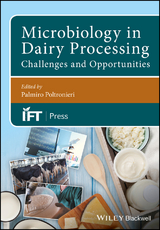
Microbiology in Dairy Processing (eBook)
John Wiley & Sons (Verlag)
978-1-119-11497-0 (ISBN)
An authoritative guide to microbiological solutions to common challenges encountered in the industrial processing of milk and the production of milk products
Microbiology in Dairy Processing offers a comprehensive introduction to the most current knowledge and research in dairy technologies and lactic acid bacteria (LAB) and dairy associated species in the fermentation of dairy products. The text deals with the industrial processing of milk, the problems solved in the industry, and those still affecting the processes. The authors explore culture methods and species selective growth media, to grow, separate, and characterize LAB and dairy associated species, molecular methods for species identification and strains characterization, Next Generation Sequencing for genome characterization, comparative genomics, phenotyping, and current applications in dairy and non-dairy productions.
In addition, Microbiology in Dairy Processing covers the Lactic Acid Bacteria and dairy associated species (the beneficial microorganisms used in food fermentation processes): culture methods, phenotyping, and proven applications in dairy and non-dairy productions. The text also reviews the potential future exploitation of the culture of novel strains with useful traits such as probiotics, fermentation of sugars, metabolites produced, bacteriocins. This important resource:
- Offers solutions both established and novel to the numerous challenges commonly encountered in the industrial processing of milk and the production of milk products
- Takes a highly practical approach, tackling the problems faced in the workplace by dairy technologists
- Covers the whole chain of dairy processing from milk collection and storage though processing and the production of various cheese types
Written for laboratory technicians and researchers, students learning the protocols for LAB isolation and characterisation, Microbiology in Dairy Processing is the authoritative reference for professionals and students.
Palmiro Poltronieri, PhD, is a Researcher at the Institute of the Sciences of Food Productions (CNR-ISPA), National Research Council of Italy. He obtained his Ph.D. in Cellular and Molecular Biology and Pathology in 1995 at the Institute of Chemical Biology, Medical Faculty of Verona University. Working in the Microbiology laboratory since 1999, he has established collaboration with the principal laboratories working in the field of food microbiology.
An authoritative guide to microbiological solutions to common challenges encountered in the industrial processing of milk and the production of milk products Microbiology in Dairy Processing offers a comprehensive introduction to the most current knowledge and research in dairy technologies and lactic acid bacteria (LAB) and dairy associated species in the fermentation of dairy products. The text deals with the industrial processing of milk, the problems solved in the industry, and those still affecting the processes. The authors explore culture methods and species selective growth media, to grow, separate, and characterize LAB and dairy associated species, molecular methods for species identification and strains characterization, Next Generation Sequencing for genome characterization, comparative genomics, phenotyping, and current applications in dairy and non-dairy productions. In addition, Microbiology in Dairy Processing covers the Lactic Acid Bacteria and dairy associated species (the beneficial microorganisms used in food fermentation processes): culture methods, phenotyping, and proven applications in dairy and non-dairy productions. The text also reviews the potential future exploitation of the culture of novel strains with useful traits such as probiotics, fermentation of sugars, metabolites produced, bacteriocins. This important resource: Offers solutions both established and novel to the numerous challenges commonly encountered in the industrial processing of milk and the production of milk products Takes a highly practical approach, tackling the problems faced in the workplace by dairy technologists Covers the whole chain of dairy processing from milk collection and storage though processing and the production of various cheese types Written for laboratory technicians and researchers, students learning the protocols for LAB isolation and characterisation, Microbiology in Dairy Processing is the authoritative reference for professionals and students.
Palmiro Poltronieri, PhD, is a Researcher at the Institute of the Sciences of Food Productions (CNR-ISPA), National Research Council of Italy. He obtained his Ph.D. in Cellular and Molecular Biology and Pathology in 1995 at the Institute of Chemical Biology, Medical Faculty of Verona University. Working in the Microbiology laboratory since 1999, he has established collaboration with the principal laboratories working in the field of food microbiology.
Title Page 7
Copyright Page 8
Contents 9
List of contributors 17
Foreword 21
Preface 23
Acknowledgements 25
Chapter 1 Milk fat components and milk quality 27
1.1 INTRODUCTION 27
1.1.1 Milk fat globules 28
1.1.2 Milk fat and fatty acid composition 30
1.2 CONCLUSIONS 33
References 33
Chapter 2 Spore-forming bacteria in dairy products 37
2.1 INTRODUCTION 37
2.2 THE BACTERIAL SPORE 39
2.2.1 Structure and chemical composition of bacterial spores 40
2.2.1.1 Exosporium 40
2.2.1.2 Spore coat 40
2.2.1.3 Outer spore membrane 41
2.2.1.4 Cortex and germ cell wall 41
2.2.1.5 Inner spore membrane 41
2.2.1.6 The core spore 41
2.2.2 Spore resistance 42
2.2.3 Life cycle of spore?forming bacteria 43
2.3 SPORE-FORMING BACTERIA IMPORTANT FOR THE DAIRY INDUSTRY 44
2.3.1 Class Bacilli 44
2.3.1.1 Bacillus genus 45
2.3.1.2 Geobacillus and Anoxybacillus genera 50
2.3.1.3 Paenibacillus genus 51
2.3.2 Class Clostridia 51
2.3.2.1 Clostridium botulinum 52
2.3.2.2 Clostridium perfringens 54
2.3.2.3 Clostridium tyrobutyricum and related species 54
2.4 CONTROL STRATEGIES TO PREVENT POISONING AND SPOILAGE OF MILK AND DAIRY PRODUCTS BY SPORE-FORMING BACTERIA 56
2.5 CONCLUSIONS 57
References 58
Chapter 3 Psychrotrophic bacteria 63
3.1 INTRODUCTION 63
3.2 SOURCES OF PSYCHROTROPHIC BACTERIA CONTAMINATION OF MILK 64
3.3 IMPORTANT SPOILAGE PSYCHROTROPHIC BACTERIA IN MILK 68
3.4 MOLECULAR TOOLS TO CHARACTERIZE PSYCHROTROPHIC BACTERIA 69
3.5 INFLUENCE OF PSYCHROTROPHIC CONTAMINATION OF RAW MILK ON DAIRY PRODUCT QUALITY 71
3.5.1 Bacterial proteases and proteolytic changes in milk 72
3.5.2 Bacterial lipases and phospholipases and their significance in milk 75
3.6 REGULATION OF EXTRACELLULAR ENZYMES 78
3.7 CONTROL OF PSYCHROTROPHIC BACTERIA AND RELATED ENZYMES 79
3.8 CONCLUSIONS 80
References 80
Chapter 4 Stabilization of milk quality by heat treatments 89
4.1 INTRODUCTION 89
4.2 THERMAL TREATMENTS OF MILK 89
4.2.1 Thermization 89
4.2.2 Pasteurization 90
4.2.3 Grade A pasteurized milk 92
4.3 MILK STERILIZATION 93
4.3.1 Control of proper time/temperature setting for safety of milk and milk products 93
4.4 DISEASES ASSOCIATED WITH UNPASTEURIZED MILK, OR POST-PASTEURIZATION DAIRY-PROCESSING CONTAMINATION 94
4.5 CONCLUSIONS 94
References 94
Chapter 5 Genomics of LAB and dairy-associated species 97
5.1 INTRODUCTION 97
5.2 GENOMICS OF LAB AND DAIRY-ASSOCIATED SPECIES 97
5.2.1 Next?generation sequencing of strains, dairy starter genomics and metagenomics 98
5.2.2 Pacific Bioscience single-molecule real-time sequencing technology 99
5.2.3 Illumina MySeq and HiSeq 2000 99
5.2.4 Ion Torrent platform 99
5.3 NGS PLATFORM APPLIED TO SEQUENCING OF MICROBIAL COMMUNITIES 100
5.3.1 Pangenomics 100
5.3.2 Omic technologies: transcriptomics, proteomics, functional genomics, systems biology 101
5.4 METABOLOMICS AND PROTEOMICS 102
5.4.1 Subcellular localisation (SLC): secretion systems for secreted proteins 103
5.4.2 Interactome for cell adhesion and pathogen exclusion 104
5.4.3 LAB peptidome 105
5.5 COMPARATIVE GENOMICS OF DAIRY-ASSOCIATED BACTERIA: THE LACTOBACILLUS GENUS COMPLEX, STREPTOCOCCI/LACTOCOCCI, ENTEROCOCCI, PROPIONIBACTERIA AND BIFIDOBACTERIA 105
5.5.1 Comparative genomics of Lb. rhamnosus and Lb. casei 109
5.5.2 Lb. casei core genome and ecotype differences in dairy adapted strains 110
5.6 CLUSTERED REGULARLY Interspaced Short PALINDROMIC REPEATS (CRISPR) IN ADAPTIVE IMMUNITY 110
5.7 REGULATION IN CARBON METABOLISM 111
5.7.1 Transcriptional and posttranscriptional regulation in carbon metabolism 111
5.7.2 Two-component systems and phosphorylation in sugar substrate regulation 112
5.7.3 Regulatory RNAs and alternative sigma factors in gene expression 113
5.8 CONCLUSIONS 114
References 114
Chapter 6 Metabolism and biochemistry of LAB and dairy-associated species 123
6.1 INTRODUCTION 123
6.2 CARBOHYDRATE SUBSTRATES, GLYCOLYSIS AND ENERGY PRODUCTION 124
6.2.1 Pentose phosphate pathway 125
6.2.2 Citrate fermentation 125
6.3 PROTEOLYSIS, PROTEIN SUBSTRATES AND AMINO ACID AVAILABILITY INFLUENCING GENE EXPRESSION 126
6.3.1 Cell-envelope proteinases: the Prt system 127
6.3.2 Oligopeptide permeases and other transporters for peptides and amino acids 127
6.3.3 Peptidolysis and free amino acids 128
6.3.4 Peptidolysis and catabolite repression 131
6.3.5 Amino acid biosynthesis and auxotrophy 131
6.4 LIPOLYSIS, LIPASES, ESTERASES 132
6.5 AROMA AND FLAVOUR PRODUCTS OF METABOLISM 133
6.5.1 Aldehydes, alcohols and carboxylic acids 136
6.5.2 Amino acids as precursor flavour compounds 138
6.6 NONENZYMATIC PRODUCTION OF FLAVOURS 139
6.7 METHODS OF ANALYSIS OF FLAVOURS IN DAIRY PRODUCTS: HPLC, GAS CHROMATOGRAPHY/MASS ANALYSIS (GC/MS) 140
6.8 NATURAL BIODIVERSITY OF STRAINS IN DAIRY PRODUCTIONS 141
6.9 CONCLUSIONS 142
References 143
Chapter 7 Growth needs and culture media for LAB and dairy-associated species 149
7.1 INTRODUCTION 149
7.2 ESTABLISHED CULTURE MEDIA FOR LACTOBACILLI 149
7.2.1 Rogosa agar 150
7.2.2 MRS medium 151
7.2.3 Skim milk and whey agar 151
7.3 M17 MEDIUM FOR SELECTION AND ENUMERATION OF LACTOCOCCI AND STREPTOCOCCI 152
7.3.1 St. thermophilus agar 152
7.4 SELECTIVE MEDIA FOR LACTOBACILLI 153
7.4.1 MRS vancomycin 153
7.4.2 Additional selective agents 154
7.4.3 MRSV plus selective agents for Lb. casei group enumeration 155
7.4.4 MRS-salicin, MRS-sorbitol, MRS-ribose, MRS gluconate agar 155
7.4.5 MRS-clindamycin-ciprofloxacin agar 155
7.4.6 MMV medium for Lb. casei group enumeration 156
7.4.7 MRS containing fructose (MRSF) 156
7.4.8 mMRS-BPB 157
7.4.9 MRS-NNLP agar and chromogenic agars for complex communities 157
7.4.10 Homofermentative-heterofermentative differential medium 157
7.5 MEDIA FOR THE ISOLATION OF BIFIDOBACTERIA 158
7.5.1 MRS-NNLP agar 159
7.5.2 BSM, WSP, TOS-MUP 159
7.5.3 MRS-ABC 160
7.6 PHENOTYPING 160
7.7 CONCLUSIONS 161
References 161
Chapter 8 LAB species and strain identification 165
8.1 INTRODUCTION 165
8.2 GENOTYPIC FINGERPRINTING METHODS 166
8.3 CULTURE-DEPENDENT APPROACHES 168
8.3.1 Random amplification of polymorphic DNA 168
8.3.2 ARDRA and RFLP 169
8.3.3 Ribotyping 169
8.3.4 Repetitive element sequence-based PCR 170
8.3.5 Amplified fragment length polymorphism 171
8.3.6 Pulsed field gel electrophoresis 171
8.4 NON-GENOTYPIC FINGERPRINTING METHODS 172
8.5 CULTURE-INDEPENDENT APPROACHES 173
8.5.1 Culture-independent methods for qualitative analysis of dairy foods microbiota 173
8.5.2 Culture-independent methods for quantitative analysis of dairy foods microbiota 176
8.6 NOVEL HIGH-THROUGHPUT TECHNIQUES: SEQUENCING AND METAGENOMICS 177
8.7 CONCLUSIONS 178
References 178
Chapter 9 LAB strains with bacteriocin synthesis genes and their applications 187
9.1 INTRODUCTION 187
9.2 BACTERIOCINS FROM LAB 187
9.3 POTENTIAL FOR USE OF LAB BACTERIOCINS AS FOOD PRESERVATIVES 190
9.4 BACTERIOCINS PRODUCED BY DAIRY LAB 191
9.5 IDENTIFICATION OF LAB-PRODUCING BACTERIOCINS 194
9.6 A NOVEL APPROACH FOR SCREENING LAB BACTERIOCINS 196
9.7 BIOTECHNOLOGICAL INTERVENTIONS FOR BACTERIOCIN ENGINEERING 197
9.8 CONCLUSIONS 198
References 198
Chapter 10 Starter strains and adjunct non-starter lactic acid bacteria (NSLAB) in dairy products 203
10.1 INTRODUCTION 203
10.2 CONTROLLED FERMENTATION 203
10.2.1 Natural versus selected lactic acid bacteria starters 204
10.2.2 Starter strains: selection parameter approaches and strain concept 205
10.2.3 Starter culture formulation 206
10.3 ADJUNCT NON-STARTER LACTIC ACID BACTERIA 207
10.3.1 Biodiversity and adaptation to cheese environment 207
10.3.2 Prospective in industrial application 208
10.3.3 Biopreservation and health benefits 209
10.4 CONCLUSIONS 211
References 211
Chapter 11 Milk fat: stability, separation and technological transformation 217
11.1 INTRODUCTION 217
11.1.1 Composition and physical state of milk fat 218
11.1.2 Melting point of milk fat 220
11.2 PHYSICAL INSTABILITY OF MILK FAT 220
11.3 MILK FAT SEPARATION 221
11.3.1 Flocculation or natural creaming 221
11.3.2 Milk fat separation by centrifugation 223
11.4 PARTIAL COALESCENCE 225
11.4.1 General aspects 225
11.4.2 Barrier against coalescence 227
11.4.2.1 Low molecular mass surfactants 227
11.4.2.2 Large sized surfactants (casein micelle) 228
11.4.2.3 Polymeric surfactants (proteins and polysaccharides) 229
11.4.2.4 Mixed films 229
11.5 FOAM IN MILK AND CREAM 230
11.5.1 General aspects 230
11.5.1.1 Foam formation without surfactants 230
11.5.1.2 Foam formation with surfactants 231
11.5.1.3 Drainage of dispersion liquid in foam 232
11.5.2 Foam from cream containing more than 30% milk fat 233
11.6 WHIPPED CREAM AND BUTTER 235
11.6.1 Technological factors affecting whipped cream and butter production 235
11.7 CHURNING PROCESS 236
11.7.1 Type of cream 236
11.7.2 Physical (crystallization) and biological maturation of cream before churning 238
11.7.3 Churning technology 241
11.7.4 Continuous churning 242
11.7.5 Moulding and packaging 243
11.8 CONCLUSIONS 243
References 244
Chapter 12 Biological traits of lactic acid bacteria: industrial relevance and new perspectives in dairy applications 245
12.1 INTRODUCTION 245
12.2 SELECTING FERMENTING BACTERIA FOR THEIR ABILITY TO HAVE A RESPIRATORY METABOLISM 246
12.3 SELECTING GALACTOSE-POSITIVE YOGURT CULTURES: WORKING “AGAINST THE NATURAL EVOLUTION OF THE SPECIES” 247
12.4 ACCELERATING THE MILK ACIDIFICATION PROCESS BY SELECTING PROTEINASE-POSITIVE STRAINS 248
12.5 ACCELERATING THE MILK ACIDIFICATION PROCESS BY SELECTING UREASE-NEGATIVE S. thermophilus STRAINS 250
12.6 PROTECTIVE CULTURES FOR DAIRY APPLICATIONS: “WORK BUT PLEASE DO NOT GROW AND DO NOT MODIFY THE SENSORY PROFILE OF THE PRODUCT” 251
12.7 SELECTION OF STARTER CULTURE FREE OF TRANSFERABLE ANTIBIOTIC-RESISTANCE MECHANISMS 253
12.8 CONCLUSIONS 254
References 255
Chapter 13 Lactic acid bacteria bacteriophages in dairy products: problems and solutions 259
13.1 INTRODUCTION 259
13.2 PHAGE CLASSIFICATION 260
13.3 PHAGE-HOST INTERACTIONS 262
13.4 SOURCES OF CONTAMINATION 264
13.4.1 Milk and cheese whey 264
13.4.2 Dairy cultures 265
13.4.2.1 The lysogenic state 265
13.5 PHAGE DETECTION AND QUANTIFICATION 266
13.6 METHODS TO CONTROL PHAGE CONTAMINATION 268
13.6.1 Phage inactivation by physical treatments 268
13.6.2 Phage inactivation by chemical treatments 270
13.6.3 Phage control by biological approaches 271
13.7 CONCLUSIONS 272
References 272
Chapter 14 Lactic acid bacteria: a cell factory for delivering functional biomolecules in dairy products 277
14.1 INTRODUCTION 277
14.2 VITAMINS 279
14.2.1 Vitamin B2 or Riboflavin 280
14.2.2 Vitamin B9 or Folate 281
14.2.3 Vitamin B12 or cobalamin 282
14.2.4 Vitamin K: menaquinone 283
14.2.5 Other B-group vitamins 284
14.3 MINERALS 284
14.4 BIOACTIVE COMPOUNDS 287
14.4.1 Anti-hypertensive peptides 288
14.4.2 Antioxidative peptides 289
14.4.3 Bioactive amines 291
14.4.4 Immune system affecting peptides 293
14.4.5 Opioid peptides 293
14.4.6 Metal-binding peptides 294
14.4.7 Conjugated linoleic acid and conjugated linolenic acid 294
14.5 LOW-CALORIE SWEETENERS 295
14.6 EXOPOLYSACCHARIDES (EPS) 297
14.7 CONCLUSIONS 299
References 299
Chapter 15 Dairy technologies in yogurt production 305
15.1 INTRODUCTION 305
15.2 YOGURT TYPES 306
15.3 YOGURT MANUFACTURING PROCESS 307
15.3.1 Initial treatment of milk 307
15.3.2 Standardization of milk components – fat and SNF content 309
15.3.3 Homogenization 310
15.3.4 Heat treatment 312
15.3.5 Fermentation process 314
15.3.5.1 Monitoring of fermentation process – prediction of fermentation evolution 316
15.3.6 Post-fermentation processing 318
15.3.6.1 Cooling – addition of additives 318
15.3.6.2 Addition of fruit 318
15.3.6.3 Packaging 320
15.3.7 Quality control of yogurt production 320
15.4 CONCLUSIONS 321
References 321
Chapter 16 Milk protein composition and sequence differences in milk and fermented dairy products affecting digestion and tolerance to dairy products 325
16.1 INTRODUCTION 325
16.2 CASEINS 327
16.2.1 Gene polymorphisms in ?-casein genes 328
16.2.2 Gene polymorphisms in ?-casein gene 329
16.3 PROTEOLYTIC RELEASE OF BIOACTIVE PEPTIDES IN FERMENTED MILK AND CHEESE 330
16.4 MINOR MILK PROTEINS 331
16.4.1 Lactoferrin 331
16.4.2 ?-Lactoglobulin (?-LG) 332
16.4.3 ?-Lactalbumin (?-LA) 332
16.5 PROTEINS WITH BIOACTIVE ROLES 333
16.6 MFGM-ASSOCIATED PROTEINS 334
16.7 COW’S MILK PROTEIN ALLERGY (CMPA) 334
16.8 CONCLUSIONS 335
References 335
Index 341
EULA 348
| Erscheint lt. Verlag | 14.9.2017 |
|---|---|
| Reihe/Serie | Institute of Food Technologists Series |
| Institute of Food Technologists Series | Institute of Food Technologists Series |
| Sprache | englisch |
| Themenwelt | Naturwissenschaften ► Biologie ► Mikrobiologie / Immunologie |
| Technik ► Lebensmitteltechnologie | |
| Weitere Fachgebiete ► Land- / Forstwirtschaft / Fischerei | |
| Schlagworte | Angewandte Mikrobiologie • applied microbiology • avoid the deterioration of milk under cold storage • bifidobacteria • Biowissenschaften • cheese and Lactic Acid Bacteria • Cheese typologies • Dairy Food • Dairy processing for cheese production • enterococci • Food Science & Technology • from collection to storage • Lactobacilli • Lactococci • Lebensmittelforschung u. -technologie • Leuconostoc spp • Life Sciences • Microbiological safety of dairy products • Microbiology, Food Safety & Security • Microbiology in Dairy Processing • Microfiltration of milk • Mikrobiologie u. Nahrungsmittelsicherheit • Milchprodukte • milk • Milk and Culture methods • milk and elimination containment of psychotropic bacteria • milk and fungi • milk and LAB taxonomy • milk and pathogens • milk and Spore forming bacteria • milk and Starter strains • milk and yeasts • Milk enriched in whey proteins and fortified in vitamins • Milk Pasteurization • Milk processing • Milk Sterilization • milk Tetrapack and packaging under sterile conditions • Palmiro Poltronieri • Streptococcus thermophiles • Sustainability of cooling for storage of dairy products |
| ISBN-10 | 1-119-11497-7 / 1119114977 |
| ISBN-13 | 978-1-119-11497-0 / 9781119114970 |
| Informationen gemäß Produktsicherheitsverordnung (GPSR) | |
| Haben Sie eine Frage zum Produkt? |
 PDF (Adobe DRM)
Kopierschutz: Adobe-DRM
Adobe-DRM ist ein Kopierschutz, der das eBook vor Mißbrauch schützen soll. Dabei wird das eBook bereits beim Download auf Ihre persönliche Adobe-ID autorisiert. Lesen können Sie das eBook dann nur auf den Geräten, welche ebenfalls auf Ihre Adobe-ID registriert sind.
Details zum Adobe-DRM
Dateiformat: PDF (Portable Document Format)
Mit einem festen Seitenlayout eignet sich die PDF besonders für Fachbücher mit Spalten, Tabellen und Abbildungen. Eine PDF kann auf fast allen Geräten angezeigt werden, ist aber für kleine Displays (Smartphone, eReader) nur eingeschränkt geeignet.
Systemvoraussetzungen:
PC/Mac: Mit einem PC oder Mac können Sie dieses eBook lesen. Sie benötigen eine
eReader: Dieses eBook kann mit (fast) allen eBook-Readern gelesen werden. Mit dem amazon-Kindle ist es aber nicht kompatibel.
Smartphone/Tablet: Egal ob Apple oder Android, dieses eBook können Sie lesen. Sie benötigen eine
Geräteliste und zusätzliche Hinweise
Buying eBooks from abroad
For tax law reasons we can sell eBooks just within Germany and Switzerland. Regrettably we cannot fulfill eBook-orders from other countries.
aus dem Bereich