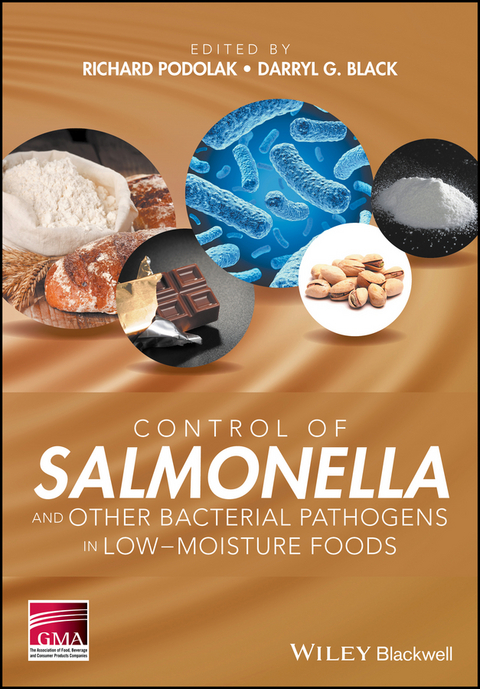
Control of Salmonella and Other Bacterial Pathogens in Low-Moisture Foods (eBook)
John Wiley & Sons (Verlag)
978-1-119-07107-5 (ISBN)
The first and only comprehensive reference/solutions manual for managing food safety in low-moisture foods
The first book devoted to an increasingly critical public health issue, Control of Salmonella and Other Bacterial Pathogens in Low-Moisture Foods reviews the current state of the science on the prevalence and persistence of bacterial pathogens in low-moisture foods and describes proven techniques for preventing food contamination for manufacturers who produce those foods.
Many pathogens, such as Salmonella, due to their enhanced thermal resistance in dry environments, can survive the drying process and may persist for prolonged periods in low-moisture foods, especially when stored in refrigerated environments. Bacterial contamination of low-moisture foods, such as peanut butter, present a vexing challenge to food safety, and especially now, in the wake of widely publicized food safety related events, food processors urgently need up-to-date, practical information on proven measures for containing the risk of contamination. While much has been written on the subject, until now it was scattered throughout the world literature in scientific and industry journals. The need for a comprehensive treatment of the subject has never been greater, and now this book satisfies that need.
- Discusses a wide variety of foods and evaluates multiple processing platforms from the standpoint of process validation of all food safety objectives for finished food products
- Takes a practical approach integrating the latest scientific and technological advances in a handy working resource
- Presents all known sources and risk factors for pathogenic bacteria of concern in the manufacturing environment for low-moisture/water activity products
- Characterizes the persistence and thermal resistance of bacterial pathogens in both the environment and most low-moisture food products
Control of Salmonella and Other Bacterial Pathogens in Low-Moisture Foods is a much-needed resource for food microbiologists and food industry scientists, as well as managers and executives in companies that produce and use low-moisture foods. It also belongs on the reference shelves of food safety regulatory agencies worldwide.
Richard Podolak, PhD, is Senior Scientist with the Grocery Manufacturers Association, based in Washington DC, USA.
Darryl G. Black, PhD, is Associate Director for Research with Food and Drug Administration, Bedford Park, IL, USA.
The first and only comprehensive reference/solutions manual for managing food safety in low-moisture foods The first book devoted to an increasingly critical public health issue, Control of Salmonella and Other Bacterial Pathogens in Low-Moisture Foods reviews the current state of the science on the prevalence and persistence of bacterial pathogens in low-moisture foods and describes proven techniques for preventing food contamination for manufacturers who produce those foods. Many pathogens, such as Salmonella, due to their enhanced thermal resistance in dry environments, can survive the drying process and may persist for prolonged periods in low-moisture foods, especially when stored in refrigerated environments. Bacterial contamination of low-moisture foods, such as peanut butter, present a vexing challenge to food safety, and especially now, in the wake of widely publicized food safety related events, food processors urgently need up-to-date, practical information on proven measures for containing the risk of contamination. While much has been written on the subject, until now it was scattered throughout the world literature in scientific and industry journals. The need for a comprehensive treatment of the subject has never been greater, and now this book satisfies that need. Discusses a wide variety of foods and evaluates multiple processing platforms from the standpoint of process validation of all food safety objectives for finished food products Takes a practical approach integrating the latest scientific and technological advances in a handy working resource Presents all known sources and risk factors for pathogenic bacteria of concern in the manufacturing environment for low-moisture/water activity products Characterizes the persistence and thermal resistance of bacterial pathogens in both the environment and most low-moisture food products Control of Salmonella and Other Bacterial Pathogens in Low-Moisture Foods is a much-needed resource for food microbiologists and food industry scientists, as well as managers and executives in companies that produce and use low-moisture foods. It also belongs on the reference shelves of food safety regulatory agencies worldwide.
Richard Podolak, PhD, is Senior Scientist with the Grocery Manufacturers Association, based in Washington DC, USA. Darryl G. Black, PhD, is Associate Director for Research with Food and Drug Administration, Bedford Park, IL, USA.
Chapter 1
Introduction and Overview
Richard Podolak1 and Darryl G. Black2
1Grocery Manufacturers Association, Washington, DC, USA
2Food and Drug Administration, Bedford Park, IL, USA
1.1 Introduction
Low water activity (aw) is a barrier to growth for many vegetative pathogens, including Salmonella spp. A product's water activity is used as a quantitative measure of the free moisture in foods available to microorganisms. Water in food that is not bound to food molecules can support the growth of bacteria, yeasts, and molds. The terms water activity and low moisture have been used interchangeably by food safety professionals even though they are quite different by definition. A variety of foods may have similar moisture content values but significantly different water activities. Of particular interest are the low-moisture foods, with water activity 0.85 and below. Processed products such as powdered milk, chocolate, peanut butter, infant foods, cereal, and bakery products are characteristically low water activity foods. While these products do not support the growth of Salmonella, all have been implicated in outbreaks of salmonellosis. Although some die-off occurs in low-moisture foods during storage, the degree of reduction depends on factors such as storage temperature and product formulation. Many other bacterial pathogens, such as toxin-producing Staphylococci, verotoxigenic E. coli (VTEC), Cronobacter sakazakii and aflatoxin-producing molds should also be considered in low-moisture foods. Due to its enhanced thermal residence in dry environments, Salmonella can survive for long periods in low-moisture food products. The heat resistance of Salmonella and other microorganisms of concern is affected by many factors, mostly by strain and serotypes tested, previous growth and storage conditions, the physical and chemical food composition, test media and the media used to recover heat damaged cells. The heat resistance of Salmonella generally increases with reducing moisture and this fact must be taken into account as a significant risk. Finally, from a quality standpoint, many spoilage organisms have been associated with low-moisture products; references will be provided in this book to aid the processor in finding the appropriate information concerning target organisms for specific low-moisture foods.
1.2 Definition of Low-Moisture Foods (LMF) and Water Activity Controlled Foods
Manipulation of the water content of foods is a classical method for food preservation and has been used by people for centuries. Salting, curing, drying, and the addition of sugars are examples of several traditional preservation methods that have been practiced over the ages. Of particular interest are the low-moisture foods and food ingredients that are naturally low in moisture or that have been subjected to a drying process and resulted in reducing the water content, for example, as in traditional sun-dried foods. Processed products such as milk-based powders, chocolate, peanut butter, powdered infant foods, seeds, herbs and spices, cereal and bakery products, and animal feeds are the examples of this type of food. Low-moisture foods have a reduced water activity (aw), which is a growth barrier for many vegetative pathogens, including Salmonella spp.
Both moisture content and water activity are key parameters in predicting the stability of low-moisture food products. The terms water activity and low moisture have been used interchangeably in the processing industry and by food safety professionals even though they are quite different by definition. Moisture content represents a measure of the quantity of water in a product, providing information about yield and texture, but it does not provide reliable information about microbial safety. However, water activity, which was originally applied by the pharmaceutical and food industries, can be used as a quantitative measure to determine the shelf-life of product. Water activity can be defined as the ratio of the vapor pressure of water in a food matrix compared to that of pure water at the same temperature (Labuza, 1980). Therefore, a water activity of 0.80 means the vapor pressure is 80% of that of pure water. Water activity can be also defined as the equilibrium relative humidity (expressed as a percentage) above the food in a closed container dived by 100. For example, an equilibrium relative humidity of 70% would be an equivalent to a water activity of 0.7. The water activity scale extends from 0 (bone dry) to 1.0 (pure water) but most foods have a water activity level in the range of 0.2 for very dry foods to 0.99 for very moist fresh foods.
In the food system, total water is present in “free” and “bound” forms. Growth of microorganisms can be limited or entirely prevented by binding water to make it inaccessible to microorganisms, for example, when salt and/or sugar are mixed with the food. The extent to which water is ‘bound” in foods is expressed in terms of water activity. Bound water is necessary to hydrate the hydrophilic molecules and to dissolve the solutes but it is not available for biological functions, so it does not contribute to water activity. It is necessary for the transport of nutrients and the removal of waste materials, to carry out enzymatic reactions, to synthesize cellular materials, and to take part in other biochemical reactions. Thus, this type of water in foods cannot be used by microorganisms for growth. The remaining water in foods exists in “free” form. Water activity is a measure of the “free” water that is available in food to react with other molecules and participate in spoilage reactions, such as enzymatic browning or microbial growth. A product’s water activity is used as a quantitative measure of the free moisture in foods available for growth of microorganisms. Water that is not bound to food molecules can support the growth of bacteria, yeasts, and molds. Thus, water activity is an indicator of stability with respect to microbial growth, biochemical reaction rates, and physical properties.
When substances are dissolved in water, there is a reaction between the substance and water. If some food ingredients such as sugar, salt, dried fruits, and so on are added to food products, they will be substantially bound to the molecules of water and reduce the number of unattached water molecules, consequently reducing the amount of water available for growth of microorganisms. The amount of water available for microorganisms will depend on the water-binding capacity of the particular ingredient; thus, the water activity of a product is dependent on food composition. At the same molecular concentration, salt lowers water activity more than sugar. For example, sodium chloride has a water-binding ability almost six times higher than sucrose. The final ingredients in a product formulation and their effect on water-binding capacity are the critical factors in controlling water activity in foods. Thus, an essential component in assuring the required water activity will be the predetermination and accurate control of product formulation at the time of preparation and packing.
The water activity of low-moisture foods is also dependent on relative humidity and temperature during storage. Although microbial spoilage is prevented at aw below 0.60, low-moisture foods are prone to gain moisture, which can be followed by undesirable changes, such as structural transformations, enzymatic changes, browning, and oxidation, depending on water activity and temperature. For example, in wafers, texture and mechanical characteristics critically depend on moisture content, due to the plasticization effect in the starch matrix (Parasoglou et al., 2009). If a wafer is too dry after baking, then it is brittle and breaks easily, making further processing difficult; but if the moisture content is too high, the texture is affected and bacterial growth may result in a significant decrease in the product shelf-life (Parasoglou et al., 2009). In instant coffee powder, high moisture content interferes with the flow characteristics and agglomeration of the product, while overdrying can result in a loss of volatile compounds affecting flavor. The effect of temperature on the water activity of a food is product specific. Some products increase in water activity with increasing temperature, others decrease with water activity, while in most high-moisture foods there is negligible change with temperature. Therefore, it is difficult to predict the direction of the change in water activity with temperature, since it depends on how temperature affects the factors that control the water activity in the food.
The relationship between moisture content and water activity is complex. A variety of foods may have similar moisture content values but significantly different water activities due to the different water-binding capacities of the food ingredients. An increase in water activity is almost always accompanied by an increase in the moisture content, but in a nonlinear trend, called the moisture sorption isotherm, at a given temperature. Moisture sorption isotherms are useful thermodynamic tools for determining interactions between water and food materials and provide information that can be used for selecting appropriate storage conditions and packaging systems that optimize retention of aroma, texture, nutrient and biological stability (Ariahu, Kaze and Achem, 2006). Sorption isotherms provide information on the moisture-binding capacity of products at a determined relative humidity and are useful means of analyzing the moisture...
| Erscheint lt. Verlag | 12.7.2017 |
|---|---|
| Sprache | englisch |
| Themenwelt | Naturwissenschaften ► Biologie ► Mikrobiologie / Immunologie |
| Technik ► Lebensmitteltechnologie | |
| Weitere Fachgebiete ► Land- / Forstwirtschaft / Fischerei | |
| Schlagworte | Angewandte Mikrobiologie • applied microbiology • bacterial pathogens in processed foods • Biowissenschaften • controlling salmonella in low-moisture food • Food Processing, Production & Manufacture • Food Safety • food safety microbiology • food science • Food Science & Technology • Herstellung u. Verarbeitung von Lebensmitteln • industry practices for the control and elimination of pathogens in low-moisture foods • industry practices for the control and elimination of pathogens in processed foods • Lebensmittelforschung u. -technologie • life cycle models of bacterial pathogens in low moisture foods • Life Sciences • low-moisture food safety • microbiological testing for low-moisture food inoculation • microbiological testing for low-moisture food selection • Microbiology, Food Safety & Security • Mikrobiologie • Mikrobiologie u. Nahrungsmittelsicherheit • Nahrungsmittelsicherheit • Pathogener Mikroorganismus • processed food safety • risk factors for pathogenic bacteria in processed foods • safety protocols for low-moisture food packaging • safety protocols for low-moisture food processing • Salmonella • salmonella contamination • Salmonellen • spoilage organisms in low-moisture foods • thermal resistance of bacterial pathogens in low-moisture foods |
| ISBN-10 | 1-119-07107-0 / 1119071070 |
| ISBN-13 | 978-1-119-07107-5 / 9781119071075 |
| Informationen gemäß Produktsicherheitsverordnung (GPSR) | |
| Haben Sie eine Frage zum Produkt? |
 EPUB (Adobe DRM)
Kopierschutz: Adobe-DRM
Adobe-DRM ist ein Kopierschutz, der das eBook vor Mißbrauch schützen soll. Dabei wird das eBook bereits beim Download auf Ihre persönliche Adobe-ID autorisiert. Lesen können Sie das eBook dann nur auf den Geräten, welche ebenfalls auf Ihre Adobe-ID registriert sind.
Details zum Adobe-DRM
Dateiformat: EPUB (Electronic Publication)
EPUB ist ein offener Standard für eBooks und eignet sich besonders zur Darstellung von Belletristik und Sachbüchern. Der Fließtext wird dynamisch an die Display- und Schriftgröße angepasst. Auch für mobile Lesegeräte ist EPUB daher gut geeignet.
Systemvoraussetzungen:
PC/Mac: Mit einem PC oder Mac können Sie dieses eBook lesen. Sie benötigen eine
eReader: Dieses eBook kann mit (fast) allen eBook-Readern gelesen werden. Mit dem amazon-Kindle ist es aber nicht kompatibel.
Smartphone/Tablet: Egal ob Apple oder Android, dieses eBook können Sie lesen. Sie benötigen eine
Geräteliste und zusätzliche Hinweise
Buying eBooks from abroad
For tax law reasons we can sell eBooks just within Germany and Switzerland. Regrettably we cannot fulfill eBook-orders from other countries.
aus dem Bereich