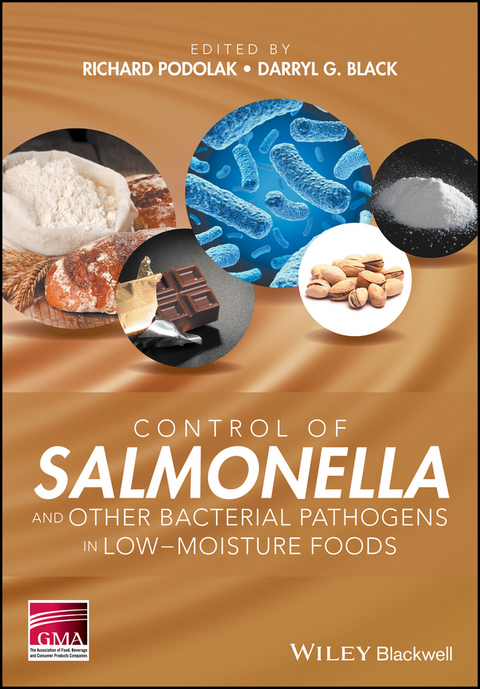
Control of Salmonella and Other Bacterial Pathogens in Low-Moisture Foods (eBook)
John Wiley & Sons (Verlag)
978-1-119-07106-8 (ISBN)
The first and only comprehensive reference/solutions manual for managing food safety in low-moisture foods
The first book devoted to an increasingly critical public health issue, Control of Salmonella and Other Bacterial Pathogens in Low-Moisture Foods reviews the current state of the science on the prevalence and persistence of bacterial pathogens in low-moisture foods and describes proven techniques for preventing food contamination for manufacturers who produce those foods.
Many pathogens, such as Salmonella, due to their enhanced thermal resistance in dry environments, can survive the drying process and may persist for prolonged periods in low-moisture foods, especially when stored in refrigerated environments. Bacterial contamination of low-moisture foods, such as peanut butter, present a vexing challenge to food safety, and especially now, in the wake of widely publicized food safety related events, food processors urgently need up-to-date, practical information on proven measures for containing the risk of contamination. While much has been written on the subject, until now it was scattered throughout the world literature in scientific and industry journals. The need for a comprehensive treatment of the subject has never been greater, and now this book satisfies that need.
- Discusses a wide variety of foods and evaluates multiple processing platforms from the standpoint of process validation of all food safety objectives for finished food products
- Takes a practical approach integrating the latest scientific and technological advances in a handy working resource
- Presents all known sources and risk factors for pathogenic bacteria of concern in the manufacturing environment for low-moisture/water activity products
- Characterizes the persistence and thermal resistance of bacterial pathogens in both the environment and most low-moisture food products
Control of Salmonella and Other Bacterial Pathogens in Low-Moisture Foods is a much-needed resource for food microbiologists and food industry scientists, as well as managers and executives in companies that produce and use low-moisture foods. It also belongs on the reference shelves of food safety regulatory agencies worldwide.
Richard Podolak, PhD, is Senior Scientist with the Grocery Manufacturers Association, based in Washington DC, USA.
Darryl G. Black, PhD, is Associate Director for Research with Food and Drug Administration, Bedford Park, IL, USA.
The first and only comprehensive reference/solutions manual for managing food safety in low-moisture foods The first book devoted to an increasingly critical public health issue, Control of Salmonella and Other Bacterial Pathogens in Low-Moisture Foods reviews the current state of the science on the prevalence and persistence of bacterial pathogens in low-moisture foods and describes proven techniques for preventing food contamination for manufacturers who produce those foods. Many pathogens, such as Salmonella, due to their enhanced thermal resistance in dry environments, can survive the drying process and may persist for prolonged periods in low-moisture foods, especially when stored in refrigerated environments. Bacterial contamination of low-moisture foods, such as peanut butter, present a vexing challenge to food safety, and especially now, in the wake of widely publicized food safety related events, food processors urgently need up-to-date, practical information on proven measures for containing the risk of contamination. While much has been written on the subject, until now it was scattered throughout the world literature in scientific and industry journals. The need for a comprehensive treatment of the subject has never been greater, and now this book satisfies that need. Discusses a wide variety of foods and evaluates multiple processing platforms from the standpoint of process validation of all food safety objectives for finished food products Takes a practical approach integrating the latest scientific and technological advances in a handy working resource Presents all known sources and risk factors for pathogenic bacteria of concern in the manufacturing environment for low-moisture/water activity products Characterizes the persistence and thermal resistance of bacterial pathogens in both the environment and most low-moisture food products Control of Salmonella and Other Bacterial Pathogens in Low-Moisture Foods is a much-needed resource for food microbiologists and food industry scientists, as well as managers and executives in companies that produce and use low-moisture foods. It also belongs on the reference shelves of food safety regulatory agencies worldwide.
Richard Podolak, PhD, is Senior Scientist with the Grocery Manufacturers Association, based in Washington DC, USA. Darryl G. Black, PhD, is Associate Director for Research with Food and Drug Administration, Bedford Park, IL, USA.
Cover 1
Title Page 5
Copyright 6
Contents 7
List of Contributors 13
Chapter 1 Introduction and Overview 15
1.1 Introduction 15
1.2 Definition of Low-Moisture Foods (LMF) and Water Activity Controlled Foods 16
1.3 Salmonella as a Continuing Challenge and Ongoing Problem in Low-Moisture Foods 18
1.4 Foodborne Outbreaks of Salmonella spp. and Other Implicated Microbial Pathogens in Low-Moisture Foods 20
1.5 Major Safety Concerns in Low-Moisture Foods 30
1.6 Content and Brief Book Chapter Review 31
1.7 Goal of the Book 35
1.8 How to Use the Book 35
References 36
Chapter 2 Regulatory Requirements for Low-Moisture Foods – The New Preventive Controls Landscape (FSMA) 43
2.1 Introduction 43
2.2 FSMA Sanitation and cGMPs 46
2.3 FSMA Preventive Controls 48
2.4 Process Controls 49
2.5 Sanitation Controls 50
2.6 Supplier Controls 51
2.7 Summary of Requirements for Low-Moisture FSMA Regulated Products 52
References 53
Chapter 3 Potential Sources and Risk Factors 55
3.1 Introduction 55
3.2 Raw Ingredients Control and Handling 57
3.2.1 Identifying Vulnerable Ingredients 57
3.2.2 Supplier Management 58
3.2.3 Receiving and Transport 60
3.2.4 Segregation/Isolation of Raw, Vulnerable Ingredients 61
3.2.5 Assessment of Remediation Practices after Loss of Control (Potential Contamination of Facility) or Assessing Sanitation Practice Effectiveness 62
3.3 Pest Control 63
3.3.1 Integrated Pest Management 64
3.3.2 Web Resources for More Information 66
3.3.3 Choosing a Pest Control Partner 68
3.4 Salmonella Harborage in the Facility 69
3.4.1 Sanitation Practices that may Lead to the Spread of Pathogens 70
3.4.2 Equipment Sources 72
3.4.3 Hygienic Sources 73
3.4.4 Management Practices for Cleaning Equipment 74
3.4.5 Rolling Stock 75
3.4.6 Raw Materials 75
3.5 Conclusions 76
References 76
Chapter 4 Persistence of Salmonella and Other Bacterial Pathogens in Low-Moisture Foods 81
4.1 Introduction 81
4.2 Factors Affecting Survival of Salmonella and Other Pathogens in Low-Moisture Foods 81
4.2.1 Water Activity (aw) 82
4.2.2 Temperature 87
4.2.3 pH 87
4.2.4 Other Factors 87
4.3 Recovery of Salmonella Cells Stressed by Low-Moisture Foods 89
4.4 Mechanism of Salmonella Survival in Food Product and Processing Environment 89
4.4.1 Viable but Nonculturable (VBNC) 90
4.4.2 Filamentation 90
4.4.3 Osmoprotectants 91
4.4.4 Biofilm Formation 92
4.4.5 Outer Membrane Porins 92
4.4.6 Other Mechanisms 92
4.4.6.1 Activation of Genes for ?E or ?S Pathways 92
4.5 Other Vegetative Pathogens 93
4.6 Summary 93
References 94
Chapter 5 Best Industry Practices to Control Salmonella in Low-Moisture Foods 101
5.1 Introduction 101
5.2 Sanitation Practices 103
5.2.1 Dry Cleaning 103
5.2.2 Wet Cleaning 106
5.2.3 Cleaning Pattern/Planning 107
5.2.4 Chemical Selection and Specific Options 108
5.2.4.1 Oxidizers 110
5.2.4.2 Surfactants 111
5.2.4.3 Alcohols 112
5.2.5 Validation and Verification 113
5.2.5.1 Validation Methods and Considerations 113
5.2.5.2 Verification of Appropriate Cleaning and Sanitization 114
5.2.6 Facility Equipment and Design 115
5.2.6.1 Hygienic Facility Design 116
5.2.6.2 Facility Condition 117
5.2.6.3 Grounds 118
5.2.6.4 Other Facility Considerations 119
5.2.6.5 Penetration Points 119
5.2.6.6 Contractors 120
5.2.6.7 Employees 121
5.2.6.8 Rolling Stock/Moving Stock 121
5.2.6.9 Waste 122
5.2.6.10 Ingredients 122
5.2.6.11 Vending/Employee Meals 122
5.2.6.12 Personnel Health 123
5.2.6.13 Sanitation 123
5.2.7 Hygienic Equipment Design 123
5.3 Current Good Manufacturing Practice 126
References 128
Chapter 6 Heat Resistance of Salmonella and Other Bacterial Pathogens in Low-Moisture Foods 135
6.1 Introduction 135
6.2 Factors Affecting Heat Resistance of Foodborne Pathogens 136
6.2.1 Strain of Bacteria 136
6.2.2 Surrogate Organisms for In?Plant Validation 138
6.2.3 Culture Conditions 139
6.2.4 Properties of the Food 142
6.2.5 Inoculation Procedures 143
6.2.6 Food Storage Conditions 144
6.2.7 Recovery Conditions 145
6.3 Use of Published Heat Resistance Data to Establish Lethal Process Lethality in Low-Moisture Foods 147
6.4 Summary 157
References 157
Chapter 7 Validation Requirements in Heat-Processed Low-Moisture Foods 163
7.1 Introduction 163
7.2 Definitions 164
7.3 Tasks of Validation 164
7.4 Task 1: Assemble a Validation Team 165
7.5 Task 2: Identify the Hazard to be Controlled Through Hazard Analysis 165
7.6 Task 3: Identify a Validation Approach for the Control Measure 166
7.6.1 Generally?held Historical Knowledge 167
7.6.2 Published “Safe Harbor” Processes 167
7.6.3 Regulatory Documents such as Performance Standards 170
7.6.4 Published Industry Processing Guidelines 172
7.6.5 Peer?Reviewed Scientific Literature or Technical Data 173
7.6.6 Scientifically?Valid Experimental Data such as a Microbiological Challenge Study 174
7.6.7 Previous Validation Studies 174
7.6.8 Scientific Pathogen Models Mathematical Modeling
7.6.9 Operational Data and Surveys 177
7.7 Task 4: Conduct the In-Production Validation 177
7.8 Task 5: Write the Results of the Validation in a Validation Report 179
7.10 Task 6: Implement the Control Measure, Monitors and Record Review 181
7.11 Task 7: Verify that the Control Measure is Operating as Intended 182
7.12 Task 8: Re-evaluate the Control Measure Periodically 183
7.13 Conclusion 184
References 185
Chapter 8 Test Methods for Salmonella in Low-Moisture Foods 189
8.1 Introduction 189
8.2 Sampling Plans 189
8.2.1 Product Testing 190
8.2.2 Environmental Monitoring Sampling Plans 191
8.2.2.1 Establishing the Monitoring Plan 192
8.2.2.2 Zone Assignment 196
8.2.2.3 Sampling Frequency 197
8.2.2.4 Track and Trend Results 197
8.2.2.5 Conclusion 198
8.3 Types of Methods 198
8.3.1 Traditional Cultural Methods for Qualitative Analysis 198
8.3.2 Rapid Methods 201
8.3.3 Quantitative Methods 204
8.3.4 Strain Identification Methods 204
8.4 Matrices Testing Challenges 206
8.5 Conclusion 208
References 208
Chapter 9 Techniques to Determine Thermal Inactivation Kinetics for Pathogenic Bacteria and their Surrogate Organisms in Low-Moisture Foods 211
9.1 Introduction 211
9.2 Kinetics of Microbial Destruction 212
9.2.1 The D?value 212
9.2.2 The z?value 213
9.2.3 Nonlinear Microbial Destruction Kinetics 214
9.2.4 The F?value 214
9.3 Experimental Design and Execution 214
9.3.1 Selection of the Target Organism 214
9.3.2 Experimental Matrix (Selection of the Product) 215
9.3.3 Test Culture Preparation 216
9.3.4 Product Inoculation 217
9.3.5 Selection of TDT Sample Container and Heat Transfer (Minimizing Come?Up Times) 219
9.3.6 TDT Study Design: Selection of Study Parameters (Times and Temperatures to Use) 221
9.3.7 Conducting the Heat Treatment (Capturing Product Temperature Data) 222
9.3.8 Recovery and Enumeration of Bacterial Cells Post?Heat Treatment (Including Sublethally Injured Cells) 224
9.3.9 Data Analysis 224
References 229
Chapter 10 Modeling and Statistical Issues Related to Salmonella in Low Water Activity Foods 233
10.1 An Introduction to Modeling Salmonella in Low Water Activity Foods 233
10.2 Developing a Predictive Model for Salmonella in Low Water Activity Foods 234
10.2.1 Primary Models 236
10.2.2 Criteria for Choosing the Best Applicable Model 238
10.2.3 Primary Model Fits 238
10.2.4 Secondary Models 238
10.3 Model Validation 240
10.4 Models in Risk Assessment 242
10.4.1 The Risk Assessment Model 242
10.4.2 The Monte Carlo Analysis 244
10.4.3 Sensitivity Analysis 245
10.4.4 Modeling Variability and Uncertainty 246
10.4.5 Available Tools in Risk Assessment 247
10.5 Summary 248
References 248
Chapter 11 Spoilage Microorganisms in Low-Moisture Foods 255
11.1 Introduction 255
11.2 Microorganisms Associated with the Spoilage of Low-Moisture Foods 255
11.2.1 Halophilic Organisms 255
11.2.2 Xerophilic Fungi 256
11.3 Factors Influencing Heat Resistance of Fungi in Low-Moisture Foods 258
11.3.1 Effect of Solutes 258
11.3.2 Effect of pH 259
11.3.3 Effect of Strains and Age of Spores 260
11.3.4 Effects of Growth Substrate and Medium Composition 260
11.3.5 Heat Resistance and Aflatoxin Production 260
11.4 Heat Resistance of Fungi in Low-Moisture Foods 261
11.5 Heat Resistance of Yeasts in Low-Moisture Foods 261
11.6 Preventing and Reducing Spoilage in Low-Moisture Foods 261
11.7 Conclusions 265
References 265
Index 269
EULA 278
| Erscheint lt. Verlag | 3.7.2017 |
|---|---|
| Sprache | englisch |
| Themenwelt | Naturwissenschaften ► Biologie ► Mikrobiologie / Immunologie |
| Technik ► Lebensmitteltechnologie | |
| Weitere Fachgebiete ► Land- / Forstwirtschaft / Fischerei | |
| Schlagworte | Angewandte Mikrobiologie • applied microbiology • bacterial pathogens in processed foods • Biowissenschaften • controlling salmonella in low-moisture food • Food Processing, Production & Manufacture • Food Safety • food safety microbiology • food science • Food Science & Technology • Herstellung u. Verarbeitung von Lebensmitteln • industry practices for the control and elimination of pathogens in low-moisture foods • industry practices for the control and elimination of pathogens in processed foods • Lebensmittelforschung u. -technologie • life cycle models of bacterial pathogens in low moisture foods • Life Sciences • low-moisture food safety • microbiological testing for low-moisture food inoculation • microbiological testing for low-moisture food selection • Microbiology, Food Safety & Security • Mikrobiologie • Mikrobiologie u. Nahrungsmittelsicherheit • Nahrungsmittelsicherheit • Pathogener Mikroorganismus • processed food safety • risk factors for pathogenic bacteria in processed foods • safety protocols for low-moisture food packaging • safety protocols for low-moisture food processing • Salmonella • salmonella contamination • Salmonellen • spoilage organisms in low-moisture foods • thermal resistance of bacterial pathogens in low-moisture foods |
| ISBN-10 | 1-119-07106-2 / 1119071062 |
| ISBN-13 | 978-1-119-07106-8 / 9781119071068 |
| Informationen gemäß Produktsicherheitsverordnung (GPSR) | |
| Haben Sie eine Frage zum Produkt? |
 PDF (Adobe DRM)
Kopierschutz: Adobe-DRM
Adobe-DRM ist ein Kopierschutz, der das eBook vor Mißbrauch schützen soll. Dabei wird das eBook bereits beim Download auf Ihre persönliche Adobe-ID autorisiert. Lesen können Sie das eBook dann nur auf den Geräten, welche ebenfalls auf Ihre Adobe-ID registriert sind.
Details zum Adobe-DRM
Dateiformat: PDF (Portable Document Format)
Mit einem festen Seitenlayout eignet sich die PDF besonders für Fachbücher mit Spalten, Tabellen und Abbildungen. Eine PDF kann auf fast allen Geräten angezeigt werden, ist aber für kleine Displays (Smartphone, eReader) nur eingeschränkt geeignet.
Systemvoraussetzungen:
PC/Mac: Mit einem PC oder Mac können Sie dieses eBook lesen. Sie benötigen eine
eReader: Dieses eBook kann mit (fast) allen eBook-Readern gelesen werden. Mit dem amazon-Kindle ist es aber nicht kompatibel.
Smartphone/Tablet: Egal ob Apple oder Android, dieses eBook können Sie lesen. Sie benötigen eine
Geräteliste und zusätzliche Hinweise
Buying eBooks from abroad
For tax law reasons we can sell eBooks just within Germany and Switzerland. Regrettably we cannot fulfill eBook-orders from other countries.
aus dem Bereich