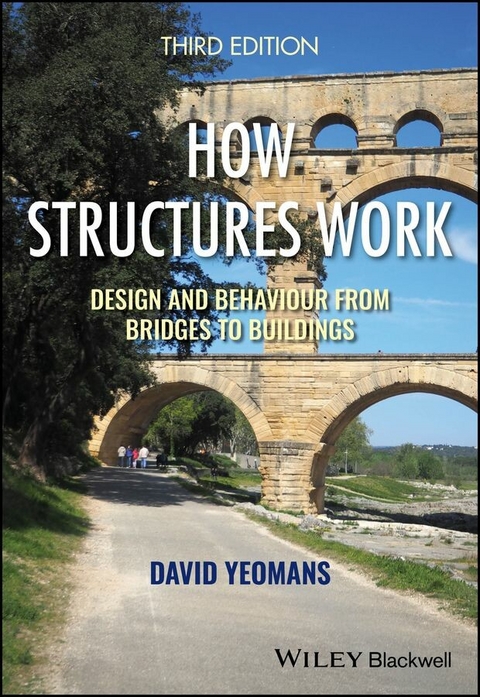
How Structures Work (eBook)
575 Seiten
Wiley-Blackwell (Verlag)
978-1-394-34014-9 (ISBN)
HOW STRUCTURES WORK
DESIGN AND BEHAVIOUR FROM BRIDGES TO BUILDINGS, THIRD EDITION
DAVID YEOMANS
Structural engineering is essential to the design of a building. How the building behaves when subjected to various forces - the weight of the materials used to build it, the weight of the occupants or the traffic it carries, the force of the wind, etc. - is fundamental to its stability. The alliance between architecture and structural engineering is therefore critical to the successful design and completion of the buildings and infrastructure that surrounds us. Yet structure is often cloaked in mathematics which many architects and surveyors find difficult to understand.
How Structures Work has been written to explain the bahaviour of structures in a clear way without resorting to complex mathematics. It is aimed at all who require a good qualitative understanding of structures, their behaviour, and design, and as such will be of benefit to students of architecture, architectural history, building surveying and civil engineering. The straightforward, nonmathematical approach ensures it will also be suitable for a wider audience including building administrators and the interested layman. This new edition includes a new chapter to deal with some little understood structures both ancient and modern.
Reviews of the first edition
'How Structures work is the most compelling on structures that I have ever read. And I have read a lot of books on structures.'
-R.L.Brungraber, Ph.D., P.E Timber Framing: Journal of the Timber Framers Guild, December 2009
'The author writes beautifully. It is a user-friendly engaging book to read and one that is very easy to understand. One learns a lot by reading it ... I think it should be a compulsory text for all first year engineering students.'
From a review of the first edition commissioned by the publisher.
About this author
David Yeomans is an engineer, an historian and a teacher. He has taught in several schools of architecture in the United Kingdom and the United States, has been a consultant on World Heritage Sites and has written widely on the history of building structures. He is vice chairman of the Construction History Society.
HOW STRUCTURES WORK DESIGN AND BEHAVIOUR FROM BRIDGES TO BUILDINGS, THIRD EDITION DAVID YEOMANS Structural engineering is essential to the design of a building. How the building behaves when subjected to various forces the weight of the materials used to build it, the weight of the occupants or the traffic it carries, the force of the wind, etc. is fundamental to its stability. The alliance between architecture and structural engineering is therefore critical to the successful design and completion of the buildings and infrastructure that surrounds us. Yet structure is often cloaked in mathematics which many architects and surveyors find difficult to understand. How Structures Work has been written to explain the bahaviour of structures in a clear way without resorting to complex mathematics. It is aimed at all who require a good qualitative understanding of structures, their behaviour, and design, and as such will be of benefit to students of architecture, architectural history, building surveying and civil engineering. The straightforward, nonmathematical approach ensures it will also be suitable for a wider audience including building administrators and the interested layman. This new edition includes a new chapter to deal with some little understood structures both ancient and modern. Reviews of the first edition How Structures work is the most compelling on structures that I have ever read. And I have read a lot of books on structures. R.L.Brungraber, Ph.D., P.E Timber Framing: Journal of the Timber Framers Guild, December 2009 The author writes beautifully. It is a user-friendly engaging book to read and one that is very easy to understand. One learns a lot by reading it I think it should be a compulsory text for all first year engineering students. From a review of the first edition commissioned by the publisher.
Preface from the First Edition
The dedication of this book requires some explanation because, although it has been written to be suitable for architectural students, it was not originally conceived as such. The dedicatees include two archaeologists and an antiquarian book dealer. The idea for the book goes back further than I care to remember. Visiting an archaeologist friend, I picked up a book on Greek architecture, and it became apparent that the author’s understanding of structure and construction lacked something. ‘Don’t you think, Louise, that it would be a good idea for archaeologists to learn something about building structures?’ ‘Yes it would’ – and so the seed was sown. The idea was simply that something on building structures might be useful for people with little or no mathematics but whose work or subject of study involves understanding buildings.
Many years later, Jane Grenville asked me if I could give some classes to her master’s course on buildings archaeology at York University. ‘Structures for archaeologists? I’ve always wanted to try teaching that’. And so the text for this began with the notes for that class. Working up the text into this form was pushed aside by other things until Julia, a dealer in antiquarian engineering books, said that she had asked the late Professor Skempton if he could teach her some structures. He’d claimed it would be difficult because the subject is highly mathematical. She thought this nonsense, pointing out that she frequently heard engineers discussing structures but they never used any mathematics. Of course, she’s right; we seldom do when thinking about structures. The general experience is that one manages with a few simple concepts. Given the rule for static equilibrium, the triangle of forces and some ideas about moments and elasticity, one has the basic bag of tools that will cope with most situations. What one needs to add to this to make a designer, rather than a mere stress analyst, is an understanding of the properties of the materials that make up the structures we build, because no real understanding is possible without that. How then to provide the simple bag of tools? Goaded by Julia’s demands, I determined to tackle the problem.
What started as something for archaeologists, architectural historians or even the interested layperson (represented by my sister), and still remains suitable for that audience, was then developed at the suggestion of my commissioning editor to include material that would make it an architectural students’ text. Here, we see what might be described as a non-threatening approach to something that is normally seen as a highly technical subject, the idea for a method coming from my experience of starting to learn Spanish.
I was taught French and Latin at school, starting with the grammar; and that is how we commonly teach the ‘theory of structures’. We begin with the ‘grammar’ and only apply it to real structures afterwards, the transition sometimes being difficult for students. Today, languages are often taught through communication. The Spanish teacher introduced herself in the first class with ‘Me llamo Maria. ¿Como te llamas?’ Tone of voice indicated a question, and one quickly grasped what the reply should be without realising one was using a reflexive verb – a difficult piece of grammar because it is something that does not exist in English. Why then not teach structures in a similar way? Begin with simple structures that are easy to understand from common experience and build up the grammar, that is, the theoretical ideas, only as necessary. This might even be something that would appeal to engineers because it sometimes seems as if they have learnt a number of abstract concepts without grasping how they apply to real structures.
Figure 0.1 The force supporting a lorry.
I only wish I had thought of this approach while I was teaching architectural students because no matter how simple we tried to make the subject for them they probably regarded structural analysis as a series of mind-numbing routines. The evidence was there in what I called my Christmas test. In the last class before the Christmas vacation I would present first-year students with a puzzle that I first came across in Meccano Magazine when I was 10 years old:
I have to weigh a lorry, but it is too long for the weighbridge. I put the front wheels on the weighbridge and take a reading. I then drive it forwards so that only the back wheels are on and take another reading. I add the two readings together. Do I have the weight of the lorry?
Half the students would answer ‘yes’ and half would answer ‘no’. Clearly, a lot of guessing was going on. I would then draw a picture representing the situation (see Figure 0.1; arrows represent forces). By the time it was complete, all would realise that the answer was ‘yes’.
They had worked with simple diagrams, happily writing down, as they had been taught, a formula that said that the sum of the support reactions must equal the sum of the loads, but this clearly had no real meaning for them. At least, it was not something that they could relate to a real situation. And that is just the problem; whatever the abstract theories – the grammar of structural analysis – they have to be related to real-life situations. It is the real situations that a designer, or someone trying to understand an actual building, begins with, which then has to be described in terms of abstract diagrams. That is the approach here. We will begin with real situations and learn to draw diagrams that represent the forces and explain how those forces work.
Some time ago, I discovered a teaching film that featured a guide to one of the French cathedrals, demonstrating the action of the vaults and flying buttresses to parties of tourists. This was done by lining up the men in two rows to represent the columns of the nave. They then raised their arms to represent the ribs of the vaults, linking hands with their neighbours and those opposite at what would be the bosses that often decorate the meeting of the ribs. The women then stood behind their husbands with their hands on their shoulders to act as the buttresses and flying buttresses (Figure 0.2).
The guide then placed his hands over the ‘bosses’ at the meeting of the ribs and lifted his weight off the ground hanging from the outstretched arms of the men. The result was that all could feel the forces thus created. To support his weight pressing down on their hands, the men would be pushing upwards with their arms. But their arms pushed downwards on their shoulders, and because their arms were inclined inwards they pushed outwards. Except for the wives pushing inwards from behind the men would have staggered backwards and the edifice would have collapsed. The tourists at the cathedral, perhaps with no previous knowledge of building structures, were given an experience they would not forget and an immediate understanding of the structural behaviour of Gothic cathedrals.
Figure 0.2 A human model of a Gothic cathedral.
Similarly, many people will be familiar with Baker’s demonstration of the way that the Forth Bridge works (see Figure 1.4). Baker was the designer of the bridge, and the photograph of his assistant being supported by two men with the aid of a couple of chairs and some struts is probably the most famous explanation of a structure. We can all imagine the forces in both these demonstrations because we all feel weights and forces when we lift or move something. We have all weighed something using a pair of scales, carried shopping, moved a piece of furniture and perhaps fixed a bracket to a wall. Some of us have played rugby and pushed in a scrum. All of these activities give us knowledge and experience of forces in action, and so we can imagine the forces in structures in a similar way. Thus, we all have the first requirement for understanding structures. Both demonstrations also illustrate what we will discover are called components of forces, but such knowledge is not necessary if all we want to understand is the cathedral or the bridge. However, if we want to go beyond these simple demonstrations we need to develop some general concepts to make up the bag of tools. In fact there are not that many, as will be shown by a glance at the Appendix, which sets out the elements of the grammar.
The other aspect of this approach is that it is about how we look at structures. It would be foolish to assume the ancients had no understanding of structural behaviour even though they did not have the panoply of mathematical tools that we use today. Of course, structures have changed since the ancients, and the way that we look at them has also changed, but design is often dependent upon the way that we look at things. The word ‘truss’ means something quite different to a present-day engineer compared with its meaning to an eighteenth-century carpenter, in spite of similar principles applying to both – so much so that engineers who have not looked at early structures have sometimes been confused by the terminology. There are historical examples of engineers who have made imaginative leaps in design by looking at structures in a different way from their contemporaries. A tendency to plunge into calculations before developing a good qualitative understanding ties one to standard solutions. Work is no substitute for thought – but it’s often so much easier to let the computer do...
| Erscheint lt. Verlag | 3.9.2025 |
|---|---|
| Sprache | englisch |
| Themenwelt | Technik ► Bauwesen |
| Schlagworte | Building Conservation • Building Technology History • Historic Buildings Preservation • structural design • structural engineering and design • structural engineering basics • structural engineering principles • structural stability architecture |
| ISBN-10 | 1-394-34014-1 / 1394340141 |
| ISBN-13 | 978-1-394-34014-9 / 9781394340149 |
| Informationen gemäß Produktsicherheitsverordnung (GPSR) | |
| Haben Sie eine Frage zum Produkt? |
 EPUB (Adobe DRM)
Kopierschutz: Adobe-DRM
Adobe-DRM ist ein Kopierschutz, der das eBook vor Mißbrauch schützen soll. Dabei wird das eBook bereits beim Download auf Ihre persönliche Adobe-ID autorisiert. Lesen können Sie das eBook dann nur auf den Geräten, welche ebenfalls auf Ihre Adobe-ID registriert sind.
Details zum Adobe-DRM
Dateiformat: EPUB (Electronic Publication)
EPUB ist ein offener Standard für eBooks und eignet sich besonders zur Darstellung von Belletristik und Sachbüchern. Der Fließtext wird dynamisch an die Display- und Schriftgröße angepasst. Auch für mobile Lesegeräte ist EPUB daher gut geeignet.
Systemvoraussetzungen:
PC/Mac: Mit einem PC oder Mac können Sie dieses eBook lesen. Sie benötigen eine
eReader: Dieses eBook kann mit (fast) allen eBook-Readern gelesen werden. Mit dem amazon-Kindle ist es aber nicht kompatibel.
Smartphone/Tablet: Egal ob Apple oder Android, dieses eBook können Sie lesen. Sie benötigen eine
Geräteliste und zusätzliche Hinweise
Buying eBooks from abroad
For tax law reasons we can sell eBooks just within Germany and Switzerland. Regrettably we cannot fulfill eBook-orders from other countries.
aus dem Bereich