How Structures Work (eBook)
291 Seiten
Wiley-Blackwell (Verlag)
978-1-394-34015-6 (ISBN)
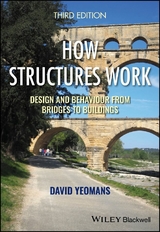
HOW STRUCTURES WORK
DESIGN AND BEHAVIOUR FROM BRIDGES TO BUILDINGS, THIRD EDITION
DAVID YEOMANS
Structural engineering is essential to the design of a building. How the building behaves when subjected to various forces - the weight of the materials used to build it, the weight of the occupants or the traffic it carries, the force of the wind, etc. - is fundamental to its stability. The alliance between architecture and structural engineering is therefore critical to the successful design and completion of the buildings and infrastructure that surrounds us. Yet structure is often cloaked in mathematics which many architects and surveyors find difficult to understand.
How Structures Work has been written to explain the bahaviour of structures in a clear way without resorting to complex mathematics. It is aimed at all who require a good qualitative understanding of structures, their behaviour, and design, and as such will be of benefit to students of architecture, architectural history, building surveying and civil engineering. The straightforward, nonmathematical approach ensures it will also be suitable for a wider audience including building administrators and the interested layman. This new edition includes a new chapter to deal with some little understood structures both ancient and modern.
Reviews of the first edition
'How Structures work is the most compelling on structures that I have ever read. And I have read a lot of books on structures.'
-R.L.Brungraber, Ph.D., P.E Timber Framing: Journal of the Timber Framers Guild, December 2009
'The author writes beautifully. It is a user-friendly engaging book to read and one that is very easy to understand. One learns a lot by reading it ... I think it should be a compulsory text for all first year engineering students.'
From a review of the first edition commissioned by the publisher.
About this author
David Yeomans is an engineer, an historian and a teacher. He has taught in several schools of architecture in the United Kingdom and the United States, has been a consultant on World Heritage Sites and has written widely on the history of building structures. He is vice chairman of the Construction History Society.
HOW STRUCTURES WORK DESIGN AND BEHAVIOUR FROM BRIDGES TO BUILDINGS, THIRD EDITION DAVID YEOMANS Structural engineering is essential to the design of a building. How the building behaves when subjected to various forces the weight of the materials used to build it, the weight of the occupants or the traffic it carries, the force of the wind, etc. is fundamental to its stability. The alliance between architecture and structural engineering is therefore critical to the successful design and completion of the buildings and infrastructure that surrounds us. Yet structure is often cloaked in mathematics which many architects and surveyors find difficult to understand. How Structures Work has been written to explain the bahaviour of structures in a clear way without resorting to complex mathematics. It is aimed at all who require a good qualitative understanding of structures, their behaviour, and design, and as such will be of benefit to students of architecture, architectural history, building surveying and civil engineering. The straightforward, nonmathematical approach ensures it will also be suitable for a wider audience including building administrators and the interested layman. This new edition includes a new chapter to deal with some little understood structures both ancient and modern. Reviews of the first edition How Structures work is the most compelling on structures that I have ever read. And I have read a lot of books on structures. R.L.Brungraber, Ph.D., P.E Timber Framing: Journal of the Timber Framers Guild, December 2009 The author writes beautifully. It is a user-friendly engaging book to read and one that is very easy to understand. One learns a lot by reading it I think it should be a compulsory text for all first year engineering students. From a review of the first edition commissioned by the publisher.
| Erscheint lt. Verlag | 26.8.2025 |
|---|---|
| Sprache | englisch |
| Themenwelt | Technik ► Bauwesen |
| Schlagworte | Building Conservation • Building Technology History • Historic Buildings Preservation • structural design • structural engineering and design • structural engineering basics • structural engineering principles • structural stability architecture |
| ISBN-10 | 1-394-34015-X / 139434015X |
| ISBN-13 | 978-1-394-34015-6 / 9781394340156 |
| Informationen gemäß Produktsicherheitsverordnung (GPSR) | |
| Haben Sie eine Frage zum Produkt? |
 PDF (Adobe DRM)
Kopierschutz: Adobe-DRM
Adobe-DRM ist ein Kopierschutz, der das eBook vor Mißbrauch schützen soll. Dabei wird das eBook bereits beim Download auf Ihre persönliche Adobe-ID autorisiert. Lesen können Sie das eBook dann nur auf den Geräten, welche ebenfalls auf Ihre Adobe-ID registriert sind.
Details zum Adobe-DRM
Dateiformat: PDF (Portable Document Format)
Mit einem festen Seitenlayout eignet sich die PDF besonders für Fachbücher mit Spalten, Tabellen und Abbildungen. Eine PDF kann auf fast allen Geräten angezeigt werden, ist aber für kleine Displays (Smartphone, eReader) nur eingeschränkt geeignet.
Systemvoraussetzungen:
PC/Mac: Mit einem PC oder Mac können Sie dieses eBook lesen. Sie benötigen eine
eReader: Dieses eBook kann mit (fast) allen eBook-Readern gelesen werden. Mit dem amazon-Kindle ist es aber nicht kompatibel.
Smartphone/Tablet: Egal ob Apple oder Android, dieses eBook können Sie lesen. Sie benötigen eine
Geräteliste und zusätzliche Hinweise
Buying eBooks from abroad
For tax law reasons we can sell eBooks just within Germany and Switzerland. Regrettably we cannot fulfill eBook-orders from other countries.
aus dem Bereich