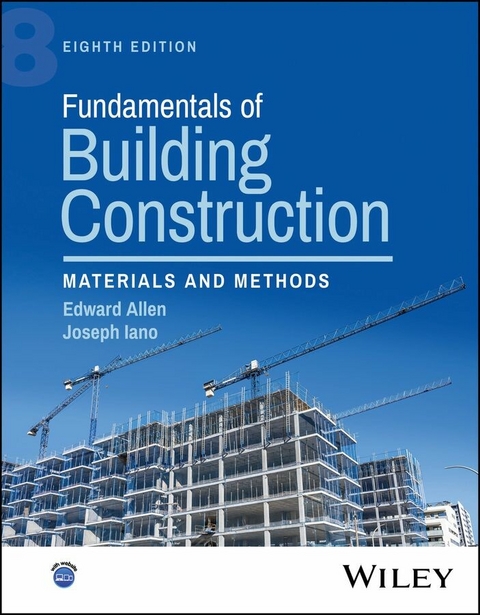
Fundamentals of Building Construction (eBook)
2412 Seiten
Wiley (Verlag)
978-1-394-22014-4 (ISBN)
Discover the big picture on building construction materials and methods in this fully-updated eighth edition of the leading text on the subject
The construction of buildings depends on the contributions of professionals from diverse fields, including architecture, construction management, civil and structural engineering, and more. All of these professionals, however, must understand the principles and materials that underlie the construction process in order to fulfil their roles in the project.
After more than a generation, Fundamentals of Building Construction continues to be the essential introduction to this subject for students in all construction-related fields. Highly readable and based on extensive pedagogical practice, it represents decades of experience in architecture and the building trades. Now updated to reflect the latest methods and industry practices, it promises to remain foundational for another generation of students.
Readers of the eighth edition of Fundamentals of Building Construction will also find:
- Significantly expanded treatment of the newest practices for mass timber construction
- Expanded discussion of the principles of enclosure design, along with an all-new case study illustrating the practical application of these principles
- Continued emphasis on sustainable construction and carbon emissions, extensively updated images and diagrams, and updates through all chapters of the text
Fundamentals of Building Construction is the ideal learning tool and resource for every architect and construction professional to help build a successful career.
Edward Allen, FAIA, taught for more than thirty-five years as a faculty member at Yale University and the Massachusetts Institute of Technology. He designed more than fifty constructed buildings and was an invited guest at institutions in the United States, South America, Europe, and Asia.
Joseph Iano is a practicing architect, author, and photographer. He has taught design and technology in schools of architecture throughout the United States and is the founder of a Seattle-based firm that provides technical and quality management consulting to the design and construction industry.
1
MAKING BUILDINGS
An ironworker connects a steel wide‐flange beam to a column.
(Courtesy of Bethlehem Steel Company.)
- Learning to Build
- Buildings and the Environment
- The Work of the Design Professional
- The Work of the Construction Professional
- Trends in the Delivery of Design and Construction Services
We build to satisfy our practical and spiritual needs. Not all human activity can take place outdoors. We need shelter from sun, wind, rain, and snow. We need dry, level surfaces on which to work, play and live. On these sheltered surfaces, we need air that is warmer or cooler, more or less humid, than outdoors. We need less light by day, and more by night, than is offered by the natural world. We need services that provide energy, communications, water, and disposal of wastes. And we need structures that house and express our cultural and spiritual aspirations. So, we gather materials and assemble them into the constructions we call buildings in an attempt to satisfy these needs.
LEARNING TO BUILD
This book is about the materials and methods of building construction. Throughout it, alternative ways of building are described: different structural systems, different methods of building enclosure, and different interior finishes, each with characteristics that distinguish it from the alternatives. Sometimes a choice between alternatives is based on visual characteristics, such as when a particular finish material is preferred for its surface character and beauty, or when a material such as concrete is selected over steel for its massiveness and plasticity. Sometimes choices are purely technical, such as the selection of a membrane that is impervious to water for a low‐slope roof, or when a particular method of masonry wall reinforcing is selected to provide resistance to earthquake forces. Choices of materials and building systems may be made with the goal of minimizing environmental impacts, or they may be dictated by regulations intended to protect public safety and welfare. Construction costs, energy efficiency, durability, and many other factors come into consideration.
This textbook will start you down the path of becoming skilled at making such choices. But it is incumbent upon the you, the reader, to go beyond what is provided here—to other books, product literature, trade publications, professional periodicals, websites, and especially the design office, workshop, and building site. One must learn how materials feel in the hand; how they look in a building; how they are manufactured, worked, and put in place; how they perform in service; how they age with time. One must become familiar with the people and organizations that produce buildings—the architects, engineers, product manufacturers, materials suppliers, contractors, subcontractors, workers, inspectors, managers, and building owners—and learn to understand their respective methods, problems, and points of view. There is no other way to gain the breadth of information and experience necessary than to get involved in the art and practice of building.
In the meantime, this long and hopefully enjoyable process of education in the materials and methods of building construction can begin here, with this text.
Go into the field where you can see the machines and methods at work that make the modern buildings, or stay in construction direct and simple until you can work naturally into building‐design from the nature of construction.
—Frank Lloyd Wright, “To the Young Man in Architecture,” 1931
BUILDINGS AND THE ENVIRONMENT
In constructing and occupying buildings, we consume large quantities of the earth's resources and generate a significant portion of its environmental pollution. The construction and operation of buildings account for more than a third of the world's consumption of energy and emissions of the global warming gas carbon dioxide. In the United States, building design, construction, and operation are responsible for the consumption of more than 35 percent of the country's energy, 12 percent of its potable water, and a third of its raw materials, while generating a third of its solid wastes and almost 40 percent of its carbon dioxide emissions. In short, building construction and operation are major contributors to many forms of environmental degradation and place a significant burden on the earth's resources.
In 1987, the United Nations report “Our Common Future” provided a concise definition of sustainable development: building to meet the needs of the present generation without compromising the ability of future generations to meet their needs. But, by consuming irreplaceable fossil fuels and other nonrenewable resources, building in sprawling patterns on prime agricultural land, using destructive land development and forestry practices that degrade natural ecosystems, generating substances that pollute water, soil, and air, and generating copious amounts of waste materials that are eventually incinerated or buried in the earth, we have been building in a manner that will make it increasingly difficult for our children and their children to meet their needs for communities, buildings, and healthy lives. Sustainable building construction demands a more symbiotic relationship between people, buildings, communities, and the natural world. Sustainable buildings—in both their construction and operation—must consume fewer resources, cause less pollution, reduce waste, discourage wasteful land development practices, and contribute to the protection of natural environments and ecosystems.
Figure 1.1 The Bullitt Center, Seattle, designed by architect Miller Hull Partnership, was the first commercial building to achieve Living Building certification in 2015. This building generates as much as 60 percent more electricity than it uses and consumes less than one‐quarter of the energy of a typical U.S. office building.
(Photo by Joseph Iano.)
In the decades since the release of “Our Common Future,” the understanding of the interplay between buildings and the environment has deepened and the standards for assessing the sustainability of building materials and construction practices have matured in approach. The definition of sustainability has expanded to include human health impacts of buildings and consideration of issues of social and economic justice. Expectations for the performance of sustainable buildings have also advanced beyond simply reducing environmental harms to doing no harm, or even undoing previous such harms (Figure 1.1).
In 2015, the United Nations adopted its “2030 Agenda for Sustainable Development,” which provides a comprehensive framework of 17 Sustainable Development Goals for global peace and prosperity. Concerns of the broadest possible social relevance—such as poverty and hunger, human health and well‐being, education, inequality, and justice—are addressed. Topics directly relating to the construction and habitation of our buildings are also considered, for example: clean water and sanitation, clean energy, resilient infrastructure, sustainable communities, sustainable consumption and production of materials, protection of the natural environment, and climate action. Throughout this book, the ways in which the materials and methods of building construction intersect with these concerns are addressed.
Sustainable Buildings and Standards
Sustainable building (also called green building) requires a holistic, interdisciplinary approach to design and construction. For example, one project goal may be to provide natural daylighting, as a means to improving productivity and the well‐being of building occupants. Good daylighting design reduces reliance on electric lighting. This, in turn, reduces electricity consumption and excess heat generated by the electric lights. This, then, reduces cooling loads and allows the building's cooling system to be reduced in capacity. Daylighting design can also influence building siting and shape, the arrangement and sizes of spaces within the building, and the building structure and enclosure. As a result of the decision to provide natural daylighting, many building systems are impacted, and many opportunities for cost savings, reductions in energy consumption, improvements in occupant health and comfort, and lessening of environmental impacts are created.
This kind of design thinking, sometimes called integrated design process...
| Erscheint lt. Verlag | 6.8.2025 |
|---|---|
| Sprache | englisch |
| Themenwelt | Technik ► Bauwesen |
| Schlagworte | Civil Engineering • Construction Management • Construction technology • Industry trend in building • light wood frame • masonry bearing wall • Reinforced Concrete Construction • SDG • steel frame • United Nations Sustainable Development Goals |
| ISBN-10 | 1-394-22014-6 / 1394220146 |
| ISBN-13 | 978-1-394-22014-4 / 9781394220144 |
| Informationen gemäß Produktsicherheitsverordnung (GPSR) | |
| Haben Sie eine Frage zum Produkt? |
 EPUB (Adobe DRM)
Kopierschutz: Adobe-DRM
Adobe-DRM ist ein Kopierschutz, der das eBook vor Mißbrauch schützen soll. Dabei wird das eBook bereits beim Download auf Ihre persönliche Adobe-ID autorisiert. Lesen können Sie das eBook dann nur auf den Geräten, welche ebenfalls auf Ihre Adobe-ID registriert sind.
Details zum Adobe-DRM
Dateiformat: EPUB (Electronic Publication)
EPUB ist ein offener Standard für eBooks und eignet sich besonders zur Darstellung von Belletristik und Sachbüchern. Der Fließtext wird dynamisch an die Display- und Schriftgröße angepasst. Auch für mobile Lesegeräte ist EPUB daher gut geeignet.
Systemvoraussetzungen:
PC/Mac: Mit einem PC oder Mac können Sie dieses eBook lesen. Sie benötigen eine
eReader: Dieses eBook kann mit (fast) allen eBook-Readern gelesen werden. Mit dem amazon-Kindle ist es aber nicht kompatibel.
Smartphone/Tablet: Egal ob Apple oder Android, dieses eBook können Sie lesen. Sie benötigen eine
Geräteliste und zusätzliche Hinweise
Buying eBooks from abroad
For tax law reasons we can sell eBooks just within Germany and Switzerland. Regrettably we cannot fulfill eBook-orders from other countries.
aus dem Bereich