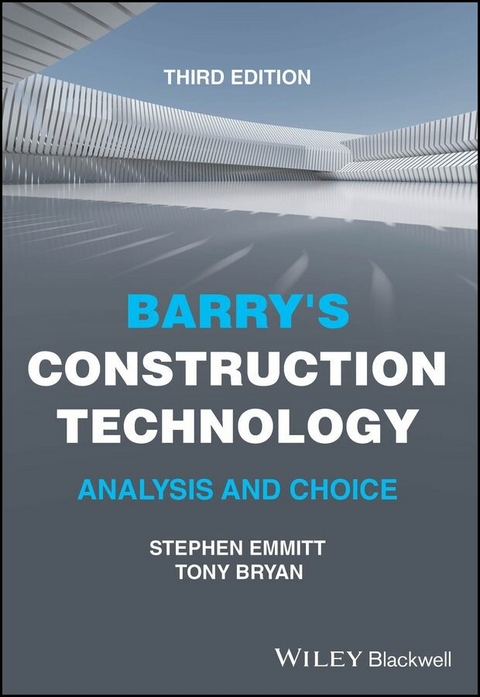
Barry's Construction Technology (eBook)
299 Seiten
Wiley-Blackwell (Verlag)
978-1-394-26466-7 (ISBN)
Updated resource guiding readers through the analysis and choices required to ensure a building will perform as expected
Robin Barry's Construction of Buildings was first published in 1958 as a five-volume set and rapidly became a standard work on the subject. Following Barry's death in 2002, a two-volume format was adopted with new authors. Developed from an earlier book by Tony Bryan, this new third volume, Barry's Construction Technology, extends the coverage to show how decisions about the design, production, maintenance and disposal of buildings may be thought through given the materials and technology available. The book challenges the reader to think about the consequences of making choices and decisions rather than relying on using what has been used before.
Barry's Construction Technology: Analysis and Choice includes information on:
- The climate emergency and the low carbon agenda as a fundamental part of construction technology analysis and choice
- Regenerative design, net zero buildings, and the circular economy for the built environment
- Constraints that location, legislation, codes and standards, sustainability, insurance, and commercial pressures apply to the performance of buildings
- Specific construction technology examples, with emphasis on questioning what we do and why, with the aim of informing and stimulating the reader to ask questions when confronted with all design and construction projects
Barry's Construction Technology: Analysis and Choice is an essential, practical, and up-to-date reference for undergraduate students of all building construction programmes including surveying, construction management, architectural technology, and architecture.
Stephen Emmitt is Professor of Architectural Practice at the Department of Architecture and Civil Engineering, University of Bath, UK. He was previously Head of Department and Director of the Centre for Advanced Studies in Architecture (CASA). He is an architect with industrial experience. His research and teaching interests cover the interface between design and construction, design management, and collaborative working.
Updated resource guiding readers through the analysis and choices required to ensure a building will perform as expected Robin Barry s Construction of Buildings was first published in 1958 as a five-volume set and rapidly became a standard work on the subject. Following Barry s death in 2002, a two-volume format was adopted with new authors. Developed from an earlier book by Tony Bryan, this new third volume, Barry s Construction Technology, extends the coverage to show how decisions about the design, production, maintenance and disposal of buildings may be thought through given the materials and technology available. The book challenges the reader to think about the consequences of making choices and decisions rather than relying on using what has been used before. Barry s Construction Technology: Analysis and Choice includes information on: The climate emergency and the low carbon agenda as a fundamental part of construction technology analysis and choiceRegenerative design, net zero buildings, and the circular economy for the built environmentConstraints that location, legislation, codes and standards, sustainability, insurance, and commercial pressures apply to the performance of buildingsSpecific construction technology examples, with emphasis on questioning what we do and why, with the aim of informing and stimulating the reader to ask questions when confronted with all design and construction projects Barry s Construction Technology: Analysis and Choice is an essential, practical, and up-to-date reference for undergraduate students of all building construction programmes including surveying, construction management, architectural technology, and architecture.
| Erscheint lt. Verlag | 5.8.2025 |
|---|---|
| Sprache | englisch |
| Themenwelt | Technik ► Bauwesen |
| Schlagworte | Building Materials • Building Performance • Building project • Building Standards • Building Sustainability • Building technology • Construction Sustainability • low carbon agenda • net zero buildings • Regenerative Design |
| ISBN-10 | 1-394-26466-6 / 1394264666 |
| ISBN-13 | 978-1-394-26466-7 / 9781394264667 |
| Informationen gemäß Produktsicherheitsverordnung (GPSR) | |
| Haben Sie eine Frage zum Produkt? |
 PDF (Adobe DRM)
Kopierschutz: Adobe-DRM
Adobe-DRM ist ein Kopierschutz, der das eBook vor Mißbrauch schützen soll. Dabei wird das eBook bereits beim Download auf Ihre persönliche Adobe-ID autorisiert. Lesen können Sie das eBook dann nur auf den Geräten, welche ebenfalls auf Ihre Adobe-ID registriert sind.
Details zum Adobe-DRM
Dateiformat: PDF (Portable Document Format)
Mit einem festen Seitenlayout eignet sich die PDF besonders für Fachbücher mit Spalten, Tabellen und Abbildungen. Eine PDF kann auf fast allen Geräten angezeigt werden, ist aber für kleine Displays (Smartphone, eReader) nur eingeschränkt geeignet.
Systemvoraussetzungen:
PC/Mac: Mit einem PC oder Mac können Sie dieses eBook lesen. Sie benötigen eine
eReader: Dieses eBook kann mit (fast) allen eBook-Readern gelesen werden. Mit dem amazon-Kindle ist es aber nicht kompatibel.
Smartphone/Tablet: Egal ob Apple oder Android, dieses eBook können Sie lesen. Sie benötigen eine
Geräteliste und zusätzliche Hinweise
Buying eBooks from abroad
For tax law reasons we can sell eBooks just within Germany and Switzerland. Regrettably we cannot fulfill eBook-orders from other countries.
aus dem Bereich