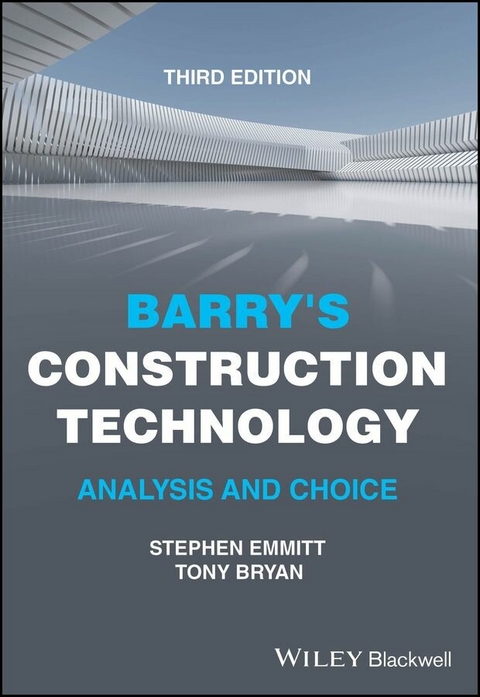
Barry's Construction Technology (eBook)
512 Seiten
Wiley-Blackwell (Verlag)
978-1-394-26465-0 (ISBN)
Updated resource guiding readers through the analysis and choices required to ensure a building will perform as expected
Robin Barry's Construction of Buildings was first published in 1958 as a five-volume set and rapidly became a standard work on the subject. Following Barry's death in 2002, a two-volume format was adopted with new authors. Developed from an earlier book by Tony Bryan, this new third volume, Barry's Construction Technology, extends the coverage to show how decisions about the design, production, maintenance and disposal of buildings may be thought through given the materials and technology available. The book challenges the reader to think about the consequences of making choices and decisions rather than relying on using what has been used before.
Barry's Construction Technology: Analysis and Choice includes information on:
- The climate emergency and the low carbon agenda as a fundamental part of construction technology analysis and choice
- Regenerative design, net zero buildings, and the circular economy for the built environment
- Constraints that location, legislation, codes and standards, sustainability, insurance, and commercial pressures apply to the performance of buildings
- Specific construction technology examples, with emphasis on questioning what we do and why, with the aim of informing and stimulating the reader to ask questions when confronted with all design and construction projects
Barry's Construction Technology: Analysis and Choice is an essential, practical, and up-to-date reference for undergraduate students of all building construction programmes including surveying, construction management, architectural technology, and architecture.
Stephen Emmitt is Professor of Architectural Practice at the Department of Architecture and Civil Engineering, University of Bath, UK. He was previously Head of Department and Director of the Centre for Advanced Studies in Architecture (CASA). He is an architect with industrial experience. His research and teaching interests cover the interface between design and construction, design management, and collaborative working.
1
The Framework for Understanding
This opening chapter outlines a framework to help develop an understanding of what must be known to take decisions on how and why we build. This is developed against a background of climate change and the impact that the built environment has on the natural environment. Responding to climate change requires a rethink about how we make decisions. This emphasises the importance of analysis and choice. The framework developed in this book suggests a way of going about selecting construction and identifies the knowledge that is required to make informed choices. It is the framework that will be developed and used throughout the book to help readers to reflect on the reasons behind the choices they make. These choices need to consider a wide variety of parameters that are underscored by the impact of the solution on the natural environment.
1.1 Responding to the climate emergency – rethinking how and why we build
It is necessary to start with the challenge facing all societies and industries and the urgent need to tackle climate change. The built environment makes a significant impact on the natural world. It is estimated that approximately 11% of greenhouse gas emissions come from the built environment. Some of the emissions are produced during the production of the building, which includes the extraction and processing of materials and the assembly of materials to realise a building project. This includes new buildings and works to the existing building stock. Some of the emissions are produced while the building is being used, primarily by using energy to create a comfortable indoor environment for the occupants. Much of the energy will be used for heating and cooling, with lighting and equipment also requiring energy. As the building weathers there will be the need for maintenance and repair, along with replacement of items that have failed or are no longer functional. As building users' needs change there may also be the need to carry out major alterations and upgrades. Sometimes this is essential to improve the serviceability of the building, sometimes it is linked to changing tastes and fashions. And when the building has finally reached the end of its service life, it provides a material bank for new building projects, with valuable materials and components recovered and reused in new building projects or repurposed into new (building) products. This prevents demolition and construction waste going to landfill and the loss of valuable resources, such as metals, bricks, concrete, glass and plastics. All these stages have an impact on carbon emissions and pollution. It is, therefore, imperative that as a society we start to design, build and operate buildings that make a positive impact on our natural environment, and which are resilient to a changing climate. This means that we need to reduce the carbon footprint of all construction activities and reduce the energy consumed when the building is in use. The choices that everyone makes who are involved in the design, engineering, construction, use, maintenance, upgrading and recycling of buildings will have an impact on the building's performance and its environmental impact. Thus the building needs to be envisaged in its entire life cycle to enable a more resilient outcome from the analysis and choice.
In many circumstances the ‘best’ and ‘most appropriate’ technology for a given context is not necessarily more complex or technologically more sophisticated, but a ‘simpler’ technology that draws on our heritage of vernacular building materials and techniques. Research and testing have shown that many ‘natural’ materials are a more practical choice compared to the more industrialised and processed carbon intensive materials. We have also developed a better understanding of the importance of existing buildings and the opportunities to renovate, upgrade, retrofit, disassemble and reuse. This reflects the development of a more conscientious approach in the procurement of usable space by those who commission and regulate the built environment.
Environmental consciousness is a significant driver in consumer decisions and hence a core customer value, which shapes purchasing and procurement decisions. Environmental consciousness shapes the analysis and choice. There are several ways of making a positive difference to our natural and built environment. The main argument is to reduce, reuse, recycle, regenerate and revitalise. These are themes that are developed further in this text, sometimes implicitly and sometimes explicitly. Taking this thinking forward we can view a building as a circular or closed system, where there is no waste produced during the entire life cycle of the building. This requires analysis and choice in a framework that considers the long‐term future of the building, and which also requires a degree of speculation as to how the future may look. This demands a rethink about how, when, why and what we build; and where. It also requires a fundamental questioning of current building legislation, codes and design guidance to go beyond what we currently know and to innovate. This, of course, raises the spectre of risk, and the balance required between exposure to risk and the realisation of value for society. It also raises questions about building technologies. Do we put our faith in offsite production, modern methods of construction, ‘greener’ industrial processes, and innovative materials? Do we revisit sustainable techniques from the past and adapt them to our current expectations, relying entirely on bio‐based (renewable) materials? Or is it a mixture of high‐tech and low‐tech choices, for example 3D printing of building components using sustainable (bio‐based) materials? Does the solution have to be complex? Why cannot we return to simpler construction assemblages that embrace passive design principles, and which may be more durable in the longer term? Can we put our faith in digital technologies and software without necessarily understanding the algorithms and data that inform the solutions?
These and similar questions are easy to raise. They are less easy to answer when faced with often competing performance criteria. Fortunately, there are established design guides and green building rating systems such as BREEAM (UK), LEED (US), Green Star (Australia) and many others that help to guide professionals towards sustainable analysis and choice. These decision‐making guides are complimented by a rapidly expanding array of digital tools that help with the modelling, calculation and visualisation of buildings at all stages in their lifespan. Some of these are best suited to familiar building forms and technologies, although they are becoming more sophisticated and applicable to a wider range of building forms and technologies.
Digital dilemmas and opportunities
The digital revolution has certainly made it easier to design, detail and specify a building. Building information models (BIMs) contain typologies of details that can be easily imported from the BIM library into the design, requiring little in the way of thinking or reflection. These are solutions that are known to work, based on previous experience. The problem with taking an ‘easy’ approach is that professionals may stop thinking and reflecting on what is required for a specific context, and more importantly what is required to tackle climate change. Standard solutions do not suit all circumstances, and one could argue that standard solutions are no longer appropriate for reducing the built environment's carbon footprint. This may be further compounded when using software to simulate and predict building performance. Do we really understand the background information that informs the software and the algorithms being used to give ‘the’ answer? This is not to say that digital tools are not useful; they are. The point is that professionals need to understand exactly what it is that the digital tools are contributing to the decision‐making process, and how they can assist with analysis and choice. Professionals need to have the knowledge and insight to be able to question the digital ‘solution’ to ensure that it is a sensible choice for the context. Thus, to understand what digital tools can contribute, and how, requires an understanding of construction technology and an ability to ask the difficult questions. Too much reliance on established typologies and details may hinder the urgent need for change to a carbon free built environment. And this brings us onto the topic of artificial intelligence (AI), machine learning (ML) and generative design.
We now have the computing power and know how to generate millions of virtual solutions for a given challenge. We can model the building using BIM and virtual digital twins to examine the way in which buildings may behave if the conditions are adjusted. BIM allows the virtual construction and disassembly of the building long before the final decision is taken to go into production. This helps to reduce errors and improves coordination, as well as aiding the safe and economic construction of the building virtually before the design enters production. Virtual digital twins can be linked via the internet to sensors in buildings that gather real time data on, for example, temperature, humidity, lighting and occupancy levels, etc. This allows a reactive adjustment of building systems by using automation; known as smart or intelligent buildings. The data will inform predictive...
| Erscheint lt. Verlag | 5.8.2025 |
|---|---|
| Sprache | englisch |
| Themenwelt | Technik ► Bauwesen |
| Schlagworte | Building Materials • Building Performance • Building project • Building Standards • Building Sustainability • Building technology • Construction Sustainability • low carbon agenda • net zero buildings • Regenerative Design |
| ISBN-10 | 1-394-26465-8 / 1394264658 |
| ISBN-13 | 978-1-394-26465-0 / 9781394264650 |
| Informationen gemäß Produktsicherheitsverordnung (GPSR) | |
| Haben Sie eine Frage zum Produkt? |
 EPUB (Adobe DRM)
Kopierschutz: Adobe-DRM
Adobe-DRM ist ein Kopierschutz, der das eBook vor Mißbrauch schützen soll. Dabei wird das eBook bereits beim Download auf Ihre persönliche Adobe-ID autorisiert. Lesen können Sie das eBook dann nur auf den Geräten, welche ebenfalls auf Ihre Adobe-ID registriert sind.
Details zum Adobe-DRM
Dateiformat: EPUB (Electronic Publication)
EPUB ist ein offener Standard für eBooks und eignet sich besonders zur Darstellung von Belletristik und Sachbüchern. Der Fließtext wird dynamisch an die Display- und Schriftgröße angepasst. Auch für mobile Lesegeräte ist EPUB daher gut geeignet.
Systemvoraussetzungen:
PC/Mac: Mit einem PC oder Mac können Sie dieses eBook lesen. Sie benötigen eine
eReader: Dieses eBook kann mit (fast) allen eBook-Readern gelesen werden. Mit dem amazon-Kindle ist es aber nicht kompatibel.
Smartphone/Tablet: Egal ob Apple oder Android, dieses eBook können Sie lesen. Sie benötigen eine
Geräteliste und zusätzliche Hinweise
Buying eBooks from abroad
For tax law reasons we can sell eBooks just within Germany and Switzerland. Regrettably we cannot fulfill eBook-orders from other countries.
aus dem Bereich