Advanced Vehicle Scanning Method (eBook)
941 Seiten
Wiley (Verlag)
978-1-394-28604-1 (ISBN)
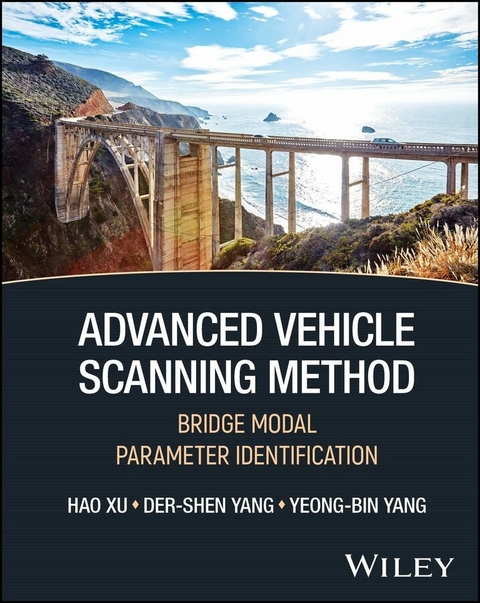
Framework for scanning modal parameters of bridges from vehicle responses utilizing the Vehicle Scanning Method (VSM)
Advanced Vehicle Scanning Method: Bridge Modal Parameter Identification delivers a complete theoretical framework for scanning of the modal parameters (frequencies, damping ratios, and mode shapes) of bridges from vehicle responses. This book provides comprehensive coverage of the application of the Vehicle Scanning Method (VSM) for different types of bridges, which has the advantage of mobility, economy, and efficiency over the conventional, direct method.
Most of the materials presented in each chapter have been published as technical papers in high-ranking international journals, which were subjected to critical reviews. The contents of the book have been arranged such that they are reflective of the progressive advancement of the VSM technique.
Edited by a highly qualified team of authors including one of the original developers of the VSM technique, Advanced Vehicle Scanning Method includes information on:
- The theoretical basis for bridge frequency identification and scanning methods enhanced by software and hardware tools
- The damping formula for determining the bridge damping ratio from the spatial correlation of the front and rear wheels of a two-axle test vehicle
- The methods for removing the damping distortion effect on bridge mode shape recovery with no prior knowledge of bridge damping ratios
- The theoretical basis of scanning frequencies, damping ratios, and mode shapes using VSM for various types of bridges, such as curved bridges and thin-walled girders
Advanced Vehicle Scanning Method is an essential reference on the subject for researchers working on bridge dynamics, graduate students in programs of study related to vehicle-bridge interaction, and practicing bridge engineers.
Dr. Hao Xu is an Associate Professor at the School of Civil Engineering, Chongqing University, China. In 2023, he was awarded the Young Elite Scientists Sponsorship Program by the China Association for Science and Technology (CAST).
Dr. Der-Shen Yang is an Associate Professor at the College of Civil Engineering, Tongji University, China. In 2024, he was awarded the Excellent Young Scientists Fund Program (Overseas) by the National Natural Science Foundation of China.
Dr. Yeong-Bin Yang is Honorary Dean of the School of Civil Engineering, Chongqing University, China. He is a member of the Chinese Academy of Engineering and the European Academy of Sciences and Arts, and a foreign member of the Austrian Academy of Sciences.
Framework for scanning modal parameters of bridges from vehicle responses utilizing the Vehicle Scanning Method (VSM) Advanced Vehicle Scanning Method: Bridge Modal Parameter Identification delivers a complete theoretical framework for scanning of the modal parameters (frequencies, damping ratios, and mode shapes) of bridges from vehicle responses. This book provides comprehensive coverage of the application of the Vehicle Scanning Method (VSM) for different types of bridges, which has the advantage of mobility, economy, and efficiency over the conventional, direct method. Most of the materials presented in each chapter have been published as technical papers in high-ranking international journals, which were subjected to critical reviews. The contents of the book have been arranged such that they are reflective of the progressive advancement of the VSM technique. Edited by a highly qualified team of authors including one of the original developers of the VSM technique, Advanced Vehicle Scanning Method includes information on: The theoretical basis for bridge frequency identification and scanning methods enhanced by software and hardware toolsThe damping formula for determining the bridge damping ratio from the spatial correlation of the front and rear wheels of a two-axle test vehicleThe methods for removing the damping distortion effect on bridge mode shape recovery with no prior knowledge of bridge damping ratiosThe theoretical basis of scanning frequencies, damping ratios, and mode shapes using VSM for various types of bridges, such as curved bridges and thin-walled girders Advanced Vehicle Scanning Method is an essential reference on the subject for researchers working on bridge dynamics, graduate students in programs of study related to vehicle-bridge interaction, and practicing bridge engineers.
Preface
Bridges are essential components of lifeline systems, serving as critical links between two sides of an area that are separated by natural or artificial barriers. Bridges constitute an essential part of transportation systems, including highways, railways, city rail systems, high‐speed railways, and so on. They are engineering structures designed to provide passages for people, vehicles, and goods, enabling connectivity and facilitating transportation. Due to aging, overloading in traffic, and natural disasters, such as earthquakes, typhoons, and flooding, the health condition of a bridge may decline in various forms during its service life, e.g., the deterioration in materials, cracking in cross sections, loosening or breaking connection, support settlements, and scouring in column foundations.
To assess the health condition of a bridge, vibration‐based monitoring methods have been widely adopted to diagnose the variation in modal properties. Conventionally, structural health monitoring has been carried out using the vibration data recorded by sensors directly deployed on the bridge, known as the direct measurement method. However, the health monitoring system, including the vibration sensors and data logger, is usually “tailored” for the particular bridge of concern, of which the setup and maintenance costs are generally high. In addition, the continuously generated “sealike” data cannot be digested in an efficient way. What is more, the lifespan of the electronic devices installed on a bridge may not be longer than that of the bridge to be monitored. For the huge number of bridges existing all over the world, there is an urgent need to develop economical and efficient methods that can be widely used in the health monitoring of most bridges.
In 2004, the vehicle scanning method (VSM) for bridge measurement was proposed by the senior (third) author and coworkers to circumvent the drawbacks of the direct measurement method. Such a method, originally known as the indirect measurement method, is featured by the fact of mobility, economy, and efficiency, in that no vibration sensors need to be mounted on the bridge and only a small number of sensors are required to be fixed on the vehicle. It was later renamed as the vehicle scanning method for bridges to make it self‐explanatory. Over the past nearly two decades, research on various aspects of the VSM has boomed globally, including the identification of bridge frequencies, modal shapes, damping ratios, and damages.
This book intends to give a broad and systematic coverage of the VSM techniques for the identification of bridge modal parameters (frequencies, modal shapes, and damping ratios). In general, the book is divided into three parts: Part I (Chapters 2–6) is dedicated to the VSM techniques for bridge frequencies, Part II (Chapters 7–11) to the VSM techniques for bridge mode shapes and damping ratios, and Part III (Chapters 12–15) to the VSM techniques for various types of bridges. To help readers quickly engage in the chapters of interest, each chapter will start with some concise background information, allowing readers to directly comprehend the chapter in a manner that requires minimal cross‐reference to the previous chapters. This book contains a total of 15 chapters in the order of increasing complexity. The following is a summary of the content of each chapter.
In Chapter 1, the basic concept of extracting bridge modal parameters using a moving test vehicle is briefed. It then provides a comprehensive review of the current state‐of‐the‐art research conducted globally up to roughly 2024 on the VSM. Progress in various aspects of the VSM is presented, including the identification of bridge frequencies, mode shapes, damping ratios, damages, and surface roughness, as well as applications to railways.
In Chapter 2, a more realistic theory is presented for the vehicle–bridge interaction (VBI) system considering the vehicle damping. To eliminate the overshadowing effect of vehicle frequency on the identification of bridge frequencies from the vehicle's spectrum, the contact response is used instead, which can be calculated backwardly from the vehicle response. The transmissibility between the vehicle and contact responses is discussed. In addition, a field test is conducted to verify the theory presented.
In Chapter 3, a refined detection technique for bridge frequencies using the rocking motion of a single‐axle moving vehicle is introduced. A new formula is derived for calculating the left and right contact responses of the two wheels of the single‐axle test vehicle, which will be used in the spectral analysis to eliminate the vehicle's vertical and rocking frequencies. The feasibility of the refined detection method for scanning the bridge frequencies is verified by the field test.
In Chapter 4, a theory for utilizing a single‐axle, two‐mass scanning vehicle to extract the bridge frequencies is presented, in which the vehicle's suspension effect is taken into account. For the two‐mass vehicle model, backward formulas are presented for computing the contact response considering the vehicle's suspension effect.
In Chapter 5, a shaker is added to the bridge to enhance the bridge vibration for alleviating the adverse effect of vibrations induced by pavement roughness. Closed‐form solutions are derived of the vehicle‐shaker‐bridge system to form the theoretical framework for future application of the shaker. The simple formula derived for the shaker's dynamic amplification factor (DAF) on the vehicle and contact responses in the study can be easily used in practice.
In Chapter 6, dual‐function amplifiers are proposed for use to enhance the capability of a scanning test vehicle for bridges. The DAFs of the amplifier and vehicle are presented for assessing the bridge/vehicle and vehicle/amplifier transmissibilities. Two differentially tuned amplifiers are used: one is to suppress the vehicle frequency, acting like the tuned mass damper (TMD), and the other to enlarge the amplitude of the bridge frequency of concern.
In Chapter 7, a theoretical framework for scanning the mode shapes of a bridge by a two‐axle test vehicle is presented. The effect of vehicle frequencies is removed by using the contact responses, and that of pavement roughness by the residue of the front and rear contact responses of the two‐axle test vehicle. Then, the contact response is processed by the variational mode decomposition (VMD) to yield the component responses and then processed by the Hilbert transform (HT) to yield the mode shapes.
In Chapter 8, a simple formula is derived for the modal damping ratio of the bridge using the correlation between the instantaneous amplitudes of the related front and rear contact responses of a two‐axle scanning vehicle by the HT technique. The feasibility of the proposed damping formula is verified in the numerical study.
As a sequel to Chapter 8, a formula for determining the bridge damping ratio from two wheels of a two‐axle scanning vehicle by the wavelet transform (WT) is presented in Chapter 9. This chapter improves the preceding Chapter 8 by considering the suspension effect of the two‐axle vehicle, while fully utilizing the spatial correlation between the front and rear contact points in the time‐space signaling.
In Chapter 10, a normalized formula for removing the damping effect in recovering the bridge mode shapes is proposed by using a moving vehicle and a stationary vehicle. The moving test vehicle is used to recover the global modal response of the bridge throughout its span length at different instants as the vehicle moves over, and the stationary vehicle is used to generate a reference response at a fixed location of the bridge for removing the damping effect.
In Chapter 11, a recursive formula for removing the damping distortion effect on bridge mode shape restoration is proposed by utilizing the spatial correlation between the front and rear contact points of a two‐axle vehicle. Further, the bridge mode shapes recovered by the HT‐ and WT‐based recursive formulas are compared, to show which technique is more effective for bridge mode shape recovery.
In Chapter 12, a procedure for recovering the frequencies and mode shapes of curved bridges is introduced. Curved bridges differ from straight bridges in that they are characterized not only by the vertical but also by radial (lateral) frequencies. The procedure for recovering vertical and radial mode shapes of the curved bridge by the VMD and synchrosqueezed wavelet transform (SWT) is presented.
In Chapter 13, a unified theory for identifying the vertical and radial damping ratios of curved bridges in a form similar to straight bridges is proposed. By using the correlation between two connected scanning vehicles and the VMD‐SWT technique, the damping formula for the vertical and radial damping ratios of curved bridges is established.
In Chapter 14, based on the kinematic hypothesis of rigid cross sections for thin‐walled girders, a procedure for separating and detecting the vertical and torsional frequencies of thin‐walled girders from vehicle's contact responses is introduced. By the WT technique, the vertical and torsional mode shapes can be recovered from the separated vertical and torsional contact responses.
In Chapter 15, a theoretical framework for...
| Erscheint lt. Verlag | 29.7.2025 |
|---|---|
| Sprache | englisch |
| Themenwelt | Technik ► Bauwesen |
| Schlagworte | bridge damping ratios • Bridge Dynamics • Bridge Engineering • bridge frequencies • Bridge health Monitoring • bridge mode shapes • Modal Parameter Identification • vehicle-bridge interaction • vehicle responses • vehicle scanning method |
| ISBN-10 | 1-394-28604-X / 139428604X |
| ISBN-13 | 978-1-394-28604-1 / 9781394286041 |
| Informationen gemäß Produktsicherheitsverordnung (GPSR) | |
| Haben Sie eine Frage zum Produkt? |
 EPUB (Adobe DRM)
Kopierschutz: Adobe-DRM
Adobe-DRM ist ein Kopierschutz, der das eBook vor Mißbrauch schützen soll. Dabei wird das eBook bereits beim Download auf Ihre persönliche Adobe-ID autorisiert. Lesen können Sie das eBook dann nur auf den Geräten, welche ebenfalls auf Ihre Adobe-ID registriert sind.
Details zum Adobe-DRM
Dateiformat: EPUB (Electronic Publication)
EPUB ist ein offener Standard für eBooks und eignet sich besonders zur Darstellung von Belletristik und Sachbüchern. Der Fließtext wird dynamisch an die Display- und Schriftgröße angepasst. Auch für mobile Lesegeräte ist EPUB daher gut geeignet.
Systemvoraussetzungen:
PC/Mac: Mit einem PC oder Mac können Sie dieses eBook lesen. Sie benötigen eine
eReader: Dieses eBook kann mit (fast) allen eBook-Readern gelesen werden. Mit dem amazon-Kindle ist es aber nicht kompatibel.
Smartphone/Tablet: Egal ob Apple oder Android, dieses eBook können Sie lesen. Sie benötigen eine
Geräteliste und zusätzliche Hinweise
Buying eBooks from abroad
For tax law reasons we can sell eBooks just within Germany and Switzerland. Regrettably we cannot fulfill eBook-orders from other countries.
aus dem Bereich