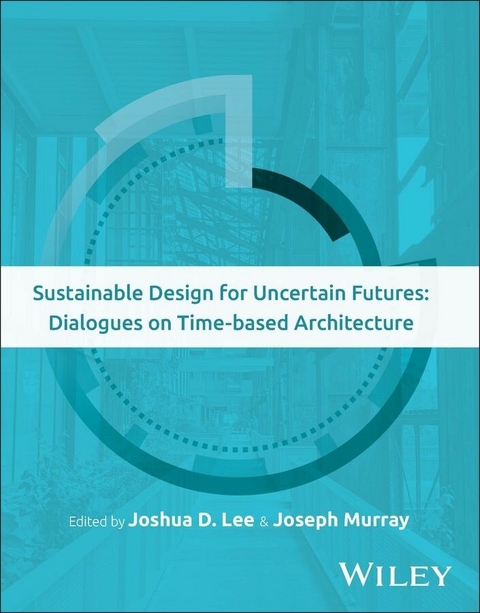
Sustainable Design for Uncertain Futures (eBook)
Explore pivotal intersections and themes between strategies for buildings and cities to adapt to shifting circumstances.
Sustainable Design for Uncertain Futures introduces fourteen time-based strategies in architecture through a series of dialogues between experts. This format embraces a dynamic exploration of strategies ranging from Adaptive Reuse to Bio Design, revealing how each one addresses forces of change and adds adaptive capacity to the built environment.
The book's structure invites readers to engage with these strategies on multiple levels. Each chapter begins with a framing of the fundamentals, providing context and key examples to situate the strategies in the wider field. At the core of each chapter is a moderated dialogue that offers key insights into how these strategies work in practice and how they can be used in combination. By presenting these strategies through dialogue, the editors demonstrate the collaborative thinking needed to address growing uncertainty in the built environment and provide readers with an actionable framework of technical and management approaches.
The book's practical focus helps bridge the gap between theory and application, making this edited volume an invaluable resource for both academics and practitioners. Readers will find dialogues involving fifteen renowned experts in their respective fields:
Avi Friedman & Naomi Keena (Mass Customization) ? Michael Fox (Computationally Responsive Environments) / Bie Plevoets (Adaptive Reuse) ? John Dale (Open Building) / Aki Ishida (Metabolism) ? Michelle Laboy (Persistence) / Felix Heisel (Circular Construction) ? Jenni Minner (Preservation) / Kim Trogal (Repair) ? Brad Guy (Design for Disassembly & Adaptability) / Sarah Wigglesworth (Inclusive Design) ? Irena Bauman (Resilience) / Doris Sung (Smart Materials) ? Mitchell Joachim (Bio Design)
Sustainable Design for Uncertain Futures presents:
- The fundamentals of each strategy, along with a short summary of each with its affordances and challenges and a few key examples
- The editors' theory of primary time signatures, enabling readers to see and plan the combination of different time-based strategies to increase building lifecycle coverage for adaptive capacity
- Critical insights from thought leaders across a wide spectrum of approaches to sustainability
Academics, practitioners, and others interested in change in the built environment can use the strategies discussed in Sustainable Design for Uncertain Futures to develop architectural solutions that accommodate climate change, shifting demographics, new live-work patterns, and many other uncertainties.
Joshua D. Lee, PhD is an Associate Teaching Professor of Architecture at Carnegie Mellon University. His research interests include sustainable design, adaptable architecture, open building, systems-based architecture, circular construction, public interest design, post-occupancy evaluation, and educational facilities. His 2019 book, Flexibility and Design: Learning from the School Construction Systems Development (SCSD) Project, provides a longitudinal evaluation of this innovative and impactful project. Joshua is a registered architect and founder of the Protean Design Collaborative. He completed his Master of Architecture, Master of Sustainable Design, and PhD at the University of Texas at Austin.
Joseph Murray is a designer and systems thinker whose projects span user experience, social research, and the built environment. He has worked for architects and engineering firms throughout his career and has developed an expertise in building lifecycle management, focusing on long-term change processes at the building and district scales. Expanding on this interdisciplinary approach, Joseph is currently pursuing a PhD in Architecture-Engineering-Construction Management at Carnegie Mellon University. His dissertation investigates adaptable building systems and time-based architectural practices. He holds an MA in Sociology and Social Anthropology from Central European University. Joseph is a board member of the Council on Open Building and is a collaborating researcher at Cornell University's Just Places Lab.
Introduction
The dynamic nature of our world presents unending challenges, and a growing concern and awareness of uncertainties, across multiple scales, is shaping our views of what is desirable, and even what is possible in the field of architecture. This book aims to operationalize new understandings of time, architecture, and the forces of change. Through curated dialogues, an awareness of a thrilling potential becomes apparent: uncertainty can activate new approaches and the time‐based strategies discussed in this book can equip us with a means of blending with, rather than working against the forces of change. These forces can range from everyday, relatively minor shifts in preference to global existential threats. Those who create and care for the built environment should plan to accommodate this reality. Unfortunately there is mounting evidence on construction, renovation, and demolition waste1 that indicates the discipline of architecture, as it is currently practiced and codified into law, fails to adequately plan for the fourth dimension—time.
The current rate of loss of both resources and cultural heritage is clearly unsustainable on many levels. However, both negative and positive outcomes are implied in our use of the term uncertain futures. While concern over existential threats such as climate change, pandemics, and runaway AI are certainly worthy of consideration, there is also the potential for unexpected positive developments in technology and increasingly equitable forms of decision making.
As a basis of discourse we have adopted a pragmatic, discursive, and pluralistic approach2 to thinking about sustainability and we remain hopeful that we can move towards the ambitious goal set forth decades ago to build in such a way that we “meet the needs of the present without compromising the ability of future generations to meet their own needs” (Our Common Future 1987). We see great potential in the growing number of architectural strategies that deal in one way or another with possible futures, in an effort to add adaptive capacity. We call these strategies time‐based because they address the forces of change, often working across multiple time scales and in consideration of evolving needs. The 14 strategies we engage in dialogue in this book provide a wide range of embedded values that offer both theoretical and practical guidance to address aspects of the polycrisis we face today and the unknown crises we will face in the future. They include Mass Customization (Avi Friedman & Naomi Keena) ↔ Computationally Responsive Environments (Michael Fox), Adaptive Reuse (Bie Plevoets) ↔ Open Building (John Dale), Metabolism (Aki Ishida) ↔ Persistence (Michelle Laboy), Circular Economy (Felix Heisel) ↔ Preservation (Jenni Minner), Repair (Kim Trogal) ↔ Design for Disassembly & Reuse (Brad Guy), Inclusive Design (Sarah Wigglesworth) ↔ Resilience (Irena Bauman), and Smart Materials (Doris Sung) ↔ Bio Design (Mitchell Joachim). Each of these strategies address time in their own way, with their own terminology, and with varying levels of success and acceptance. What is common among them is a willingness to consider specific forces of change. See the matrix of these forces in Figure 0.1, which shows an example of a multi‐family residence and a partial listing of the forces of change acting upon such a structure across multiple categories of change across scales. The central premise of this book is that by engaging in dialogue across time‐based strategies we can develop innovative approaches to addressing our current needs and manage long term uncertainties by designing adaptive capacities while honoring the efforts of previous generations.
Figure 0.1 Forces and Scales of Change Matrix. This example is for a multi‐family residence. The y‐axis provides a variety of categories of change and the x‐axis relates these to a continuum of scales. The z‐axis indicates time, which recedes into greater uncertainty. The forces and scales of change rarely fit neatly in a single cell, but attempting to map these can be helpful when planning for the future, uncertain as it is.
To operationalize the strategies in combination we have aligned the strategies to the building lifecycle according to six time signatures as illustrated in Figure 0.2. The potential for secondary time signatures will be explored as the strategic understandings broaden through the dialogues. Mass Customization is closely associated with the Planning & Design phase because it provides many options and choices that designers and clients can make throughout the pre‐built phase. Inclusive Design embraces the needs of diverse users through the design process. Computationally Responsive Environments and Smart Materials are linked to Immediate Change, which occur in real time in frequent cycles. For example, Computationally Responsive Environments can open or close a window or blinds within seconds of a specific gesture. Some Smart Materials can change their shape as the temperature or humidity changes.
Figure 0.2 Time Signatures.
Intermittent Changes occur at irregular intervals and are aligned with Open Building, Metabolism, Repair, Resilience, and Bio Design. Open Building provides infill components such as demountable partitions that can respond to occupant spatial needs such as a change in household composition. Metabolism favors relocatable pods that can be moved from one core structure to another. Repair also requires consistent dedication to keeping structures in good, and possibly improving condition, over many years. Resilience offers a variety of ways to recover from human‐made and natural disasters. Bio Design occurs through activities like pruning and grafting that work in concert with natural growth cycles.
Long‐term Change occurs slowly over a long span of time and includes strategies like Persistence, and Preservation. Persistence is most evident after many decades or centuries. Preservation is typically supported for structures that are more than 50 years old and gain significance through meaningful events occurring in or around them over time.
The final phase is the End of Use & Reuse, which includes Adaptive Reuse, Circular Construction, and Design for Disassembly & Adaptability. Here we are distinguishing between the end of a specific use and end of life. End of use recognizes the potential for substantial reuse whereas end of life suggests a linear process leading to the landfill. In the case of Adaptive Reuse there is the potential for both end of use and end of life scenarios. Circular Construction, on the other hand, advocates the direct reuse of building components such as the recomposition of warehouse structural components into the design of a new office building. Design for Disassembly & Adaptability plans for reuse by specifying details like bolted connections that can be easily repurposed. Throughout the dialogues and in the Conclusion chapter we make an argument for strategically curating these strategies to cover as many of the time signatures as possible given the project contexts and requirements.
How this Book Emerged and Evolved
The structure of the book is based on a popular course at Carnegie Mellon University taught by Professor Joshua D. Lee entitled Protean Systems: Sustainable Design for Uncertain Futures. In addition to discussing the various strategies through key readings and case studies, the course includes a series of guest lectures by thought leaders from around the globe aligned with each strategy.
Extending beyond the premise of the course we imagined what these experts might say in direct dialogue with one another. Through a series of semi‐structured interviews we engaged an exceptional assemblage of academics and practitioners to contribute to this volume, each representing a time‐based strategy. We used a switchboard matchmaking process by lining up the strategies relative to their primary time signature and speculated what we thought different pairings of specific experts might produce (see Figure 0.3). In general we tried to create time‐signature mismatches to accentuate different temporal foci. We encourage you to also play this game as there are dozens of potential strategies with hundreds of representative champions, which could result in thousands of potential combinations. It is important to note that we asked all 15 of our dialogists to serve as representatives of distinct strategies for the sake of clarity, however each of them are polymaths with multiple areas of expertise. Amid this variety of experience and expertise the contributors helped to expand field boundaries, leading in many cases to collaborative and inventive new discourses. The strategies and representatives we ultimately selected offered clear points of constructive interference and a potential for a sum greater than the parts, what we called the 1 + 1 = 3 formulation.
After a recruitment and scheduling process, we supplied a list of prompts to our dialogists to review and comment on before our 90‐minute recorded online sessions. Prompts for the questions were made and remade. As editors we have taken...
| Erscheint lt. Verlag | 29.7.2025 |
|---|---|
| Sprache | englisch |
| Themenwelt | Technik ► Bauwesen |
| Schlagworte | adaptive reuse • bio design • circular construction • Computationally Responsive Environments • Design for Disassembly & Adaptability • inclusive design • Mass Customization • Metabolism • Open Building • Persistence • Preservation • Resilience • Smart Materials |
| ISBN-13 | 9781394217168 / 9781394217168 |
| Informationen gemäß Produktsicherheitsverordnung (GPSR) | |
| Haben Sie eine Frage zum Produkt? |
 EPUB (Adobe DRM)
Kopierschutz: Adobe-DRM
Adobe-DRM ist ein Kopierschutz, der das eBook vor Mißbrauch schützen soll. Dabei wird das eBook bereits beim Download auf Ihre persönliche Adobe-ID autorisiert. Lesen können Sie das eBook dann nur auf den Geräten, welche ebenfalls auf Ihre Adobe-ID registriert sind.
Details zum Adobe-DRM
Dateiformat: EPUB (Electronic Publication)
EPUB ist ein offener Standard für eBooks und eignet sich besonders zur Darstellung von Belletristik und Sachbüchern. Der Fließtext wird dynamisch an die Display- und Schriftgröße angepasst. Auch für mobile Lesegeräte ist EPUB daher gut geeignet.
Systemvoraussetzungen:
PC/Mac: Mit einem PC oder Mac können Sie dieses eBook lesen. Sie benötigen eine
eReader: Dieses eBook kann mit (fast) allen eBook-Readern gelesen werden. Mit dem amazon-Kindle ist es aber nicht kompatibel.
Smartphone/Tablet: Egal ob Apple oder Android, dieses eBook können Sie lesen. Sie benötigen eine
Geräteliste und zusätzliche Hinweise
Buying eBooks from abroad
For tax law reasons we can sell eBooks just within Germany and Switzerland. Regrettably we cannot fulfill eBook-orders from other countries.
aus dem Bereich