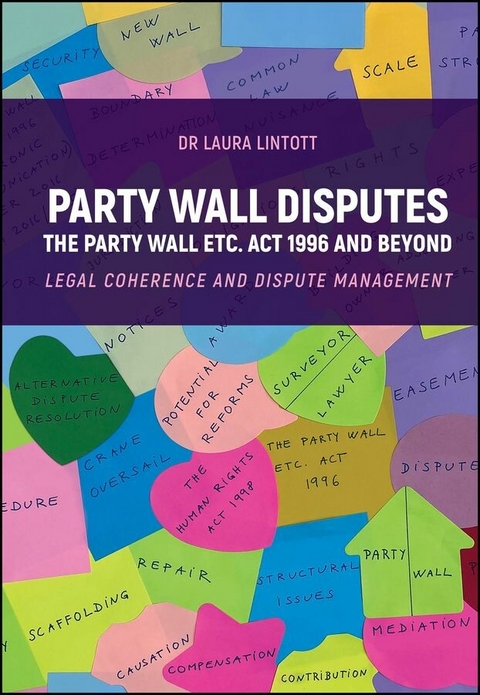
Party Wall Disputes (eBook)
415 Seiten
Wiley-Blackwell (Verlag)
978-1-394-27497-0 (ISBN)
An accessible roadmap to the complexities of party wall disputes
Party Wall Disputes: The Party Wall etc. Act 1996 and Beyond - Legal Coherence and Dispute Management meets the need for a roadmap to the main areas of law and fact relevant to party wall disputes:
- Statutes, including a detailed analysis of the Party Wall etc. Act 1996 and other relevant legislation,
- Property rights, such as rights of way, rights of support, drainage rights and rights linked to easements,
- Torts, such as nuisance related to noise and vibration and breaches of rights to light, and
- Factual matters, such as structural issues.
In addition, this book maps out the available dispute management options under the Party Wall etc. Act 1996, in court as well as alternative dispute resolution methods (arbitration, mediation, medi-arb, expert determination and early neutral evaluation). The result is an invaluable resource for lawyers, party wall surveyors, construction professionals, academics and property owners who encounter or are interested in party wall disputes.
'I can say with confidence that Dr Lintott has done the professions both of the law and of surveying in particular, as well as property owners, a great service in providing something of a stocktake..., where the tectonic plates of title, use of land, statute and common law, easements, planning and construction codes, rights, liabilities and obligations all meet. ... She is mindful of the reality that party wall practice is ultimately driven by mutual proprietorial and essentially practical considerations ...'
-THE EARL OF LYTTON
Dr Laura Lintott LLM PLP (BPP), MA (Oxon), PhD (Cantab), FCIArb is a Solicitor Advocate and International Arbitrator in London. She has extensive experience leading on complex international and domestic construction disputes. Laura is a Fellow of the Chartered Institute of Arbitrators and a Visiting Fellow at King's College London where she joined the Centre of Construction Law & Dispute Resolution's Taskforce, which responded to the Law Commission's two consultations regarding Arbitration Act 1996 reforms reflected in the Arbitration Bill noted in the King's Speech in 2024. The Arbitration Act 2025 then received Royal Assent on 24 February 2025. Laura contributed a chapter to the book The History of the Technology and Construction Court on its 150th Anniversary, edited by Sir Peter Coulson and Dr David Sawtell. She is a frequent panellist/(podcast) speaker and publishes regularly in numerous journals and periodicals.
An accessible roadmap to the complexities of party wall disputes Party Wall Disputes: The Party Wall etc. Act 1996 and Beyond - Legal Coherence and Dispute Management meets the need for a roadmap to the main areas of law and fact relevant to party wall disputes: Statutes, including a detailed analysis of the Party Wall etc. Act 1996 and other relevant legislation,Property rights, such as rights of way, rights of support, drainage rights and rights linked to easements,Torts, such as nuisance related to noise and vibration and breaches of rights to light, andFactual matters, such as structural issues. In addition, this book maps out the available dispute management options under the Party Wall etc. Act 1996, in court as well as alternative dispute resolution methods (arbitration, mediation, medi-arb, expert determination and early neutral evaluation). The result is an invaluable resource for lawyers, party wall surveyors, construction professionals, academics and property owners who encounter or are interested in party wall disputes. I can say with confidence that Dr Lintott has done the professions both of the law and of surveying in particular, as well as property owners, a great service in providing something of a stocktake , where the tectonic plates of title, use of land, statute and common law, easements, planning and construction codes, rights, liabilities and obligations all meet. She is mindful of the reality that party wall practice is ultimately driven by mutual proprietorial and essentially practical considerations THE EARL OF LYTTON
2
What Is a Party Wall?
2.1 Introduction
Before one can analyse party wall disputes, and the related legal coherence forming the backbone behind the topic of party walls and related disputes, the first step is to identify what ‘party walls’ are.
Party walls can obstruct a view, limit a source of light, impede a neighbour's airspace or have an impact on the support of neighbouring land or property. Party walls need to be repaired from time to time, so the question arises as to who needs to repair them. This in turn leads to issues about whether it is possible to require a person to repair a party wall. Parties need to be clear on their rights to be able to access the relevant party walls. If a party attempts to access a party wall and wrongfully interferes with the other party's possessory rights in its land, this can lead to trespass. Overgrown roots of a tree can interfere with a party wall. Works on a party wall can cause construction noise and vibration. Alternatively, party walls in buildings may not be insulated enough to prevent certain noises from carrying from one room to another. A party wall is not necessarily visible in its entirety. It can be linked to the ground or to a structure. It can be linked to the ground below the land surface, and it can be impacted by ground conditions.
From the above examples, it is clear that party walls can be at the root of many disputes linking statutory, proprietary, tortious and structural matters. This is simply because of the highly contentious nature of the disputes linked to party walls. When the parties are evaluating which dispute resolution avenue they could or should take, this depends on their personal preference, willingness or necessity to preserve the relationship between the neighbouring landowners, cost and time available and need for clarity, certainty and a binding outcome.
2.2 Definitions of ‘Party Wall'
When it comes to defining what exactly the terminology ‘party wall' means, there is no one clear‐cut definition.4 Before a legal estate in tenancy in common was abolished by the Law of Property Act 1925, in relation to a wall that was owned in common by different owners, each of the owners had generally the right to demolish the wall as long as the intention was to rebuild it again and to do the required repairs and underpinning.5 However, case law made it clear that the provisions of the party wall legislation superseded such common law rights.6 In common law, the terminology ‘party wall’ is not defined and does not have an exact meaning.
According to Megarry & Wade, since 1925,7 the term ‘party wall' may mean any one of the below.8
- (i) a wall divided longitudinally into strips, one belonging to each of the neighbouring owners; or
- (ii) a wall divided as in (i), but each half being subject to an easement of support in favour of the owner of the other half;
- (iii) a wall belonging entirely to one of the adjoining owners, but subject to an easement or right in the other to have it maintained as a dividing wall.
Prior to 1926 there was a fourth category. There could be a party wall of which the two adjoining owners were tenants in common. The disadvantage of such a wall was that either owner could insist upon partition. Had special provision not been made by statute, all party walls in this category would have become subject to a trust for sale after 1925. It was provided therefore that after 1925 all party walls of this kind, whether created before 1926 or after 1925, should be deemed to be severed vertically, and that the owner of each part should have such rights of support and use over the rest of the wall as were requisite for giving the parties rights similar to those which they would have enjoyed had they been tenants in common of the wall. The practical effect of this provision was to translate all party walls of this kind into the second category listed above.
To elaborate on the terminology in the different categories, ‘longitudinal division into two strips' in (i) above means that the ownership of the party wall is split longitudinally between the two landowners. However, cases of longitudinal division of this kind are rare. The issue with this category is that neither owner has any right of lateral support from one another. This can lead to either owner removing their half of the wall. While having to act with reasonable care, the result may be a structure that is not capable of standing on its own.9
The effect of the Law of Property Act 1925 (Section 38) was that a party wall is not owned in common but longitudinally where each of the parties has an easement of support over each other's property. While party walls fell under the law of co‐ownership or easements of support, they had to be excluded from the statutory trust for sale that was imposed in cases of co‐ownership after 1925.10 There are easements that can affect party walls, which is why a separate Chapter VI is dedicated to easements in connection with party walls.
According to Gale on the Law of Easements:11
A wall could (and still can) be a party‐wall up to a certain point, namely, so far as it divides two buildings of unequal height, and an external wall above that point; and a pilaster or portico, or a fascia, which appears to form an integral portion of one house, may be parcel of and pass on a conveyance of another house. The raising of a party‐wall by one part owner without the consent of the other is a violation of that other’s right of ownership and possession of his half, and is not less so because a private Act provides that it shall be lawful for the owner or part owner of any party‐wall to raise it, provided that the wall when raised will be of the substance required by any byelaw.
The above statement further shows that where a wall is a ‘party wall', it is linked to certain rights and obligations that parties to the party wall must abide by.
As opposed to the definitions addressed above, which focus on ownership, when it comes to the definition of what a ‘party wall' is under the PWA 1996, this definition does not relate to ownership but to the function of the wall. The PWA 1996 applies to England and Wales, and some of its provisions were adopted from legislation specific to Inner London and other parts of the country, which were in existence for a number of years prior to the PWA 1996.12 The PWA 1996 regulates the construction and repair of party walls as well as related dispute resolution within the realms of the PWA 1996.13
Section 20 of the PWA 1996 states:
… ‘party wall’ means –
(a) A wall which forms part of a building and stands on lands of different owners to a greater extent than the projection of any artificially formed support on which the wall rests; and
(b) so much of a wall not being a wall referred to in paragraph (a) above as separates buildings belonging to different owners.
As Keating on Construction Contracts says, a party wall always forms part of one or more buildings and where a wall does not stand on the land of both owners, such a wall will constitute a party wall only to the extent that it separates two buildings (as per the definition of Section 20(b) of the PWA 1996).14
By way of example, where a wall separates two terraced houses up to the height of two storeys (out of eight), however the wall is that of one building at the next (third) storey, for level three, it will not be a party wall. It would be a party wall only if it stood on the lands of both owners. Equally, where a wall separates houses for the full depth of one house but then carries on as the external wall of the other house, it will not be a party wall from the point of the end of the first house. Again, it would be a party wall only if it stood on the lands of both owners.15
Notably, the PWA 1996 does not abolish fabric rights, meaning rights of ownership and support. On the contrary, it places an obligation on the building owner to provide protection from weather in a case where the building owner exposes a party wall to the elements.16 There can be temporary interference with, for example, support that the party wall provides during construction works.17
Section 20 of the PWA 1996 distinguishes between:
- Party walls – Walls forming part of a building and standing on lands of different owners to a greater extent than the projection of any artificially formed support on which the walls rest and walls separating buildings belonging to different owners.
- Party fence walls (or boundary walls) – Walls, which are not part of buildings, stand on land of different owners and are used or constructed to be used for separating such adjoining. However, party fence walls do not include walls that have been built on the land of one owner where the artificially formed support projects into the land of another owner.
- Party structures – Party walls and also floor partitions or other structures separating buildings or parts of buildings approached solely by separate staircases or separate entrances.
All three types of walls/structures are further elaborated on below.
Party walls envisage some form of solid structure, their purpose being to divide properties of different landowners or occupiers. The Department for Communities and Local Governments...
| Erscheint lt. Verlag | 28.5.2025 |
|---|---|
| Sprache | englisch |
| Themenwelt | Technik ► Bauwesen |
| Schlagworte | arbitration • Architecture • Building Design • building trades • building work • Construction • Engineering • English and Welsh law • expert determination • Litigation • Mediation • Party Walls etc. Act 1996 • Real Estate Development • Surveying |
| ISBN-10 | 1-394-27497-1 / 1394274971 |
| ISBN-13 | 978-1-394-27497-0 / 9781394274970 |
| Informationen gemäß Produktsicherheitsverordnung (GPSR) | |
| Haben Sie eine Frage zum Produkt? |
 EPUB (Adobe DRM)
Kopierschutz: Adobe-DRM
Adobe-DRM ist ein Kopierschutz, der das eBook vor Mißbrauch schützen soll. Dabei wird das eBook bereits beim Download auf Ihre persönliche Adobe-ID autorisiert. Lesen können Sie das eBook dann nur auf den Geräten, welche ebenfalls auf Ihre Adobe-ID registriert sind.
Details zum Adobe-DRM
Dateiformat: EPUB (Electronic Publication)
EPUB ist ein offener Standard für eBooks und eignet sich besonders zur Darstellung von Belletristik und Sachbüchern. Der Fließtext wird dynamisch an die Display- und Schriftgröße angepasst. Auch für mobile Lesegeräte ist EPUB daher gut geeignet.
Systemvoraussetzungen:
PC/Mac: Mit einem PC oder Mac können Sie dieses eBook lesen. Sie benötigen eine
eReader: Dieses eBook kann mit (fast) allen eBook-Readern gelesen werden. Mit dem amazon-Kindle ist es aber nicht kompatibel.
Smartphone/Tablet: Egal ob Apple oder Android, dieses eBook können Sie lesen. Sie benötigen eine
Geräteliste und zusätzliche Hinweise
Buying eBooks from abroad
For tax law reasons we can sell eBooks just within Germany and Switzerland. Regrettably we cannot fulfill eBook-orders from other countries.
aus dem Bereich