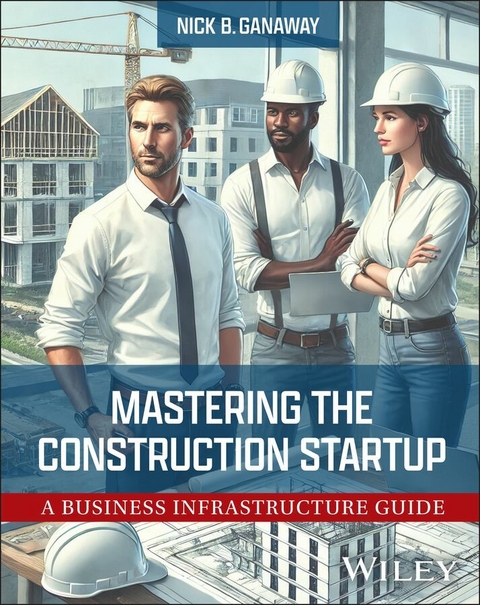
Mastering the Construction Startup (eBook)
282 Seiten
Wiley (Verlag)
978-1-394-29233-2 (ISBN)
EQUIPS STARTUP CONTRACTORS WITH THE TOOLS TO BUILD RESILIENT INFRASTRUCTURE IN THE CONSTRUCTION INDUSTRY
For construction professionals starting their businesses, success depends on more than just skill and dedication. Mastering the Construction Startup provides an essential master plan for creating the foundational infrastructure every contractor needs to achieve sustainable growth and upon which every strategic decision will be made. Written by industry expert Nick B. Ganaway, this real-world guide details how to strategically align people, systems, and processes with business goals to proactively address risks, reduce errors, and build lasting operational resilience.
Grounded in decades of general contracting experience and research, each concise and accessible chapter breaks down the key components of sustainable success, such as identifying elements of a solid legal and financial base, establishing relationships with essential professionals, and creating a culture that attracts and retains the best talent. Throughout the book, Ganaway, often engaging directly with the reader, offers expert insights on everything from the role of the contractor to elements of leadership to advantages of niche contracting.
Mastering the Construction Startup empowers contractors to set up their companies for success during the challenging early years and beyond. Here is a small sample of the principles discussed:
- Why your company's culture is critical to your success and how to ensure it will be what you want
- Billing procedures to follow to ensure that you get paid for your work
- Your essential need to hire the right lawyer and the right accountant for your business before your Day 1
- Your personal guarantee, its extreme risk for you, and what to do when it is required
- The legal and financial consequences of improper business registration and professional licensing
- How to choose the form of business structure best suited to your company
- An essential checklist for startups, and forms you can use
- The risks inherent in the Sole Proprietorship form of business
- The problems with partnerships and how to address them in advance
Mastering the Construction Startup: A Business Infrastructure Guide is perfect for trade school and college courses in construction management and entrepreneurship, and a must-have resource for contractors, project managers, and subcontractors at all levels.
NICK B. GANAWAY is a seasoned construction industry expert with decades of hands-on experience. From 1974 to 1999, he founded and grew Ganaway Contracting Company into a successful commercial general contracting firm operating across the Southeastern states. Since selling the company several years ago, Nick has continued his involvement in commercial real estate development. He authored Construction Business Management in 2006 and has contributed to industry publications such as Construction Business Owner, Construction Executive, and Entrepreneur.
EQUIPS STARTUP CONTRACTORS WITH THE TOOLS TO BUILD RESILIENT INFRASTRUCTURE IN THE CONSTRUCTION INDUSTRY For construction professionals starting their businesses, success depends on more than just skill and dedication. Mastering the Construction Startup provides an essential master plan for creating the foundational infrastructure every contractor needs to achieve sustainable growth and upon which every strategic decision will be made. Written by industry expert Nick B. Ganaway, this real-world guide details how to strategically align people, systems, and processes with business goals to proactively address risks, reduce errors, and build lasting operational resilience. Grounded in decades of general contracting experience and research, each concise and accessible chapter breaks down the key components of sustainable success, such as identifying elements of a solid legal and financial base, establishing relationships with essential professionals, and creating a culture that attracts and retains the best talent. Throughout the book, Ganaway, often engaging directly with the reader, offers expert insights on everything from the role of the contractor to elements of leadership to advantages of niche contracting. Mastering the Construction Startup empowers contractors to set up their companies for success during the challenging early years and beyond. Here is a small sample of the principles discussed: Why your company s culture is critical to your success and how to ensure it will be what you wantBilling procedures to follow to ensure that you get paid for your workYour essential need to hire the right lawyer and the right accountant for your business before your Day 1Your personal guarantee, its extreme risk for you, and what to do when it is requiredThe legal and financial consequences of improper business registration and professional licensingHow to choose the form of business structure best suited to your companyAn essential checklist for startups, and forms you can use The risks inherent in the Sole Proprietorship form of businessThe problems with partnerships and how to address them in advance Mastering the Construction Startup: A Business Infrastructure Guide is perfect for trade school and college courses in construction management and entrepreneurship, and a must-have resource for contractors, project managers, and subcontractors at all levels.
Chapter 1
Entrepreneurial Characteristics
Entrepreneurs are people who take a unique or innovative idea and run with it. Some of them are serial entrepreneurs who often move on to their next challenge.
By contrast, other businessmen and women open their own new business not to innovate but to make their way in an established field such as construction.
In this book, I use the term “entrepreneur” interchangeably with “businessperson” to describe all businessmen and women who started and ran their own businesses, including those who started as an innovator.
A study published in the Journal of Business Venturing in March 2019 compared the brain patterns of 21 entrepreneurs and 21 parents who were not entrepreneurs. The study was designed to investigate how and why company founders bond with their business creation.
As reported in the Wall Street Journal, this study using functional magnetic resonance imaging (fMRI) found that when entrepreneurs think about their businesses, their brain patterns are very similar to the brain patterns of parents when they think about their children.
As parent, business founder, and operator for several decades, I am not surprised by these results. There really is nothing in your life other than your loved ones that is as dear and meaningful to you as the company you dreamed about, risked your life savings for, and worked impossible hours to finally bring to fruition and beyond.
It’s Not Easy
You are probably used to working hard and putting in a lot of hours at your present or former job, but it is likely that starting or acquiring and running your own construction business is going to require even more of you. Not only in terms of time and effort, but also in many unfamiliar challenges as you travel new avenues, all the while knowing you have a lot or maybe everything on the line.
However, you will have a lot of company, including everyone in the past, present, and future who gets that impossible-to-ignore drive to take their future into their own hands and accept the same risks you are taking.
You might have thought you’ll no longer have a boss, but you will in fact have the most demanding one you’ve ever had. He or she will be sitting right there on your shoulder asking hard questions. Judging your performance. Waking you up at 3 a.m. to question whether you put the right markup on the bid you submitted yesterday. Whether hiring Jack over Josh as your new project manager was the right decision. Demanding that you excel in every decision you make.
And you will at some point ask yourself, “What was I possibly thinking?” when you made this choice, even though you know the answer. But when those who never experienced the entrepreneurial fire in the belly or took total responsibility for their own fate notice the outward things it’s costing you now – working long hours, skipping date night too often, etc. – they won’t understand what drives you.
What you will get in return for your extraordinary sacrifices is the pride, the excitement, the freedom, the joy, and the challenge in watching your construction business grow and in knowing that you made it happen. And the expectation and determination you show will pay you and your family back in multiples at some point in the future.
Of course, things can and sometimes do go wrong, but if you master the following you’re starting from a position of strength that puts you far ahead of the pack.
- Build a strong infrastructure for your company as described in this book.
- Understand the type of construction you will pursue.
- Know how to put a bid together.
- Identify the proper market for your business.
- Have access to adequate operating capital.
- Know how to manage money.
- Possess good judgment and managerial skills.
Starting a new business, particularly in the construction industry, involves significant risk due to factors including market fluctuations, regulatory requirements, and financial management challenges. If you are just starting out on your own, be prepared to take calculated risks and face potential setbacks with resilience and determination.
Successful entrepreneurs have a clear vision for their company, which includes setting, monitoring, and adjusting strategic goals as circumstances change. This vision drives decision-making and inspires confidence in your customers, financial professionals, and your employees.
As you know from your exposure to the construction business in some earlier capacity, starting and running a construction company demands a lot of hard work. From long hours to the hands-on management of projects, a strong work ethic ensures that you are prepared mentally and physically to handle the sometimes-extreme demands of the business, meet deadlines, and exceed customer expectations. My daily runs as a recreational runner during any particularly stressful period gave me an hour or so of sanity-preserving peace.
Comprehensive knowledge of the construction business is crucial. This includes understanding different building methods, materials, safety regulations, and staying updated on industry trends. Such knowledge is necessary for delivering quality work and also in making good business decisions. Set aside time to read construction-focused management books and magazines for helpful information and knowledge. Whatever sector of construction you pursue, there are likely numerous periodical publications that focus on your field from which you can get useful ideas. But also read general business and money magazines, such as Entrepreneur, Forbes, The Economist, and Money, to name a few.
An understanding of finance is essential for managing budgets, arranging for funding, pricing projects, and maintaining profitability. Financial knowledge also helps you manage cash flow effectively, critical for the survival of any new business. Learn how to analyze your company’s financial statements. They shine a probing light on your past performance and suggest opportunities as well as guardrails for the road ahead.
The construction industry can be unpredictable due to, for example, changing economic conditions, weather, and client dynamics. I have described elsewhere in this book a period in which some of these conditions severely rocked my company. Successful entrepreneurs adjust strategies, pivot when necessary, and remain alert to new opportunities as they arise.
Challenging situations are common in construction projects. Finely hone your problem-solving skills to address and resolve issues to keep your projects on track, even at times when you do not have all the necessary information.
Quality in construction heavily depends on attention to detail. Your and your managers’ conscientious oversight of projects is essential to reduce opportunities for mistakes, meet safety standards, and satisfy a demanding customer’s requirements.
Adopt new technologies and seek solutions to construction challenges to give your new company advantages over your established competitors.
It is the rare person who possesses all of these entrepreneurial characteristics. Hone those you possess and work toward mastering others. They will serve you well as you navigate the complex landscape of starting and running a construction company.
Your Dual Role as Owner and Manager of Your Company
As the owner and the key element in the infrastructure of your construction firm, you fulfill two separate but equally essential roles: that of owner and that of manager/chief executive officer (CEO).
As the owner, you establish the business’ objectives and vision, and you require yourself as CEO to carry them out.
In your role as the CEO, it is your responsibility to carry out these objectives by organizing, planning, controlling, directing, and facilitating the necessary elements.
Periodically throughout the year, step back and take a hard look at your performance as CEO against the predetermined business objectives you established as owner. The outcomes might meet your expectations, or they could fall short. If it’s the latter, you as CEO must delve into and analyze the reasons behind it and detail them in a report. Then you the owner need to digest that report and determine the necessary internal changes that you the CEO must now put into place.
Managing the intertwined roles of owner and manager comes with demands. Fulfilling each role independently forces you to acknowledge any deviation from expectations and take action to get back on track. Without this continual performance check, you may default to simply comparing the current year’s results against those of the prior year. It is easy to see how unhealthy that is. Occasional deviation from your strategic plans and goals is to be expected, but if you maintain them as your benchmark, your home plate, you will always know where you are relative to them. Doing this reality check frequently should make it easy for you to see what went wrong and what you need to do to quickly get back on track. Do not allow the complacency that sometimes accompanies success to derail you from this foundational policy.
Things never stay the same. If they get better, it is usually because of good management practices. Without early attention and response to problems as they arise, they will get worse. As noted elsewhere in this book, one of the primary causes for the high five-year startup failure rate is the lack of knowledgeable and effective...
| Erscheint lt. Verlag | 1.5.2025 |
|---|---|
| Sprache | englisch |
| Themenwelt | Technik ► Bauwesen |
| Schlagworte | business infrastructure for contractors • construction business management • construction company growth • construction industry success • construction leadership • contractor business strategy • hiring construction employees • legal considerations for contractors • niche contracting • risk management in construction • startup contractor guide • Subcontractor |
| ISBN-10 | 1-394-29233-3 / 1394292333 |
| ISBN-13 | 978-1-394-29233-2 / 9781394292332 |
| Informationen gemäß Produktsicherheitsverordnung (GPSR) | |
| Haben Sie eine Frage zum Produkt? |
 EPUB (Adobe DRM)
Kopierschutz: Adobe-DRM
Adobe-DRM ist ein Kopierschutz, der das eBook vor Mißbrauch schützen soll. Dabei wird das eBook bereits beim Download auf Ihre persönliche Adobe-ID autorisiert. Lesen können Sie das eBook dann nur auf den Geräten, welche ebenfalls auf Ihre Adobe-ID registriert sind.
Details zum Adobe-DRM
Dateiformat: EPUB (Electronic Publication)
EPUB ist ein offener Standard für eBooks und eignet sich besonders zur Darstellung von Belletristik und Sachbüchern. Der Fließtext wird dynamisch an die Display- und Schriftgröße angepasst. Auch für mobile Lesegeräte ist EPUB daher gut geeignet.
Systemvoraussetzungen:
PC/Mac: Mit einem PC oder Mac können Sie dieses eBook lesen. Sie benötigen eine
eReader: Dieses eBook kann mit (fast) allen eBook-Readern gelesen werden. Mit dem amazon-Kindle ist es aber nicht kompatibel.
Smartphone/Tablet: Egal ob Apple oder Android, dieses eBook können Sie lesen. Sie benötigen eine
Geräteliste und zusätzliche Hinweise
Buying eBooks from abroad
For tax law reasons we can sell eBooks just within Germany and Switzerland. Regrettably we cannot fulfill eBook-orders from other countries.
aus dem Bereich