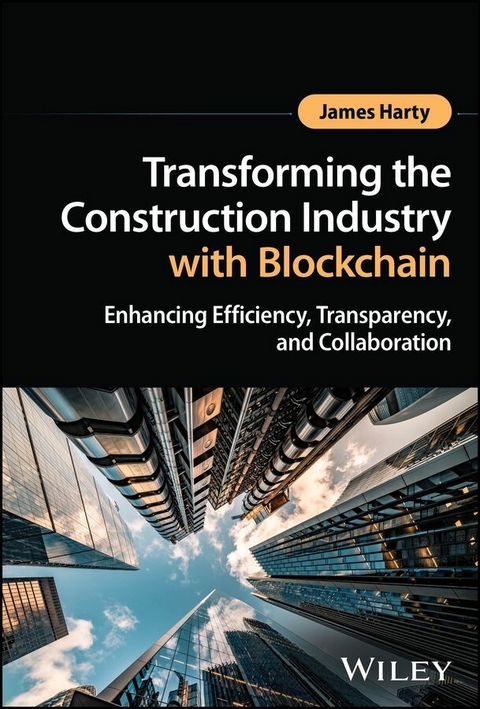
Transforming the Construction Industry with Blockchain (eBook)
361 Seiten
Wiley (Verlag)
978-1-394-21640-6 (ISBN)
Apply a transformative new technology to construction projects with this timely guide
The blockchain is one of the most transformative technologies to emerge in the twenty-first century. But Artificial Intelligence and Machine Learning will also have a profound impact in construction in equal measure. Both will influence how digitalization is applied and how these new technologies are addressed with an identifiable skills gap in their implementation.
Using a decentralized digital ledger to ensure that information stored across numerous computers cannot be altered, it provides a fully transparent and secure way of storing and sharing information. Transforming the Construction Industry with Blockchain provides a comprehensive overview of this technology and its applications in construction and the building trades. Beginning with an overview of basic blockchain principles and then moving to construction-specific applications, it provides a range of strategies by which construction professionals can increase and streamline their collaborations with other stakeholders and create smarter, more transparent projects.
Transforming the Construction Industry with Blockchain readers will also find:
- Case studies throughout showing blockchain at work in construction projects
- Detailed discussion of topics including improving data flows on construction projects, reducing sub-contracts and misaligned workflows, and many more
- Guidance for using blockchain to encourage sustainable and ethically-sourced design and construction
Transforming the Construction Industry with Blockchain is ideal for all construction professionals or potential stakeholders in building projects.
James Harty, PhD, is a Lecturer at KEA, Copenhagen School of Design & Technology, Denmark. He has taught numerous subjects within architectural technology and construction management over the last two decades, and his research focuses on mapping virtual worlds onto reality and other technological advances.
Apply a transformative new technology to construction projects with this timely guide The blockchain is one of the most transformative technologies to emerge in the twenty-first century. But Artificial Intelligence and Machine Learning will also have a profound impact in construction in equal measure. Both will influence how digitalization is applied and how these new technologies are addressed with an identifiable skills gap in their implementation. Using a decentralized digital ledger to ensure that information stored across numerous computers cannot be altered, it provides a fully transparent and secure way of storing and sharing information. Transforming the Construction Industry with Blockchain provides a comprehensive overview of this technology and its applications in construction and the building trades. Beginning with an overview of basic blockchain principles and then moving to construction-specific applications, it provides a range of strategies by which construction professionals can increase and streamline their collaborations with other stakeholders and create smarter, more transparent projects. Transforming the Construction Industry with Blockchain readers will also find: Case studies throughout showing blockchain at work in construction projectsDetailed discussion of topics including improving data flows on construction projects, reducing sub-contracts and misaligned workflows, and many moreGuidance for using blockchain to encourage sustainable and ethically-sourced design and construction Transforming the Construction Industry with Blockchain is ideal for all construction professionals or potential stakeholders in building projects.
CHAPTER 2
Data Handling
Undoubtedly, data collection is the foundation for making better decisions to drive improvements, but it becomes complicated if there is too much data and it is not in an ordered fashion. Questions about ownership and management also make it difficult to navigate and its filtration and usefulness come into play as we wade into the melee. It can also grow into a data lake where in future it can be used in predictive maintenance. Data handling also requires an agreed environment in which all stakeholders are considered and have an agreed protocol for the exchange and use of the data generated through a project. It is built over four phases in which:
- The first sets out the processes, where the scope and content are broadly outlined for each stakeholder. This means it is an internal process, setting one's house in order before engagement.
- Second is the sharing phase, where information content is considered complete for some disciplines (those closely related to each other) and is subject to review and modification to dovetail with the other parties.
- Third is the publishing phase where the endeavours of the first two phases blossom, and the data is definitive but subject to revision. In this phase, it is operational.
- The final phase is archival, meaning it is kept for the record and is accessible or valid but is now superseded.
In general, it can be seen as a fluid process, but with defined framing and defined channels of communication. By definition, it is easily accessible to all stakeholders who must each have a position and responsibility towards the content. It provides a method of traceability, meaning accountability is embedded in it. It must cover all data formats, which have to be agreed and understood, and it must contain open protocols for the exchange and accessibility of data. It has to be updatable and be confidential and secure.
By having such a model, then the flows and previous bottlenecks are made easier. All stakeholders can easily engage and be content that the data is up‐to‐date and accurate. It replaces the requests for information (RFIs), which could seriously delay a project, due to the time and analogous nature of the information flows. Typically, in the past, a request for information might only happen at a fortnightly site meeting, meaning it was first addressed at the next meeting and approved at the following meeting. This process when it becomes digital removes much of the downtime and the waiting for approvals.
It removes much of the paperwork, often taken up an entire day at the end of the week, which was dreaded and derided, with sayings like the job's not done, till the paperwork is done. Now an item of work can be allocated, when completed can be shown as finished (completion photo or similar) and approved for payment all within a cloud solution. This digitalisation process is revolutionising the industry, and once adopted is rarely rescinded or withdrawn in favour of the older methods. It is controlled by an International Standard, ISO 19650 (previously being the PAS 1192 series) and manifests itself through many platforms. These include but by no means are exclusive: Autodesk's BIM 360, Dalux Field, Box Delivery and FM, Revizto, ASTA Progress Mobile App and Field View.
On the construction site, in order to ensure proper coordination and dissemination of tasks SISK, an Irish contractor, involved with Center Parcs leisure centre, used digital project delivery (DPD) methods divided into fourth dimension construction sequencing, building information modelling, a progress mobile app (ASTA) and another called field view to keep everything up to scratch. Field view was used in their quality sign‐off procedures, to ensure environmental and safety auditing on a hand‐held device, reducing paperwork and waiting time for approval. Not only does this improve the day‐to‐day management of the site but also it builds into a bigger picture where things can be monitored, best practices gleaned and improvements made on evidence‐based decisions, making the whole enterprise better and fit for purpose.
This reduces time spent using paper formats, it allows for tasks to be easily raised in a meaningful way while saving time with inspections. Tracking live progress was critical for them on the project, using the ASTA mobile app, a planning software which allows GANNT charts to be prepared so that informed decisions can be made while reducing the amount of data inputs previously made manually. This improved and increased programme awareness throughout the entire team made data entry faster, increasing value added time for better planning.
BIM, especially 4D BIM was instrumental on site to utilise and plan the works effectively. Their software allows for the collation, distribution and management of all of the project and technical documentation. This means that their designers can off‐feed their information through one platform allowing collaboration for the various stakeholders across the project. It is a key delivery tool that has been around a while but in combination with the other tools adds to the overall success to the project.
4D modelling has been used on site in conjunction with the handling, the logistics, the supervision and day‐to‐day delivery scheduling and the call‐offs from their suppliers moving outside of the site and involving third parties in a lean process that could cause multiple delays previously. A reluctance to implement such strategies was quickly dismissed as the benefits accrued during the project as workers saw the improvements to workflows and reaped the paybacks in their workloads with improved efficiencies.
Maximising these activities on site allows lean constructions to improve work sampling, just‐in‐time (JIT) delivery and something they call ‘kitting’. Kitting involves the correct quantities being sent out to the correct assemble and installation points. In their many on‐site warehouses, it is used to utilise the kitting. Essentially, a kit of parts is put together for each and every job, just like flat‐pack constructions that come with the correct number of parts and the correct number of fittings, needed to assemble it in‐place.
This reduces wastages and promotes collaboration, as when it is bagged, boxed or palleted, the receiver knows that all that is needed is supplied and does not need to be quality checked and accounted for, improving cross platform collaboration for all concerned. So, it comes to the right location with the right quantity. For example, a boiler kit for a particular lodge. This means that the fitter receives the right quantity and the right specification in the bag, eliminating waste while improving the workflow.
If kitting is a method used for management of materials, then work‐sampling is a method used for management of resources. Sampling is a method of observing activities ongoing so that they can be classified. Basically, a worker is assigned to monitor blocks of work lasting an hour where all activities are recorded as value added, a support activity or waste. Following the exercise areas of waste are high‐lighted and reviewed to see if they can be eliminated if possible. This might include a method of detailing to make the task easier, to make some activities simpler or quicker and to look how the crews were set‐up managing materials and accessories in the field.
The benefits of work sampling in one instance meant that they were able make a 22% productivity improvement observed in key trades, bringing packages back within budget. So, in a fast track, large‐scale unique project with its own set of key challenges, the team has used cutting edge technology to help deliver this project in an efficient and effective manner. This means that they remain on‐time, on‐budget, delivering to the highest level of safety and quality. Embracing technology can be a challenge at times but their future success depends upon it, says Brian Kennedy of SISK contractors (Kennedy 2019).
So, the research question would be: What is the process that is being replaced? What are the advantages of implementing such a regime? What are the benefits of adoption? Where does CDE lead stakeholders to in the next phase, BIM Level 3, Building Lifecycle Management? What is being replaced is inefficient methods that support all the problems that have beseeched the industry. The advantages encourage better collaboration, remove double work and improve productivity. It fosters a better method for better practices, and it can reward such practices.
Having a single source of files, typically in a cloud or, in a common data environment (CDE) means that there are no revision mis‐matches, that files are always up‐to‐date, and accountability is easier to handle as there is trail of who has done what and where, it is traceable. Also, as BIM Level 3 expands, it can generate a digital twin which means that the project is built virtually before it is realised. This means that errors and erratic solutions can be caught before stepping on site. The twin allows what‐if scenarios to be confronted, and this enforces facilities management issues to be addressed and tested. The twin replaces the Facilities Managers (FM'ers) making a fresh clean sheet report after handover.
Data Mining
If data is ubiquitous (and it is), then feeding artificial intelligence (AI) more and more data becomes an endless thankless cycle. Moreover, the AI's appetite becomes...
| Erscheint lt. Verlag | 7.3.2025 |
|---|---|
| Sprache | englisch |
| Themenwelt | Technik ► Bauwesen |
| Schlagworte | building trades • cloud-based project data • Data Security • data storage • Distributed Ledger Technology • Document control • payment processes • Project Management • Supply Chain Management • Sustainable construction • workflow misalignment |
| ISBN-10 | 1-394-21640-8 / 1394216408 |
| ISBN-13 | 978-1-394-21640-6 / 9781394216406 |
| Informationen gemäß Produktsicherheitsverordnung (GPSR) | |
| Haben Sie eine Frage zum Produkt? |
 EPUB (Adobe DRM)
Kopierschutz: Adobe-DRM
Adobe-DRM ist ein Kopierschutz, der das eBook vor Mißbrauch schützen soll. Dabei wird das eBook bereits beim Download auf Ihre persönliche Adobe-ID autorisiert. Lesen können Sie das eBook dann nur auf den Geräten, welche ebenfalls auf Ihre Adobe-ID registriert sind.
Details zum Adobe-DRM
Dateiformat: EPUB (Electronic Publication)
EPUB ist ein offener Standard für eBooks und eignet sich besonders zur Darstellung von Belletristik und Sachbüchern. Der Fließtext wird dynamisch an die Display- und Schriftgröße angepasst. Auch für mobile Lesegeräte ist EPUB daher gut geeignet.
Systemvoraussetzungen:
PC/Mac: Mit einem PC oder Mac können Sie dieses eBook lesen. Sie benötigen eine
eReader: Dieses eBook kann mit (fast) allen eBook-Readern gelesen werden. Mit dem amazon-Kindle ist es aber nicht kompatibel.
Smartphone/Tablet: Egal ob Apple oder Android, dieses eBook können Sie lesen. Sie benötigen eine
Geräteliste und zusätzliche Hinweise
Buying eBooks from abroad
For tax law reasons we can sell eBooks just within Germany and Switzerland. Regrettably we cannot fulfill eBook-orders from other countries.
aus dem Bereich