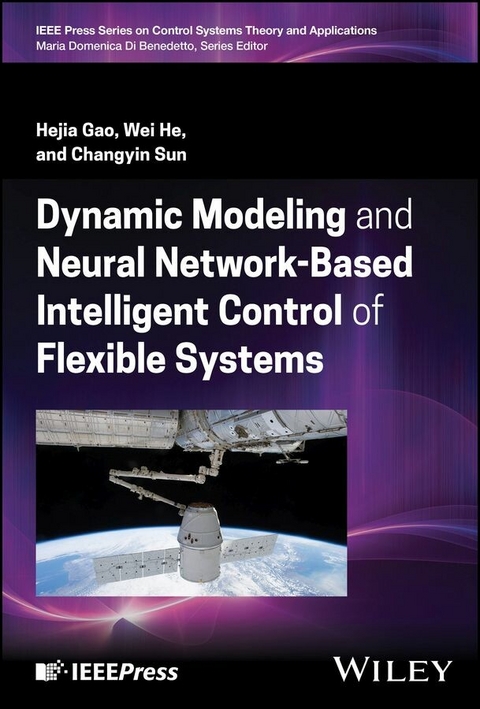
Dynamic Modeling and Neural Network-Based Intelligent Control of Flexible Systems (eBook)
485 Seiten
Wiley-IEEE Press (Verlag)
978-1-394-25528-3 (ISBN)
Comprehensive treatment of several representative flexible systems, ranging from dynamic modeling and intelligent control design through to stability analysis
Fully illustrated throughout, Dynamic Modeling and Neural Network-Based Intelligent Control of Flexible Systems proposes high-efficiency modeling methods and novel intelligent control strategies for several representative flexible systems developed by means of neural networks. It discusses tracking control of multi-link flexible manipulators, vibration control of flexible buildings under natural disasters, and fault-tolerant control of bionic flexible flapping-wing aircraft and addresses common challenges like external disturbances, dynamic uncertainties, output constraints, and actuator faults.
Expanding on its theoretical deliberations, the book includes many case studies demonstrating how the proposed approaches work in practice. Experimental investigations are carried out on Quanser Rotary Flexible Link, Quanser 2 DOF Serial Flexible Link, Quanser Active Mass Damper, and Quanser Smart Structure platforms.
The book starts by providing an overview of dynamic modeling and intelligent control of flexible systems, introducing several important issues, along with modeling and control methods of three typical flexible systems. Other topics include:
- Foundational mathematical preliminaries including the Hamilton principle, model discretization methods, Lagrange's equation method, and Lyapunov's stability theorem
- Dynamic modeling of a single-link flexible robotic manipulator and vibration control design for a string with the boundary time-varying output constraint
- Unknown time-varying disturbances, such as earthquakes and strong winds, and how to suppress them and use MATLAB and Quanser to verify effectiveness of a proposed control
- Adaptive vibration control methods for a single-floor building-like structure equipped with an active mass damper (AMD)
Dynamic Modeling and Neural Network-Based Intelligent Control of Flexible Systems is an invaluable resource for researchers and engineers seeking high-efficiency modeling methods and neural-network-based control solutions for flexible systems, along with industry engineers and researchers who are interested in control theory and applications and students in related programs of study.
Hejia Gao, PhD, is an Associate Professor at the School of Artificial Intelligence, Anhui University, Hefei, China. Previously, she was a Visiting Researcher at the Department of Mechanical, Industrial and Aerospace Engineering, Concordia University, Canada. She has published over 30 international journal and conference papers. Her research interests include neural networks, reinforcement learning, flexible systems, and vibration control.
Wei He, PhD, is a Full Professor at the School of Automation and Electrical Engineering, University of Science and Technology Beijing, China. He has co-authored three books and published over 100 international journal and conference papers. He was awarded a Newton Advanced Fellowship from the Royal Society, UK, in 2017. His research interests include adaptive control, vibration control, and bionic flapping wing aircraft.
Changyin Sun, PhD, is a Professor at the School of Automation, Southeast University, Nanjing, China. He has co-authored four books and published over 160 international journal papers. Prof. Sun is a Chinese Association of Automation Fellow. His research interests include intelligent control, flight control, pattern recognition, and optimal theory.
Comprehensive treatment of several representative flexible systems, ranging from dynamic modeling and intelligent control design through to stability analysis Fully illustrated throughout, Dynamic Modeling and Neural Network-Based Intelligent Control of Flexible Systems proposes high-efficiency modeling methods and novel intelligent control strategies for several representative flexible systems developed by means of neural networks. It discusses tracking control of multi-link flexible manipulators, vibration control of flexible buildings under natural disasters, and fault-tolerant control of bionic flexible flapping-wing aircraft and addresses common challenges like external disturbances, dynamic uncertainties, output constraints, and actuator faults. Expanding on its theoretical deliberations, the book includes many case studies demonstrating how the proposed approaches work in practice. Experimental investigations are carried out on Quanser Rotary Flexible Link, Quanser 2 DOF Serial Flexible Link, Quanser Active Mass Damper, and Quanser Smart Structure platforms. The book starts by providing an overview of dynamic modeling and intelligent control of flexible systems, introducing several important issues, along with modeling and control methods of three typical flexible systems. Other topics include: Foundational mathematical preliminaries including the Hamilton principle, model discretization methods, Lagrange s equation method, and Lyapunov s stability theoremDynamic modeling of a single-link flexible robotic manipulator and vibration control design for a string with the boundary time-varying output constraintUnknown time-varying disturbances, such as earthquakes and strong winds, and how to suppress them and use MATLAB and Quanser to verify effectiveness of a proposed controlAdaptive vibration control methods for a single-floor building-like structure equipped with an active mass damper (AMD) Dynamic Modeling and Neural Network-Based Intelligent Control of Flexible Systems is an invaluable resource for researchers and engineers seeking high-efficiency modeling methods and neural-network-based control solutions for flexible systems, along with industry engineers and researchers who are interested in control theory and applications and students in related programs of study.
Preface
The flexible system covers many different objects such as flexible robotic manipulators, bionic flexible flapping wing aircraft, and flexible buildings. With a large number of applications of flexible systems, its control theory and method issues have become a prospective high-tech research direction, which attracts concerns from both academic and industrial fields. At present, the control theory and method of flexible systems, such as the tracking and vibration control of multi-link flexible manipulators, the constraint control of flexible buildings under natural disasters, and the fault-tolerant control of bionic flexible flapping-wing robots, has developed into a common scientific problem, which is extremely challenging. In order to solve the technical problems of dynamic modeling and intelligent control of uncertain flexible systems with environmental adaptability, the book makes a systematic and detailed study on modeling mechanism and control strategy of several flexible systems.
Chapter 1 provides an overview of dynamic modeling and intelligent control of flexible systems, introducing several important issues in the study of flexible systems. The modeling and control methods of three typical flexible systems are discussed separately.
Chapter 2 provides the corresponding mathematical preliminaries of subsequent chapters, including the Hamilton principle, model discretization methods, Lagrange’s equation method, neural networks, and Lyapunov stability theorem.
Chapter 3 develops the dynamic model of the single-link flexible robotic manipulator, which overcomes the challenge from the system dynamics being infinite dimensional. The fuzzy neural network control with uniform approximation performance is designed to solve the system uncertainties. Numerical simulations and extensive experiments have been investigated to verify the effectiveness of the proposed methods.
Chapter 4 establishes a finite-dimensional dynamic model of the two-link flexible robotic manipulator. A high-gain observer-based neural network control strategy is proposed to estimate the immeasurable states in practice. The semi-globally uniformly ultimate boundedness (SGUUB) of the closed-loop system is guaranteed via Lyapunov’s stability theory. The simulation and experimental results demonstrate the effectiveness of the proposed control strategy.
Chapter 5 present the vibration control design for a string with the boundary time-varying output constraint. The dynamics of the string is a distributed parameter system described by a partial differential equation and two ordinary differential equations. A barrier Lyapunov function with a logarithmic function is adopted to prevent the time-varying constraint violations. Adaptive control is designed to handle the system parametric uncertainties. Stability analysis and the solvability of the inequality equations are provided. Numerical simulations are provided to illustrate the effectiveness of the proposed control design.
Chapter 6 focuses on a stand-alone tall building-like structure with an eccentric load. A neural network control approach is proposed to suppress vibrations caused by unknown time-varying disturbances (earthquake, strong wind, etc.). The output constraint on the angle of the eccentric load is also considered, and such angle can be ensured within the safety limit by incorporating a barrier Lyapunov function. Simulations and experiments based on MATLAB and Quanser are carried out to verify the feasibility and effectiveness of the proposed control.
Chapter 7 discusses an adaptive vibration control method for a single-floor building-like structure equipped with an active mass damper (AMD). The method uses a hybrid learning control strategy to suppress vibrations caused by unknown time-varying disturbances such as earthquakes or strong winds. The effectiveness of the proposed control approach is demonstrated through experimental investigation on a Quanser Active Mass Damper. The research results aim to bring new ideas and methods to the field of disaster reduction for engineering development.
Chapter 8 investigates a single-floor building-like structure equipped with an active mass damper (AMD). Optimal vibration control, while dealing with system uncertainties, is realized by the reinforcement learning technique. When the unexpected natural disasters occur, the proposed controller applying to the active mass damper can compensate the increase of the system vibration caused by external disturbances. The experimental results in the form of graphics and tables have shown the effectiveness of the proposed control algorithm.
Chapter 9 develops the visualization model of the rigid-flexible coupled bionic flapping wing by the advanced system-level modeling software MapleSim. A novel neural network controller based on disturbance observer technology is proposed to compensate the system uncertainties. The proposed method can successfully suppress the vibration of the flapping wing while accurately track the desired trajectory. Co-simulation results from MapleSim and Matlab/Simulink validate the effectiveness of the proposed method.
Chapter 10 focuses on the flexible wings of the aircraft, which has great advantages, such as being lightweight, having high flexibility, and offering low energy consumption. A novel adaptive finite-time controller based on the fuzzy neural network and nonsingular fast terminal slidingmode scheme are proposed for tracking control and vibration suppression of the flexible wings, while successfully addressing the issues of system uncertainties and actuator failures. Co-simulations through MapleSim and MATLAB/Simulink are carried out to verify the performance of the proposed controller.
Chapter 11 discusses the importance of vibration control for bionic flapping-wing robotic aircraft and autonomous ornithopter applications. A visualization model of the rigid-flexible coupled bionic flapping wing is established using MapleSim software. A novel adaptive vibration controller based on neural network (NN) algorithm is proposed to compensate for system uncertainties. The proposed method can successfully suppress the vibration of the flapping wing while accurately tracking the desired trajectory. The effectiveness of the proposed method is validated through co-simulation results from MapleSim and Matlab/Simulink.
Chapter 12 investigate dynamic modeling, active boundary control design, and stability analysis for a coupled floating wind turbine (FWT) system, which is connected with two flexible mooring lines. It is a coupled beam-strings structure, and we design two boundary controllers to restrain the vibrations of this flexible system caused by external disturbances based on the coupled partial differential equations and ordinary differential equations (PDEs-ODEs) model. Meanwhile, significant performance of designed boundary controllers and system’s stability are theoretically analyzed, and a set of simulation results are provided to show efficacy of the proposed approach.
Chapter 13 summarizes the practical significance in the application of neural network-based intelligent control and proposes some future research directions in this field.
In summary, this book proposes high-efficiency modeling methods and novel intelligent control strategies for several representative flexible systems developed by means of neural networks. The book discusses the tracking control of multi-link flexible manipulators, the vibration control of flexible buildings under natural disasters, and the fault-tolerant control of bionic flexible flapping-wing aircraft. Expanding on its theoretical deliberations, the book includes many case studies demonstrating how the proposed approaches work in practice. The most important features of the book include:
- a comprehensive review of modeling and control theory for flexible systems;
- detailed presentation of the modeling methods and the neural network-based control strategies;
- successful addressing of external disturbances, dynamic uncertainties, output constrains, and actuator faults;
- abundance case studies illustrating the important steps in designing the neural network-based control; and
- performance analysis of the described control approaches by a large number of figures and tables.
This book can be regarded as an authoritative reference for the field (studies) of dynamics and control of flexible systems. Interested readers will gain a systematic understanding of the flexible systems as well as the technical details involved. The material presented in this book will be useful for researchers and engineers who wish to avoid excessive time in searching high-efficiency modeling methods and neural-network-based control solutions for flexible systems. It is written for industry engineers and researchers who are interested in control theory and the applications. This book is also good for postgraduate students engaged in self-study of adaptive control for the flexible systems.
| Hejia Gao Anhui University, China Wei He University of Science and Technology Beijing, China Changyin Sun Southeast University, China... |
| Erscheint lt. Verlag | 3.1.2025 |
|---|---|
| Reihe/Serie | IEEE Press Series on Control Systems Theory and Applications |
| Sprache | englisch |
| Themenwelt | Technik ► Bauwesen |
| Technik ► Elektrotechnik / Energietechnik | |
| Schlagworte | active mass damper • bionic flexible flapping wing • flexible building-like structure • flexible robotic manipulator • Lyapunov's stability theorem • Model discretization methods • unknown time-varying disturbances • vibration control methods |
| ISBN-10 | 1-394-25528-4 / 1394255284 |
| ISBN-13 | 978-1-394-25528-3 / 9781394255283 |
| Informationen gemäß Produktsicherheitsverordnung (GPSR) | |
| Haben Sie eine Frage zum Produkt? |
 EPUB (Adobe DRM)
Kopierschutz: Adobe-DRM
Adobe-DRM ist ein Kopierschutz, der das eBook vor Mißbrauch schützen soll. Dabei wird das eBook bereits beim Download auf Ihre persönliche Adobe-ID autorisiert. Lesen können Sie das eBook dann nur auf den Geräten, welche ebenfalls auf Ihre Adobe-ID registriert sind.
Details zum Adobe-DRM
Dateiformat: EPUB (Electronic Publication)
EPUB ist ein offener Standard für eBooks und eignet sich besonders zur Darstellung von Belletristik und Sachbüchern. Der Fließtext wird dynamisch an die Display- und Schriftgröße angepasst. Auch für mobile Lesegeräte ist EPUB daher gut geeignet.
Systemvoraussetzungen:
PC/Mac: Mit einem PC oder Mac können Sie dieses eBook lesen. Sie benötigen eine
eReader: Dieses eBook kann mit (fast) allen eBook-Readern gelesen werden. Mit dem amazon-Kindle ist es aber nicht kompatibel.
Smartphone/Tablet: Egal ob Apple oder Android, dieses eBook können Sie lesen. Sie benötigen eine
Geräteliste und zusätzliche Hinweise
Buying eBooks from abroad
For tax law reasons we can sell eBooks just within Germany and Switzerland. Regrettably we cannot fulfill eBook-orders from other countries.
aus dem Bereich