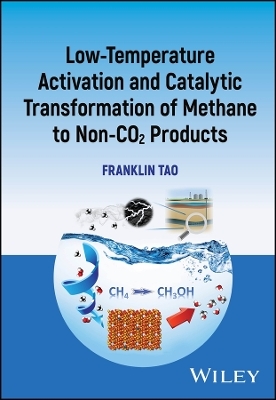
Low-temperature Activation and Catalytic Transformation of Methane to Non-CO2 Products
John Wiley & Sons Inc (Verlag)
978-1-394-19325-7 (ISBN)
- Noch nicht erschienen (ca. Januar 2026)
- Versandkostenfrei
- Auch auf Rechnung
- Artikel merken
Methane is one of our crucial natural resources, with myriad applications both domestic and industrial. The increasingly urgent search for a sustainable and green chemical production demands methods for the transformations of methane that maximize its potential as a raw material of chemical, manufacturing, and energy industries without a harmful effect on the atmosphere and local environment.
Low-Temperature Activation and Catalytic Transformation of Methane to Non-CO2 Products introduces a growing field in chemistry, chemical engineering, and energy sciences. Beginning with an overview of methane formation and its significance in chemical production, the book surveys historical transformations of methane to value-added chemicals and explains why a low-temperature route of methane transformation is necessary and significant. It then discusses existing findings in low-temperature activation and catalytic transformation, including activations with free standing single-atom cations, free standing MO+ clusters, and broadly defined M-O clusters encapsulated in zeolites, and catalytic oxidation by molecular catalysts, metal atoms anchored in zeolites, and metal sites on alloy nanoparticles. The book concludes with a chapter discussing current challenges and promising solutions to tackle these challenges.
Low-Temperature Activation and Catalytic Transformation of Methane to Non-CO2 Products readers will also find:
Coverage of concepts, perspectives, and skills required for those working in this important field in catalysis research.
Exemplified experimental and computational results throughout, derived from existing research literature.
Detailed discussion of low-temperature transformation methods incorporating catalysts including zeolite, gold-palladium, and many more.
Low-Temperature Activation and Catalytic Transformation of Methane to Non-CO2 Products is ideal for experimentalists, researchers, scientists, and engineers working in methane transformation, heterogeneous catalysis, homogeneous catalysis, sustainable chemistry, surface science and related fields.
Franklin Tao, Ph.D., Professor of Chemistry and Chemical Engineering was elected a Fellow of the American Association for the Advancement of Science (AAAS) in 2017 and a recipient of the University Scholarly Achievement Award in 2019 while serving as a professor at the University of Kansas. He has published more than 210 research articles in the fields of catalysis for transformation of light hydrocarbons including methane, single-atom catalysis, catalytic conversion of biomass derivatives, electrochemical and photocatalytic transformations of small molecules, surface chemistry, catalyst structure dynamics, in situ/operando characterization techniques and methods, and instrumentation for studying materials and reactions under reaction and operational conditions. He has been a professor or visiting scientist at multiple academic institutions including University of Notre Dame and University of California, Berkeley.
Preface xi
Acknowledgments xv
1 Why Do We Care About Methane? 1
1.1 Chemical Production 1
1.2 Energy Supply 2
1.3 Climate Change 5
1.4 Reconciling Shale-Gas Utilization and Environmental Issue 5
2 Properties and Chemical Inertness of Methane 8
3 Formation of Methane in Nature and by Anthropogenic Activity 11
3.1 Methane Formed in Rocks 11
3.2 Methane Hydrate Formed in Seabed 12
3.3 Bio-methanation 12
3.4 Methane Formed as a Byproduct in Industrial Processes 18
4 Extraction of Methane for Chemical Production 21
5 Methane Emission and Its Impact on Environment 26
5.1 Methane Emissions 26
5.2 Fundamentals on Methane-relevant Environmental Issue 27
6 Brief of High-Temperature Catalytic and Noncatalytic Transformation of Methane 33
6.1 Steam Reforming of Methane 33
6.2 Reforming of Methane by Consumption of CO2 40
6.3 Partial Oxidation of Methane 44
6.4 Methane Transformation Involving both Heterogeneous and Homogeneous Catalysis 52
6.5 Oxidative Coupling of Methane 54
6.6 Aromatization of Methane 60
6.7 Direct Activation of Methane on Single Sites of Fe to Synthesize Ethylene and Aromatics 71
6.8 Transformation of Methane to Form Hydrogen and Carbon 72
6.9 Methane Oxidation to Formaldehyde 79
7 Electrochemical Conversion of Chemical Energy of CH4 to Electrical Energy at Intermediate Temperature 102
8 Brief of Thermodynamics of Transformation of Methane at Low Temperature 107
8.1 Feasibility of Methane Conversion at Low Temperature through Oxidation 107
8.2 Why Should We Pursue a Low-temperature CH4 Transformation Route? 108
8.3 Significance of Catalyst Design for Compensating Slow Kinetics of Methane Conversion at Low Temperature 109
9 Activation of CH4 by Free-standing Cations (M+ or Ma n+) of Single Atom or Cluster at Room Temperature and Its Significant Indication for CH4 Low-Temperature Activation 110
9.1 Activity in Dehydrogenation of CH4 and Reaction with Other Hydrocarbons on Free-standing Cation of Single-atom M+ of the First-row (3d) Transition Metals and Its Indication for CH4 Low-Temperature Activation 111
9.2 Activity in Dehydrogenation of CH4 on Free-standing Cation of Single-atom M+ of the Third-row (5d) Transition Metals and Its Indication for CH4 Low-Temperature Activation 112
9.3 Factors Leading to the Difference between High Activity of 5d Transition Metal Ion to CH4 Dehydrogenation and Nearly Inertness of 3d or 4d Metal Ion 114
9.4 Activity in CH4 Dehydrogenation or C2H4 Formation on Free-standing Cluster [Ma]0 or Cluster Cation [Ma]n+ and Its Indication to CH4 Low-Temperature Activation 116
10 Oxidization of CH4 by Free-standing MO+ Clusters at Room Temperature in Low-pressure CH4 121
10.1 Brief 121
10.2 Preparation of MO+ Clusters 121
10.3 Experimental and Computational Approaches for Studying Reaction between MO+ Cluster and CH4 122
10.4 Chemical Properties of MO+ and Their Indications for Activity in Oxidizing CH4 123
10.5 Fundamental Understanding of the Evolution of the Activity of MO+ in Oxidizing CH4 and Its Indication for Catalytic Oxidation of CH4 124
10.6 Fundamental Understanding of Product Selectivity for CH3OH in Oxidation of CH4 133
11 Catalytic Oxidation of Methane through Free-standing M+ in Gas Phase at Low Temperature 139
12 Activation and Catalytic Oxidation of CH4 through M1On Clusters Anchored on Open Support at Low Temperature 142
12.1 Context 142
12.2 Cations Doped on Open Surface of Transition Metal Oxide 142
12.3 Cations on the Surface of Iridium Oxide Thin Film 148
13 Catalytic Transformation of Methane through Organometallic Approach at Low Temperature 153
13.1 Pt-based Catalysts for Production of Methanol 153
13.2 Pt-based Catalysts for the Production of Acetic Acid 155
13.3 Pd-based Catalyst for Production of Methanol 156
13.4 Pd-based Catalyst for the Production of Acetic Acid 157
13.5 Rh-based Molecular Catalysts for the Production of Acetic Acid with the Participation of External CO 160
13.6 Hg-based Catalysts for Production of Methanol 162
13.7 Ru-based Catalysts for the Production of Methanol 165
13.8 Peroxydisulphate for the Production of Acetic Acid without External CO 166
13.9 Polyoxometalates for the Production of Methanol 167
13.10 Ag-based Catalyst for Inserting CH2 167
13.11 Au-based Catalyst for the Production of Methanol 168
13.12 Ir-based Catalyst for Borylation of Methane 170
14 Solid Organic Catalysts for the Selective Low-temperature Oxidation of Methane to Methanol 175
15 Confinement Effect in Micropores of Microporous Aluminosilicate 180
15.1 Origin of Confinement: Elevation of Energy of Molecular Orbitals and Reduction of Gap of HOMO and LUMO 180
15.2 Relaxation of Atoms of the Concave Surface 184
15.3 Quantification of the Confinement Effect 186
15.4 Confinement-directed Catalytic Performance 187
16 Brief of Experimental Methods of Low-temperature Activation and Catalytic Conversion of CH4 through M–O Clusters Anchored in Zeolite 190
17 Oxidation of Methane by N2O through M–O Clusters Anchored in Zeolite in the Gas Phase at Low Temperature 194
17.1 Early Studies of Partial Oxidation of Methane 194
17.2 Fe-ZSM-5 196
17.3 Small Pore Metallozeolite 200
17.4 A Comparison of Pore Size on Oxidation of Methane 201
17.5 Isothermal Activation of Cu-ZSM-5, Partial Oxidation, and Gas Phase Extraction of Methanol 202
18 Oxidation of Methane through M–O Sites Anchored in Zeolite or AuPd Nanoparticles by H2O2 at Low Temperature 207
18.1 Brief of the Difference between the Catalytic Oxidation of CH4 with N2O at a Relatively High Temperature and that with H2O2 in Aqueous Solution at a Low Temperature 207
18.2 Fe-S-1 and Fe-ZSM-5 208
18.3 Pd-ZSM-5 212
18.4 AuPd Supported on ZSM-5 217
19 Noncatalytic and Catalytic Oxidation of Methane with O2 through M–O Clusters Anchored in Zeolite in Liquid at Low Temperature 222
19.1 Cu-ZSM-5 222
19.2 Cu-MOR 230
19.3 Ni-ZSM-5 241
19.4 Zeolite with Small Pore Cu-SSZ-13, Cu-SSZ-16, and Cu-SSZ-39 245
19.5 Pore Size-dependence on Activity 247
19.6 Catalytic Oxidation of Methane with O2 by Cu-zeolite 248
19.7 Catalytic Coupling between O2 or HOO· and CH3· in a Solution with Coexisting O2 and H2O2 252
20 Oxidation of CH4 and CO with O2 through M–O Clusters Anchored in Zeolite in Liquid at Low Temperature 259
21 Challenges and Prospect 268
21.1 Challenge in Achieving High Selectivity for a Specific Product 268
21.2 Challenge in Achieving High Conversion of CH4 268
21.3 Challenge in Finding a New Reaction 269
21.4 Challenge in Reproducible Preparation of Metallozeolite with Homogeneous Catalytic Sites 270
21.5 Challenge in Characterizing the Actual Catalyst during Catalysis 271
21.6 Challenge in the Fundamental Understanding of the Catalytic Mechanism 272
21.7 Challenge in Transforming Low-concentration Methane of Waste Gas 272
References 273
Index 277
| Erscheint lt. Verlag | 29.1.2026 |
|---|---|
| Verlagsort | New York |
| Sprache | englisch |
| Themenwelt | Naturwissenschaften ► Chemie |
| Technik ► Elektrotechnik / Energietechnik | |
| Technik ► Maschinenbau | |
| ISBN-10 | 1-394-19325-4 / 1394193254 |
| ISBN-13 | 978-1-394-19325-7 / 9781394193257 |
| Zustand | Neuware |
| Informationen gemäß Produktsicherheitsverordnung (GPSR) | |
| Haben Sie eine Frage zum Produkt? |
aus dem Bereich