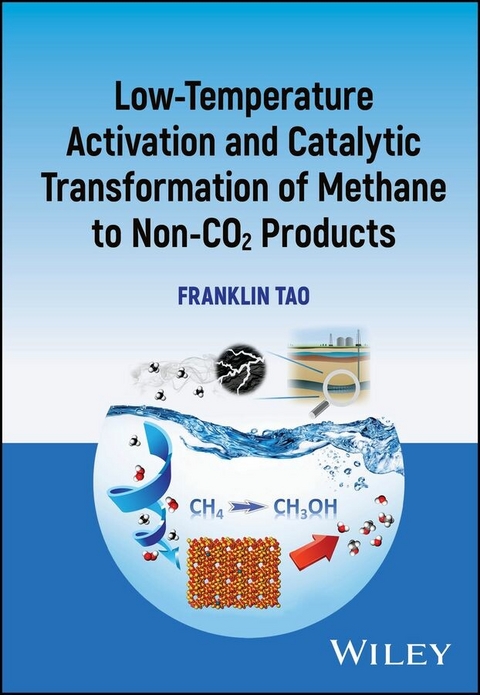
Low-temperature Activation and Catalytic Transformation of Methane to Non-CO2 Products (eBook)
463 Seiten
Wiley (Verlag)
978-1-394-19327-1 (ISBN)
Sustainably tap into one of the world's most abundant natural resources with these approaches
Methane is one of our crucial natural resources, with myriad applications both domestic and industrial. The increasingly urgent search for a sustainable and green chemical production demands methods for the transformations of methane that maximize its potential as a raw material of chemical, manufacturing, and energy industries without a harmful effect on the atmosphere and local environment.
Low-Temperature Activation and Catalytic Transformation of Methane to Non-CO2 Products introduces a growing field in chemistry, chemical engineering, and energy sciences. Beginning with an overview of methane formation and its significance in chemical production, the book surveys historical transformations of methane to value-added chemicals and explains why a low-temperature route of methane transformation is necessary and significant. It then discusses existing findings in low-temperature activation and catalytic transformation, including activations with free standing single-atom cations, free standing MO+ clusters, and broadly defined M-O clusters encapsulated in zeolites, and catalytic oxidation by molecular catalysts, metal atoms anchored in zeolites, and metal sites on alloy nanoparticles. The book concludes with a chapter discussing current challenges and promising solutions to tackle these challenges.
Low-Temperature Activation and Catalytic Transformation of Methane to Non-CO2 Products readers will also find:
- Coverage of concepts, perspectives, and skills required for those working in this important field in catalysis research.
- Exemplified experimental and computational results throughout, derived from existing research literature.
- Detailed discussion of low-temperature transformation methods incorporating catalysts including zeolite, gold-palladium, and many more.
Low-Temperature Activation and Catalytic Transformation of Methane to Non-CO2 Products is ideal for experimentalists, researchers, scientists, and engineers working in methane transformation, heterogeneous catalysis, homogeneous catalysis, sustainable chemistry, surface science and related fields.
Franklin Tao, Ph.D., Professor of Chemistry and Chemical Engineering was elected a Fellow of the American Association for the Advancement of Science (AAAS) in 2017 and a recipient of the University Scholarly Achievement Award in 2019 while serving as a professor at the University of Kansas. He has published more than 210 research articles in the fields of catalysis for transformation of light hydrocarbons including methane, single-atom catalysis, catalytic conversion of biomass derivatives, electrochemical and photocatalytic transformations of small molecules, surface chemistry, catalyst structure dynamics, in situ/operando characterization techniques and methods, and instrumentation for studying materials and reactions under reaction and operational conditions. He has been a professor or visiting scientist at multiple academic institutions including University of Notre Dame and University of California, Berkeley.
Sustainably tap into one of the world s most abundant natural resources with these approaches Methane is one of our crucial natural resources, with myriad applications both domestic and industrial. The increasingly urgent search for a sustainable and green chemical production demands methods for the transformations of methane that maximize its potential as a raw material of chemical, manufacturing, and energy industries without a harmful effect on the atmosphere and local environment. Low-Temperature Activation and Catalytic Transformation of Methane to Non-CO2 Products introduces a growing field in chemistry, chemical engineering, and energy sciences. Beginning with an overview of methane formation and its significance in chemical production, the book surveys historical transformations of methane to value-added chemicals and explains why a low-temperature route of methane transformation is necessary and significant. It then discusses existing findings in low-temperature activation and catalytic transformation, including activations with free standing single-atom cations, free standing MO+ clusters, and broadly defined M-O clusters encapsulated in zeolites, and catalytic oxidation by molecular catalysts, metal atoms anchored in zeolites, and metal sites on alloy nanoparticles. The book concludes with a chapter discussing current challenges and promising solutions to tackle these challenges. Low-Temperature Activation and Catalytic Transformation of Methane to Non-CO2 Products readers will also find: Coverage of concepts, perspectives, and skills required for those working in this important field in catalysis research.Exemplified experimental and computational results throughout, derived from existing research literature.Detailed discussion of low-temperature transformation methods incorporating catalysts including zeolite, gold-palladium, and many more. Low-Temperature Activation and Catalytic Transformation of Methane to Non-CO2 Products is ideal for experimentalists, researchers, scientists, and engineers working in methane transformation, heterogeneous catalysis, homogeneous catalysis, sustainable chemistry, surface science and related fields.
1
Why Do We Care About Methane?
1.1 Chemical Production
Methane (CH4) plays a significant role in two key sectors: chemical production and energy supply. It is anticipated to emerge as a substitute for petroleum, serving as a foundational raw material in chemical industries. Over the last decades, the maturation of shale gas extraction techniques, such as horizontal drilling and hydraulic fracturing, has significantly lowered the cost of shale gas. Consequently, the usage of CH4 as a raw material in the production of intermediate compounds has increased in the past decade, although presently, the primary raw material for chemical and manufacturing industries is still petroleum.
One of the major applications of CH4 is the production of H2 at an industrial scale through steam reforming for chemical production, food processing, and fertilizer synthesis. Other than these conventional applications, industries have increasingly turned to CH4 to produce chemical intermediates, thereby creating value‐added chemicals for manufacturing industries, although petroleum is still the dominant raw material for years or even decades. CH4 can undergo chemical transformation through syngas route and direct transformation routes (Figure 1.1). In direct pathways, CH4 is converted into synthesis gas (a mixture of CO and H2) via steam reforming, dry reforming, or partial oxidation. Synthesis gas serves as a precursor to numerous vital intermediate compounds of chemical industries, including methanol, hydrocarbons, hydrogen, and many others. These intermediate can be used to produce a great number of value‐added chemicals such as acetic acid, formaldehyde, vinyl acetate, allyl alcohol, alkylbenzene, propylene oxide, ethanol, acrolein, ethyl chloride, other alcohols, Hydrogen peroxide, alkylamine, aniline, nitrile, and ammonia. These value‐added chemicals serve as building blocks for manufacturing various functional materials, including plastics, polymers, cloths, cosmetics, and medicines (Figure 1.1).
Particularly noteworthy is the routes of chemical production from CH4 that avoids releasing environmentally harmful CO2. Unfortunately, most CH4 transformation reactions listed in Figure 1.1 occur at high temperatures, demanding substantial energy input, costly production facilities, and extensive maintenance. Furthermore, many of these transformations yield CO2 as a byproduct. Particularly noteworthy are these routes of chemical production from CH4 that do not release environmentally harmful CO2. Therefore, the development of low‐temperature reactions without releasing CO2 and suitable catalysts for these reactions is vital to achieve a green transformation of CH4 with low energy input and zero environmental impact. This pursuit underscores the significance of fundamental studies of activation and catalytic transformation of CH4 under a mild condition in terms of low reaction temperatures.
Figure 1.1 Expected chemical transformation map taking CH4 as a substitute for petroleum in synthesizing crucial chemical intermediates to produce value‐added chemicals and materials used in healthcare and daily household products.
1.2 Energy Supply
In the energy sector, CH4 presently contributes predominantly to electricity generation [1]. The combustion of CH4 at high temperatures provides heat to vaporize water, generating steam to drive electrical generators in CH4 power plants. The advent of shale‐gas‐based electricity generation has considerably reduced electricity prices, leading to the retirement of numerous coal plants in America. According to the United States Energy Information Administration, 39.8% of electricity in the United States is generated through CH4 combustion‐based power plants (Table 1.1) [2]. It is the largest component in fossil‐fuel‐derived electricity, including 39.8% from CH4, 19.5% from coal, and 0.6% from petroleum. In addition, nuclear power plants and renewables contribute 18.2% and 21.5%, respectively. Essentially, CH4, coal, nuclear, and renewables account for 39.8%, 19.5%, 18.2%, and 21.5% of the electricity generated in the United States (Table 1.1) [2].
Table 1.1 The US utility‐scale electricity generation by source, amount, and share of the total in 2022 (data as of October 2023).a
Source: [2] / U.S. Energy Information Administration / Public Domain.
| Energy source (Category level 1) | Energy source (Category level 2) | Energy source (Category level 3) | Amount (kWh) | Share of total |
|---|
| All sources | 4231 | 100% |
| Fossil fuels (total) | 2553 | 60.4% |
| Natural gas | 1687 | 39.9% |
| Coal | 832 | 19.7% |
| Petroleum (total) | 23 | 0.5% |
| Petroleum liquids | 16 | 0.4% |
| Petroleum coke | 7 | 0.2% |
| Other gasesb | 12 | 0.3% |
| Nuclear | Nuclear | 772 | 18.2% |
| Renewables (total) | 901 | 21.3% |
| Wind | 434 | 10.3% |
| Hydropower | 255 | 6.0% |
| Solar (total) | 144 | 3.4% |
| Photovoltaicc | 141 | 3.3% |
| Solar thermal | 3 | 0.1% |
| Biomass (total) | 52 | 1.2% |
| Wood | 35 | 0.8% |
| Landfill gas | 9 | 0.2% |
| Municipal solid waste | 6 | 0.1% |
| Other biomass waste | 2 | <0.1% |
| Geothermal | 16 | 0.4% |
| Pumped storage hydropower d | −6 | –0.1% |
| Other sources e | 11 | 0.3% |
a Utility‐scale electricity generation is electricity generation from power plants with at least 1 MW (or 1000 kW) of total electricity generating capacity. Data are for net electricity generation.
b Small‐scale solar photovoltaic (PV) systems are electricity generators with less than 1 megawatt (MW) of electricity generating capacity, which are not connected to a power plant that has a combined capacity of one MW or larger. Most small‐scale PV systems are at or near the location where the electricity is consumed, and many are net metered systems. Smaller PV systems are usually installed on building rooftops.
c Other gases include blast furnace gas and other manufactured and waste gases derived from fossil fuels.
d Pumped storage hydroelectricity generation is negative because most pumped storage electricity generation facilities use more electricity than they produce annually. Most pumped storage systems use fossil fuels or nuclear energy for pumping water to the storage component of the system.
e Other (utility‐scale) sources include nonbiogenic municipal solid waste, batteries, hydrogen, purchased steam, sulfur, tire‐derived fuel, and other miscellaneous energy sources.
Apart from electricity generation for industries and households, CH4 serves as the primary energy source for three energy‐end uses, including space heating, water heating, and cooking for households across the United States (Figure 1.2). As per the 2020 report from the United States Energy Information Administration, 61% of households in the United States utilize natural gas for at least one energy‐end use [3]. As shown in Figure 1.2, the Midwest Census Region and West Census Region have the highest share of households at 74% in 2020. The share of households for spacing heating, water heating, and cooking in the South was lowest.
In certain European and Asian countries, CH4 is allowed to directly be employed as fuel to combust in natural gas engines for vehicles, while it remains prohibited for combustion engines in North American. Consequently, CH4 serves as the fuel for methane‐powered vehicles in these regions. In addition, CH4 is...
| Erscheint lt. Verlag | 23.12.2025 |
|---|---|
| Sprache | englisch |
| Themenwelt | Naturwissenschaften ► Chemie |
| Schlagworte | Catalytic oxidation • Catalytic transformation • chemical feedstocks • Chemical Production • Chemical Synthesis • climate change • Environmental remediation • global warming • Heterogeneous catalysis • Homogeneous catalysis • In situ Characterization • in situ studies • low-temperature activation • low-temperature catalysis • metal cluster • Metal Oxide Cluster • Micropore • MO-clusters • noncatalytic activation • operando • operando characterization • organometallic catalysis • single atom catalysis • Sustainable chemistry • Sustainable energy • zeolite |
| ISBN-10 | 1-394-19327-0 / 1394193270 |
| ISBN-13 | 978-1-394-19327-1 / 9781394193271 |
| Informationen gemäß Produktsicherheitsverordnung (GPSR) | |
| Haben Sie eine Frage zum Produkt? |
 EPUB (Adobe DRM)
Kopierschutz: Adobe-DRM
Adobe-DRM ist ein Kopierschutz, der das eBook vor Mißbrauch schützen soll. Dabei wird das eBook bereits beim Download auf Ihre persönliche Adobe-ID autorisiert. Lesen können Sie das eBook dann nur auf den Geräten, welche ebenfalls auf Ihre Adobe-ID registriert sind.
Details zum Adobe-DRM
Dateiformat: EPUB (Electronic Publication)
EPUB ist ein offener Standard für eBooks und eignet sich besonders zur Darstellung von Belletristik und Sachbüchern. Der Fließtext wird dynamisch an die Display- und Schriftgröße angepasst. Auch für mobile Lesegeräte ist EPUB daher gut geeignet.
Systemvoraussetzungen:
PC/Mac: Mit einem PC oder Mac können Sie dieses eBook lesen. Sie benötigen eine
eReader: Dieses eBook kann mit (fast) allen eBook-Readern gelesen werden. Mit dem amazon-Kindle ist es aber nicht kompatibel.
Smartphone/Tablet: Egal ob Apple oder Android, dieses eBook können Sie lesen. Sie benötigen eine
Geräteliste und zusätzliche Hinweise
Buying eBooks from abroad
For tax law reasons we can sell eBooks just within Germany and Switzerland. Regrettably we cannot fulfill eBook-orders from other countries.
aus dem Bereich