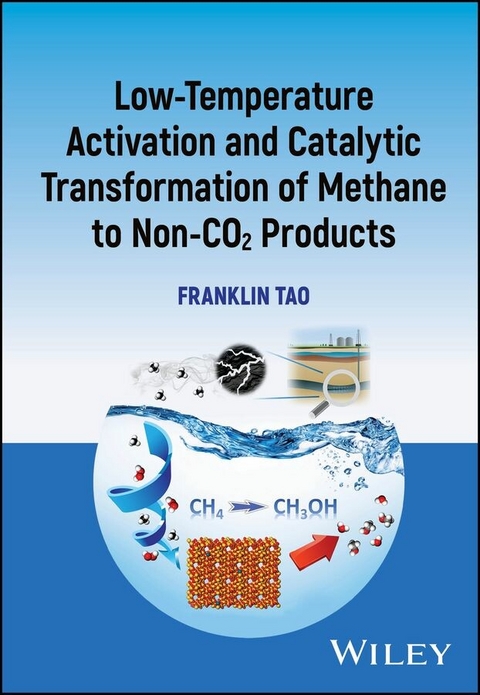
Low-temperature Activation and Catalytic Transformation of Methane to Non-CO2 Products (eBook)
301 Seiten
Wiley (Verlag)
978-1-394-19326-4 (ISBN)
Sustainably tap into one of the world's most abundant natural resources with these approaches
Methane is one of our crucial natural resources, with myriad applications both domestic and industrial. The increasingly urgent search for a sustainable and green chemical production demands methods for the transformations of methane that maximize its potential as a raw material of chemical, manufacturing, and energy industries without a harmful effect on the atmosphere and local environment.
Low-Temperature Activation and Catalytic Transformation of Methane to Non-CO2 Products introduces a growing field in chemistry, chemical engineering, and energy sciences. Beginning with an overview of methane formation and its significance in chemical production, the book surveys historical transformations of methane to value-added chemicals and explains why a low-temperature route of methane transformation is necessary and significant. It then discusses existing findings in low-temperature activation and catalytic transformation, including activations with free standing single-atom cations, free standing MO+ clusters, and broadly defined M-O clusters encapsulated in zeolites, and catalytic oxidation by molecular catalysts, metal atoms anchored in zeolites, and metal sites on alloy nanoparticles. The book concludes with a chapter discussing current challenges and promising solutions to tackle these challenges.
Low-Temperature Activation and Catalytic Transformation of Methane to Non-CO2 Products readers will also find:
- Coverage of concepts, perspectives, and skills required for those working in this important field in catalysis research.
- Exemplified experimental and computational results throughout, derived from existing research literature.
- Detailed discussion of low-temperature transformation methods incorporating catalysts including zeolite, gold-palladium, and many more.
Low-Temperature Activation and Catalytic Transformation of Methane to Non-CO2 Products is ideal for experimentalists, researchers, scientists, and engineers working in methane transformation, heterogeneous catalysis, homogeneous catalysis, sustainable chemistry, surface science and related fields.
Franklin Tao, Ph.D., Professor of Chemistry and Chemical Engineering was elected a Fellow of the American Association for the Advancement of Science (AAAS) in 2017 and a recipient of the University Scholarly Achievement Award in 2019 while serving as a professor at the University of Kansas. He has published more than 210 research articles in the fields of catalysis for transformation of light hydrocarbons including methane, single-atom catalysis, catalytic conversion of biomass derivatives, electrochemical and photocatalytic transformations of small molecules, surface chemistry, catalyst structure dynamics, in situ/operando characterization techniques and methods, and instrumentation for studying materials and reactions under reaction and operational conditions. He has been a professor or visiting scientist at multiple academic institutions including University of Notre Dame and University of California, Berkeley.
| Erscheint lt. Verlag | 23.12.2025 |
|---|---|
| Sprache | englisch |
| Themenwelt | Naturwissenschaften ► Chemie |
| Schlagworte | Catalytic oxidation • Catalytic transformation • chemical feedstocks • Chemical Production • Chemical Synthesis • climate change • Environmental remediation • global warming • Heterogeneous catalysis • Homogeneous catalysis • In situ Characterization • in situ studies • low-temperature activation • low-temperature catalysis • metal cluster • Metal Oxide Cluster • Micropore • MO-clusters • noncatalytic activation • operando • operando characterization • organometallic catalysis • single atom catalysis • Sustainable chemistry • Sustainable energy • zeolite |
| ISBN-10 | 1-394-19326-2 / 1394193262 |
| ISBN-13 | 978-1-394-19326-4 / 9781394193264 |
| Informationen gemäß Produktsicherheitsverordnung (GPSR) | |
| Haben Sie eine Frage zum Produkt? |
 PDF (Adobe DRM)
Kopierschutz: Adobe-DRM
Adobe-DRM ist ein Kopierschutz, der das eBook vor Mißbrauch schützen soll. Dabei wird das eBook bereits beim Download auf Ihre persönliche Adobe-ID autorisiert. Lesen können Sie das eBook dann nur auf den Geräten, welche ebenfalls auf Ihre Adobe-ID registriert sind.
Details zum Adobe-DRM
Dateiformat: PDF (Portable Document Format)
Mit einem festen Seitenlayout eignet sich die PDF besonders für Fachbücher mit Spalten, Tabellen und Abbildungen. Eine PDF kann auf fast allen Geräten angezeigt werden, ist aber für kleine Displays (Smartphone, eReader) nur eingeschränkt geeignet.
Systemvoraussetzungen:
PC/Mac: Mit einem PC oder Mac können Sie dieses eBook lesen. Sie benötigen eine
eReader: Dieses eBook kann mit (fast) allen eBook-Readern gelesen werden. Mit dem amazon-Kindle ist es aber nicht kompatibel.
Smartphone/Tablet: Egal ob Apple oder Android, dieses eBook können Sie lesen. Sie benötigen eine
Geräteliste und zusätzliche Hinweise
Buying eBooks from abroad
For tax law reasons we can sell eBooks just within Germany and Switzerland. Regrettably we cannot fulfill eBook-orders from other countries.
aus dem Bereich