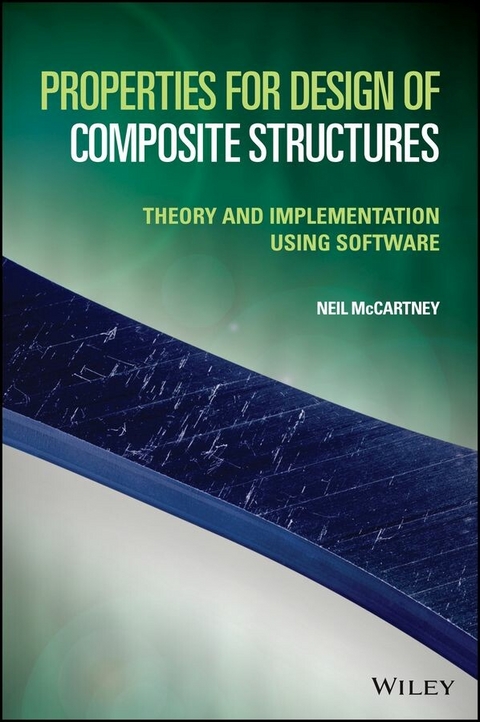
Properties for Design of Composite Structures (eBook)
John Wiley & Sons (Verlag)
978-1-118-78978-0 (ISBN)
A comprehensive guide to analytical methods and source code to predict the behavior of undamaged and damaged composite materials
In Properties for Design of Composite Structures: Theory and Implementation Using Software, distinguished researcher Dr. Neil McCartney delivers a unique and insightful approach to the development of predictive methods for the properties of undamaged and damaged laminated composite materials. The book focuses on presenting compact analytical formulae for several important effective properties-including mechanical, thermal, and electrical-that can be applied to a variety of reinforcement geometries.
The author introduces a compact notation that enables an explicit treatment of laminate property determination, including the out-of-plane shear properties required for three-dimensional numerical simulations of structural features using finite and boundary element analyses. There is also a detailed consideration of ply crack closure and a useful study of the interrelationships between the effective thermoelastic constants of damaged laminates.
The book also offers:
- A thorough introduction to the principles and formulae for homogenous materials and applications, including continuum and fracture concepts for homogeneous materials
- A comprehensive exploration of the properties of undamaged composites, including undamaged composite materials with multiple phases and the properties of a single undamaged lamina
- Practical discussions of the properties of damaged composites, including matrix cracking in UD composites and damaged laminates
- Consideration of effects of delamination, fatigue, and environmentally induced damage
- In-depth examinations of derivations of key results, including the analysis of bridged cracks and stress transfer mechanics for cross-ply and general symmetric laminates
Perfect for composite design engineers in all types of material-supplying industries and manufacturing companies, Properties for Design of Composite Structures: Theory and Implementation Using Software will also earn a place in the libraries of undergraduate and graduate students in engineering, aerospace, and materials departments.
Neil McCartney graduated with a PhD in Mathematics from Manchester University in 1968 and spent the whole of his career at the National Physical Laboratory (NPL) undertaking theoretical research associated with many aspects of materials science. He is currently an Emeritus Senior NPL Fellow. For many years he studied damage initiation and growth in unidirectional fibre reinforced composites and their laminates, with applications to multi-layered materials involving metals, ceramics, and polymers. His current work includes modelling of polymer electrolyte membrane fuel cells and batteries, and of multi-layered piezoelectric systems subject to mechanical, thermal, and electrical stimulation. He was Visiting Professor in the Department of Materials Science and Engineering, University of Surrey, March 1995 to 31 August 2010, and Visiting Professor in the Centre for Collaborative Research, The University of Tokyo, Japan, 1 February to 8 May 1999. He is a Fellow of the Institute of Mathematics and its Applications and a Chartered Mathematician.
PROPERTIES FOR DESIGN OF COMPOSITE STRUCTURES A comprehensive guide to analytical methods and source code to predict the behavior of undamaged and damaged composite materials In Properties for Design of Composite Structures: Theory and Implementation Using Software, distinguished researcher Dr. Neil McCartney delivers a unique and insightful approach to the development of predictive methods for the properties of undamaged and damaged laminated composite materials. The book focuses on presenting compact analytical formulae for several important effective properties including mechanical, thermal, and electrical that can be applied to a variety of reinforcement geometries. The author introduces a compact notation that enables an explicit treatment of laminate property determination, including the out-of-plane shear properties required for three-dimensional numerical simulations of structural features using finite and boundary element analyses. There is also a detailed consideration of ply crack closure and a useful study of the interrelationships between the effective thermoelastic constants of damaged laminates. The book also offers: A thorough introduction to the principles and formulae for homogenous materials and applications, including continuum and fracture concepts for homogeneous materials A comprehensive exploration of the properties of undamaged composites, including undamaged composite materials with multiple phases and the properties of a single undamaged lamina Practical discussions of the properties of damaged composites, including matrix cracking in UD composites and damaged laminates Consideration of effects of delamination, fatigue, and environmentally induced damage In-depth examinations of derivations of key results, including the analysis of bridged cracks and stress transfer mechanics for cross-ply and general symmetric laminates Perfect for composite design engineers in all types of material-supplying industries and manufacturing companies, Properties for Design of Composite Structures: Theory and Implementation Using Software will also earn a place in the libraries of undergraduate and graduate students in engineering, aerospace, and materials departments.
Neil McCartney graduated with a PhD in Mathematics from Manchester University in 1968 and spent the whole of his career at the National Physical Laboratory (NPL) undertaking theoretical research associated with many aspects of materials science. He is currently an Emeritus Senior NPL Fellow. For many years he studied damage initiation and growth in unidirectional fibre reinforced composites and their laminates, with applications to multi-layered materials involving metals, ceramics, and polymers. His current work includes modelling of polymer electrolyte membrane fuel cells and batteries, and of multi-layered piezoelectric systems subject to mechanical, thermal, and electrical stimulation. He was Visiting Professor in the Department of Materials Science and Engineering, University of Surrey, March 1995 to 31 August 2010, and Visiting Professor in the Centre for Collaborative Research, The University of Tokyo, Japan, 1 February to 8 May 1999. He is a Fellow of the Institute of Mathematics and its Applications and a Chartered Mathematician.
Preface vii
About the Companion Website ix
1 Introduction 1
2 Fundamental Relations for Continuum Models 5
3 Maxwell's Far-field Methodology Applied to the Prediction of Effective Properties of Multiphase Isotropic Particulate Composites 43
4 Maxwell's Methodology for the Prediction of Effective Properties of Unidirectional Multiphase Fibre-reinforced Composites 65
5 Reinforcement with Ellipsoidal Inclusions 97
6 Properties of an Undamaged Single Lamina 111
7 Effective Thermoelastic Properties of Undamaged Laminates 129
8 Energy Balance Approach to Fracture in Anisotropic Elastic Material 163
9 Ply Crack Formation in Symmetric Cross-ply Laminates 189
10 Theoretical Basis for a Model of Ply Cracking in General Symmetric Laminates 223
11 Ply Cracking in Cross-ply Laminates Subject to Biaxial Bending 249
12 Energy-based Delamination Theory for Biaxial Loading in the Presence of Thermal Stresses 271
13 Energy Methods for Fatigue Damage Modelling of Laminates 297
14 Model of Composite Degradation Due to Environmental Damage 329
15 Maxwell's Far-field Methodology Predicting Elastic Properties of Multiphase Composites Reinforced with Aligned Transversely Isotropic Spheroids 345
16 Debonding Models and Application to Fibre Fractures and Matrix Cracks 379
17 Interacting Bridged Ply Cracks in a Cross-ply Laminate 425
18 Theoretical Basis for a Model of Ply Cracking in General Symmetric Laminates 447
19 Stress-transfer Mechanics for Biaxial Bending 479
Appendix A: Solution for Shear of Isolated Spherical Particle in an Infinite Matrix 503
Appendix B: Elasticity Analysis of Two Concentric Cylinders 510
Appendix C: Gibbs Energy per Unit Volume for a Cracked Laminate 518
Appendix D: Crack Closure Conditions for Laminates 523
Appendix E: Derivation of the Solution of Nonlinear Equations 531
Appendix F: Analysis for Transversely Isotropic Cylindrical Inclusions 536
Appendix G: Recurrence Relations, Differential Equations and Boundary Conditions 541
Appendix H: Solution of Differential Equations 546
Appendix I: Energy Balance Equation for Delamination Growth 551
Appendix J: Derivation of Energy-based Fracture Criterion for Bridged Cracks 554
Appendix K: Numerical Solution of Integral Equations for Bridged Cracks 560
Index 565
1
Introduction
Improving the properties and performance of materials by reinforcing them with different types of stiffer and/or stronger phases, such as particles or fibres, leads to the class of material known as composites. This approach was first exploited during natural developments (both living plants and organisms) and later by mankind, e.g. the use by Egyptians when making clay building bricks reinforced with straw to improve handling and performance, and when using gravel to reinforce cement forming a much stronger concrete material. Over the centuries, increasingly sophisticated composites have been developed, responding especially to the advent of higher-performance fibres (for high stiffness, strength and/or high temperature resistance). Even greater benefits can arise by the manufacture of composites reinforced with hollow and/or multicoated inclusions, and nanotubes.
The simplest inclusion geometry for matrix reinforcement is a set of spherical particles which might exhibit a range of radii. When the matrix and reinforcement is homogeneously mixed, the resulting material has improved properties which are usually considered to be isotropic. Another simple geometry uses aligned continuous fibres to reinforce an isotropic matrix forming a material that is anisotropic such that the properties in the fibre (or axial) direction differ from transverse properties in the plane normal to the fibre direction. This type of material is known as unidirectionally fibre-reinforced composite where the transverse stiffnesses and strengths are usually much lower than the stiffness and strength in the fibre direction. To overcome this significant practical problem, composite laminates are considered where a stack of unidirectional composites known as plies are bonded together where the fibres in each ply in the laminate are aligned in a direction that varies from ply to ply. Laminates are often weak under compression because of a damage mode known as delamination where debonding occurs at or near the interfaces between the various plies. To overcome this practical problem, woven or stitched fibre architectures are used. Such composites can be analysed effectively only if numerical methods are used. This topic will not, therefore, be considered in this book, as the intention is to focus here on the development and use of analytical methods. Composites, often made where the reinforcement is a set of short fibres which are either aligned in a given direction or are randomly oriented, are also not considered in this book.
The engineering application of composite materials for equilibrium calculations requires a full understanding the key materials properties which can be thought of as being classified as elastic, thermal, electrical and magnetic. In addition, when nonequilibrium transport phenomena occur, such as heat flow and electrical conduction, an additional type of property known as conductivities must also be considered. All these properties are well known, and for isotropic materials often encountered in engineering, a limited number of material properties are sufficient to characterise, fully, the physical behaviour of such materials. However, when composite materials are considered, the properties are usually no longer isotropic, and many more properties describing the directional behaviour of the material, and even of the fibres themselves, need to be considered in the engineering design process. This complexity also leads to needs for suitable measurement methods capable of determining the values of the multitude of properties required to fully characterise an anisotropic composite material, an important topic that will not be considered in this book. It is noted that the numerical analysis of three-dimensional composite components requires a very large number of materials properties, associated with the anisotropic nature of composite materials, some of which are extremely difficult to measure (e.g. through-thickness shear moduli). Analytical methods provide a pragmatic way of providing such data, but this leads on to needs to have access to reliable data for fibre properties, which are frequently anisotropic, and some properties are seldom known reliably (e.g. Poisson’s ratios, shear moduli and transverse thermal expansion).
The effective properties of composite materials, which arise when samples are considered as homogeneous materials having anisotropic properties, depend in a complex way on the properties of the materials used in their manufacture (e.g. reinforcements and matrix) and on the geometrical arrangement of these materials. It is plainly not feasible to undertake an experimental programme designed to use measurement methods to determine the relationships between effective properties of composite materials and the constituent properties and structure. Instead, theoretical methods are used based on the well-established principles of continuum thermodynamics defined in its most general form so that both continuum mechanics and electrodynamics are considered in a thermodynamic context. It is indeed of interest to know that James Clerk Maxwell, developer of the famous Maxwell equations of electrodynamics, is believed to be the first scientist to develop a formula for an effective property of a composite material. He considered a cluster of spherical particles, all having the same isotropic permittivity value, embedded in an infinite matrix, having a different value for isotropic permittivity, and developed an elegant method of estimating the effective properties of the particle cluster. Although Maxwell argued that his neglect of particle interactions would limit the validity of his effective property to low volume fractions, it is known that results obtained using his methodology are in fact valid for much larger volume fractions. This important scientific contribution appeared in 1873 as part of Chapter 9 in his book entitled A Treatise on Electricity and Magnetism, published by Clarendon Press, Oxford. Maxwell’s methodology will be used in this book to help understand the relationship of many effective composite properties to the properties of the reinforcements and their geometrical arrangements within a matrix.
In recent years, although many developments of materials and structures in the composites field have used a make-and-test philosophy, the scientific understanding that has now developed means that predictive methods of assessing composite performance are being used more widely. There is a wide spectrum of predictive techniques that can be used ranging from analytical models, which is the theme of this book, through to numerical simulations of engineering components, having complex geometries and loadings, which are based on numerical techniques such as the finite element and boundary element methods. There is a need to employ both analytical and numerical techniques. The former are models where predictions are possible through use of mathematical formulae that relate the important parameters that might be varied when designing a new material, whether a unidirectional ply or a complex laminate. The parameters normally encountered are the fibre volume fractions, the thermoelastic constants of both fibre and matrix, or of a ply or a laminate. When assessing damage resistance, other types of property are encountered such as fracture energies. Analytical methods provide a clear understanding of the key physical processes that are involved, and they provide methods of assessing whether, or not, candidate materials have good prospects of being used as improved engineering materials. Analytical models can also be used to develop exact solutions to relatively simple and amenable practical situations. These solutions can be used as special cases to validate the numerical methods which have much wider applicability.
The principal objectives of this book are to present, in a single publication, a description of the derivations of selected theoretical methods of predicting the effective properties of composite materials for situations where they are either undamaged or are subject to damage in the form of matrix cracking, in fibre-reinforced unidirectional composites, or in the plies of laminates, or to a lesser extent on the interfaces between neighbouring plies. The major focus of the book is on derivations of analytical formulae which can be the basis of software that is designed to predict composite behaviour, e.g. prediction of properties and growth of damage and its effect on composite properties. Software will be available from the John Wiley & Sons, Inc. website [1] including examples of software predictions associated with relevant chapters of this book.
The chapters of this book are grouped into three parts. The first group comprises Chapters 1 and 2, which provide the introduction and the fundamental relations for continuum models, and Chapters 3–7 that focus on preferred methods of estimating the thermoelastic properties of undamaged composites: particulate reinforced (both spheres and spheroids), fibre reinforced and laminates. The second group comprises Chapters 8–14 considering the fundamentals of ply cracking, and the predictions of ply crack formation in damaged composites, which are categorised into symmetric cross-plies and general symmetric laminates subject to general in-plane loading, and also nonsymmetric cross-ply laminates subject to combined biaxial bending and in-plane loading. A rigorous approach is developed that allows much theoretical development without having to know the detailed distributions of stress and strain within the laminates. Much effort is devoted to the development of very useful interrelationships between the effective properties of...
| Erscheint lt. Verlag | 7.6.2022 |
|---|---|
| Sprache | englisch |
| Themenwelt | Technik ► Bauwesen |
| Technik ► Maschinenbau | |
| Schlagworte | Bauingenieur- u. Bauwesen • Civil Engineering & Construction • Composites • composite structure implementation • Composite structure theory • damaged composites • damaged laminates • fiber properties • homogeneous applications • Homogenous Materials • Maschinenbau • Maschinenbau - Entwurf • Materials Science • Materialwissenschaften • mechanical engineering • Mechanical Engineering - Design • Structures • thermo-elastic properties • Tragwerke • undamaged composites • undamaged laminates • Verbundwerkstoff • Verbundwerkstoffe |
| ISBN-10 | 1-118-78978-4 / 1118789784 |
| ISBN-13 | 978-1-118-78978-0 / 9781118789780 |
| Informationen gemäß Produktsicherheitsverordnung (GPSR) | |
| Haben Sie eine Frage zum Produkt? |
 EPUB (Adobe DRM)
Kopierschutz: Adobe-DRM
Adobe-DRM ist ein Kopierschutz, der das eBook vor Mißbrauch schützen soll. Dabei wird das eBook bereits beim Download auf Ihre persönliche Adobe-ID autorisiert. Lesen können Sie das eBook dann nur auf den Geräten, welche ebenfalls auf Ihre Adobe-ID registriert sind.
Details zum Adobe-DRM
Dateiformat: EPUB (Electronic Publication)
EPUB ist ein offener Standard für eBooks und eignet sich besonders zur Darstellung von Belletristik und Sachbüchern. Der Fließtext wird dynamisch an die Display- und Schriftgröße angepasst. Auch für mobile Lesegeräte ist EPUB daher gut geeignet.
Systemvoraussetzungen:
PC/Mac: Mit einem PC oder Mac können Sie dieses eBook lesen. Sie benötigen eine
eReader: Dieses eBook kann mit (fast) allen eBook-Readern gelesen werden. Mit dem amazon-Kindle ist es aber nicht kompatibel.
Smartphone/Tablet: Egal ob Apple oder Android, dieses eBook können Sie lesen. Sie benötigen eine
Geräteliste und zusätzliche Hinweise
Buying eBooks from abroad
For tax law reasons we can sell eBooks just within Germany and Switzerland. Regrettably we cannot fulfill eBook-orders from other countries.
aus dem Bereich