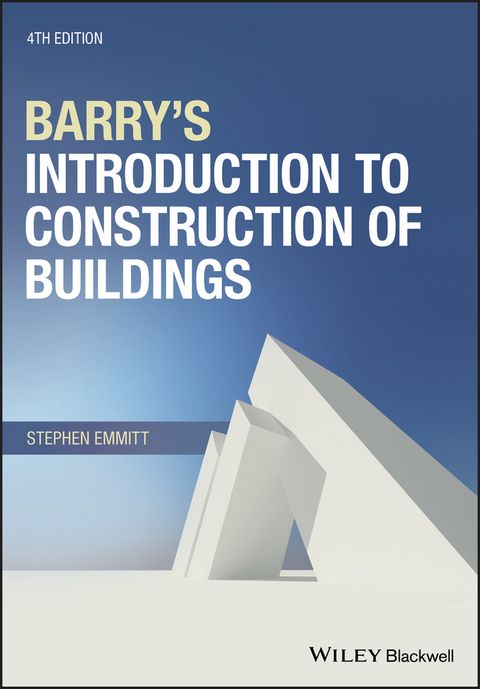
Barry's Introduction to Construction of Buildings (eBook)
John Wiley & Sons (Verlag)
978-1-118-97721-7 (ISBN)
An authoritative, well-established, comprehensive, practical, and highly illustrated guide to construction practice
Based mainly on domestic and residential buildings-and filled with extensive illustrations throughout-this concise text is the ideal introduction to the subject of building construction. It provides the basic material that readers need in order to understand the construction process for the majority of low rise buildings. The book explains construction technology through the key functional and performance requirements for the main elements common to all buildings. With a strong focus on building efficiency and meeting the challenges posed by limiting the environmental impact of buildings, and new 'at a glance' summaries allowing you to grasp the salient points of each chapter, readers will find the text fully up to date with the latest building regulations and construction technology.
Barry's Introduction to Construction of Buildings, Fourth Edition starts by taking an in-depth look at the construction process and general principles of construction. It then offers comprehensive chapter coverage of site analysis, set-up, drainage and scaffolding; ground stability and foundations; floors, walls, doors, windows, roofs, stairs, and ramps; surface finishes; internal environment and energy supply; and water supply and sanitation.
- Deals with design, technology, site assembly, and environmental issues of domestic and residential buildings
- Thoroughly updated, with particular attention paid to the concept of building efficiency and improved integration of the topics covered to match current student needs
- New 'at a glance' summaries at the beginning of each chapter
- A companion to Barry's Advanced Construction of Buildings, Fourth Edition
Barry's Introduction to Construction of Buildings is an excellent source of information for undergraduate students and those working towards similar NQF level 5 and 6 qualifications in building and construction.
Stephen Emmitt, BA (Hons), Dip. Arch, MA (Prof. Ed.), PhD, is Head of the Department of Architecture and Civil Engineering and Professor of Architectural Practice at the University of Bath. He is a registered architect with industrial experience and has taught architectural technology and architectural detailing across a wide range of built environment programmes in the UK, Europe, and Asia.
Stephen Emmitt, BA (Hons), Dip. Arch, MA (Prof. Ed.), PhD, is Head of the Department of Architecture and Civil Engineering and Professor of Architectural Practice at the University of Bath. He is a registered architect with industrial experience and has taught architectural technology and architectural detailing across a wide range of built environment programmes in the UK, Europe, and Asia.
1
Introduction
The aim of this introductory chapter is to highlight some of the factors that determine how buildings are constructed and also to provide some context to the chapters that follow. Related issues are dealt with in the introduction to Barry’s Advanced Construction of Buildings. A brief overview of the building process and the function and performance of buildings leads into a discussion about responding to climate change. This is followed by a description of the general principles of construction, concluding with some comments on legislation, sources of information and making informed choices.
1.1 The construction process
In simple terms, the process of design and construction starts with a want or need. This may relate to, for example, a new building, or extension, repair and/or alteration of an existing structure. These wants and needs are translated into a set of requirements, a written ‘brief’ that informs the design team. The design team will develop a conceptual design and increase the level of detail to such an extent that a constructor can interpret written and drawn instructions to realise a physical artefact. The constructor will bring together appropriate resources – people, materials and machinery – to realise the design safely and within the agreed parameters of time, cost and quality. This process, or more correctly this series of interlinked processes, involves a large number of people working towards a common goal. This requires a collaborative and integrated approach to deliver the project and the product (building) to the expectations of the client. It also requires a collective understanding of many issues, including construction technology.
The process of design and construction is extensively covered in the literature on design management, project management and construction management, and therefore it does not need to be repeated here. However, it is necessary to make the point that we rarely make decisions in isolation when designing and constructing buildings. The nature of collaboration is determined by the type of procurement route used for a project and the success of the interactions between the organisations and individuals assembled to realise the project. The process is aided by information communication technologies (ICTs) and building information models (BIMs), and conducted within a legislative framework. Digital technologies allow project contributors to communicate regardless of physical location and to work collaboratively on the design and construction via a shared virtual BIM. The legislative framework includes regulations and guidance relating to fire protection, health and safety, the wellbeing of workers and building users, and the protection of our environment. Our decisions are also influenced by the physical site on which the building is to be constructed, as well as the availability of materials and technologies to realise the building in an ethical manner.
Genius loci – the importance of site
Buildings exist within a local context, and they should be designed, detailed and constructed to be in harmony with nature – that is, they should respond to their genius loci in a positive and sustainable way. Understanding the physical characteristics of the site and its unique microclimate is fundamental to designing and constructing a building that is in balance with its environment. The importance of site characteristics becomes even more critical with some of the alternative approaches and technologies that may be more prone to damage from, for example, water. Sensitivity to the site is a crucial factor in ensuring a durable and trouble‐free building. It follows that the proposed site of the building must be carefully analysed in terms of the microclimate, soil type, position of water table, etc. Then, and only then, should we start to design and make decisions about the most appropriate materials and construction techniques to realise the project within the given parameters of time, cost and quality. Site analysis is described further in Chapter 2.
1.2 The function and performance of buildings
Buildings are designed, constructed, altered, upgraded, restored or demolished for a variety of reasons. Whether the aim is simply to provide more space or to make a financial gain from speculative development, all building projects need to fulfil a function and meet set performance criteria, no matter how fundamental or sophisticated the client’s requirements may be. The function of the building, be it, for example, a house, school or, hospital, will influence its design and architectural appearance. Similarly, the performance requirements will influence the type of materials and technologies used to realise the building, factors that also influence the building’s architecture. Both the function of the building and the performance requirements are initially determined through discussions with the client at the briefing stage.
The briefing process aims to establish what the client wants and why. The written brief will set out the type of building required and its primary function. Performance requirements, such as the thermal performance of the building, size of rooms, etc., will also be stated, along with a financial budget, timescale for completion of the project and the required level of quality. The brief informs and guides the design team. As the design develops, attention will turn to the function of individual building elements and components and their assembly to meet the agreed performance requirements safely and efficiently. This involves interaction with specialists, manufacturers and constructors to harness knowledge and expertise to the benefit of the building’s design and construction.
Function
The primary function of a building is to provide shelter from the weather, and as a container for living, working and playing in. This involves understanding how people will use the building and the equipment required to support the comfort and wellbeing of the occupants over a long time period. Thus, the daily activities that will take place within and around the building will influence the building’s function. The principal functional requirements may be broken down into the following:
- Provide shelter, security and privacy
- Provide structural and fire safety
- Ensure thermal comfort and wellbeing
- Have low environmental impact
- Be easy to use and operate (functionality)
- Be easy to maintain, repair and replace/upgrade
- Be adaptable and durable
- Be able to reuse and recycle materials and components at a future date
The overall goal is to achieve these functions in an economical, safe and timely fashion using the most appropriate resources available and with minimal negative impact on the environment. These primary functional requirements are explored in the chapters that follow in relation to specific building elements – for example, walls and windows.
Performance
In construction, the word ‘performance’ is used to describe: (1) the performance of the design and construction team, known as ‘project performance’, and (2) the performance of the building, known as ‘product performance’. In this book, the focus is on the performance of the building, although the manner in which the design and construction team performs – the decisions made and the actions taken – will impact upon the overall performance of the building. The design and construction of the building will influence how the users of the building are able to perform their tasks. Good design and construction will encourage positive performance and wellbeing, whereas poor design and construction will have a negative influence on performance and wellbeing.
Performance requirements will be specific to the client, the unique physical building site and the time of construction. Thus, performance requirements will vary from project to project, from site to site and over time. However, the main considerations are likely to be:
- Space, determined by the floor area and/or volume (and related to anticipated use)
- Thermal, visual and acoustic performance (quality of indoor climate)
- Design life and service life of the building and specific building components/elements
- Cost of construction, cost of use and cost of demolition/deconstruction and recycling
- Quality of the finished building (functionality, durability and usability)
- Appearance of the finished building (aesthetics)
- Environmental impact and ethical resourcing of materials and components
- Adherence to prevailing legislation and codes
Other specific performance criteria will relate to the use of the building – for example, the provision of special work surfaces for catering establishments. Legislative performance requirements are set out in building codes and regulations (see the section titled ‘Building control and building regulations’). Specific performance requirements – for example, the thermal insulation of walls and fire protection of doors – must be met or bettered in the proposed construction method.
Quality
Function and performance will influence the quality of the building. The quality of the completed building, as well as the process that brings it about, will also be determined by the quality of thought behind the design process, the quality of the...
| Erscheint lt. Verlag | 10.9.2018 |
|---|---|
| Sprache | englisch |
| Themenwelt | Technik ► Bauwesen |
| Schlagworte | Artificial lighting • Bauausführung • Bauingenieur- u. Bauwesen • bedrock • building and construction • Building Construction • Building Construction Technologies • building foundations • Building Regulations • built environments • ceiling finishes • Civil Engineering & Construction • Construction • Construction Handbook • Construction process • door frames • door hardware • door requirements • DOORS • Energy Supply • floor finishes • floor requirements • foul drainage • foundation construction • ground stability • indoor climate control • loadbearing walls • <p>construction • mortar • NQF level 5 and 6 qualifications • ramp requirements • RAMPs • roof requirements • Roofs • sanitary appliances</p> • Sanitation • Scaffolding • site analysis • site drainage • Site Security • soil types • stair requirements • stairs • surface finishes • surface requirements • wall construction • wall finishes • wall requirements • Walls • water supply • Window frames • window requirements • WINDOWS • window types |
| ISBN-10 | 1-118-97721-1 / 1118977211 |
| ISBN-13 | 978-1-118-97721-7 / 9781118977217 |
| Informationen gemäß Produktsicherheitsverordnung (GPSR) | |
| Haben Sie eine Frage zum Produkt? |
 EPUB (Adobe DRM)
Kopierschutz: Adobe-DRM
Adobe-DRM ist ein Kopierschutz, der das eBook vor Mißbrauch schützen soll. Dabei wird das eBook bereits beim Download auf Ihre persönliche Adobe-ID autorisiert. Lesen können Sie das eBook dann nur auf den Geräten, welche ebenfalls auf Ihre Adobe-ID registriert sind.
Details zum Adobe-DRM
Dateiformat: EPUB (Electronic Publication)
EPUB ist ein offener Standard für eBooks und eignet sich besonders zur Darstellung von Belletristik und Sachbüchern. Der Fließtext wird dynamisch an die Display- und Schriftgröße angepasst. Auch für mobile Lesegeräte ist EPUB daher gut geeignet.
Systemvoraussetzungen:
PC/Mac: Mit einem PC oder Mac können Sie dieses eBook lesen. Sie benötigen eine
eReader: Dieses eBook kann mit (fast) allen eBook-Readern gelesen werden. Mit dem amazon-Kindle ist es aber nicht kompatibel.
Smartphone/Tablet: Egal ob Apple oder Android, dieses eBook können Sie lesen. Sie benötigen eine
Geräteliste und zusätzliche Hinweise
Buying eBooks from abroad
For tax law reasons we can sell eBooks just within Germany and Switzerland. Regrettably we cannot fulfill eBook-orders from other countries.
aus dem Bereich