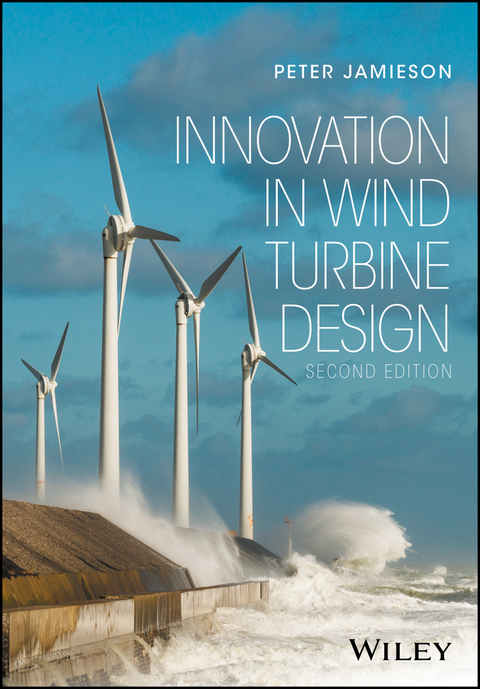
Innovation in Wind Turbine Design (eBook)
John Wiley & Sons (Verlag)
978-1-119-13794-8 (ISBN)
An updated and expanded new edition of this comprehensive guide to innovation in wind turbine design
Innovation in Wind Turbine Design, Second Edition comprehensively covers the fundamentals of design, explains the reasons behind design choices, and describes the methodology for evaluating innovative systems and components.
This second edition has been substantially expanded and generally updated. New content includes elementary actuator disc theory of the low induction rotor concept, much expanded discussion of offshore issues and of airborne wind energy systems, updated drive train information with basic theory of the epicyclic gears and differential drives, a clarified presentation of the basic theory of energy in the wind and fallacies about ducted rotor design related to theory, lab testing and field testing of the Katru and Wind Lens ducted rotor systems, a short review of LiDAR, latest developments of the multi-rotor concept including the Vestas 4 rotor system and a new chapter on the innovative DeepWind VAWT.
The bookis divided into four main sections covering design background, technology evaluation, design themes and innovative technology examples.
Key features:
- Expanded substantially with new content.
- Comprehensively covers the fundamentals of design, explains the reasons behind design choices, and describes the methodology for evaluating innovative systems and components.
- Includes innovative examples from working experiences for commercial clients.
- Updated to cover recent developments in the field.
The book is a must-have reference for professional wind engineers, power engineers and turbine designers, as well as consultants, researchers and graduate students.
PETER JAMIESON is based at Strathclyde University for two days a week acting as a special technical advisor whilst also conducting independent research into wind energy. As a founder member of GL Garrad Hassan's Scottish office and of their Special Projects Department, he is uniquely positioned to offer the highest guidance in the future development of wind energy in the UK and beyond.
An updated and expanded new edition of this comprehensive guide to innovation in wind turbine design Innovation in Wind Turbine Design, Second Edition comprehensively covers the fundamentals of design, explains the reasons behind design choices, and describes the methodology for evaluating innovative systems and components. This second edition has been substantially expanded and generally updated. New content includes elementary actuator disc theory of the low induction rotor concept, much expanded discussion of offshore issues and of airborne wind energy systems, updated drive train information with basic theory of the epicyclic gears and differential drives, a clarified presentation of the basic theory of energy in the wind and fallacies about ducted rotor design related to theory, lab testing and field testing of the Katru and Wind Lens ducted rotor systems, a short review of LiDAR, latest developments of the multi-rotor concept including the Vestas 4 rotor system and a new chapter on the innovative DeepWind VAWT. The bookis divided into four main sections covering design background, technology evaluation, design themes and innovative technology examples. Key features: Expanded substantially with new content. Comprehensively covers the fundamentals of design, explains the reasons behind design choices, and describes the methodology for evaluating innovative systems and components. Includes innovative examples from working experiences for commercial clients. Updated to cover recent developments in the field. The book is a must-have reference for professional wind engineers, power engineers and turbine designers, as well as consultants, researchers and graduate students.
PETER JAMIESON is based at Strathclyde University for two days a week acting as a special technical advisor whilst also conducting independent research into wind energy. As a founder member of GL Garrad Hassan's Scottish office and of their Special Projects Department, he is uniquely positioned to offer the highest guidance in the future development of wind energy in the UK and beyond.
Introduction
0.1 Why Innovation?
Fuel crises, concerns about global environmental threats and the urgent needs for energy in expanding new economies of the former third world have all contributed to an ever-increasing growth of renewable energy technologies. Presently, wind energy is the most mature and cost-effective of these.
While other more diverse applications are discussed, this book keeps the main focus on wind energy converters that produce electricity. This is primarily because the greater part of the author's experience is with such systems. However, in a more objective defence of that stance, it may be observed that by far the largest impact of wind technology on the world's energy supply presently comes from systems generating into electrical networks.
Innovation is about new ideas, and some quite unusual designs are evaluated in this book. Why give attention to such designs which may not be in the mainstream? Exploring alternative concepts not only deepens understanding of why the mainstream options are preferred but also suggests where they should be challenged by alternatives that have significant promise. In any case, ideas are grist to the mill of technological progress and those which fail in one embodiment may well later be adapted and successfully reincarnated.
As is discussed shortly, the generation of power from the wind presents unique challenges. Unlike cars and houses, for example, energy is a commodity which has utilitarian value only. No one prefers a particular petrol because it has a nicer colour. The wealthy may indulge in gold or gold-plated bathroom taps, but no one can purchase gold-plated electricity. Energy must meet generally stringent specifications of quality in order to be useful (voltage and frequency levels particularly in the case of electricity). Once it does, the main requirement is that it is dependably available and as cheap as possible.
The end purpose of innovation in wind turbine design is to improve the technology. Usually, this means reducing the cost of energy and this is the general basis of evaluating innovation in this book. However, even this simply stated goal is not always the final criterion. In some instances, for example, the objective is to maximise energy return from an available area of land. Sometimes capital cost has a predominant influence. The bottom line is that any technology must be tailored accurately to an engineering design specification that may include environmental, market, cost and performance issues.
The detailed design of a wind turbine system is not a minor or inexpensive task. By the time an innovative design is the subject of a detailed design study, although it may yet be some way from market, it has already received significant investment and has passed preliminary tests as to the potential worth of the new concepts.
Thus, there is an intermediate stage between first exposure of a concept up to the stage of securing investment in a prototype when the concepts are examined and various levels of design are undertaken. Usually, a search for fatal flaws or obvious major shortcomings is the first stage. The design may be feasible but will have much more engineering content than its competitors and it is therefore unlikely to be cost-effective. More typically, there is no clear initial basis for rejecting the new concepts and a second level of appraisal is required. A systematic method is needed to review qualitatively, and where possible quantitatively, how the design compares to existing technology and for what reason(s) it may have merit. At this stage, detailed, expensive and time-consuming analyses are precluded, but there is a great need for parametric evaluations and simplified analyses that can shed light on the potential of the new concepts.
This book is very much about these preliminary evaluation stages, how simple insightful methods can provide guidance at a point where the value of the innovation is too uncertain to justify immediate substantial investment or detailed design.
0.2 The Challenge of Wind
According to Murray [1], the earliest written reference to windmills is of the fifth century BC. Windmills (although probably only then existing as children's toys) are listed, among other things, as something a devout Buddhist would have nothing to do with! The aerodynamic rotor concept is evidently ancient.
To generate electricity (by no means the only use for a wind turbine but certainly a major one under present consideration), requires the connection of such a rotor to an electric generator. Electric motor/generator technology began in Faraday's discoveries in the mid-nineteenth century. About 70 years ago and preceding the modern wind industry, the average household in the United States contained about 40 electric motors. The electric motor/generator is therefore not ancient but has been in mass production for a long time in recent history. What then is difficult about the marriage of rotor and generator into successful and economic power generating systems? The challenge of modern wind technology lies in two areas, the specification of an electricity-generating wind turbine and the variability of the wind.
0.3 The Specification of a Modern Wind Turbine
Traditional ‘Dutch’ windmills (Figure 0.1) have proliferated to the extent of 100 000 over Europe in their heyday. Some have survived 400–600 years, the oldest still operating in the United Kingdom being the post mill at Outwood, Surrey built in 1628. A short account of the history of early traditional wind technology in Eggleston and Stoddard [2] shows that they exhibit considerable practical engineering skill and empirical aerodynamic knowledge in their design and interesting innovations such as variable solidity blades (spilling the air through slats that can open or close) that have not surfaced in modern wind turbine design. However, these machines were always attended, were controlled manually for the most part, were integrated parts of the community and were designed for frequent replacement of certain components, and efficiency was of little consequence.
Figure 0.1 Jill post mill at Clayton Sussex.
Reproduced with permission of Paul Barber.
In contrast, to generate electricity cost-effectively is the specification of a modern power-generating wind turbine. To meet economic targets, it is unthinkable for the wind turbine to be permanently attended, and unacceptable for it to be much maintained. Yet, each unit is a self-contained mini-power station, requiring to output electricity of standard frequency and voltage into a grid system. Cost-effectiveness is overriding, but the efficiency of individual units cannot be sacrificed lightly. Energy is a prime value; whereas the lifetime costs comprise many components, each one of which has a lesser impact on cost of energy. Also, the total land area requirements per unit output will increase as efficiency drops.
It should be clear that wind technology embraces what is loosely called ‘high-tech’ and ‘low-tech’ engineering. The microprocessor plays a vital role in achieving self-monitoring unmanned installations. There is in fact nothing particularly simple about any kind of system for generating quality electricity. Diesel generators are familiar but not simple, and have a long history of development.
Thus, it is by no means enough to build something ‘simple and rugged’ that will survive any storm. Instead, the wind turbine must be value engineered very carefully to generate cheap electricity with adequate reliability. This is the first reason why the technology is challenging.
0.4 The Variability of the Wind
The greatest gust on record was on 12 April 1934 at the peak of Mount Washington in the Northern Appalachians [3]. ‘On record’ is a revealing phrase as anemometers have usually failed in the most extreme conditions. At 103 m/s, a person exposing 0.5 m2 of frontal area would have experienced a force equivalent to about 1/3 of a tonne weight. In terms of annual mean wind speed, the windiest place in the world [3] is on the edge of Antarctica, on a mountain margin of East Adelie land. At 18 m/s annual mean wind speed, the available wind energy is about 200 times that of a typical European wind site. These are of course extreme examples and there are no plans to erect wind turbines on either site.
Nevertheless, it underlines that there is enormous variation in wind conditions. This applies both on a worldwide basis but also in very local terms. In the rolling hills of the Altamont Pass area of California, where many wind farms were sited in the 1980s, there are large differences in wind resource (100%, say, in energy terms) between locations no more than a few hundred metres apart. Wind turbines are situated right at the bottom of the earth's boundary layer. Their aerofoils generally travel much more slowly than aircraft or helicopter rotors, and the effect of wind turbulence is much more consequential for design. The crux of this is that it is hard to refine a design for such potentially variable conditions, and yet uneconomic to design a wind turbine fit to survive anywhere. Standardisation is much desired to cheapen production, but is in conflict with best economics at specific local sites. Designs often need to have adaptive features to accommodate larger rotors, uprated generators or additional structural reinforcement as necessary.
Anemometry studies, both to determine suitable sites and for the micro-siting of machines within a chosen area, are not academic exercises. Because of the sensitivity of wind...
| Erscheint lt. Verlag | 12.3.2018 |
|---|---|
| Sprache | englisch |
| Themenwelt | Technik ► Bauwesen |
| Technik ► Elektrotechnik / Energietechnik | |
| Schlagworte | airborne wind energy systems • basic theory of the epicyclic gears and differential drives • Bauingenieur- u. Bauwesen • Civil Engineering & Construction • ducted rotor design fallacies • elementary actuator disc theory of the low induction rotor concept • Energie • Energietechnik • Energy • guide to wind turbine design • innovative DeepWind VAWT • Katru and Wind Lens ducted rotor systems • LiDAR review • Maschinenbau • Maschinenbau - Entwurf • mechanical engineering • Mechanical Engineering - Design • multi-rotor concept developments • Structures • Tragwerke • Vestas 4 rotor system • Windenergie • Wind Energy • Windturbine • wind turbine design • wind turbine design components • wind turbine design fundamentals • wind turbine design innovations • wind turbine design offshore issues • wind turbine design systems • Wind Turbine Design Technology • wind turbine design technology evaluation |
| ISBN-10 | 1-119-13794-2 / 1119137942 |
| ISBN-13 | 978-1-119-13794-8 / 9781119137948 |
| Informationen gemäß Produktsicherheitsverordnung (GPSR) | |
| Haben Sie eine Frage zum Produkt? |
 EPUB (Adobe DRM)
Kopierschutz: Adobe-DRM
Adobe-DRM ist ein Kopierschutz, der das eBook vor Mißbrauch schützen soll. Dabei wird das eBook bereits beim Download auf Ihre persönliche Adobe-ID autorisiert. Lesen können Sie das eBook dann nur auf den Geräten, welche ebenfalls auf Ihre Adobe-ID registriert sind.
Details zum Adobe-DRM
Dateiformat: EPUB (Electronic Publication)
EPUB ist ein offener Standard für eBooks und eignet sich besonders zur Darstellung von Belletristik und Sachbüchern. Der Fließtext wird dynamisch an die Display- und Schriftgröße angepasst. Auch für mobile Lesegeräte ist EPUB daher gut geeignet.
Systemvoraussetzungen:
PC/Mac: Mit einem PC oder Mac können Sie dieses eBook lesen. Sie benötigen eine
eReader: Dieses eBook kann mit (fast) allen eBook-Readern gelesen werden. Mit dem amazon-Kindle ist es aber nicht kompatibel.
Smartphone/Tablet: Egal ob Apple oder Android, dieses eBook können Sie lesen. Sie benötigen eine
Geräteliste und zusätzliche Hinweise
Buying eBooks from abroad
For tax law reasons we can sell eBooks just within Germany and Switzerland. Regrettably we cannot fulfill eBook-orders from other countries.
aus dem Bereich