Zum Hauptinhalt springen
Nicht aus der Schweiz? Besuchen Sie lehmanns.de

Mechanics of Microsystems (eBook)

eBook Download: EPUB
2017
John Wiley & Sons (Verlag)
978-1-119-05381-1 (ISBN)

Lese- und Medienproben

Mechanics of Microsystems - Alberto Corigliano, Raffaele Ardito, Claudia Comi, Attilio Frangi, Aldo Ghisi, Stefano Mariani
Systemvoraussetzungen
109,99 inkl. MwSt
(CHF 107,45)
Der eBook-Verkauf erfolgt durch die Lehmanns Media GmbH (Berlin) zum Preis in Euro inkl. MwSt.
  • Download sofort lieferbar
  • Zahlungsarten anzeigen

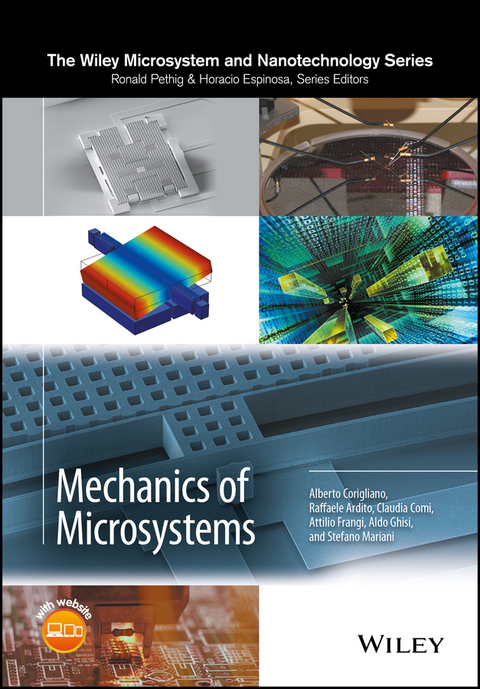
Mechanics of Microsystems

Alberto Corigliano, Raffaele Ardito, Claudia Comi, Attilio Frangi, Aldo Ghisi and Stefano Mariani, Politecnico di Milano, Italy


A mechanical approach to microsystems, covering fundamental concepts including MEMS design, modelling and reliability


Mechanics of Microsystems takes a mechanical approach to microsystems and covers fundamental concepts including MEMS design, modelling and reliability. The book examines the mechanical behaviour of microsystems from a 'design for reliability' point of view and includes examples of applications in industry.

Mechanics of Microsystems is divided into two main parts. The first part recalls basic knowledge related to the microsystems behaviour and offers an overview on microsystems and fundamental design and modelling tools from a mechanical point of view, together with many practical examples of real microsystems. The second part covers the mechanical characterization of materials at the micro-scale and considers the most important reliability issues (fracture, fatigue, stiction, damping phenomena, etc) which are fundamental to fabricate a real working device.


Key features:

  • Provides an overview of MEMS, with special focus on mechanical-based Microsystems and reliability issues.
  • Includes examples of applications in industry.
  • Accompanied by a website hosting supplementary material.


The book provides essential reading for researchers and practitioners working with MEMS, as well as graduate students in mechanical, materials and electrical engineering.


Alberto Corigliano, Raffaele Ardito, Claudia Comi, Attilio Frangi, Aldo Ghisi, and Stefano Mariani - Politecnico di Milano, Italy

Alberto Corigliano is a Professor of Solid and Structural Mechanics at the Department of Civil and Environmental Engineering of Politecnico di Milano, Italy. A. Corigliano has authored and co-authored more than 240 scientific publications in fields related to solid and structural mechanics at various scales, including 2 book chapters in Microsystems area, and 7 patents on Microsystems. During his research activity, A. Corigliano covered a wide range of subjects in the fields of structural and materials mechanics, with particular reference to theoretical and computational problems relevant to non-linear material responses.

Raffaele Ardito is an Associate Professor of Solid and Structural Mechanics at the Department of Civil and Environmental Engineering of Politecnico di Milano, Italy. He graduated in 2000 (cum laude) at the Politecnico di Milano in Civil Engineering and he received the Ph.D. degree, cum laude, in 2004. From 2004 to 2006 he was a research fellow at the National Institute for Nuclear Physics, joining an international research group with focus on solid mechanics in cryogenic conditions. He spent, in 2008 and 2010, two periods of research at the Research Laboratory of Electronics, Massachusetts Institute of Technology, as visiting scientist. His scientific contributions to the field of MEMS focus on theoretical and computational aspects of adhesion and multi-physics behavior.

Claudia Comi is a Professor of Solid and Structural Mechanics at the Department of Civil and Environmental Engineering of Politecnico di Milano, Italy. C. Comi has authored and co-authored more than 140 scientific publications in various fields of solid and structural mechanics and 4 patents on Microsystems. Her main research interests concern theoretical and computational mechanics of materials and structures. Her research activities focus on damage and quasi-brittle fracture modelling, on instability phenomena and nonlocal models for elastoplastic and damaging one-phase and multi-phase materials, including functionally graded materials, and on design and reliability of MEMS.

Attilio Frangi is a Professor of Solid and Structural Mechanics at the Department of Civil and Environmental Engineering of Politecnico di Milano, Italy. A. Frangi has authored and co-authored more than 150 scientific publications on issues of computational mechanics and micromechanics and 5 patents on Microsystems. He has co-edited one scientific monograph on the multi-physics simulation of MEMS and NEMS. The research interests of A. Frangi in the field of MEMS include: the design of new devices; the theoretical and numerical analysis of multi-physics phenomena; the analysis of non-linear phenomena in the dynamical response of MOEMS.

Aldo Ghisi is an Assistant Professor of Solid and Structural Mechanics at the Department of Civil and Environmental Engineering of Politecnico di Milano, Italy. A. Ghisi has authored and co-authored more than 70 scientific publications on various subjects related to materials and structural mechanics. His research areas include multi-physics phenomena in micro/nano structures, particularly related to mechanical simulation of drop impacts, fatigue in polysilicon, gas-solid interaction, study of wafer-to-wafer bonding. Besides microsystems, he is also involved in the numerical and experimental study of metallic alloys for cryogenic applications and in dam engineering.

Stefano Mariani is an Associate Professor of Solid and Structural Mechanics at the Department of Civil and Environmental Engineering of Politecnico di Milano, Italy. S. Mariani has authored and co-authored about 170 scientific publications. His main research interests are: numerical simulations of ductile fracture in metals and quasi-brittle fracture in heterogeneous and functionally graded materials; extended finite element methods; calibration of constitutive models via extended and sigma-point Kalman filters; multi-scale solution methods for dynamic delamination in layered composites; reliability of MEMS subject to shocks and drops; structural health monitoring of composite structures through MEMS sensors.


Mechanics of Microsystems Alberto Corigliano, Raffaele Ardito, Claudia Comi, Attilio Frangi, Aldo Ghisi and Stefano Mariani, Politecnico di Milano, Italy A mechanical approach to microsystems, covering fundamental concepts including MEMS design, modelling and reliability Mechanics of Microsystems takes a mechanical approach to microsystems and covers fundamental concepts including MEMS design, modelling and reliability. The book examines the mechanical behaviour of microsystems from a design for reliability point of view and includes examples of applications in industry. Mechanics of Microsystems is divided into two main parts. The first part recalls basic knowledge related to the microsystems behaviour and offers an overview on microsystems and fundamental design and modelling tools from a mechanical point of view, together with many practical examples of real microsystems. The second part covers the mechanical characterization of materials at the micro-scale and considers the most important reliability issues (fracture, fatigue, stiction, damping phenomena, etc) which are fundamental to fabricate a real working device. Key features: Provides an overview of MEMS, with special focus on mechanical-based Microsystems and reliability issues. Includes examples of applications in industry. Accompanied by a website hosting supplementary material. The book provides essential reading for researchers and practitioners working with MEMS, as well as graduate students in mechanical, materials and electrical engineering.
Notation


Latin symbols


crack length
unknown variables in the method of weighted residuals
acceleration
cross-sectional area of beam
body force
beam width; magnetic field intensity
damping coefficient
specific heat
distance vector between two origins; material compliance matrix
C concentrated couple in a beam
capacitance
material stiffness matrix
electric displacement
Young's modulus
electric field
frequency
surface force
electrostatic force
viscous force
concentrated force
elastic force
acceleration due to gravity
initial gap in a capacitor
energy release rate
critical energy release rate
convection constant; function in Weibull approach
beam height
, , unit vectors of Cartesian axes
moment of inertia of beam
geometrical torsional stiffness of beam
stiffness of linear elastic spring; thermal conductivity
electrostatic stiffness
mode I stress intensity factor
mode II stress intensity factor
mode III stress intensity factor
material fracture toughness in mode I
stiffness matrix
length of beam; length of other device
length of fracture process zone
length of beam
Lagrangian functional
angular momentum with respect to point
point mass; Weibull material parameter
bending moment in a beam
torsional moment in a beam
mass matrix
axially distributed load in a beam
axial force in a beam
origin of a reference system
hydrostatic part of a stress tensor or distributed load in a beam orthogonal to beam axis; gas pressure
external power
probability of failure in Weibull approach
internal power
assigned axial load in a beam
electric charge; flow rate
electric charge contained in a volume
heat flux
internal source of thermal power per unit volume
linear momentum
radial coordinate in linear elastic fracture mechanics
R error; residual in the method of weighted residuals
stress ratio in fatigue
out-of-plane beam thickness
deviatoric stress
surface in a capacitor
action functional
time; thickness
temperature
kinetic energy
displacement function
approximating function in the method of weighted residuals
displacement vector
displacement amplitude
displacement function; stroke volume
velocity vector
weight functions in the method of weighted residuals
shear force in a beam
work of nonconservative forces
, , Cartesian axes
position vector
time-dependent amplitude of free vibration of beam

Greek symbols


coefficient of thermal expansion
parameter in Weibull approach
boundary of a deformable body
film fracture energy
free boundary of a deformable body
constrained boundary of a deformable body
displacement jump across a crack
permittivity of free space
relative permittivity
column matrix of strains
axial deformation of beam
angle of torsional rotation per unit length in a beam; angle of rotation in a rotational microactuator
Euler angle; circumferential coordinate in linear elastic fracture mechanics
first Lamé constant
second Lamé constant
dynamic viscosity
Poisson's ratio
kinematic viscosity
nondimensional constant for damping
total potential energy
mass density per unit volume
electric charge density per unit length
electric charge density per unit surface area
electric charge density per unit volume
, , incident, reflected, transmitted stress in impacts
nominal stress in Weibull approach
principal stresses
nominal stress at rupture
Weibull material parameter
equivalent stress in Weibull approach
column matrix of stresses
cohesive crack law
Euler angle; phase angle; electrostatic potential
displacement function at crack tip in linear elastic fracture mechanics
constant polarization voltage
beam curvature
Euler angle
basis functions in the method of weighted residuals
stress functions at crack tip in linear elastic fracture mechanics
undamped circular natural frequency
damped circular natural frequency
angular velocity
volume of deformable body
equivalent volume in Weibull approach

Acronyms


dof degree of freedom; degrees of freedom
MEMS microelectromechanical system; microelectromechanical systems
NEMS nanoelectromechanical system; nanoelectromechanical...

Erscheint lt. Verlag 20.11.2017
Reihe/Serie Microsystem and Nanotechnology Series
Microsystem and Nanotechnology Series
The Wiley Microsystem and Nanotechnology Series
Sprache englisch
Themenwelt Technik Bauwesen
Technik Elektrotechnik / Energietechnik
Technik Maschinenbau
Schlagworte Electrical & Electronics Engineering • Electrical Engineering • Elektrotechnik u. Elektronik • Maschinenbau • Maschinenbau - Entwurf • materials engineering • mechanical behaviour of microsystems • mechanical engineering • Mechanical Engineering - Design • Mechanics of Microsystems • MEMS • MEMS damping phenomena • MEMS design • MEMS fatigue • MEMS fracture • MEMS modelling • MEMS reliability • MEMS stiction • microsystem fundamentals • microsystem mechanics • microsystem modelling tools • microsystems • microsystems behaviour • Nanotechnologie • nanotechnology
ISBN-10 1-119-05381-1 / 1119053811
ISBN-13 978-1-119-05381-1 / 9781119053811
Informationen gemäß Produktsicherheitsverordnung (GPSR)
Haben Sie eine Frage zum Produkt?
EPUBEPUB (Adobe DRM)

Kopierschutz: Adobe-DRM
Adobe-DRM ist ein Kopierschutz, der das eBook vor Mißbrauch schützen soll. Dabei wird das eBook bereits beim Download auf Ihre persönliche Adobe-ID autorisiert. Lesen können Sie das eBook dann nur auf den Geräten, welche ebenfalls auf Ihre Adobe-ID registriert sind.
Details zum Adobe-DRM

Dateiformat: EPUB (Electronic Publication)
EPUB ist ein offener Standard für eBooks und eignet sich besonders zur Darstellung von Belle­tristik und Sach­büchern. Der Fließ­text wird dynamisch an die Display- und Schrift­größe ange­passt. Auch für mobile Lese­geräte ist EPUB daher gut geeignet.

Systemvoraussetzungen:
PC/Mac: Mit einem PC oder Mac können Sie dieses eBook lesen. Sie benötigen eine Adobe-ID und die Software Adobe Digital Editions (kostenlos). Von der Benutzung der OverDrive Media Console raten wir Ihnen ab. Erfahrungsgemäß treten hier gehäuft Probleme mit dem Adobe DRM auf.
eReader: Dieses eBook kann mit (fast) allen eBook-Readern gelesen werden. Mit dem amazon-Kindle ist es aber nicht kompatibel.
Smartphone/Tablet: Egal ob Apple oder Android, dieses eBook können Sie lesen. Sie benötigen eine Adobe-ID sowie eine kostenlose App.
Geräteliste und zusätzliche Hinweise

Buying eBooks from abroad
For tax law reasons we can sell eBooks just within Germany and Switzerland. Regrettably we cannot fulfill eBook-orders from other countries.

Mehr entdecken
aus dem Bereich
Auf der Suche nach dem Gleichgewicht

von Karl-Eugen Kurrer

eBook Download (2025)
Ernst & Sohn (Verlag)
CHF 119,95
Schwerpunkte: Bauen im Bestand; nichtmetallische Bewehrungen

von Konrad Bergmeister; Frank Fingerloos …

eBook Download (2025)
Ernst & Sohn (Verlag)
CHF 159,95
Mobilität im Umbruch

von Oliver Schwedes; Marcus Keichel

eBook Download (2025)
Springer Vieweg (Verlag)
CHF 78,15