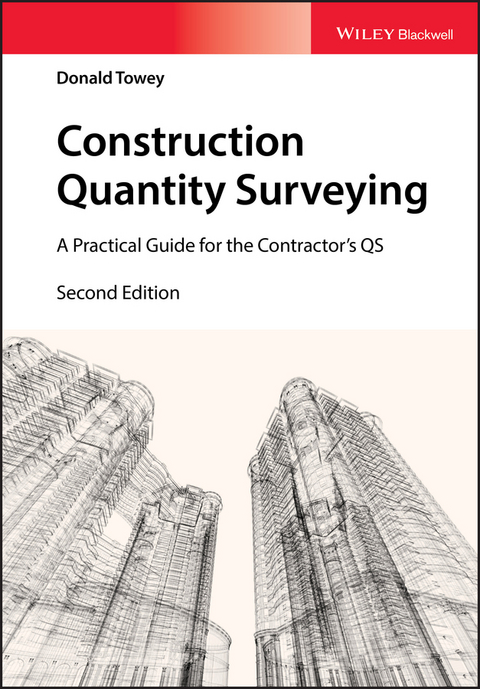
Construction Quantity Surveying (eBook)
John Wiley & Sons (Verlag)
978-1-119-31295-6 (ISBN)
The revised and updated comprehensive resource for Quantity Surveyors working with a construction contractor
The second edition of Construction Quantity Surveying offers a practical guide to quantity surveying from a main contractor's perspective. This indispensable resource covers measurement methodology (including samples using NRM2 as a guide), highlights the complex aspects of a contractor's business, reviews the commercial and contractual management of a construction project and provides detailed and practical information on running a project from commencement through to completion.
Today's Quantity Surveyor (QS) plays an essential role in the management of construction projects, although the exact nature of the role depends on who employs the QS. The QS engaged by the client and the contractor's QS have different parts to play in any construction project, with the contractor's QS role extending beyond traditional measurement activities, to encompass day-to-day tasks of commercial building activities including estimating, contract administration, and construction planning, as well as cost and project management. This updated and practical guide:
- Focuses on the application, knowledge and training required of a modern Quantity Surveyor
- Clearly shows how Quantity Surveying plays an essential central role within the overall management of construction projects
- Covers measurement methodology, the key elements of the contractor's business and the commercial and contractual management of a construction project
The construction industry changes at fast pace meaning the quantity surveyor has a key role to play in the successful execution of construction projects by providing essential commercial input. Construction Quantity Surveying meets this demand as an up-to-date practical guide that includes the information needed for a Quantity Surveyor to perform at the highest level. It clearly demonstrates that quantity surveying is not limited to quantifying trade works and shows it as an important aspect of commercial and project management of construction projects.
Donald Towey MRICS has over 30 years' experience in the construction industry. Originating from Manchester, his wealth of experience includes working with contractors and consultants in the UK, Australia and Middle East helping to deliver a range of building types for both public and private sector clients.
Donald Towey MRICS has over 30 years' experience in the construction industry. Originating from Manchester, his wealth of experience includes working with contractors and consultants in the UK, Australia and Middle East helping to deliver a range of building types for both public and private sector clients.
Preface vii
1 The Construction Industry and the Quantity Surveyor 1
1.1 Industry Overview 1
1.2 Parties Involved in a Construction Project 4
1.3 Legislation and Control of the Building Process 15
1.4 Industrial Bodies 20
1.5 Funding and Market Drivers 24
1.6 Economic and Construction Cycles 25
1.7 Development of Quantity Surveying 26
1.8 Construction Innovation and the Contractor's Quantity Surveyor 28
1.9 Prospects for the Contractor's Quantity Surveyor 36
2 Measurement and Quantities 41
2.1 Measurement Guides and Coverage Rules 41
2.2 RICS New Rules of Measurement (NRM) 42
2.3 Other Measurement Guides 44
2.4 Arrangement of Project Information 45
2.5 Measurement Terminology 50
2.6 Measurement Example 55
2.7 Builder's Quantities 57
2.8 Software Systems 72
2.9 Alternative Bills of Quantities 73
3 Working with the Main Contractor 77
3.1 Contracting Organisations 77
3.2 Management Systems 83
3.3 Marketing for Contracts 87
3.4 Procurement 89
3.5 Estimating and the Contractor's Quantity Surveyor 111
3.6 Construction Contracts 149
3.7 Remedies for Breach of Contract 165
4 Project Commencement 175
4.1 The Project Team 175
4.2 Pre?]Construction Handover 177
4.3 Office and Site?]Based Roles 178
4.4 Construction Programme 179
4.5 Project Administration 184
4.6 Site Establishment 205
4.7 Review of the Main Contract 209
5 Supply Chain Procurement 243
5.1 The Supply Chain 243
5.2 Labour?]Only Subcontractors 245
5.3 Labour and Material Subcontractors 248
5.4 Material Supply Scheduling and Purchase Ordering 267
5.5 Labour Hire Agreements 272
5.6 Plant Hire Agreements 274
5.7 Consultant Appointments 275
6 Running the Project 279
6.1 Document Control 279
6.2 Changes to the Works 283
6.3 Reimbursement 292
6.4 Cost Centres and Financial Reporting 309
6.5 Tracking Expenditure 310
6.6 Extension of Time (EOT) Claims 314
6.7 Financial Claims 318
6.8 Voluntary and Involuntary Contract Terminations 328
6.9 Project Reporting 336
7 Project Completion 339
7.1 Sectional and Practical Completion 339
7.2 Operating Manuals and As?]Built Information 342
7.3 Defects 345
7.4 Final Accounts 347
7.5 Project Closure 355
Further Reading 359
Index 361
1
The Construction Industry and the Quantity Surveyor
1.1 Industry Overview
The construction industry is a generic term for a service industry forming part of the nation’s economy that carries out the planning, designing, constructing, altering, refurbishing, maintaining, repairing and demolition of structures. It is a large dynamic and complex industry that plays an important role in the economy of which there are three sectors, that is, buildings, infrastructure and industrial. Building construction can be subdivided into two groups, residential and non‐residential. The former requires no elaboration, while the latter encompasses commercial, institutional and government‐owned/leased projects covering a range of building types such as hotels, banks, schools and hospitals. Infrastructure refers to highway and civil engineering structures, including large public works such as motorways, bridges and other transportation networks, utility distribution and water/wastewater treatment. Industrial includes chemical processing plants, warehouses, factories, power generation facilities, manufacturing plants and mills. The construction process commences with a planning stage stemming from early designs and includes financing and developing the designs for working purposes. This continues with a construction phase until the project is complete, which triggers the occupational phase when the building is operated as its intended use.
1.1.1 The British Construction Industry
The demand for new buildings and the refurbishment of existing is driven by available spending in the public and private sectors. Because of this, the construction industry is buoyant in terms of the demands it must meet, yet is susceptible to the mood of local economies and the national economy as a whole at any time. According to a House of Commons Briefing Paper entitled Construction industry: statistics and policy published during Q4 of 2015, the British construction industry amassed £103 billion in economic output during 2014. This represents 6.5% of the gross value added (GVA), which is the construction industry’s economic contribution to the total value of the national accounts. The briefing paper advises that employment in the industry grew at a steady pace since 2010, with 2.11 million jobs filled during 2015. The paper predicts that a decade of future economic growth lies ahead based on the (then) coalition government’s report Construction 2025, which was published during Q3 2013 and prepared from the guidance and support of the Construction Industrial Strategy Advisory Council (CISAC), an advisory body comprising members that seek, construct and issue advice on buildings and infrastructure. This report predicts world economic output will grow at a rate of 4.3% per annum through to 2025, which will create changes in the international economy and provide new opportunities for the United Kingdom. To embrace these opportunities and be well placed domestically, the government has pledged to work with a range of industrial bodies with end goals for 2025 that aim to:
- reduce the initial cost of construction and whole life asset cost by one‐third (2009/2010 levels);
- reduce by half the overall time it takes to acquire new/refurbished buildings from inception to completion (2013 industrial outputs);
- reduce by half greenhouse gas emissions in the built environment (based on 1990 levels); and
- reduce by half the trade gap between imports and exports for construction products and materials (based on a trade deficit of £6 billion in 2013).
With such challenges ahead, the industry must be ready for change and is indeed a giant in terms of the contribution it makes to the nation’s economy which creates room for interesting careers and job security in the process.
1.1.2 Equal Opportunities and Diversity
The UK is a diverse society comprising people from multicultural and multilingual backgrounds, where everyone has something different to bring to society and the workplace. The construction industry is one that requires a variety of skills and abilities to function, which means it is important for people from different backgrounds, life experiences and abilities to be suitably employed to enable the industry to achieve the high levels of skills and deliverables needed. For this reason, employers, unions, service providers, service users and industrial bodies are encouraged to endorse integration regardless of age, disability, gender reassignment, marriage or civil partnership, pregnancy and maternity, race, religion and beliefs, gender, sexual orientation or socio‐economic background. This requirement is also legislated under UK labour law with the Equality Act 2010 applicable in England and Wales and, in part, Scotland and Northern Ireland. The Act makes it illegal to discriminate against access to education, public services, private goods and services or premises and employment opportunities. Hailed by lawyers as the most significant development of equality legislation in decades, the Act harmonises and consolidates previous anti‐discrimination legislation, and strengthens legal rights to equality. The Act’s purpose was to replace a mass of disjointed legislation with more uniform, accessible and comprehensive rights. Following its introduction, it has succeeded in setting standards and raising awareness of rights to equality, as well as tackling discrimination and, in particular, the role of the public sector with regards achieving equality.
1.1.3 Global Construction
In a report entitled Global Construction 2030 published by Global Perspectives Ltd during Q4 2015, the global construction market is expected to grow by an average of 3.9% per annum from 2015 through to 2030. This is comparable to the 4.3% prediction through to 2025 advised in the UK Government’s report Construction 2025. According to Global Construction 2030, cumulative growth through to 2030 will surpass global domestic product (GDP) (the construction industry’s economic contribution to the total value of a nation’s accounts including taxes less subsidies) by one‐quarter. This is primarily due to developed countries continuing to gather pace following a sustained period of economic stability, and the ongoing confidence of developing countries with industrialisation and reform. China is expected to be the largest construction market for most of the period, anticipated to level off by 2030, with the United States growing at a faster rate in second place with the financial gap narrowing during the period. India’s economy is expected to surpass that of Japan to become the third‐largest construction market by 2021, with the top three accounting for 57% of all growth. It is predicted that Japan’s role will be notched down to fourth place by 2030 to be taken over by Indonesia.
For cultural reasons, countries tend to rely on home‐grown companies to design, manage and construct projects with their residents/citizens incentivised under labour law to carry out services. This varies from country to country and region to region, and even with the local market tested, it is still possible for skill shortages to affect the servicing of projects. This is appeased with globalisation and the services of international recruitment and construction companies that seek candidates for project employers in host countries. The selection and suitability of such candidates can be endorsed with experience, qualifications and membership of trade and/or professional institutions that have reciprocal agreements with their counterparts in other countries, meaning the status can be obtained in more than one country at the same time.
Foreign recruitment and the investment in overseas schemes can lead to the expansion of a business and the opening of overseas branches. The integration of a new business with the construction industry of another country is indeed a challenge, and one that requires commitment to time and resources. A risk management strategy is therefore vital, which must be created by any business wishing to diversify its interests meaning the impact of the investment must be fully understood prior to making commitments. When appraising the possibilities for starting an overseas construction business, the investor must have an understanding of risks associated with any of the following:
- the need to invest, competition expected and the likelihood of securing contracts;
- referral from others that may have already ventured into the locality and their results;
- anticipated duration of the overseas investment (i.e. short‐ or long‐term or permanent);
- financial stability of the overseas country;
- financial stability of the home country and foreseeable trends (e.g. currency exchange rates, existence of double taxation treaties, changes in legislation and tax breaks);
- performance of competitors on completed projects (i.e. what is normal and the quality expected);
- trade unions and their influence;
- health, safety and environmental attitudes;
- availability of suitable labour skills and material resources;
- political stability;
- cultural working practices;
- existence of corruption;
- legislation with regards planning at local and national level;
- existing industrial relations and building control;
- land and terrain;
- sources and status of infrastructure and utility service providers;
- terrorism and militants;
- communication...
| Erscheint lt. Verlag | 7.9.2017 |
|---|---|
| Sprache | englisch |
| Themenwelt | Technik ► Bauwesen |
| Schlagworte | Bauingenieur- u. Bauwesen • Bauökonomie • Civil Engineering & Construction • <p>Alternative bills of quantities, Builder’s bills of quantities, Building costs, Building project, Changes to the works, Commercial and contractual management, Construction clients, Construction contractor, Construction contracts, Construction Defects, Construction innovation, Construction Procurement, Construction project, Construction Project administration, Construction Project Commencement, Construction Supply Chain Procurement, Contracting organisations, Contractor’s business, Contractor’s QS, Contra • Massenermittlung u. Bauökonomie • Quantity Surveying & Construction Economics |
| ISBN-10 | 1-119-31295-7 / 1119312957 |
| ISBN-13 | 978-1-119-31295-6 / 9781119312956 |
| Informationen gemäß Produktsicherheitsverordnung (GPSR) | |
| Haben Sie eine Frage zum Produkt? |
 EPUB (Adobe DRM)
Kopierschutz: Adobe-DRM
Adobe-DRM ist ein Kopierschutz, der das eBook vor Mißbrauch schützen soll. Dabei wird das eBook bereits beim Download auf Ihre persönliche Adobe-ID autorisiert. Lesen können Sie das eBook dann nur auf den Geräten, welche ebenfalls auf Ihre Adobe-ID registriert sind.
Details zum Adobe-DRM
Dateiformat: EPUB (Electronic Publication)
EPUB ist ein offener Standard für eBooks und eignet sich besonders zur Darstellung von Belletristik und Sachbüchern. Der Fließtext wird dynamisch an die Display- und Schriftgröße angepasst. Auch für mobile Lesegeräte ist EPUB daher gut geeignet.
Systemvoraussetzungen:
PC/Mac: Mit einem PC oder Mac können Sie dieses eBook lesen. Sie benötigen eine
eReader: Dieses eBook kann mit (fast) allen eBook-Readern gelesen werden. Mit dem amazon-Kindle ist es aber nicht kompatibel.
Smartphone/Tablet: Egal ob Apple oder Android, dieses eBook können Sie lesen. Sie benötigen eine
Geräteliste und zusätzliche Hinweise
Buying eBooks from abroad
For tax law reasons we can sell eBooks just within Germany and Switzerland. Regrettably we cannot fulfill eBook-orders from other countries.
aus dem Bereich