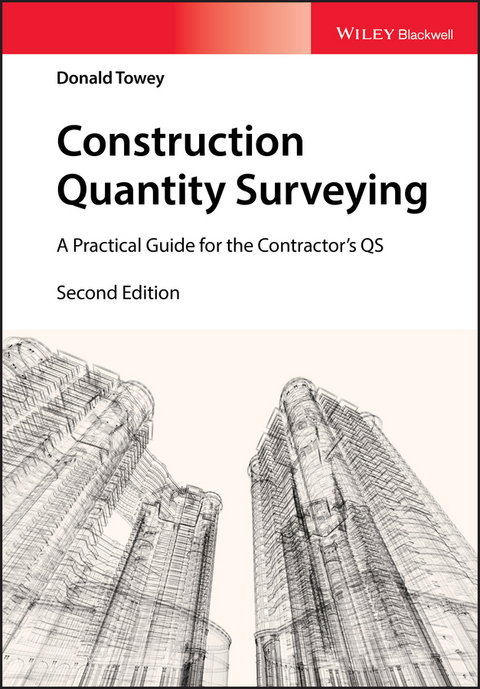
Construction Quantity Surveying (eBook)
John Wiley & Sons (Verlag)
978-1-119-31294-9 (ISBN)
The revised and updated comprehensive resource for Quantity Surveyors working with a construction contractor
The second edition of Construction Quantity Surveying offers a practical guide to quantity surveying from a main contractor's perspective. This indispensable resource covers measurement methodology (including samples using NRM2 as a guide), highlights the complex aspects of a contractor's business, reviews the commercial and contractual management of a construction project and provides detailed and practical information on running a project from commencement through to completion.
Today's Quantity Surveyor (QS) plays an essential role in the management of construction projects, although the exact nature of the role depends on who employs the QS. The QS engaged by the client and the contractor's QS have different parts to play in any construction project, with the contractor's QS role extending beyond traditional measurement activities, to encompass day-to-day tasks of commercial building activities including estimating, contract administration, and construction planning, as well as cost and project management. This updated and practical guide:
- Focuses on the application, knowledge and training required of a modern Quantity Surveyor
- Clearly shows how Quantity Surveying plays an essential central role within the overall management of construction projects
- Covers measurement methodology, the key elements of the contractor's business and the commercial and contractual management of a construction project
The construction industry changes at fast pace meaning the quantity surveyor has a key role to play in the successful execution of construction projects by providing essential commercial input. Construction Quantity Surveying meets this demand as an up-to-date practical guide that includes the information needed for a Quantity Surveyor to perform at the highest level. It clearly demonstrates that quantity surveying is not limited to quantifying trade works and shows it as an important aspect of commercial and project management of construction projects.
Donald Towey MRICS has over 30 years' experience in the construction industry. Originating from Manchester, his wealth of experience includes working with contractors and consultants in the UK, Australia and Middle East helping to deliver a range of building types for both public and private sector clients.
The revised and updated comprehensive resource for Quantity Surveyors working with a construction contractor The second edition of Construction Quantity Surveying offers a practical guide to quantity surveying from a main contractor's perspective. This indispensable resource covers measurement methodology (including samples using NRM2 as a guide), highlights the complex aspects of a contractor's business, reviews the commercial and contractual management of a construction project and provides detailed and practical information on running a project from commencement through to completion. Today s Quantity Surveyor (QS) plays an essential role in the management of construction projects, although the exact nature of the role depends on who employs the QS. The QS engaged by the client and the contractor's QS have different parts to play in any construction project, with the contractor's QS role extending beyond traditional measurement activities, to encompass day-to-day tasks of commercial building activities including estimating, contract administration, and construction planning, as well as cost and project management. This updated and practical guide: Focuses on the application, knowledge and training required of a modern Quantity Surveyor Clearly shows how Quantity Surveying plays an essential central role within the overall management of construction projects Covers measurement methodology, the key elements of the contractor's business and the commercial and contractual management of a construction project The construction industry changes at fast pace meaning the quantity surveyor has a key role to play in the successful execution of construction projects by providing essential commercial input. Construction Quantity Surveying meets this demand as an up-to-date practical guide that includes the information needed for a Quantity Surveyor to perform at the highest level. It clearly demonstrates that quantity surveying is not limited to quantifying trade works and shows it as an important aspect of commercial and project management of construction projects.
Donald Towey MRICS has over 30 years' experience in the construction industry. Originating from Manchester, his wealth of experience includes working with contractors and consultants in the UK, Australia and Middle East helping to deliver a range of building types for both public and private sector clients.
Title Page 5
Copyright Page 6
Contents 7
Preface 9
Chapter 1 The Construction Industry and the Quantity Surveyor 11
1.1 Industry Overview 11
1.1.1 The British Construction Industry 11
1.1.2 Equal Opportunities and Diversity 12
1.1.3 Global Construction 12
1.2 Parties Involved in a Construction Project 14
1.2.1 The Client’s Team 14
1.2.2 Architect 16
1.2.3 Geotechnical Engineer 18
1.2.4 Structural Engineer 18
1.2.5 Civil Engineer 19
1.2.6 Service Engineers 20
1.2.7 The Client’s Quantity Surveyor/Cost Manager 22
1.2.8 Main Contractor 23
1.3 Legislation and Control of the Building Process 25
1.3.1 Planning Permission 25
1.3.2 Building Regulations 27
1.3.3 Building Control 27
1.3.4 CDM Regulations 2015 28
1.4 Industrial Bodies 30
1.4.1 Royal Institution of Chartered Surveyors (RICS) 30
1.4.2 Chartered Institute of Building (CIOB) 31
1.4.3 Benefits of Membership 32
1.4.4 Continuing Professional Development (CPD) 32
1.5 Funding and Market Drivers 34
1.6 Economic and Construction Cycles 35
1.7 Development of Quantity Surveying 36
1.7.1 Background 36
1.7.2 Traits and Skills of a Quantity Surveyor 37
1.7.3 Education and Training 38
1.8 Construction Innovation and the Contractor’s Quantity Surveyor 38
1.8.1 Information Technology (IT) 39
1.8.2 Building Information Modelling (BIM) 41
1.8.3 The Environment 42
1.9 Prospects for the Contractor’s Quantity Surveyor 46
1.9.1 Contracts Administrator 47
1.9.2 Contracts Manager 47
1.9.3 Commercial Manager 48
1.9.4 Project Manager 48
1.9.5 Cost Engineer 49
1.9.6 Estimator 49
1.9.7 Independent Roles 49
Chapter 2 Measurement and Quantities 51
2.1 Measurement Guides and Coverage Rules 51
2.2 RICS New Rules of Measurement (NRM) 52
2.2.1 NRM1 52
2.2.2 NRM2 52
2.2.3 NRM3 53
2.3 Other Measurement Guides 54
2.3.1 Standard Method of Measurement of Building Works (SMM) 54
2.3.2 Civil Engineering Standard Method of Measurement (CESMM) 54
2.3.3 Manual of Contract Documents for Highway Works (MCHW) 54
2.3.4 Standard Method of Measurement for Industrial Engineering Construction 55
2.3.5 Overseas 55
2.3.6 International Construction Measurement Standards (ICMS) 55
2.4 Arrangement of Project Information 55
2.4.1 Drawings 56
2.4.2 Specifications 56
2.4.3 Reports 57
2.4.4 Planning Production Schedules 57
2.5 Measurement Terminology 60
2.5.1 Taking-Off 60
2.5.2 Centre Line Calculation 61
2.5.3 Descriptions of Works 61
2.6 Measurement Example 65
2.7 Builder’s Quantities 67
2.7.1 Preambles 72
2.7.2 Measured Works 72
2.7.3 Non?Measurable Works 76
2.7.4 Preliminaries 77
2.7.5 Client?directed sums 78
2.7.6 Dayworks 80
2.7.7 Client-Engaged Contractors 81
2.7.8 Cost Centres 81
2.8 Software Systems 82
2.9 Alternative Bills of Quantities 83
2.9.1 Operational Bills 83
2.9.2 Activity Bills 84
2.9.3 Annotated Bills 84
2.9.4 Elemental Bills 84
2.9.5 Approximate Quantities 84
Chapter 3 Working with the Main Contractor 87
3.1 Contracting Organisations 87
3.1.1 Tier 3 Small-Sized Contractors 87
3.1.2 Tier 2 (Medium-Sized) and Tier 1 (Large-Sized) Contractors 88
3.1.3 Premises and Assets 89
3.2 Management Systems 93
3.2.1 Health and Safety Management 94
3.2.2 Environmental Management 94
3.2.3 Quality Management 95
3.3 Marketing for Contracts 97
3.4 Procurement 99
3.4.1 The Client’s Brief 99
3.4.2 Traditional Pathways 100
3.4.3 Design and Build 103
3.4.4 Construction Management Schemes 106
3.4.5 Private Finance Initiative (PFI) and Public–Private Partnerships (PPPs) 108
3.4.6 Prime Contracting 114
3.4.7 Partnering and Strategic Alliances 116
3.4.8 Project Alliances 117
3.4.9?Framework Arrangements 118
3.4.10 Public Procurement and European Legislation 118
3.5 Estimating and the Contractor’s Quantity Surveyor 121
3.5.1 Activity on Receipt of Tender Documents 122
3.5.2 Trade Contractor Pricing 124
3.5.3 Works Schedules 130
3.5.4 Resources Costing 131
3.5.5 Unit Rate Calculations 139
3.5.6 Operational Estimating 142
3.5.7 Preliminaries Pricing 144
3.5.8 Cost-Planned Tenders 152
3.5.9 Tender Submission 156
3.5.10 Value Management 158
3.6 Construction Contracts 159
3.6.1 Memorandums of Understanding 159
3.6.2 The Joint Contracts Tribunal (JCT) 161
3.6.3 New Engineering Contract (NEC) 166
3.6.4 GC/Work Contracts 168
3.6.5 Association of Consultant Architects (ACA) 169
3.6.6 Institution of Civil Engineers (ICE) 170
3.6.7 Institution of Chemical Engineers (IChemE) 170
3.6.8 Fédération Internationale des Ingénieurs-Conseils (FIDIC) 171
3.6.9 Edited and Bespoke Forms of Contract 173
3.7 Remedies for Breach of Contract 175
3.7.1 Litigation 176
3.7.2 Alternative Dispute Resolution (ADR) 177
3.7.3 Negotiation 178
3.7.4 Mediation 178
3.7.5 Conciliation 179
3.7.6 Dispute Boards 179
3.7.7 Early Neutral Evaluation 180
3.7.8 Expert Determination 181
3.7.9 Adjudication 182
3.7.10 Arbitration 183
Chapter 4 Project Commencement 185
4.1 The Project Team 185
4.2 Pre-Construction Handover 187
4.3 Office and Site-Based Roles 188
4.4 Construction Programme 189
4.4.1 Programme Float 192
4.4.2 Programme Acceleration 193
4.5 Project Administration 194
4.5.1 Cash Flow 196
4.5.2 Cost Targets 200
4.5.3 Works Package Scheduling 201
4.5.4 Material Supply and Plant Hire Registers 207
4.5.5 Design and Documentation Registers 208
4.5.6 Progress Claim Scheduling 209
4.5.7 Cost Management Systems (CMS) 214
4.6 Site Establishment 215
4.6.1 Site Induction 216
4.7 Review of the Main Contract 219
4.7.1 Expressed and Implied Terms 220
4.7.2 Articles of the Agreement 221
4.7.3 Insurance 223
4.7.4 Employer’s Financial Security 227
4.7.5 Carrying out the Works 229
4.7.6 Delays in Carrying Out the Works 236
4.7.7 Control of the Works 241
4.7.8 Cost Variations 244
4.7.9 Payments 246
4.7.10 Termination 247
4.7.11 Warranties 248
4.7.12 Contract Schedules and Special Provisions 249
Chapter 5 Supply Chain Procurement 253
5.1 The Supply Chain 253
5.2 Labour-Only Subcontractors 255
5.2.1 Methods of Engagement and Reimbursement 255
5.2.2 Contractor’s Risk 256
5.3 Labour and Material Subcontractors 258
5.3.1 Domestic Subcontractors 258
5.3.2 Nominated Subcontractors 261
5.3.3 Tender Periods and Openings 262
5.3.4 Tender Comparisons 264
5.3.5 Negotiations 265
5.3.6 Subcontractor Insurances 271
5.3.7 Bespoke Forms of Subcontract Agreement 273
5.3.8 Generic Forms of Subcontract Agreement 276
5.3.9 Back-to-Back Forms of Subcontract Agreement 276
5.4 Material Supply Scheduling and Purchase Ordering 277
5.4.1 Bulk Orders 280
5.5 Labour Hire Agreements 282
5.5.1 Apprentices 283
5.5.2 Management Hire 284
5.6 Plant Hire Agreements 284
5.7 Consultant Appointments 285
5.7.1 With Design Input 286
5.7.2 Without Design Input 286
Chapter 6 Running the Project 289
6.1 Document Control 289
6.1.1 Design and Documentation Changes 289
6.1.2 Contractor-Generated Documents 291
6.2 Changes to the Works 293
6.2.1 Changes in Quantity 294
6.2.2 Changes in Quality 294
6.2.3 Changes in Sequence of Works 296
6.2.4 Abortive Works 298
6.2.5 Variation Submissions 300
6.2.6 Rejection of a Variation 301
6.3 Reimbursement 302
6.3.1 Client Interim Payments 303
6.3.2 Subcontractor’s Payments 310
6.3.3 Material Suppliers and Hire Company Payments 315
6.3.4 Consultant’s Payments 318
6.3.5 Project Banking 318
6.4 Cost Centres and Financial Reporting 319
6.5 Tracking Expenditure 320
6.5.1 Accruals 320
6.5.2 Cost Value Reconciliations (CVRs) 323
6.6 Extension of Time (EOT) Claims 324
6.7 Financial Claims 328
6.7.1 Delay and Prolongation 329
6.7.2 Disruption and Acceleration 331
6.7.3 Common Law 333
6.7.4 Ex Gratia 333
6.7.5 Set-Off 334
6.7.6 Claims from the Supply Chain to the Contractor 334
6.7.7 Claims from the Contractor to the Supply Chain 337
6.8 Voluntary and Involuntary Contract Terminations 338
6.8.1 Main Contract Termination 339
6.8.2 Supply Chain Terminations 341
6.9 Project Reporting 346
Chapter 7 Project Completion 349
7.1 Sectional and Practical Completion 349
7.1.1 Final Certification 350
7.1.2 Definition and Effect of Practical Completion 351
7.2 Operating Manuals and As-Built Information 352
7.3 Defects 355
7.3.1 Patent Defects 355
7.3.2 Latent Defects 357
7.4 Final Accounts 357
7.4.1 Main Contract Final Account 358
7.4.2 Issue and Effect of the Final Payment Certificate 360
7.4.3 Supply Chain Final Accounts 362
7.4.4 Final Project Costs 363
7.5 Project Closure 365
7.5.1 Feedback 365
7.5.2 Archiving and Retrieval 366
Further Reading 369
Index 371
EULA 379
| Erscheint lt. Verlag | 5.9.2017 |
|---|---|
| Sprache | englisch |
| Themenwelt | Technik ► Bauwesen |
| Schlagworte | Bauingenieur- u. Bauwesen • Bauökonomie • Civil Engineering & Construction • <p>Alternative bills of quantities, Builder’s bills of quantities, Building costs, Building project, Changes to the works, Commercial and contractual management, Construction clients, Construction contractor, Construction contracts, Construction Defects, Construction innovation, Construction Procurement, Construction project, Construction Project administration, Construction Project Commencement, Construction Supply Chain Procurement, Contracting organisations, Contractor’s business, Contractor’s QS, Contra • Massenermittlung u. Bauökonomie • Quantity Surveying & Construction Economics |
| ISBN-10 | 1-119-31294-9 / 1119312949 |
| ISBN-13 | 978-1-119-31294-9 / 9781119312949 |
| Informationen gemäß Produktsicherheitsverordnung (GPSR) | |
| Haben Sie eine Frage zum Produkt? |
 PDF (Adobe DRM)
Kopierschutz: Adobe-DRM
Adobe-DRM ist ein Kopierschutz, der das eBook vor Mißbrauch schützen soll. Dabei wird das eBook bereits beim Download auf Ihre persönliche Adobe-ID autorisiert. Lesen können Sie das eBook dann nur auf den Geräten, welche ebenfalls auf Ihre Adobe-ID registriert sind.
Details zum Adobe-DRM
Dateiformat: PDF (Portable Document Format)
Mit einem festen Seitenlayout eignet sich die PDF besonders für Fachbücher mit Spalten, Tabellen und Abbildungen. Eine PDF kann auf fast allen Geräten angezeigt werden, ist aber für kleine Displays (Smartphone, eReader) nur eingeschränkt geeignet.
Systemvoraussetzungen:
PC/Mac: Mit einem PC oder Mac können Sie dieses eBook lesen. Sie benötigen eine
eReader: Dieses eBook kann mit (fast) allen eBook-Readern gelesen werden. Mit dem amazon-Kindle ist es aber nicht kompatibel.
Smartphone/Tablet: Egal ob Apple oder Android, dieses eBook können Sie lesen. Sie benötigen eine
Geräteliste und zusätzliche Hinweise
Buying eBooks from abroad
For tax law reasons we can sell eBooks just within Germany and Switzerland. Regrettably we cannot fulfill eBook-orders from other countries.
aus dem Bereich