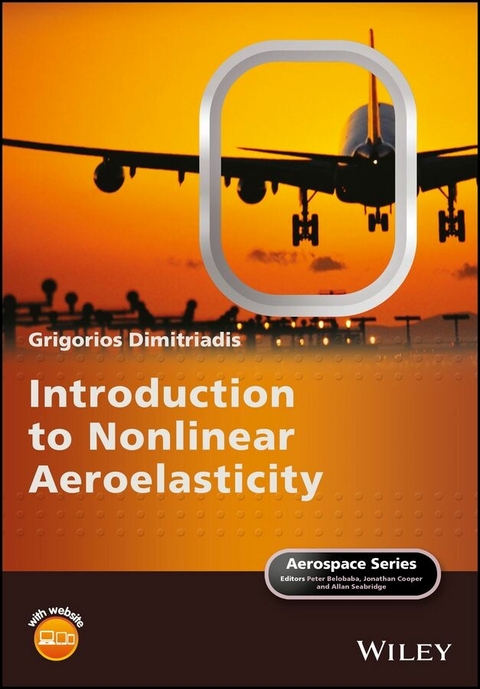
Introduction to Nonlinear Aeroelasticity (eBook)
John Wiley & Sons (Verlag)
978-1-118-75646-1 (ISBN)
Introduction to Nonlinear Aeroelasticity
Grigorios Dimitriadis, University of Liège, Belgium
Introduces the latest developments and technologies in the area of
nonlinear aeroelasticity
Nonlinear aeroelasticity has become an increasingly popular research area in recent years. There have been many driving forces behind this development, increasingly flexible structures, nonlinear control laws, materials with nonlinear characteristics, etc. Introduction to Nonlinear Aeroelasticity covers the theoretical basics in nonlinear aeroelasticity and applies the theory to practical problems.
As nonlinear aeroelasticity is a combined topic, necessitating expertise from different areas, the book introduces methodologies from a variety of disciplines such as nonlinear dynamics, bifurcation analysis, unsteady aerodynamics, non-smooth systems and others. The emphasis throughout is on the practical application of the theories and methods, so as to enable the reader to apply their newly acquired knowledge.
Key features:
- Covers the major topics in nonlinear aeroelasticity, from the galloping of cables to supersonic panel flutter.
- Discusses nonlinear dynamics, bifurcation analysis, numerical continuation, unsteady aerodynamics and non-smooth systems.
- Considers the practical application of the theories and methods.
- Covers nonlinear dynamics, bifurcation analysis and numerical methods.
- Accompanied by a website hosting Matlab code.
Introduction to Nonlinear Aeroelasticity is a comprehensive reference for researchers and workers in industry and is also a useful introduction to the subject for graduate and undergraduate students across engineering disciplines.
Grigorios Dimitriadis, University of Liège, Belgium
Introduction to Nonlinear Aeroelasticity Introduces the latest developments and technologies in the area of nonlinear aeroelasticity Nonlinear aeroelasticity has become an increasingly popular research area in recent years. There have been many driving forces behind this development, increasingly flexible structures, nonlinear control laws, materials with nonlinear characteristics and so on. Introduction to Nonlinear Aeroelasticity covers the theoretical basics in nonlinear aeroelasticity and applies the theory to practical problems. As nonlinear aeroelasticity is a combined topic, necessitating expertise from different areas, the book introduces methodologies from a variety of disciplines such as nonlinear dynamics, bifurcation analysis, unsteady aerodynamics, non-smooth systems and others. The emphasis throughout is on the practical application of the theories and methods, so as to enable the reader to apply their newly acquired knowledge Key features: Covers the major topics in nonlinear aeroelasticity, from the galloping of cables to supersonic panel flutter Discusses nonlinear dynamics, bifurcation analysis, numerical continuation, unsteady aerodynamics and non-smooth systems Considers the practical application of the theories and methods Covers nonlinear dynamics, bifurcation analysis and numerical methods Accompanied by a website hosting Matlab code Introduction to Nonlinear Aeroelasticity is a comprehensive reference for researchers and workers in industry and is also a useful introduction to the subject for graduate and undergraduate students across engineering disciplines.
Grigorios Dimitriadis, University of Liège, Belgium
1
Introduction
Nonlinear aeroelasticity is the study of the interactions between inertial, elastic and aerodynamic forces on engineering structures that are exposed to an airflow and feature non‐negligible nonlinearity. There exist several good textbooks on linear aeroelasticity for aircraft (Bisplinghoff et al. 1996; Fung 1993; Hodges and Alvin Pierce 2002; Wright and Cooper 2015). Dowell (2004) even includes chapters on nonlinear aeroelasticity and stall flutter, while Paidoussis et al. (2011) discusses a number of nonlinear aeroelastic phenomena occurring in civil engineering structures. However, there is no introductory text that presents the methodologies of nonlinear dynamics and applies them to a wide range of nonlinear aeroelastic systems. The present book aims to fill this gap to a certain degree. The subject area is vast and mutlidisciplinary and it would be impossible to fit every aspect of it in a textbook. The main omission is high fidelity numerical simulation using Computational Fluid Dynamics and Computational Structural Dynamics solvers; these methodologies are already the subject of a dedicated text (Bazilevs et al. 2013). The aerodynamic models used in this book are analytical, empirical or based on panel methods while the structural models are either analytical or make use of series solutions.
The book is introductory but it assumes knowledge of structural dynamics, aerodynamics and some linear aeroelasticity. The main linear aeroelastic phenomena of flutter and static divergence are discussed in detail because they can affect nonlinear behaviour, but the present work is by no means a complete text on linear aeroelasticity. Unsteady aerodynamic modelling is used throughout the book and discussed in Chapters 8, 10 and in the Appendix. However, again this book is not a complete reference on unsteady aerodynamics, linear or nonlinear. On the other hand, nonlinear dynamics and bifurcation analysis are presented in great detail as they do not normally feature in most undergraduate or even graduate Aerospace and Mechanical Engineering courses. The emphasis of all discussions is on the application rather than the rigorous derivation of the theorems; there already exist several classic textbooks for the latter (Kuznetsov 1998; Guckenheimer and Holmes 1983). More application‐based works on nonlinear dynamics also exist (e.g. Strogatz 1994) but they address a wide range of physical, chemical, biological, accounting models, to name a few, whereas the present book concentrates exclusively on aeroelastic phenomena.
Nonlinear aeroelasticity has become an increasingly popular research area over the last 30 years. There have been many driving forces behind this development, including faster computers, increasingly flexible structures, automatic control systems for aircraft and other engineering products, new materials, optimisation‐based design methods and others. Aeroelasticians have acquired expertise from many different fields in order to address nonlinear aeroelastic problems, mainly nonlinear dynamics, bifurcation analysis, control theory, nonlinear structural analysis and Computational Fluid Dynamics. The main applications of nonlinear aeroelasticity lie in aeronautics and civil engineering but other types of structure are also concerned, such as bridges and wind turbines.
In classical linear aeroelasticity, the relationships between the states of a system and the internal forces acting on them are always assumed to be linear. Force‐displacement diagrams for the structure and lift or moment curves for the aerodynamics are always assumed to be linear, while friction is neglected and damping is also linear. As an example, consider a torsional spring that provides a restoring moment M when twisted through an angle ϕ. Figure 1.1a plots experimentally measured values of ϕ and M. Clearly, the function M(ϕ) is not linear but, if we concentrate in the range , the curve is nearly linear and we can curve fit it as the straight line , where K is the linear stiffness of the spring.
Figure 1.1 Linearised load‐displacement diagrams
Figure 1.1b plots the aerodynamic lift coefficient acting on a wing placed at an angle α to a free stream of speed U, defined as
where l is the lift force per unit length, ρ is the air density and c is the chord. The curve cl(α) is by no means linear but, again, if we focus in the range , we can curve fit the lift coefficient as the straight line , where is the lift curve slope. An aeroelastic system featuring the spring of Figure 1.1a and the wing of Figure 1.1b will be nonlinear but, if we ensure that ϕ and α never exceed their respective linear ranges for all operating conditions, then we can treat the system as linear and use linear analysis to design it. In nonlinear aeroelasticity, the angles ϕ and α will always exceed their linear ranges and therefore we must use nonlinear analysis, both static and dynamic, in order to design the system.
Nonlinear dynamics is the field of study of nonlinear ordinary and partial differential equations, which in this book model aeroelastic systems. Unlike linear differential equations, nonlinear equations have no general analytical solutions and, in some cases, several different solutions may coexist at the same operating conditions. Furthermore, nonlinear systems can have many more types of solution than linear ones. The operating conditions of an aeroelastic system are primarily the free stream airspeed and the air density (or flight altitude), while the Reynolds number, Mach number and mean angle of attack can also be important. As these system parameters vary, the number and type of solutions of the nonlinear equations of motion can change drastically. The study of the changing nature of solutions as the system parameters are varied is known as bifurcation analysis. In this book we will use almost exclusively local bifurcation analysis, which means that we will identify individual solutions and track their nature and their intersections with other solutions for all the parameter values of interest.
A wide variety of nonlinear aeroelastic phenomena will be investigated, from the galloping of cables to the buckling and flutter of panels in supersonic flow and from stall flutter to the limit cycle oscillations of finite wings. We will also briefly discuss transonic aeroelastic phenomena but we will not analyse them in detail because such analysis requires high fidelity computational fluid and structural mechanics and is still the subject of extensive research. The equations of motion treated in this book are exclusively ordinary differential equations; whenever we encounter partial differential equations we will first transform them to ordinary using a series solution. It is hoped that the book will contribute towards the current trend of taking nonlinear aeroelasticity out of the research lab and introducing it into the classroom and in industry.
1.1 Sources of Nonlinearity
Traditionally, a lot of effort has been devoted to designing and building engineering structures that are as linear as possible. Despite this effort, nonlinearity, weak or strong, has always been present in engineering systems. In recent years, increasing amounts of nonlinearity have been tolerated or even purposefully included in many applications, since nonlinear analysis methods have progressed sufficiently to allow the handling of nonlinearity at the design stage. Furthermore, nonlinearity can have significant beneficial effects, for example in shock absorbers and suspension systems.
In this book we will only consider nonlinearities that are present in aeroelastic systems. Since aeroelasticity is of particularly importance to the fields of aeronautics, civil engineering and energy harvesting, we will limit the discussion of nonlinearity to these application areas. The nonlinear functions that are most often encountered in these systems have three main sources:
- the structure,
- the aerodynamics and
- the control system.
The structural nonlinearities of interest occur during the normal operation of the underlying engineering system. Nonlinearities appearing in damaged, cracked, plastically deformed and, in general, off‐design systems are beyond the scope of this book. The most common forms of nonlinearity appearing in structures are geometric (caused by large deformations), clearance (i.e. freeplay, contact and other non‐smooth phenomena), dissipative (i.e. friction or other nonlinear damping forces) and inertial (of particular interest in rotors and turbomachinery).
Aerodynamic nonlinearities arise from the existence of either unsteady separated flow or oscillating shock waves or a combination of the two (e.g. shock‐induced separation). Separation‐induced nonlinearity can affect all aeroelastic systems, although bluff bodies such as bridges, towers and cables are always exposed to it. Shock‐induced nonlinearity is of interest mostly to the aeronautical industry. It should be noted that aerodynamic nonlinearity is inertial, dissipative and elastic.
Engineering structures are increasingly designed to feature passive and/or active control systems. These systems can either aim to stabilise the structure (e.g. suppress or mitigate unwanted vibrations) or to control it (e.g. aircraft automatic flight control systems). Passive systems can be seen as parts of the structure and therefore included...
| Erscheint lt. Verlag | 10.3.2017 |
|---|---|
| Reihe/Serie | Aerospace Series |
| Aerospace Series (PEP) | Aerospace Series (PEP) |
| Mitarbeit |
Herausgeber (Serie): Peter Belobaba, Jonathan Cooper, Allan Seabridge |
| Sprache | englisch |
| Themenwelt | Technik ► Bauwesen |
| Technik ► Maschinenbau | |
| Schlagworte | Aeronautic & Aerospace Engineering • Bauingenieur- u. Bauwesen • Baustatik u. Baumechanik • Bifurcation • Civil Engineering & Construction • Festkörpermechanik • freeplay • Galloping • Harmonic balance • Limit Cycle Oscillations • Luft- u. Raumfahrttechnik • Maschinenbau • mechanical engineering • Nonlinear aeroelasticity • Non-smooth Systems • Numerical continuation • Panel fluter • solid mechanics • Stall flutter • Structural Theory & Structural Mechanics |
| ISBN-10 | 1-118-75646-0 / 1118756460 |
| ISBN-13 | 978-1-118-75646-1 / 9781118756461 |
| Informationen gemäß Produktsicherheitsverordnung (GPSR) | |
| Haben Sie eine Frage zum Produkt? |
 EPUB (Adobe DRM)
Kopierschutz: Adobe-DRM
Adobe-DRM ist ein Kopierschutz, der das eBook vor Mißbrauch schützen soll. Dabei wird das eBook bereits beim Download auf Ihre persönliche Adobe-ID autorisiert. Lesen können Sie das eBook dann nur auf den Geräten, welche ebenfalls auf Ihre Adobe-ID registriert sind.
Details zum Adobe-DRM
Dateiformat: EPUB (Electronic Publication)
EPUB ist ein offener Standard für eBooks und eignet sich besonders zur Darstellung von Belletristik und Sachbüchern. Der Fließtext wird dynamisch an die Display- und Schriftgröße angepasst. Auch für mobile Lesegeräte ist EPUB daher gut geeignet.
Systemvoraussetzungen:
PC/Mac: Mit einem PC oder Mac können Sie dieses eBook lesen. Sie benötigen eine
eReader: Dieses eBook kann mit (fast) allen eBook-Readern gelesen werden. Mit dem amazon-Kindle ist es aber nicht kompatibel.
Smartphone/Tablet: Egal ob Apple oder Android, dieses eBook können Sie lesen. Sie benötigen eine
Geräteliste und zusätzliche Hinweise
Buying eBooks from abroad
For tax law reasons we can sell eBooks just within Germany and Switzerland. Regrettably we cannot fulfill eBook-orders from other countries.
aus dem Bereich