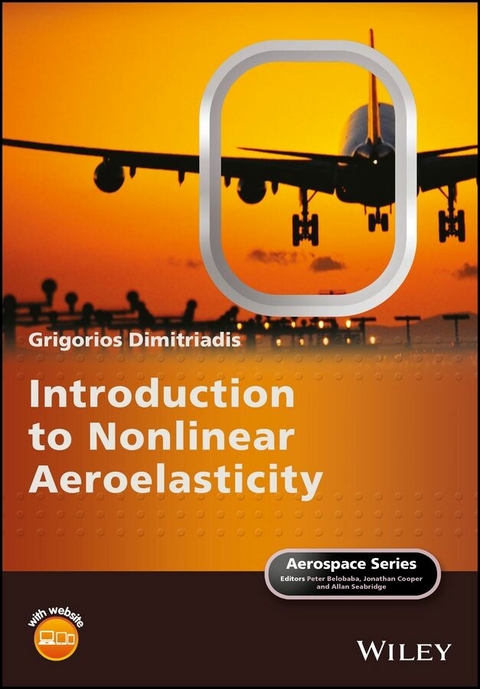
Introduction to Nonlinear Aeroelasticity (eBook)
John Wiley & Sons (Verlag)
978-1-118-75645-4 (ISBN)
Introduces the latest developments and technologies in the area of nonlinear aeroelasticity
Nonlinear aeroelasticity has become an increasingly popular research area in recent years. There have been many driving forces behind this development, increasingly flexible structures, nonlinear control laws, materials with nonlinear characteristics, etc. Introduction to Nonlinear Aeroelasticity covers the theoretical basics in nonlinear aeroelasticity and applies the theory to practical problems.
As nonlinear aeroelasticity is a combined topic, necessitating expertise from different areas, the book introduces methodologies from a variety of disciplines such as nonlinear dynamics, bifurcation analysis, unsteady aerodynamics, non-smooth systems and others. The emphasis throughout is on the practical application of the theories and methods, so as to enable the reader to apply their newly acquired knowledge.
Key features:
- Covers the major topics in nonlinear aeroelasticity, from the galloping of cables to supersonic panel flutter.
- Discusses nonlinear dynamics, bifurcation analysis, numerical continuation, unsteady aerodynamics and non-smooth systems.
- Considers the practical application of the theories and methods.
- Covers nonlinear dynamics, bifurcation analysis and numerical methods.
- Accompanied by a website hosting Matlab code.
Introduction to Nonlinear Aeroelasticity is a comprehensive reference for researchers and workers in industry and is also a useful introduction to the subject for graduate and undergraduate students across engineering disciplines.
Grigorios Dimitriadis, University of Liège, Belgium
Grigorios Dimitriadis is currently a full time Assistant Professor at the Aerospace and Mechanical Engineering Department of the University of Liège and a part time lecturer at the Institut Supérieur de l'Aéronautique et de l'Espace in Toulouse. His area of expertise is aeroelasticity, with particular application to nonlinear theoretical and experimental aeroelasticity, flutter testing, system identification, nonlinear dynamics and flapping flight. He is the Associate Editor for aeroelasticity in the journal Aerospace Science and Technology.
Introduction to Nonlinear Aeroelasticity Introduces the latest developments and technologies in the area of nonlinear aeroelasticity Nonlinear aeroelasticity has become an increasingly popular research area in recent years. There have been many driving forces behind this development, increasingly flexible structures, nonlinear control laws, materials with nonlinear characteristics and so on. Introduction to Nonlinear Aeroelasticity covers the theoretical basics in nonlinear aeroelasticity and applies the theory to practical problems. As nonlinear aeroelasticity is a combined topic, necessitating expertise from different areas, the book introduces methodologies from a variety of disciplines such as nonlinear dynamics, bifurcation analysis, unsteady aerodynamics, non-smooth systems and others. The emphasis throughout is on the practical application of the theories and methods, so as to enable the reader to apply their newly acquired knowledge Key features: Covers the major topics in nonlinear aeroelasticity, from the galloping of cables to supersonic panel flutter Discusses nonlinear dynamics, bifurcation analysis, numerical continuation, unsteady aerodynamics and non-smooth systems Considers the practical application of the theories and methods Covers nonlinear dynamics, bifurcation analysis and numerical methods Accompanied by a website hosting Matlab code Introduction to Nonlinear Aeroelasticity is a comprehensive reference for researchers and workers in industry and is also a useful introduction to the subject for graduate and undergraduate students across engineering disciplines.
Grigorios Dimitriadis, University of Liège, Belgium
Title Page 5
Copyright Page 6
Contents 7
Preface 13
Dimitriadis: Nonlinear Aeroelasticity – Series Preface Oct 2016 15
About the Companion Website 17
Chapter 1 Introduction 19
1.1 Sources of Nonlinearity 21
1.2 Origins of Nonlinear Aeroelasticity 23
References 24
Chapter 2 Nonlinear Dynamics 27
2.1 Introduction 27
2.2 Ordinary Differential Equations 27
2.3 Linear Systems 29
2.3.1 Stable Oscillatory Response 31
2.3.2 Neutral Oscillatory Response 33
2.3.3 Unstable Oscillatory Response 35
2.3.4 Stable Non-oscillatory Response 37
2.3.5 Unstable Non-oscillatory Response 39
2.3.6 Fixed Point Summary 41
2.4 Nonlinear Systems 42
2.4.1 Linearisation Around Fixed Points 43
2.4.2 The Pitching Wing Section with Cubic Stiffness 46
2.4.3 The Pitchfork Bifurcation 48
2.5 Stability in the Lyapunov Sense 52
2.6 Asymmetric Systems 55
2.6.1 The Fold Bifurcation 56
2.6.2 The Transcritical Bifurcation 59
2.7 Existence of Periodic Solutions 63
2.7.1 Nonlinear Aeroelastic Galloping 65
2.8 Estimating Periodic Solutions 67
2.8.1 Periodic Solutions of the Nonlinear Galloping Oscillator 68
2.8.2 The Hopf Bifurcation 70
2.9 Stability of Periodic Solutions 71
2.9.1 Stability of Galloping Oscillations 73
2.9.3 The Fold Bifurcation of Cycles 74
2.10 Concluding Remarks 79
References 79
Chapter 3 Time Integration 81
3.1 Introduction 81
3.2 Euler Method 82
3.2.1 Linear Systems 83
3.2.2 Nonlinear Systems 84
3.3 Central Difference Method 86
3.3.1 Explicit Solution of Nonlinear Systems 87
3.3.2 Implicit Solution of Nonlinear Systems 90
3.4 Runge–Kutta Method 92
3.5 Time-Varying Linear Approximation 98
3.6 Integrating Backwards in Time 104
3.7 Time Integration of Systems with Multiple Degrees of Freedom 106
3.8 Forced Response 110
3.9 Harmonic Balance 117
3.9.1 Newton–Raphson 121
3.9.2 Discrete Fourier Transform Techniques 124
3.10 Concluding Remarks 128
References 129
Chapter 4 Determining the Vibration Parameters 131
4.1 Introduction 131
4.2 Amplitude and Frequency Determination 131
4.2.1 Event Detection 135
4.3 Equivalent Linearisation 138
4.4 Hilbert Transform 143
4.5 Time-Varying Linear Approximation 147
4.6 Short Time Fourier Transform 149
4.7 Pinpointing Bifurcations 155
4.7.1 Newton–Raphson 159
4.7.2 Successive Bisection 160
4.8 Limit Cycle Study 161
4.9 Poincaré Sections 164
4.10 Stability of Periodic Solutions 167
4.10.1 Floquet Analysis 170
4.11 Concluding Remarks 174
References 174
Chapter 5 Bifurcations of FundamentalAeroelastic Systems 177
5.1 Introduction 177
5.2 Two-Dimensional Unsteady Pitch-Plunge-ControlWing 178
5.3 Linear Aeroelastic Analysis 179
5.4 Hardening Stiffness 188
5.4.1 Supercritical Hopf Bifurcation 188
5.4.2 Subcritical Hopf Bifurcation 198
5.4.3 Fold Bifurcation of Cycles 201
5.4.4 Flutter of Nonlinear Systems 207
5.4.5 Period-Doubling Bifurcation 211
5.4.6 Torus Bifurcation 219
5.5 Softening Stiffness 227
5.6 Damping Nonlinearity 232
5.6.1 Subcritical Hopf Bifurcation 234
5.6.2 Static Divergence of Cycles 238
5.6.3 Pitchfork Bifurcation of Cycles 242
5.7 Two-Parameter Bifurcations 251
5.7.1 Generalised Hopf Bifurcation 251
5.7.2 Pitchfork–Hopf Bifurcation 255
5.7.3 Hopf-Hopf Bifurcation 258
5.8 Asymmetric Nonlinear Aeroelastic Systems 260
5.8.1 Fold Bifurcation of Fixed Points and Cycles 261
5.8.2 Transcritical Bifurcation of Fixed Points and Cycles 269
5.8.3 Fold-Hopf Bifurcation 274
5.9 Concluding Remarks 275
References 277
Chapter 6 Discontinuous Nonlinearities 279
6.1 Introduction 279
6.2 Piecewise Linear Stiffness 280
6.2.1 Underlying and Overlying Linear Systems 282
6.2.2 Fixed Points and Boundary Equilibrium Bifurcations 287
6.2.3 Equivalent Linearisation of Piecewise Linear Stiffness 290
6.2.4 Three-Domain Limit Cycles 296
6.2.5 Two-Domain Limit Cycles 303
6.2.6 Time Domain Solutions 307
6.3 Discontinuity-Induced Bifurcations 315
6.3.1 The Boundary Equilibrium Bifurcation 315
6.3.2 The Grazing Bifurcation 320
6.4 Freeplay and Friction 327
6.5 Concluding Remarks 328
References 328
Chapter 7 Numerical Continuation 331
7.1 Introduction 331
7.2 Algebraic Problems 332
7.2.1 Prediction Correction 334
7.2.2 Arclength Continuation 339
7.2.3 Pseudo-Arclength Continuation 345
7.3 Direct Location of Folds 346
7.4 Fixed Point Solutions of Dynamic Systems 350
7.4.1 Branch Points 350
7.4.2 Arclength Step Control 355
7.5 Periodic Solutions of Dynamic Systems 360
7.5.1 Starting the Continuation Scheme 366
7.5.2 Folds and Branch Points 369
7.5.3 Branch Switching 373
7.6 Stability of Periodic Solutions Calculated from Numerical Continuation 376
7.7 Shooting 382
7.7.1 Starting the Continuation Scheme 385
7.7.2 Arclength Continuation 386
7.7.3 Stability Analysis 388
7.7.4 Branch Point Location and Branch Switching 390
7.7.5 Grazing 393
7.8 Harmonic Balance 397
7.9 Concluding Remarks 405
References 405
Chapter 8 Low-Speed AerodynamicNonlinearities 407
8.1 Introduction 407
8.2 Vortex-Induced Vibrations 411
8.3 Galloping 420
8.4 Stall Flutter 429
8.4.1 Dynamic Stall 431
8.4.2 Leishman–Beddoes Model 435
8.4.3 ONERA Model 452
8.4.4 Aeroelastic Simulations using Dynamic Stall Models 460
8.5 Concluding Remarks 467
References 467
Chapter 9 High-Speed AeroelasticNonlinearities 471
9.1 Introduction 471
9.2 Piston Theory 471
9.3 Panel Flutter 486
9.3.1 Buckling 488
9.3.2 Limit Cycle Oscillations 502
9.4 Concluding Remarks 519
References 519
Chapter 10 Finite Wings 521
10.1 Introduction 521
10.2 Cantilever Plate in Supersonic Flow 522
10.3 Three-Dimensional Aerodynamic Modelling by the Vortex Lattice Method 537
10.3.1 Aeroelastic Coupling 546
10.3.2 Transforming to the Time Domain 554
10.3.3 Nonlinear Response 560
10.4 Concluding Remarks 570
References 570
Appendix A Aeroelastic Models 573
A.1 Galloping Oscillator 573
A.2 Two-Dimensional Pitch-Plunge-Control Wing Section with Unsteady Aerodynamics 574
A.3 Two-Dimensional Pitch-Plunge-Control Wing Section with Quasi-Steady Aerodynamics 582
A.4 Two-Dimensional Pitch-Plunge Wing Section with Quasi-Steady Aerodynamics 583
A.5 Two-Dimensional Pitching Wing Section with Quasi-Steady Aerodynamics 584
A.6 Two-Dimensional Pitch-Plunge Wing with Leishman–Beddoes Aerodynamic Mode 584
A.7 Two-Dimensional Pitch-Plunge Wing with ONERA Aerodynamic Model 586
A.8 Two-Dimensional Pitch-Plunge-Control Wing Section with Supersonic Aerodynamics 587
A.9 Two-Dimensional Pitch-Plunge Wing Section with Supersonic Aerodynamics 588
References 588
Index 589
| Erscheint lt. Verlag | 1.3.2017 |
|---|---|
| Reihe/Serie | Aerospace Series | Aerospace Series (PEP) |
| Mitarbeit |
Herausgeber (Serie): Peter Belobaba, Jonathan Cooper, Allan Seabridge |
| Sprache | englisch |
| Themenwelt | Technik ► Bauwesen |
| Technik ► Maschinenbau | |
| Schlagworte | Aeronautic & Aerospace Engineering • Bauingenieur- u. Bauwesen • Baustatik u. Baumechanik • Bifurcation • Civil Engineering & Construction • Festkörpermechanik • freeplay • Galloping • Harmonic balance • Limit Cycle Oscillations • Luft- u. Raumfahrttechnik • Maschinenbau • mechanical engineering • Nonlinear aeroelasticity • Non-smooth Systems • Numerical continuation • Panel fluter • solid mechanics • Stall flutter • Structural Theory & Structural Mechanics |
| ISBN-10 | 1-118-75645-2 / 1118756452 |
| ISBN-13 | 978-1-118-75645-4 / 9781118756454 |
| Informationen gemäß Produktsicherheitsverordnung (GPSR) | |
| Haben Sie eine Frage zum Produkt? |
 PDF (Adobe DRM)
Kopierschutz: Adobe-DRM
Adobe-DRM ist ein Kopierschutz, der das eBook vor Mißbrauch schützen soll. Dabei wird das eBook bereits beim Download auf Ihre persönliche Adobe-ID autorisiert. Lesen können Sie das eBook dann nur auf den Geräten, welche ebenfalls auf Ihre Adobe-ID registriert sind.
Details zum Adobe-DRM
Dateiformat: PDF (Portable Document Format)
Mit einem festen Seitenlayout eignet sich die PDF besonders für Fachbücher mit Spalten, Tabellen und Abbildungen. Eine PDF kann auf fast allen Geräten angezeigt werden, ist aber für kleine Displays (Smartphone, eReader) nur eingeschränkt geeignet.
Systemvoraussetzungen:
PC/Mac: Mit einem PC oder Mac können Sie dieses eBook lesen. Sie benötigen eine
eReader: Dieses eBook kann mit (fast) allen eBook-Readern gelesen werden. Mit dem amazon-Kindle ist es aber nicht kompatibel.
Smartphone/Tablet: Egal ob Apple oder Android, dieses eBook können Sie lesen. Sie benötigen eine
Geräteliste und zusätzliche Hinweise
Buying eBooks from abroad
For tax law reasons we can sell eBooks just within Germany and Switzerland. Regrettably we cannot fulfill eBook-orders from other countries.
aus dem Bereich