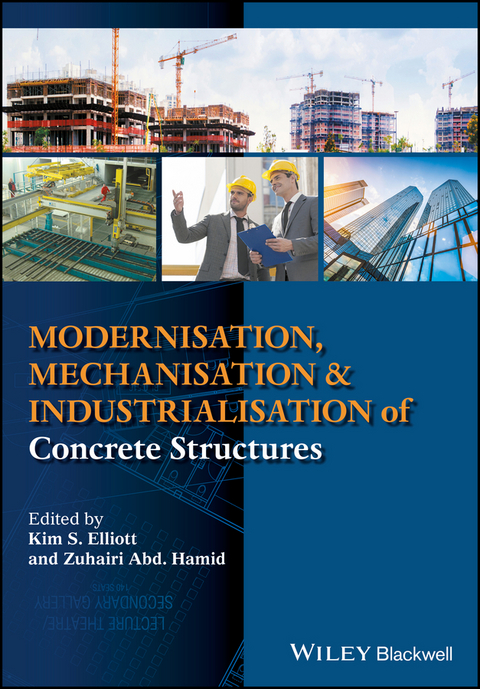
Modernisation, Mechanisation and Industrialisation of Concrete Structures (eBook)
John Wiley & Sons (Verlag)
978-1-118-87654-1 (ISBN)
Kim S. Elliott is a consultant to the precast industry in the UK and Malaysia. He was Senior Lecturer in the School of Civil Engineering at Nottingham University from 1987-2010, and was formerly at Trent Concrete Structures Ltd., one of the UK's leading precast concrete manufacturers. An active researcher into the behaviour of precast concrete structures, he has published extensively on the subject. He is a member of FIB Commission on Prefabrication.
Zuhairi Abd. Hamid is Executive Director of the Construction Research Institute of Malaysia (CREAM). With more than 32 years of experience in the construction industry, his research interests and expertise falls within the area of Strategic Management of IT in Construction, Strategic Facilities Management in the Health Sector, Structural dynamics (wind engineering and earthquake engineering), prefabricated building construction and the Open Building System.
Modernisation, Mechanisation and Industrialisation of Concrete Structures discusses the manufacture of high quality prefabricated concrete construction components, and how that can be achieved through the application of developments in concrete technology, information modelling and best practice in design and manufacturing techniques.
Kim S. Elliott is a consultant to the precast industry in the UK and Malaysia. He was Senior Lecturer in the School of Civil Engineering at Nottingham University from 1987-2010, and was formerly at Trent Concrete Structures Ltd., one of the UK's leading precast concrete manufacturers. An active researcher into the behaviour of precast concrete structures, he has published extensively on the subject. He is a member of FIB Commission on Prefabrication. Zuhairi Abd. Hamid is Executive Director of the Construction Research Institute of Malaysia (CREAM). With more than 32 years of experience in the construction industry, his research interests and expertise falls within the area of Strategic Management of IT in Construction, Strategic Facilities Management in the Health Sector, Structural dynamics (wind engineering and earthquake engineering), prefabricated building construction and the Open Building System.
Cover 1
Title Page 5
Copyright 6
Contents 7
About the Editors 13
Notes on Contributors 15
Preface 19
Part I Modernisation of Precast Concrete Structures 23
Chapter 1 Historical and Chronological Development of Precast Concrete Structures 25
1.1 The five periods of development and optimisation 25
1.2 Developing years and the standardisation period 48
1.3 Optimisation and the lightweight period 56
1.4 The thermal mass period 68
References 81
Chapter 2 Industrial Building Systems (IBS) Project Implementation 83
2.1 Introduction 83
2.2 Routes to IBS procurement 91
2.3 Precast concrete IBS solution to seven-storey skeletal frame 111
2.4 Manufacture of precast concrete components and ancillaries 115
2.5 Minimum project sizes and component efficiency for IBS 142
2.6 Design implications in construction matters 142
2.7 Conclusions 144
References 146
Chapter 3 Best Practice and Lessons Learned in IBS Design, Detailing and Construction 147
3.1 Increasing off-site fabrication 147
3.2 Standardisation 155
3.3 Self-compacting concrete for precast components 159
3.4 Recycled precast concrete 164
3.5 Building services 166
3.6 Conclusions 169
References 169
Chapter 4 Research and Development Towards the Optimisation of Precast Concrete Structures 171
4.1 The research effort on precast concrete framed structures 171
4.2 Precast frame connections 184
4.3 Studies on structural integrity of precast frames and connections 192
References 195
Part II Mechanisation and Automation of the Production of Concrete Elements 199
Chapter 5 Building Information Modelling (BIM) and Software for the Design and Detailing of Precast Structures 201
5.1 Building information modelling (BIM) 201
5.2 Technologies 210
5.3 BIM in precast construction 220
5.4 Summary 229
References 229
Chapter 6 Mechanisation and Automation in Concrete Production 232
6.1 Development of industrialization and automation in the concrete prefabrication industry 232
6.2 CAD-CAM BIM from Industry 2.0 to 4.0 246
6.3 Automation methods 264
6.4 Integrated and automated prefabricated production process 308
6.5 Limits of automation 320
6.6 Summary and outlook 322
Part III Industrialisation of Concrete Structures 323
Chapter 7 Lean Construction - Industrialisation of On-site Production Processes 325
7.1 Work process planning (WPP) 326
7.2 Construction production process planning procedure 336
7.3 Work process planning (WPP) - work execution estimation 344
7.4 Work process planning (WPP) - planning the processes and construction methods 351
7.5 Planning the execution process 354
7.6 Procedure for selecting construction methods and processes 358
7.7 Conclusions to Chapter 7 365
References 366
Chapter 8 Lean Construction - Industrialisation of On-site Production Processes 368
8.1 Introduction - top-down / bottom-up work planning scheduling and resource planning 369
8.2 Scheduling and resource planning 370
8.3 Site Logistics 374
8.4 Weekly work plans 379
8.5 Construction site controlling process 413
8.6 CIP - the continuous improvement process 420
8.7 Conclusions 423
References 425
Chapter 9 New Cooperative Business Model - Industrialization of Off-Site Production 426
9.1 Introduction 427
9.2 Objectives of the new business model 428
9.3 Modelling 430
9.4 Conclusion 442
References 443
Chapter 10 Retrospective View and Future Initiatives in Industrialised Building Systems (IBS) and Modernisation, Mechanisation and Industrialisation (MMI) 446
10.1 Industrialisation of the construction industry 446
10.2 Overview on global housing prefabrication 448
10.3 Housing prefabrication in Malaysia - the industrialisation building system (IBS) 449
10.4 Social acceptability of IBS in relation to housing 461
10.5 IBS in future - opportunity for wider IBS adoption 465
10.6 Conclusion 472
References 472
Chapter 11 Affordable and Quality Housing Through Mechanization, Modernization and Mass Customisation 475
11.1 Introduction 475
11.2 Design for flexibility - insight from the vernacular architecture 479
11.3 Scope of flexibility in residential housing 481
11.4 Divergent Dwelling Design (D3) - proposed mass housing system for today and tomorrow 483
11.5 Design principles of D3 486
11.6 Conclusion 494
References 495
Index 497
EULA 506
| Erscheint lt. Verlag | 9.2.2017 |
|---|---|
| Sprache | englisch |
| Themenwelt | Technik ► Bauwesen |
| Schlagworte | automated concrete etching • automated concrete finishing • automated concrete polishing • automated fatade panels • automated reinforcement cages • Automation of precast concrete production • Bauingenieur- u. Bauwesen • Baustoffe • Beton • Betonbau • Civil Engineering & Construction • concrete technology • construction materials • design of precast concrete components • Efficient production of precast concrete • hollow core slabs • industrial precast concrete production • insulated panels • Konstruktionswerkstoffe • manufacture of precast concrete components • Massivbau • Materials Science • Materialwissenschaften • Omnia type floors with welded girders • Precast concrete durability • precast concrete production • Precast concrete quality • prefabrication design • reproducible construction components • Structural & Building Engineering • Sustainable design solutions • Tief- u. Hochbau / Massivbau • twin walls |
| ISBN-10 | 1-118-87654-7 / 1118876547 |
| ISBN-13 | 978-1-118-87654-1 / 9781118876541 |
| Informationen gemäß Produktsicherheitsverordnung (GPSR) | |
| Haben Sie eine Frage zum Produkt? |
 PDF (Adobe DRM)
Kopierschutz: Adobe-DRM
Adobe-DRM ist ein Kopierschutz, der das eBook vor Mißbrauch schützen soll. Dabei wird das eBook bereits beim Download auf Ihre persönliche Adobe-ID autorisiert. Lesen können Sie das eBook dann nur auf den Geräten, welche ebenfalls auf Ihre Adobe-ID registriert sind.
Details zum Adobe-DRM
Dateiformat: PDF (Portable Document Format)
Mit einem festen Seitenlayout eignet sich die PDF besonders für Fachbücher mit Spalten, Tabellen und Abbildungen. Eine PDF kann auf fast allen Geräten angezeigt werden, ist aber für kleine Displays (Smartphone, eReader) nur eingeschränkt geeignet.
Systemvoraussetzungen:
PC/Mac: Mit einem PC oder Mac können Sie dieses eBook lesen. Sie benötigen eine
eReader: Dieses eBook kann mit (fast) allen eBook-Readern gelesen werden. Mit dem amazon-Kindle ist es aber nicht kompatibel.
Smartphone/Tablet: Egal ob Apple oder Android, dieses eBook können Sie lesen. Sie benötigen eine
Geräteliste und zusätzliche Hinweise
Buying eBooks from abroad
For tax law reasons we can sell eBooks just within Germany and Switzerland. Regrettably we cannot fulfill eBook-orders from other countries.
aus dem Bereich