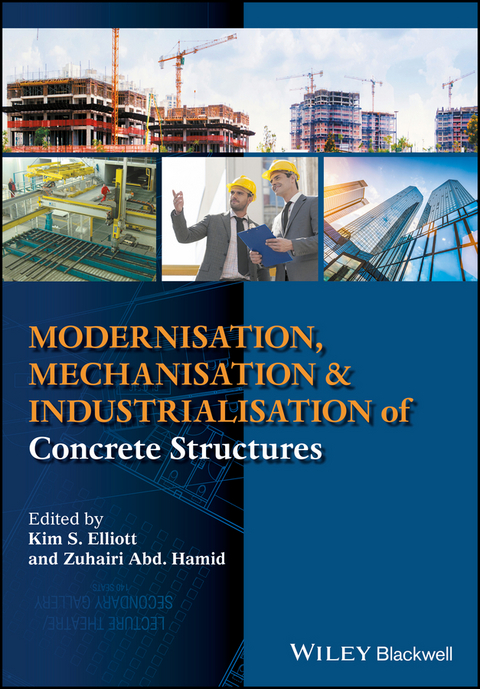
Modernisation, Mechanisation and Industrialisation of Concrete Structures (eBook)
John Wiley & Sons (Verlag)
978-1-118-87651-0 (ISBN)
Kim S. Elliott is a consultant to the precast industry in the UK and Malaysia. He was Senior Lecturer in the School of Civil Engineering at Nottingham University from 1987-2010, and was formerly at Trent Concrete Structures Ltd., one of the UK's leading precast concrete manufacturers. An active researcher into the behaviour of precast concrete structures, he has published extensively on the subject. He is a member of FIB Commission on Prefabrication.
Zuhairi Abd. Hamid is Executive Director of the Construction Research Institute of Malaysia (CREAM). With more than 32 years of experience in the construction industry, his research interests and expertise falls within the area of Strategic Management of IT in Construction, Strategic Facilities Management in the Health Sector, Structural dynamics (wind engineering and earthquake engineering), prefabricated building construction and the Open Building System.
Modernisation, Mechanisation and Industrialisation of Concrete Structures discusses the manufacture of high quality prefabricated concrete construction components, and how that can be achieved through the application of developments in concrete technology, information modelling and best practice in design and manufacturing techniques.
Kim S. Elliott is a consultant to the precast industry in the UK and Malaysia. He was Senior Lecturer in the School of Civil Engineering at Nottingham University from 1987-2010, and was formerly at Trent Concrete Structures Ltd., one of the UK's leading precast concrete manufacturers. An active researcher into the behaviour of precast concrete structures, he has published extensively on the subject. He is a member of FIB Commission on Prefabrication. Zuhairi Abd. Hamid is Executive Director of the Construction Research Institute of Malaysia (CREAM). With more than 32 years of experience in the construction industry, his research interests and expertise falls within the area of Strategic Management of IT in Construction, Strategic Facilities Management in the Health Sector, Structural dynamics (wind engineering and earthquake engineering), prefabricated building construction and the Open Building System.
Preface
The modernisation and industrialisation of concrete structures, through the means of prefabrication of concrete elements together with the computerization of design, detailing and scheduling, is taking an awful long time to come to fruition. The once aspired paperless journey from the architect's concept to the factory floor and beyond is gradually closing in. Critics may cite the post WW2 boom in the construction of high-rise apartment buildings in part of northern and eastern Europe as 70-year-old industrialisation, but it was nothing more than concrete construction on such a large scale that it was thought to be “industrialisation” - the linear and manual processes of design, detailing, scheduling and manufacture were no more advanced than early twentieth-century construction.
There was little automation in the concrete industry until the combined technologies of long line pretensioning of steel wires and the extrusion of semi-dry concrete lead to such elements as prefabricated hollow core floor slabs in the 1950s. Except for a number of step-change advancements such as (i) the hydraulic extruder, (ii) the “carousel” method of casting and moving beds, and (iii) higher performance/strength concrete, hollow core units are still made in much the same way. Changes came in the 1970s after the Japanese taught the Europeans and Americans how they made cars – with forward/sideways/up/down production of the individual components leading to the whole. We now see such automotive methods used in the carousel table-top production of concrete wall panels and façade units, and together with CAD/CAM, Auto-CAD systems, TIM scheduling, and the automated supply of drawings and component schedules to the factories, the age of modernisation, mechanisation and industrialization (MMI) of concrete structures has finally arrived.
Architects and consulting engineers are still wary of the term “building systems”, with images of shoe-box designs typified by the 1960s national building frames, carelessly exploiting modularization and standardisation possible in precast concrete. Today fully bespoke and individually tailored precast concrete elements can be designed and erected into many diverse forms to cover the huge spectrum of building architecture – all of which are industrialised by MMI. The term IBS (Industrialised Building Systems) can now be used with architectural and engineering freedom, for example, Sydney Opera House's torus-shaped prestressed beams and tiled facades. During a precast concrete workshop in Singapore in the mid 2000s an architect asked (something like) “what are the major features that distinguish precast concrete buildings from cast insitu”. The reply, given by one of the authors of this book, was that “precast is used when the client or architect sees concrete as something special – both structurally of aesthetically, and maximises the operations that you can only carry out in the controlled environment of a factory”, and so on.
The move to increased automation in the factory has coincided with the automation of spatial design – the use of three-dimensional co-ordinate orthogonal geometry, well known to school boys, to build 3D models from rectilinear 2D building plans and elevations, now known as BIM (Building Information Modelling) and the accompanying software for the design and detailing of precast (and steel, timber, etc.) structures. Professor C. J. Anumba of Pennsylvania State University addressed a Seminar & Workshop on the Developments and Future Directions in BIM (Kuala Lumpur, 2012) thus Developments in BIM have resulted in significant industry interest and uptake. Most new building projects are dependent on BIM for resolving coordination, schedule, integration, estimating and other functions. Advances in information and communications technologies are continuing to open up new opportunities and applications. As such, more needs to be done to fully exploit the potential of these technologies and to meet the requirements of increasingly complex projects.
Against this background of MMI and BIM the aims and objectives of this book were, as conceived by Dr Zuhairi, from CREAM (Construction Research Institute of Malaysia), to provide a concise text to show how the modernisation, mechanisation and industrialisation of prefabricated concrete structures can be achieved through the knowledge of best practice, information modelling, and the procedures and management of factory engineered concrete products and systems. The main objectives were to:
- i. show how previous R&D and present design and manufacturing techniques can be best exploited for the construction of modern precast concrete structures,
- ii. show how the IBS ethos can control the supply chain from the client to sub-contractors, and can best utilise BIM methods and design/detailing software,
- iii. introduce the best concepts of automation and robotics in concrete production, and
- iv. exploit the industrialisation of off-site production and on-site processes, including low cost housing in south east Asia.
The authors were selected from the UK, Germany, Switzerland, Austria and Malaysia, each having expertise and a (fairly) long history in items (i) to (iv). Of significance was Mr Robert Neubauer of SAA Software Engineering, a production/structural engineer able to harmonise the requirements of prefabrication in design with automated production; Mr Thomas Leopoldseder and Ms Suzanna Schachinger, of Precast Software, with abilities to exploit BIM and related software to the full advantage of precast solutions; Prof Gerhard Girmsheid and Dr Julia Selberherr, of ETH (Swiss Federal Institute of Technology, Zurich) specialising in the respective roles of industrialisation of off-site and on-site construction; CREAM consultants Dr Zuhairi, Mr Gan Hock Beng, Foo Chee Hung and Ahmad Hazim Abdul Rahim responsible for the technical advancements of IBS for low-cost housing; and Dr Kim S Elliott, precast consultant, summarising the modernisation and optimization of precast and prestressed elements and structures.
This book is divided into three key themes, as reflected in its title:
Part 1: MODERNISATION
- Chapter 1: Historical and Chronological Development of Precast Concrete Structures
- Chapter 2: Industrial Building Systems (IBS) Project Implementation
- Chapter 3: Best Practice and Lessons Learned in IBS Design, Detailing and Construction
Part 2: MECHANISATION AND AUTOMATION
- Chapter 4: Research and Development Towards the Optimisation of Precast Concrete Structures
- Chapter 5: Building Information Modelling (BIM) and Software for the Design and Detailing of Precast Structures
- Chapter 6: Mechanisation, Automation and Robotics in Concrete Production
Part 3: INDUSTRIALISATION
- Chapter 7: Lean Construction, Part 1 – Industrialisation of On-Site Production Processes
- Chapter 8: Lean Construction, Part 2 – Planning and Execution of Construction Processes
- Chapter 9: New Cooperative Business Model - Industrialisation of Off-Site Production
- Chapter 10: Retrospective View and Future Initiatives in IBS and MMI
- Chapter 11: Affordable and Quality Housing Through Mechanization, Modernization and Mass Customization
A number of chapters address the issues of modern housing. Concrete has great potential to offer building and housing construction works towards improving the function, value, and whole life performance, especially in the era where quick, efficient, and inexpensive construction and delivery are becoming the necessity and desires of the societies. Precast concrete construction is a technology that possesses the potential to eliminate building site inconveniences, reducing the lapsed time and cost of construction, and contributing to an end product that conforms to the required standards and codes.
However, buildings and houses produced with such technology have a rigid structure, an interlocking plan, and predetermined functions, where very few of them are sufficiently open plan to enable retrofitting and reconfigurations to be made quickly, economically, and repeatedly. Moreover, various negative perceptions, opinions, and images spring to mind when considering the concept of prefabrication and standardisation in housing, as a result of a number of buildings constructed in the past making use of prefabrication were judged to be of poor quality. This book will provide insight to builders of the potential for building and housing design system that makes use of the prefabrication construction to produce a variety of housing design options that meet possible user requirements not yet identified at the design stage, while retaining principal uniformity to facilitate the execution of simple but accurate construction with a minimal initial cost.
It is believed that only by having combined design and construction systems that take advantage of mass production and mass customisation, the efficient design of offices, parking structures, shopping and residential buildings, coupled with housing affordability and liveability can be achieved. A home that can be altered with minimum effort and expense at a time of change in the lives of its owners is a home that evolves with the lifecycles of its household rather than becoming rigidly obsolete in the conventional manner. As such, the affordable housing needs to be designed in such a way that it is economically and easily adjustable,...
| Erscheint lt. Verlag | 13.2.2017 |
|---|---|
| Sprache | englisch |
| Themenwelt | Technik ► Bauwesen |
| Schlagworte | automated concrete etching • automated concrete finishing • automated concrete polishing • automated fatade panels • automated reinforcement cages • Automation of precast concrete production • Bauingenieur- u. Bauwesen • Baustoffe • Beton • Betonbau • Civil Engineering & Construction • concrete technology • construction materials • design of precast concrete components • Efficient production of precast concrete • hollow core slabs • industrial precast concrete production • insulated panels • Konstruktionswerkstoffe • manufacture of precast concrete components • Massivbau • Materials Science • Materialwissenschaften • Omnia type floors with welded girders • Precast concrete durability • precast concrete production • Precast concrete quality • prefabrication design • reproducible construction components • Structural & Building Engineering • Sustainable design solutions • Tief- u. Hochbau / Massivbau • twin walls |
| ISBN-10 | 1-118-87651-2 / 1118876512 |
| ISBN-13 | 978-1-118-87651-0 / 9781118876510 |
| Informationen gemäß Produktsicherheitsverordnung (GPSR) | |
| Haben Sie eine Frage zum Produkt? |
 EPUB (Adobe DRM)
Kopierschutz: Adobe-DRM
Adobe-DRM ist ein Kopierschutz, der das eBook vor Mißbrauch schützen soll. Dabei wird das eBook bereits beim Download auf Ihre persönliche Adobe-ID autorisiert. Lesen können Sie das eBook dann nur auf den Geräten, welche ebenfalls auf Ihre Adobe-ID registriert sind.
Details zum Adobe-DRM
Dateiformat: EPUB (Electronic Publication)
EPUB ist ein offener Standard für eBooks und eignet sich besonders zur Darstellung von Belletristik und Sachbüchern. Der Fließtext wird dynamisch an die Display- und Schriftgröße angepasst. Auch für mobile Lesegeräte ist EPUB daher gut geeignet.
Systemvoraussetzungen:
PC/Mac: Mit einem PC oder Mac können Sie dieses eBook lesen. Sie benötigen eine
eReader: Dieses eBook kann mit (fast) allen eBook-Readern gelesen werden. Mit dem amazon-Kindle ist es aber nicht kompatibel.
Smartphone/Tablet: Egal ob Apple oder Android, dieses eBook können Sie lesen. Sie benötigen eine
Geräteliste und zusätzliche Hinweise
Buying eBooks from abroad
For tax law reasons we can sell eBooks just within Germany and Switzerland. Regrettably we cannot fulfill eBook-orders from other countries.
aus dem Bereich