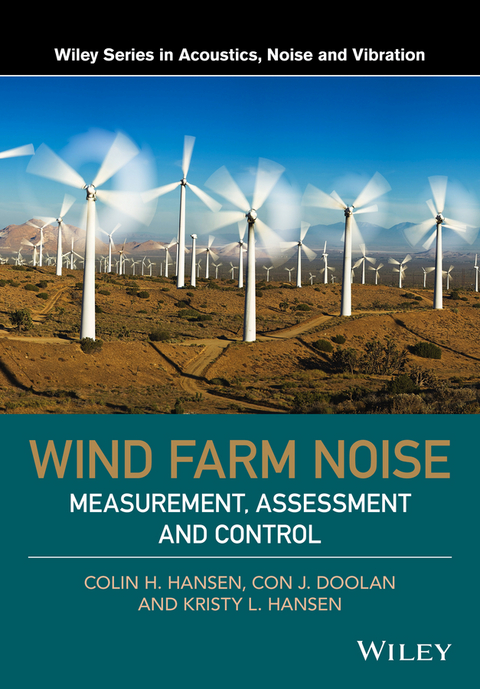
Wind Farm Noise (eBook)
John Wiley & Sons (Verlag)
978-1-118-82612-6 (ISBN)
Wind Farm Noise: Measurement, Assessment and Control
Colin H Hansen, University of Adelaide, Australia
Con J Doolan, University of New South Wales, Australia
Kristy L Hansen, Flinders University, Australia
A comprehensive guide to wind farm noise prediction, measurement, assessment, control and effects on people
Wind Farm Noise covers all aspects associated with the generation, measurement, propagation, regulation and adverse health effects of noise produced by large horizontal-axis wind turbines of the type used in wind farms.
The book begins with a brief history of wind turbine development and the regulation of their noise at sensitive receivers. Also included is an introductory chapter on the fundamentals of acoustics relevant to wind turbine noise so that readers are well prepared for understanding later chapters on noise measurements, noise generation mechanisms, noise propagation modelling and the assessment of the noise at surrounding residences.
Key features:
• Potential adverse health effects of wind farm noise are discussed in an objective way.
• Means for calculating the noise at residences due to a wind farm prior to construction are covered in detail along with uncertainty estimates.
• The effects of meteorological conditions and other influences, such as obstacles, ground cover and atmospheric absorption, on noise levels at residences are explained.
• Quantities that should be measured as well as how to best measure them in order to properly characterise wind farm noise are discussed in detail.
• Noise generation mechanisms and possible means for their control are discussed as well as aspects of wind farm noise that still require further research to be properly understood.
The book provides comprehensive coverage of the topic, containing both introductory and advanced level material.
Professor Colin Hansen has been consulting, researching and teaching in the field of noise and vibration for 40 years. He has authored or co-authored eleven books, edited two books, and contributed seven chapters to various other books. His current research is focused on the generation, assessment and control of wind farm noise, on which he has been working since 2010 and for which he has been funded by the Australian Research Council. He is an Honorary Fellow and past-president of the International Institute of Acoustics and Vibration, a Fellow of the Australian Acoustical Society and a Fellow of Engineers Australia. He was awarded the 2009 Rayleigh Medal by the British institute of Acoustics for outstanding contributions to acoustics, the 2013 A.G.M. Michell medal by Engineers Australia for outstanding service to the discipline of Mechanical Engineering and the 2014 Rossing Prize in Acoustics Education by the Acoustical Society of America.
AssociateProfessor Doolan has an Honours Degree in Mechanical Engineering and a PhD in Aerospace Engineering from the University of Queensland. He has over 20 years experience in research and development, teaching and consulting, with over 150 technical publications. His research interests focus upon compressible flow, which includes the area of aeroacoustics - the science of how fluid flow creates sound - with the aim to control noise from modern technologies such as aircraft, wind turbines and submarines. Associate Professor Doolan has been involved for many years in the understanding and control of wind turbine noise, with funding from the Australian Research Council to perform aeroacoustic testing of scaled turbines in wind tunnels.
Dr Kristy Hansen completed an Honours Degree in Mechanical Engineering and a PhD in Aerodynamics/Fluid Mechanics at the University of Adelaide. She spent 3 years working on an Australian Research Council funded grant investigating the impact of wind farm noise on rural communities. This work involved collection of an extensive data set which resulted from simultaneous measurements of noise, vibration and meteorological data at rural locations near different wind farms. Results from the analysis of these data have been presented in a number of peer-reviewed journals and conference papers. She is continuing her research on wind farm noise as part of her current employment at Flinders University.
A comprehensive guide to wind farm noise prediction, measurement, assessment, control and effects on people Wind Farm Noise covers all aspects associated with the generation, measurement, propagation, regulation and adverse health effects of noise produced by large horizontal-axis wind turbines of the type used in wind farms. The book begins with a brief history of wind turbine development and the regulation of their noise at sensitive receivers. Also included is an introductory chapter on the fundamentals of acoustics relevant to wind turbine noise so that readers are well prepared for understanding later chapters on noise measurements, noise generation mechanisms, noise propagation modelling and the assessment of the noise at surrounding residences. Key features: Potential adverse health effects of wind farm noise are discussed in an objective way. Means for calculating the noise at residences due to a wind farm prior to construction are covered in detail along with uncertainty estimates. The effects of meteorological conditions and other influences, such as obstacles, ground cover and atmospheric absorption, on noise levels at residences are explained. Quantities that should be measured as well as how to best measure them in order to properly characterise wind farm noise are discussed in detail. Noise generation mechanisms and possible means for their control are discussed as well as aspects of wind farm noise that still require further research to be properly understood. The book provides comprehensive coverage of the topic, containing both introductory and advanced level material.
Professor Colin Hansen has been consulting, researching and teaching in the field of noise and vibration for 40 years. He has authored or co-authored eleven books, edited two books, and contributed seven chapters to various other books. His current research is focused on the generation, assessment and control of wind farm noise, on which he has been working since 2010 and for which he has been funded by the Australian Research Council. He is an Honorary Fellow and past-president of the International Institute of Acoustics and Vibration, a Fellow of the Australian Acoustical Society and a Fellow of Engineers Australia. He was awarded the 2009 Rayleigh Medal by the British institute of Acoustics for outstanding contributions to acoustics, the 2013 A.G.M. Michell medal by Engineers Australia for outstanding service to the discipline of Mechanical Engineering and the 2014 Rossing Prize in Acoustics Education by the Acoustical Society of America. AssociateProfessor Doolan has an Honours Degree in Mechanical Engineering and a PhD in Aerospace Engineering from the University of Queensland. He has over 20 years experience in research and development, teaching and consulting, with over 150 technical publications. His research interests focus upon compressible flow, which includes the area of aeroacoustics - the science of how fluid flow creates sound - with the aim to control noise from modern technologies such as aircraft, wind turbines and submarines. Associate Professor Doolan has been involved for many years in the understanding and control of wind turbine noise, with funding from the Australian Research Council to perform aeroacoustic testing of scaled turbines in wind tunnels. Dr Kristy Hansen completed an Honours Degree in Mechanical Engineering and a PhD in Aerodynamics/Fluid Mechanics at the University of Adelaide. She spent 3 years working on an Australian Research Council funded grant investigating the impact of wind farm noise on rural communities. This work involved collection of an extensive data set which resulted from simultaneous measurements of noise, vibration and meteorological data at rural locations near different wind farms. Results from the analysis of these data have been presented in a number of peer-reviewed journals and conference papers. She is continuing her research on wind farm noise as part of her current employment at Flinders University.
Chapter 1
Wind Energy and Noise
1.1 Introduction
Why write this book about noise generated by wind farms? Many people believe that wind farm noise is a non-issue and that people complain about it because they are unhappy with the lack of financial compensation they receive compared to their neighbours who are hosting the turbines. Other reasons that we often see on pro-wind-farm web sites are that the anti-wind-farm lobby has suggested a range of symptoms are caused by wind farms and that this suggestion has made some people living near wind farms develop these symptoms as a result: the ‘so-called’ nocebo effect. Although the authors of this book would consider themselves neither pro- nor anti-wind-farms, they have taken a sufficient number of their own measurements and spoken to a sufficient number of residents living in the vicinity of wind farms (including wind farm hosts) to appreciate that the character and level of wind farm noise is a problem for a significant number of people, even those who reside at distances of 3 km or more from the nearest turbine.
Although one chapter in this book is concerned with the effects of wind farm noise on people, the main focus of this book is on how wind farm noise is generated and propagated, the characteristics of the noise arriving at residences in the vicinity of wind farms, and measurement procedures and instrumentation, as well as assessment criteria that are necessary for properly quantifying the noise. As many people living in the vicinity of wind farms report ‘feeling’ vibration when they lie down, vibration generation, propagation and measurement are also discussed in sections in Chapters 4, 5 and 6.
To lay the foundation for the remaining chapters, the rest of this chapter is concerned with a description of how the wind industry has developed in various countries, followed by a brief history of noise studies (including a summary of noise levels generated by large wind turbines), a summary of some public inquiries and wind farm noise regulations, and finally a discussion of the current consensus on wind farm noise and its effects on people.
It is not possible to usefully take part in the wind farm noise debate without having some understanding of acoustics. This is the reason for writing Chapter 2 to follow. First, basic concepts in acoustics necessary for understanding the legislation are discussed. This is followed by a discussion of the fundamentals of frequency analysis, which is an important tool for analysing wind farm noise. Chapter 2 concludes with a discussion of some advanced concepts of frequency analysis, an understanding of which is essential for practitioners wishing to undertake more advanced analyses of wind farm noise.
Chapter 3 contains an overview of how wind turbines generate noise, while Chapter 4 is about estimating wind turbine sound power levels. Chapter 5 is concerned with using turbine sound power levels and sound propagation models to estimate noise levels in the community. Several propagation models are considered, beginning with the simplest and progressing to the more complex and supposedly more accurate models. Chapter 6 is devoted to a detailed description of procedures and instrumentation for the measurement of wind farm noise and vibration, and includes a discussion of potential errors associated with such measurements. The chapter also includes a discussion on wind tunnel measurements for testing turbine models. Chapter 7 is about the effects of wind farm noise on people, Chapter 8 contains a discussion of various options that can reduce wind turbine noise, both outside of and inside residences, and Chapter 9 contains some suggestions of where we should be heading in terms of wind farm noise research and the reduction of its effects on people.
1.2 Development of the Wind Energy Industry
1.2.1 Early Development Prior to 2000
Mankind has harvested energy from the wind for over a thousand years. The first device designed for this purpose was a vertical-axis, sail-type windmill developed in Persia between 500 and 900 AD. This design appears to have been inspired by boats that used their sails to harness the wind for propulsion. Windmills have been primarily used for water pumping and grain grinding, with the mechanical power developed in the rotating shaft used directly to drive a pump or turn a grindstone. Wind turbines differ from windmills in that they convert the mechanical power into electrical power through use of a generator. They also have a smaller number of blades, since windmills require high torque at low rotor speeds (Manwell et al. 2009); for optimal electrical power generation higher rotor speeds and thus fewer blades are desirable. This is because high rotor speeds result in increased loading and reducing the number of blades reduces stresses on the rotor (Manwell et al. 2009). Another factor to consider is that wind turbine blades are very costly and therefore it is beneficial to minimise their number.
The most common wind turbine configuration that is used today is a horizontal-axis wind turbine (HAWT) and this book will concentrate on aspects of noise associated with this particular design, with a focus on large, industrial-scale wind turbines. The major components of a HAWT are shown in Figure 1.1. The basic principle of operation is that wind causes the blades to rotate and the rotor drives a shaft that is connected, generally via a gearbox, to a generator, which converts the rotational energy into electrical energy.
Figure 1.1 Schematic of typical wind turbine: LE, leading edge; TE, trailing edge.
The power output and rotational speed of a HAWT can be controlled either by designing the blades such that they begin to stall at a certain wind speed (stall control) or by having a mechanism and control system that is able to vary the blade pitch (pitch control, which involves rotation of the blades about the blade axis as opposed to the rotor axis). In a pitch-controlled turbine, the controller will continually adjust the blade pitch to ensure that the power output is optimised for the wind speed being experienced by the blade. A pitch controlled machine can also be easily ‘turned off’ to protect the turbine when the wind speed becomes too great. This is done by adjusting the pitch of the blades so that they no longer generate appreciable lift. A stall-controlled turbine blade is designed with some twist to ensure the blade stalls gradually along its length. The blade profile also has to be designed so that it stalls just as the wind speed becomes too high, thus reducing the lift force acting on the blade, which in turn limits the blade speed and power. An active stall-controlled turbine is similar to a pitch-controlled turbine in that the pitch is continually adjusted to optimise the power output. However, when the wind speed becomes too great, the stall-controlled turbine will rotate the blades so that they stall, as opposed to a pitch-controlled turbine, which rotates the blades in the opposite direction so that the lift is minimised. In some cases, turbines are also controlled using yaw control. This involves turning the rotor so the blades no longer face directly into the wind. However, this is only used on small turbines and is not relevant to the turbines that are the subject of this book.
Development of large HAWTs for incorporation into electric utilities first began in the early 1930s with the construction of the Balaklava wind turbine in Russia, which was 30 m in diameter, two-bladed and rated to a power of 100 kW. This turbine operated for around two years and generated 200 MWh (Sektorov 1934). In the late 1930s, development of the first megawatt-scale wind turbine began in the USA in a collaborative project between an engineer named Palmer C. Putnam and the Smith company, which was experienced in the construction of hydroelectric turbines and electrical power equipment. The Smith–Putnam HAWT consisted of a two-bladed rotor of diameter 53.3 m, mounted on a truss-type tower at a rotor-axis height of 33.5 m (Putnam 1948). This wind turbine was rated at 1.25 MW and included a number of technological innovations such as blade-pitch control, flapping hinges on the blades to reduce dynamic loading on the shaft, and active yaw control (Spera 2009). Several weeks of continuous operation yielded excellent power production and it was demonstrated that the wind turbine was capable of being inserted into the grid. Unfortunately, development was discontinued in 1945 when a faulty blade spar separated at the repair weld and there were insufficient funds to continue the project.
Over the next 25 years, development proceeded at a modest rate, taking place predominantly in Western Europe, where there was a temporary post-war shortage of fossil fuels that led to increased energy prices. Two HAWT designs emerged from Denmark and Germany during this time, and these would form the basis of future wind turbine development in the 1970s. The 24-m diameter, 200 kW Gedser Mill wind turbine was constructed in Denmark and was designed by Johannes Juul. The rotor consisted of three fixed-pitch blades that were connected with a support frame to improve structural integrity. This frame was removed in later years when the metal blades were replaced with fibreglass ones (Dodge 2006). The rotor was located upwind of the concrete tower and the design was notable for its simplicity, ruggedness and reliability. This wind turbine supplied AC power to the local utility from 1958 until 1967, achieving annual capacity factors of 20% in some years (Spera...
| Erscheint lt. Verlag | 31.1.2017 |
|---|---|
| Reihe/Serie | Wiley Series in Acoustics Noise and Vibration |
| Wiley Series in Acoustics Noise and Vibration | Wiley Series in Acoustics Noise and Vibration |
| Sprache | englisch |
| Themenwelt | Technik ► Bauwesen |
| Technik ► Elektrotechnik / Energietechnik | |
| Technik ► Maschinenbau | |
| Schlagworte | Aeroacoustics • Atmospheric acoustics • Control Process & Measurements • Energie • Energy • Maschinenbau • mechanical engineering • Mess- u. Regeltechnik • Noise measurement • Noise Propagation • Physics • Physics of Acoustics • Physik • Physik des Schalls • Windenergie • Wind Energy • Wind farm infrasound • Wind farm noise • Wind turbine adverse health effects • Wind Turbine Noise • Wind turbine noise control |
| ISBN-10 | 1-118-82612-4 / 1118826124 |
| ISBN-13 | 978-1-118-82612-6 / 9781118826126 |
| Informationen gemäß Produktsicherheitsverordnung (GPSR) | |
| Haben Sie eine Frage zum Produkt? |
 EPUB (Adobe DRM)
Kopierschutz: Adobe-DRM
Adobe-DRM ist ein Kopierschutz, der das eBook vor Mißbrauch schützen soll. Dabei wird das eBook bereits beim Download auf Ihre persönliche Adobe-ID autorisiert. Lesen können Sie das eBook dann nur auf den Geräten, welche ebenfalls auf Ihre Adobe-ID registriert sind.
Details zum Adobe-DRM
Dateiformat: EPUB (Electronic Publication)
EPUB ist ein offener Standard für eBooks und eignet sich besonders zur Darstellung von Belletristik und Sachbüchern. Der Fließtext wird dynamisch an die Display- und Schriftgröße angepasst. Auch für mobile Lesegeräte ist EPUB daher gut geeignet.
Systemvoraussetzungen:
PC/Mac: Mit einem PC oder Mac können Sie dieses eBook lesen. Sie benötigen eine
eReader: Dieses eBook kann mit (fast) allen eBook-Readern gelesen werden. Mit dem amazon-Kindle ist es aber nicht kompatibel.
Smartphone/Tablet: Egal ob Apple oder Android, dieses eBook können Sie lesen. Sie benötigen eine
Geräteliste und zusätzliche Hinweise
Buying eBooks from abroad
For tax law reasons we can sell eBooks just within Germany and Switzerland. Regrettably we cannot fulfill eBook-orders from other countries.
aus dem Bereich