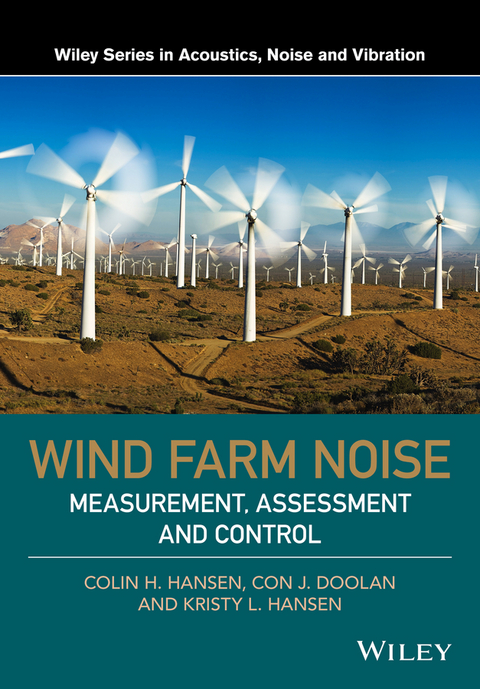
Wind Farm Noise (eBook)
John Wiley & Sons (Verlag)
978-1-118-82611-9 (ISBN)
A comprehensive guide to wind farm noise prediction, measurement, assessment, control and effects on people
Wind Farm Noise covers all aspects associated with the generation, measurement, propagation, regulation and adverse health effects of noise produced by large horizontal-axis wind turbines of the type used in wind farms.
The book begins with a brief history of wind turbine development and the regulation of their noise at sensitive receivers. Also included is an introductory chapter on the fundamentals of acoustics relevant to wind turbine noise so that readers are well prepared for understanding later chapters on noise measurements, noise generation mechanisms, noise propagation modelling and the assessment of the noise at surrounding residences.
Key features:
- Potential adverse health effects of wind farm noise are discussed in an objective way.
- Means for calculating the noise at residences due to a wind farm prior to construction are covered in detail along with uncertainty estimates.
- The effects of meteorological conditions and other influences, such as obstacles, ground cover and atmospheric absorption, on noise levels at residences are explained.
- Quantities that should be measured as well as how to best measure them in order to properly characterise wind farm noise are discussed in detail.
- Noise generation mechanisms and possible means for their control are discussed as well as aspects of wind farm noise that still require further research to be properly understood.
The book provides comprehensive coverage of the topic, containing both introductory and advanced level material.
Professor Colin Hansen has been consulting, researching and teaching in the field of noise and vibration for 40 years. He has authored or co-authored eleven books, edited two books, and contributed seven chapters to various other books. His current research is focused on the generation, assessment and control of wind farm noise, on which he has been working since 2010 and for which he has been funded by the Australian Research Council. He is an Honorary Fellow and past-president of the International Institute of Acoustics and Vibration, a Fellow of the Australian Acoustical Society and a Fellow of Engineers Australia. He was awarded the 2009 Rayleigh Medal by the British institute of Acoustics for outstanding contributions to acoustics, the 2013 A.G.M. Michell medal by Engineers Australia for outstanding service to the discipline of Mechanical Engineering and the 2014 Rossing Prize in Acoustics Education by the Acoustical Society of America.
AssociateProfessor Doolan has an Honours Degree in Mechanical Engineering and a PhD in Aerospace Engineering from the University of Queensland. He has over 20 years experience in research and development, teaching and consulting, with over 150 technical publications. His research interests focus upon compressible flow, which includes the area of aeroacoustics - the science of how fluid flow creates sound - with the aim to control noise from modern technologies such as aircraft, wind turbines and submarines. Associate Professor Doolan has been involved for many years in the understanding and control of wind turbine noise, with funding from the Australian Research Council to perform aeroacoustic testing of scaled turbines in wind tunnels.
Dr Kristy Hansen completed an Honours Degree in Mechanical Engineering and a PhD in Aerodynamics/Fluid Mechanics at the University of Adelaide. She spent 3 years working on an Australian Research Council funded grant investigating the impact of wind farm noise on rural communities. This work involved collection of an extensive data set which resulted from simultaneous measurements of noise, vibration and meteorological data at rural locations near different wind farms. Results from the analysis of these data have been presented in a number of peer-reviewed journals and conference papers. She is continuing her research on wind farm noise as part of her current employment at Flinders University.
A comprehensive guide to wind farm noise prediction, measurement, assessment, control and effects on people Wind Farm Noise covers all aspects associated with the generation, measurement, propagation, regulation and adverse health effects of noise produced by large horizontal-axis wind turbines of the type used in wind farms. The book begins with a brief history of wind turbine development and the regulation of their noise at sensitive receivers. Also included is an introductory chapter on the fundamentals of acoustics relevant to wind turbine noise so that readers are well prepared for understanding later chapters on noise measurements, noise generation mechanisms, noise propagation modelling and the assessment of the noise at surrounding residences. Key features: Potential adverse health effects of wind farm noise are discussed in an objective way. Means for calculating the noise at residences due to a wind farm prior to construction are covered in detail along with uncertainty estimates. The effects of meteorological conditions and other influences, such as obstacles, ground cover and atmospheric absorption, on noise levels at residences are explained. Quantities that should be measured as well as how to best measure them in order to properly characterise wind farm noise are discussed in detail. Noise generation mechanisms and possible means for their control are discussed as well as aspects of wind farm noise that still require further research to be properly understood. The book provides comprehensive coverage of the topic, containing both introductory and advanced level material.
Professor Colin Hansen has been consulting, researching and teaching in the field of noise and vibration for 40 years. He has authored or co-authored eleven books, edited two books, and contributed seven chapters to various other books. His current research is focused on the generation, assessment and control of wind farm noise, on which he has been working since 2010 and for which he has been funded by the Australian Research Council. He is an Honorary Fellow and past-president of the International Institute of Acoustics and Vibration, a Fellow of the Australian Acoustical Society and a Fellow of Engineers Australia. He was awarded the 2009 Rayleigh Medal by the British institute of Acoustics for outstanding contributions to acoustics, the 2013 A.G.M. Michell medal by Engineers Australia for outstanding service to the discipline of Mechanical Engineering and the 2014 Rossing Prize in Acoustics Education by the Acoustical Society of America. AssociateProfessor Doolan has an Honours Degree in Mechanical Engineering and a PhD in Aerospace Engineering from the University of Queensland. He has over 20 years experience in research and development, teaching and consulting, with over 150 technical publications. His research interests focus upon compressible flow, which includes the area of aeroacoustics - the science of how fluid flow creates sound - with the aim to control noise from modern technologies such as aircraft, wind turbines and submarines. Associate Professor Doolan has been involved for many years in the understanding and control of wind turbine noise, with funding from the Australian Research Council to perform aeroacoustic testing of scaled turbines in wind tunnels. Dr Kristy Hansen completed an Honours Degree in Mechanical Engineering and a PhD in Aerodynamics/Fluid Mechanics at the University of Adelaide. She spent 3 years working on an Australian Research Council funded grant investigating the impact of wind farm noise on rural communities. This work involved collection of an extensive data set which resulted from simultaneous measurements of noise, vibration and meteorological data at rural locations near different wind farms. Results from the analysis of these data have been presented in a number of peer-reviewed journals and conference papers. She is continuing her research on wind farm noise as part of her current employment at Flinders University.
Cover 1
Title Page 5
Copyright 6
Dedication 7
Contents 9
Wiley Series in Acoustics, Noise and Vibration 17
Preface 19
Chapter 1 Wind Energy and Noise 21
1.1 Introduction 21
1.2 Development of the Wind Energy Industry 22
1.2.1 Early Development Prior to 2000 22
1.2.2 Development since 2000 28
1.2.3 Support Received by the Wind Industry 31
1.3 History of Wind Turbine Noise Studies 33
1.3.1 Modern Wind Turbine Sound Power Levels 36
1.4 Current Wind Farm Noise Guidelines and Assessment Procedures 38
1.4.1 ETSU-R-97 (used mainly in the UK and Ireland) 38
1.4.2 National Planning Policy Framework for England 45
1.4.3 World Health Organisation Guidelines 45
1.4.4 DEFRA Guidelines 47
1.4.5 Noise Perception Index 48
1.5 Wind Farm Noise Standards 49
1.5.1 General Environmental Noise Standards 49
1.5.2 IEC 61400-11 49
1.5.3 NZS6808 51
1.5.4 AS4959 51
1.6 Regulations 52
1.6.1 What Should be Included in a Wind Farm Noise Regulation 52
1.6.2 Existing Noise Ordinances and Regulations 58
1.7 Inquiries and Government Investigations 63
1.7.1 Australia 2010-2014 63
1.7.2 Canada 68
1.7.3 Denmark 2013 70
1.7.4 Northern Ireland 2013 71
1.7.5 Scotland 71
1.7.6 Wales 71
1.8 Current Consensus on Wind Farm Noise 72
References 72
Chapter 2 Fundamentals of Acoustics and Frequency Analysis 77
2.1 Introduction 77
2.2 Basic Acoustics Concepts 77
2.2.1 Root Mean Square Sound Pressure 78
2.2.2 Statistical Descriptors and Their Use 79
2.2.3 Amplitude, Frequency, Wavelength, Wavenumber and Speed for Single-frequency Sound 80
2.2.4 Units for Sound Pressure Measurement 82
2.2.5 Sound Power 83
2.2.6 Beating 84
2.2.7 Amplitude Modulation and Amplitude Variation 86
2.2.8 Decibel Addition 89
2.2.9 Decibel Subtraction 90
2.2.10 Noise Source Directivity 91
2.2.11 Weighting Networks 91
2.2.12 Noise Level Measures 93
2.2.13 Sound in Rooms 96
2.3 Basic Frequency Analysis 99
2.3.1 Digital Filtering 102
2.3.2 Octave Band and 1/3-Octave Band Analysis 103
2.3.3 Octave and 1/3-Octave Filter Rise and Settling times 104
2.4 Advanced Frequency Analysis 108
2.4.1 Auto Power Spectrum and Power Spectral Density 111
2.4.2 Linear Spectrum 115
2.4.3 Leakage 115
2.4.4 Windowing 116
2.4.5 Sampling Frequency and Aliasing 123
2.4.6 Overlap Processing 123
2.4.7 Zero Padding 125
2.4.8 Uncertainty Principle 125
2.4.9 Time Synchronous Averaging and Synchronous Sampling 125
2.4.10 Hilbert Transform 126
2.4.11 Cross-spectrum 127
2.4.12 Coherence 129
2.4.13 Frequency-response (or Transfer) Function 130
2.4.14 Coherent Output Power 131
2.4.15 Convolution 132
2.4.16 Auto-correlation and Cross-correlation Functions 133
2.4.17 Maximum Length Sequence 135
2.5 Summary 137
References 137
Chapter 3 Noise Generation 139
3.1 Introduction 139
3.1.1 Definitions 140
3.2 Aeroacoustics 142
3.2.1 Turbulence and Sound 142
3.2.2 The Effect of Solid Surfaces 144
3.2.3 The Effect of Moving Solid Surfaces 145
3.3 Aerodynamic Noise Generation on Wind Turbines 148
3.3.1 The Aerodynamic Environment of a Wind Turbine 148
3.3.2 Trailing-edge Noise 151
3.3.3 Separation-stall Noise 158
3.3.4 Tip Noise 159
3.3.5 Turbulence-Leading-edge Interaction Noise 161
3.3.6 Wind-shear Noise 164
3.3.7 Blade-Tower Interaction Noise 165
3.3.8 Thickness Noise 167
3.4 Aero-elasticity and Noise 168
3.5 Other Noise Sources 169
3.6 Summary and Outlook 171
References 172
Chapter 4 Wind Turbine Sound Power Estimation 177
4.1 Introduction 177
4.2 Aerodynamic Noise Prediction 177
4.2.1 Types of Prediction Methods 177
4.3 Simple Models 178
4.4 Semi-empirical Methods (Class II Models) 179
4.4.1 Overall Framework 179
4.4.2 Aerodynamic Analysis 180
4.4.3 Boundary-layer Estimates 183
4.4.4 Airfoil Noise Models 184
4.4.5 Inflow Noise Model 186
4.4.6 Prediction of Total Sound Power 188
4.5 Computational Methods (Class III Models) 188
4.6 Estimations of Sound Power From Measurements 189
4.6.1 Instrumentation 190
4.6.2 Procedure 191
4.6.3 Data Analysis 192
4.6.4 Comments on Turbine Sound Power Measurements 194
4.6.5 Possible Improvements to Procedures for Measuring Turbine Sound Power Levels 195
4.7 Summary 197
References 197
Chapter 5 Propagation of Noise and Vibration 200
5.1 Introduction 200
5.2 Principles Underpinning Noise Propagation Modelling 202
5.2.1 Spherical Spreading, Adiv 203
5.2.2 Atmospheric Absorption, Aatm 206
5.2.3 Ground Effect, Agr 207
5.2.4 Meteorological Effects, Amet 208
5.2.5 Barrier Effects, Abar 229
5.2.6 Miscellaneous Propagation Effects, Amisc 229
5.2.7 Infrasound and Low-frequency Noise 230
5.2.8 Propagation Modelling Procedure 230
5.3 Simplest Noise Propagation Models 232
5.4 Danish Low-frequency Propagation Model 233
5.5 CONCAWE (1981) 234
5.5.1 Spherical Spreading, K1 234
5.5.2 Atmospheric Absorption, K2 234
5.5.3 Ground Effects, K3 235
5.5.4 Meteorological Effects, K4 235
5.5.5 Source-height Effects, K5 238
5.5.6 Barrier Attenuation, K6 238
5.5.7 In-plant Screening, K7 241
5.5.8 Vegetation Screening, Kv 241
5.5.9 Limitations of the CONCAWE Model 241
5.6 ISO9613-2 (1996) Noise Propagation Model 243
5.6.1 Ground Effects, Agr 244
5.6.2 Barrier Attenuation, Abar 245
5.6.3 Vegetation Screening, Af 247
5.6.4 Effect of Reflections other than Ground Reflections 248
5.6.5 Recommended Adjustments to the ISO9613-2 Model for Wind Farm Noise 248
5.6.6 Limitations of the ISO9613-2 Model 250
5.7 NMPB-2008 Noise Propagation Model 251
5.7.1 Ground, Barrier and Terrain Excess Attenuation, Agr+bar 252
5.7.2 Reflections from Vertical Surfaces 261
5.7.3 Limitations of the NMPB-2008 Model 262
5.8 Nord2000 Noise Propagation Model 262
5.8.1 Combination of Sound Rays from the Same Source Arriving at the Receiver via Different Paths 264
5.8.2 Ground, Barrier and Terrain Excess Attenuation, Agr+bar 269
5.8.3 Multiple Ground Reflections 272
5.8.4 Excess Attenuation, Asc, due to a Ray Travelling Through a Scattering Zone 275
5.8.5 Excess Attenuation, Ar' due to Reflection from a Facade or Building 276
5.8.6 Limitations of the Nord2000 model 279
5.9 Harmonoise (2002) Noise Propagation Engineering Model 280
5.9.1 Combination of Sound Rays from the Same Source Arriving at the Receiver via Different Paths (for Calculating Agr+bar) 283
5.9.2 Coordinate Transformation for the Ground Profile 284
5.9.3 Ground, Barrier and Terrain Excess Attenuation, Agr+bar 286
5.9.4 Excess Attenuation due to Scattering 286
5.9.5 Excess Attenuation, Ar' due to Reflection from a Facade or Building 287
5.9.6 Limitations of the Harmonoise Model 288
5.10 Required Input Data for the Various Propagation Models 289
5.10.1 CONCAWE 289
5.10.2 ISO9613-2 289
5.10.3 NMPB-2008 290
5.10.4 Nord2000 291
5.10.5 Harmonoise 291
5.11 Offshore Wind Farm Propagation Models 292
5.12 Propagation Model Prediction Uncertainty 292
5.13 Outside versus Inside Noise at Residences 296
5.14 Vibration Propagation 300
5.14.1 Vibration Generation 301
5.14.2 Vibration Propagation 301
5.14.3 Vibration Detection 302
5.15 Summary 303
References 305
Chapter 6 Measurement 309
6.1 Introduction 309
6.2 Measurement of Environmental Noise Near Wind Farms 310
6.2.1 Instrumentation 311
6.2.2 Effects of Wind 320
6.2.3 Wind Screens for Microphones 321
6.2.4 Microphone Height 327
6.2.5 Ambient or Background Noise Assessment 327
6.2.6 A- and C-weighted Levels 334
6.2.7 Infrasound and Low-frequency Noise 337
6.2.8 Indoor Measurements 342
6.2.9 Outdoor-to-indoor Noise Reduction 344
6.2.10 Amplitude Modulation and Variation 348
6.2.11 Psychoacoustic Descriptors 369
6.2.12 Tonality 371
6.2.13 Additional Turbine Noise Analysis Techniques 383
6.2.14 Compliance Testing 385
6.2.15 Beamforming for Source Localisation on Full-scale Wind Turbines 406
6.2.16 Measurement Uncertainty 407
6.3 Vibration 413
6.3.1 Instrumentation 414
6.3.2 Measurement 414
6.3.3 Analysis 415
6.4 Wind, Wind Shear and Turbulence 415
6.4.1 Instrumentation 415
6.4.2 Measurement 419
6.4.3 Analysis 421
6.5 Reporting on Noise, Vibration and Meteorological Conditions 425
6.6 Wind Tunnel Testing 428
6.6.1 Wind Tunnel Techniques 429
6.6.2 Noise Measurements in Wind Tunnels 433
6.6.3 Review of some Recent Measurements 442
6.7 Conclusions 445
References 445
Chapter 7 Effects of Wind Farm Noise and Vibration on People 456
7.1 Introduction 456
7.2 Annoyance and Adverse Health Effects 461
7.2.1 Amplitude Modulation, Amplitude Variation and Beating 473
7.3 Hearing Mechanism 475
7.3.1 External Ear 475
7.3.2 Middle Ear 475
7.3.3 Inner Ear 477
7.3.4 Frequency Response of the Human Ear 479
7.4 Reproduction of Wind Farm Noise for Adverse Effects Studies 485
7.5 Vibration Effects 487
7.6 Nocebo Effect 487
7.7 Summary and Conclusion 488
References 490
Chapter 8 Wind Farm Noise Control 496
8.1 Introduction 496
8.2 Noise Control by Turbine Design Modification 497
8.2.1 Optimisation of Blade Design 498
8.2.2 Trailing-edge Treatments 499
8.2.3 Blade-pitch Control 501
8.2.4 Phase Control 503
8.2.5 Control of Noise Resulting from Aeroacoustic Excitation of the Blades 505
8.2.6 Control of Noise Resulting from Mechanical Excitation of the Gearbox, Blades and Tower 506
8.3 Optimisation of Turbine Layout 507
8.4 Options for Noise Control at the Residences 508
8.4.1 Active Noise Control 508
8.4.2 Masking 512
8.5 Administrative Controls 512
8.6 Summary 513
References 513
Chapter 9 Recommendations for Future Research 516
9.1 Introduction 516
9.2 Further Investigation of the Effects of Wind Farm Noise on People 517
9.3 Improvements to Regulations and Guidelines 519
9.4 Propagation Model Improvements 524
9.5 Identification and Amelioration of the Problem Noise Sources on Wind Turbines 524
9.5.1 Identification of Noise Sources 524
9.5.2 Amelioration of Noise Sources 525
9.6 Reducing Low-frequency Noise Levels in Residences 526
References 526
Appendix A Basic Mathematics 527
A.1 Introduction 527
A.2 Logarithms 527
A.3 Complex Numbers 528
A.4 Exponential Function 528
Appendix B The BPM model 529
B.1 Boundary-layer Parameters 529
B.2 Turbulent Trailing-edge Noise Model 531
B.3 Blunt Trailing-edge Noise Model 533
Reference 535
Appendix C Ground Reflection Coefficient Calculations 536
C.1 Introduction 536
C.2 Flow Resistivity 537
C.3 Characteristic Impedance 538
C.4 Plane-wave Reflection Coefficient 540
C.5 Spherical-wave Reflection Coefficient 541
C.6 Incoherent Reflection Coefficient 544
References 545
Appendix D Calculation of Ray Path Distances and Propagation Times for the Nord2000 Model 546
D.1 Introduction 546
D.2 Equivalent Linear Atmospheric Vertical Sound-speed Profile 547
D.3 Calculation of Ray Path Lengths and Propagation Times 549
D.3.1 Direct Ray 549
D.3.2 Reflected Ray 551
References 552
Appendix E Calculation of Terrain Parameters for the Nord2000 Sound Propagation Model 554
E.1 Introduction 554
E.2 Terrain Effects 554
E.3 Approximating Terrain Profiles by Straight-line Segments 559
E.4 Calculation of the Excess Attenuation due to the Ground Effect for Relatively Flat Terrain with no Diffraction Edges 560
E.5 Calculation of the Excess Attenuation due to the Ground Effect for Relatively Flat Terrain with a Variable Impedance Surface and no Diffraction Edges 561
E.6 Calculation of the Excess Attenuation due to the Ground Effect for Valley-shaped Terrain 563
E.7 Identification of the Two Most Efficient Diffraction Edges 564
E.8 Calculation of the Sound Pressure at the Receiver for each Diffracted Path in Hilly Terrain 567
E.8.1 Diffraction over a Single Finite-impedance Wedge-shaped Screen 567
E.8.2 Diffraction over a Finite-impedance Thick screen with Two Diffraction Edges 570
E.8.3 Diffraction over Two Finite-impedance Wedges 574
E.9 Calculation of the Combined Ground and Barrier Excess-attenuation Effects 576
E.9.1 Terrain Involving a Single Diffraction Wedge 577
E.9.2 Terrain involving a Double Diffraction Wedge 581
E.9.3 Terrain involving Two Single Diffraction Wedges 581
References 583
Appendix F Calculation of Fresnel Zone Sizes and Weights 584
F.1 Introduction 584
F.2 Fresnel Zone for Reflection from Flat Ground 584
F.3 Fresnel Weights for Reflection from a Concave or Transition Ground Segment 587
F.4 Fresnel Weights for Reflection from a Convex Ground Segment 590
Reference 591
Appendix G Calculation of Diffraction and Ground Effects for the Harmonoise Model 592
G.1 Introduction 592
G.2 Diffraction Effect, ??????LD 594
G.3 Ground Effect 597
G.3.1 Concave Model 599
G.3.2 Transition Model 602
G.4 Fresnel Zone for Reflection from a Ground Segment 604
References 607
Appendix H Active Noise-control System Algorithms 608
H.1 Introduction 608
H.2 Single-input, Single-output (SISO) Weight Update Algorithm 608
H.3 Multiple-input, Multiple-output Weight Update Algorithm 610
References 612
Index 613
EULA 626
| Erscheint lt. Verlag | 31.1.2017 |
|---|---|
| Reihe/Serie | Wiley Series in Acoustics Noise and Vibration |
| Wiley Series in Acoustics Noise and Vibration | Wiley Series in Acoustics Noise and Vibration |
| Sprache | englisch |
| Themenwelt | Technik ► Bauwesen |
| Technik ► Elektrotechnik / Energietechnik | |
| Technik ► Maschinenbau | |
| Schlagworte | Aeroacoustics • Atmospheric acoustics • Control Process & Measurements • Energie • Energy • Maschinenbau • mechanical engineering • Mess- u. Regeltechnik • Noise measurement • Noise Propagation • Physics • Physics of Acoustics • Physik • Physik des Schalls • Windenergie • Wind Energy • Wind farm infrasound • Wind farm noise • Wind turbine adverse health effects • Wind Turbine Noise • Wind turbine noise control |
| ISBN-10 | 1-118-82611-6 / 1118826116 |
| ISBN-13 | 978-1-118-82611-9 / 9781118826119 |
| Informationen gemäß Produktsicherheitsverordnung (GPSR) | |
| Haben Sie eine Frage zum Produkt? |
 PDF (Adobe DRM)
Kopierschutz: Adobe-DRM
Adobe-DRM ist ein Kopierschutz, der das eBook vor Mißbrauch schützen soll. Dabei wird das eBook bereits beim Download auf Ihre persönliche Adobe-ID autorisiert. Lesen können Sie das eBook dann nur auf den Geräten, welche ebenfalls auf Ihre Adobe-ID registriert sind.
Details zum Adobe-DRM
Dateiformat: PDF (Portable Document Format)
Mit einem festen Seitenlayout eignet sich die PDF besonders für Fachbücher mit Spalten, Tabellen und Abbildungen. Eine PDF kann auf fast allen Geräten angezeigt werden, ist aber für kleine Displays (Smartphone, eReader) nur eingeschränkt geeignet.
Systemvoraussetzungen:
PC/Mac: Mit einem PC oder Mac können Sie dieses eBook lesen. Sie benötigen eine
eReader: Dieses eBook kann mit (fast) allen eBook-Readern gelesen werden. Mit dem amazon-Kindle ist es aber nicht kompatibel.
Smartphone/Tablet: Egal ob Apple oder Android, dieses eBook können Sie lesen. Sie benötigen eine
Geräteliste und zusätzliche Hinweise
Buying eBooks from abroad
For tax law reasons we can sell eBooks just within Germany and Switzerland. Regrettably we cannot fulfill eBook-orders from other countries.
aus dem Bereich