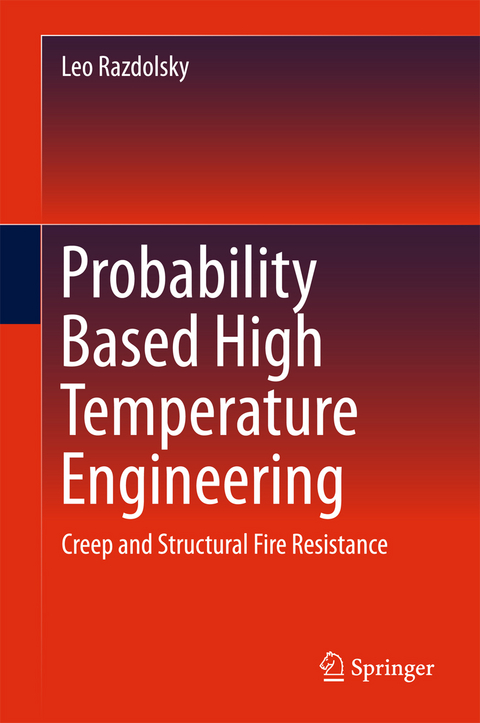
Probability Based High Temperature Engineering (eBook)
XVII, 656 Seiten
Springer International Publishing (Verlag)
978-3-319-41909-1 (ISBN)
This volume on structural fire resistance is for aerospace, structural, and fire prevention engineers; architects, and educators. It bridges the gap between prescriptive- and performance-based methods and simplifies very complex and comprehensive computer analyses to the point that the structural fire resistance and high temperature creep deformations will have a simple, approximate analytical expression that can be used in structural analysis and design. The book emphasizes methods of the theory of engineering creep (stress-strain diagrams) and mathematical operations quite distinct from those of solid mechanics absent high-temperature creep deformations, in particular the classical theory of elasticity and structural engineering. Dr. Razdolsky's previous books focused on methods of computing the ultimate structural design load to the different fire scenarios. The current work is devoted to the computing of the estimated ultimate resistance of the structure taking into account the effect of high temperature creep deformations. An essential resource for aerospace structural engineers who wish to improve their understanding of structure exposed to flare up temperatures and severe fires, the book also serves as a textbook for introductory courses in fire safety in civil or structural engineering programs, vital reading for the PhD students in aerospace fire protection and structural engineering, and a case study of a number of high-profile fires (the World Trade Center, Broadgate Phase 8, One Meridian Plaza; Mandarin Towers). Probability Based High Temperature Engineering: Creep and Structural Fire Resistance successfully bridges the information gap between aerospace, structural, and engineers; building inspectors, architects, and code officials.
Leo Razdolsky, Ph.D., P.E., S.E., has nearly 50 years' experience as a practitioner and consultant in structural engineering, specializing in design of tall structures, site inspection, and project management. He has also taught structural engineering courses for more than 15 years at the University of Illinois at Chicago and Northwestern University, and conducted research on structural fire load and high-rise building design to mitigate extreme conditions during fires.
Leo Razdolsky, Ph.D., P.E., S.E., has nearly 50 years' experience as a practitioner and consultant in structural engineering, specializing in design of tall structures, site inspection, and project management. He has also taught structural engineering courses for more than 15 years at the University of Illinois at Chicago and Northwestern University, and conducted research on structural fire load and high-rise building design to mitigate extreme conditions during fires.
Introduction.- Integral Volterra Equations.- Phenomenological Time Invariant Creep Models.- Phenomenological Time Variant Nonlinear Creep Models.- Transient Engineering Creep of Materials Under Various Fire Conditions.- Anisotropic Materials and Composite Structures.- Probabilistic Modeling of Creep and Stress-Strain Diagram.- Probability-based Engineering Creep and Design Fire Exposure.- Fire Severity and Structural Creep Analysis/Design.
| Erscheint lt. Verlag | 18.8.2016 |
|---|---|
| Zusatzinfo | XVII, 656 p. 308 illus., 257 illus. in color. |
| Verlagsort | Cham |
| Sprache | englisch |
| Themenwelt | Technik ► Bauwesen |
| Technik ► Maschinenbau | |
| Schlagworte | Aerospace Structural Engineering • Engineering Creep Modeling • High Temperature Creep of Materials • Probability Based Methods in Structural Analysis • Rheological Models of Creep • Structural Fire Resistance |
| ISBN-10 | 3-319-41909-9 / 3319419099 |
| ISBN-13 | 978-3-319-41909-1 / 9783319419091 |
| Informationen gemäß Produktsicherheitsverordnung (GPSR) | |
| Haben Sie eine Frage zum Produkt? |
 PDF (Wasserzeichen)
DRM: Digitales Wasserzeichen
Dieses eBook enthält ein digitales Wasserzeichen und ist damit für Sie personalisiert. Bei einer missbräuchlichen Weitergabe des eBooks an Dritte ist eine Rückverfolgung an die Quelle möglich.
Dateiformat: PDF (Portable Document Format)
Mit einem festen Seitenlayout eignet sich die PDF besonders für Fachbücher mit Spalten, Tabellen und Abbildungen. Eine PDF kann auf fast allen Geräten angezeigt werden, ist aber für kleine Displays (Smartphone, eReader) nur eingeschränkt geeignet.
Systemvoraussetzungen:
PC/Mac: Mit einem PC oder Mac können Sie dieses eBook lesen. Sie benötigen dafür einen PDF-Viewer - z.B. den Adobe Reader oder Adobe Digital Editions.
eReader: Dieses eBook kann mit (fast) allen eBook-Readern gelesen werden. Mit dem amazon-Kindle ist es aber nicht kompatibel.
Smartphone/Tablet: Egal ob Apple oder Android, dieses eBook können Sie lesen. Sie benötigen dafür einen PDF-Viewer - z.B. die kostenlose Adobe Digital Editions-App.
Buying eBooks from abroad
For tax law reasons we can sell eBooks just within Germany and Switzerland. Regrettably we cannot fulfill eBook-orders from other countries.
aus dem Bereich