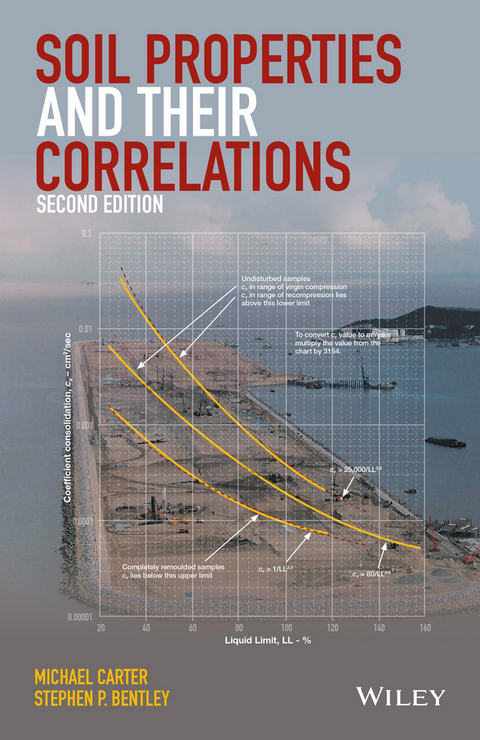
Soil Properties and their Correlations (eBook)
John Wiley & Sons (Verlag)
978-1-119-13090-1 (ISBN)
An essential guide to improving preliminary geotechnical analysis and design from limited data
Soil Properties and their Correlations, Second Edition provides a summary of commonly-used soil engineering properties and gives a wide range of correlations between the various properties, presented in the context of how they will be used in geotechnical design.
The book is divided into 11 chapters: Commonly-measured properties; Grading and plasticity; Density; Permeability, Consolidation and settlement; Shear strength; California bearing ratio; Shrinkage and swelling characteristics; Frost susceptibility; Susceptibility to combustion; and Soil-structure interfaces. In addition, there are two appendices: Soil classification systems; and Sampling methods.
This new, more comprehensive, edition provides material that would be of practical assistance to those faced with the problem of having to estimate soil behaviour from little or no laboratory test data.
Key features:
- Soil properties explained in practical terms.
- A large number of correlations between different soil properties.
- A valuable aid for assessing design values of properties.
- Clear statements on practical limitations and accuracy.
An invaluable source of reference for experienced professionals working on geotechnical design, it will also give students and early-career engineers an in-depth appreciation of the appropriate use of each property and the pitfalls to avoid.
Mike Carter is a civil and geotechnical engineer whose experience ranges from the practical, including site-based supervision of construction work, to the analytical, including the preparation of geotechnical design manuals and computer-based methods for consulting engineers. He has worked both in the UK and overseas; for consulting engineers, a contractor, a specialist site investigation contractor and as a university lecturer. In terms of engineering complexity, projects he has worked on have varied from the basic, such rural roads in East Africa and India, to the large and complex, such as the construction of an artificial island for Macau International Airport. He has also been involved in the analysis and rectification of numerous earthworks failures and has worked as a lecturer and trainer in the UK, Indonesia and Sri Lanka. He is the author of three books on geotechnical engineering.
Dr Bentley is an Engineering Geologist. During his long academic career at Cardiff University he has acted as a consultant to many large UK companies including the Department of the Environment (UK). He has also been retained as a consultant to the Departments of Public Works in Brunei and Saudi Arabia. He has supervised 12 PhD and over 60 MSc students; most of the PhD research topics were collaborative with industry. He has published 110 technical papers. Highlights of his research work include the first edition of the textbook 'Correlation of Soil Properties' which was adopted by many consultancy firms as a standard reference book. Also the visualisation software, 'STRATA', which was successfully commercialised and sold into over 100 companies in 12 countries worldwide.
An essential guide to improving preliminary geotechnical analysis and design from limited data Soil Properties and their Correlations, Second Edition provides a summary of commonly-used soil engineering properties and gives a wide range of correlations between the various properties, presented in the context of how they will be used in geotechnical design. The book is divided into 11 chapters: Commonly-measured properties; Grading and plasticity; Density; Permeability, Consolidation and settlement; Shear strength; California bearing ratio; Shrinkage and swelling characteristics; Frost susceptibility; Susceptibility to combustion; and Soil-structure interfaces. In addition, there are two appendices: Soil classification systems; and Sampling methods. This new, more comprehensive, edition provides material that would be of practical assistance to those faced with the problem of having to estimate soil behaviour from little or no laboratory test data. Key features: Soil properties explained in practical terms. A large number of correlations between different soil properties. A valuable aid for assessing design values of properties. Clear statements on practical limitations and accuracy. An invaluable source of reference for experienced professionals working on geotechnical design, it will also give students and early-career engineers an in-depth appreciation of the appropriate use of each property and the pitfalls to avoid.
Mike Carter is a civil and geotechnical engineer whose experience ranges from the practical, including site-based supervision of construction work, to the analytical, including the preparation of geotechnical design manuals and computer-based methods for consulting engineers. He has worked both in the UK and overseas; for consulting engineers, a contractor, a specialist site investigation contractor and as a university lecturer. In terms of engineering complexity, projects he has worked on have varied from the basic, such rural roads in East Africa and India, to the large and complex, such as the construction of an artificial island for Macau International Airport. He has also been involved in the analysis and rectification of numerous earthworks failures and has worked as a lecturer and trainer in the UK, Indonesia and Sri Lanka. He is the author of three books on geotechnical engineering. Dr Bentley is an Engineering Geologist. During his long academic career at Cardiff University he has acted as a consultant to many large UK companies including the Department of the Environment (UK). He has also been retained as a consultant to the Departments of Public Works in Brunei and Saudi Arabia. He has supervised 12 PhD and over 60 MSc students; most of the PhD research topics were collaborative with industry. He has published 110 technical papers. Highlights of his research work include the first edition of the textbook 'Correlation of Soil Properties' which was adopted by many consultancy firms as a standard reference book. Also the visualisation software, 'STRATA', which was successfully commercialised and sold into over 100 companies in 12 countries worldwide.
Title Page 5
Copyright Page 6
Contents 7
Preface 12
Acknowledgements 14
List of Symbols 15
List of Property Values and Correlations in the Tables and Figures 22
Chapter 1 Commonly Measured Properties 27
1.1 Moisture Content 28
1.1.1 Test Methods 28
1.2 Grading 29
1.2.1 Test Methods 30
1.3 Plasticity 33
1.3.1 Test Methods 33
1.4 Specific Gravity of Soil Particles 36
1.4.1 Test Method 36
1.5 Soil Density 37
1.5.1 Test Methods 38
1.6 Permeability 42
1.6.1 Test Methods 43
1.7 Consolidation 45
1.7.1 Test Method 46
1.8 Shear Strength 47
1.8.1 Test Methods 48
1.8.2 Choice of Shear Strength Test 53
1.9 Standard Compaction Test 53
1.9.1 Test Method 53
1.10 California Bearing Ratio 56
1.10.1 Test Method 56
1.11 Other Properties 58
1.11.1 Swelling Potential 58
1.11.2 Frost Susceptibility 58
1.11.3 Combustible Content 59
References 59
Chapter 2 Grading and Plasticity 60
2.1 Grading 60
2.1.1 The Influence of Grading on Soil Properties 61
2.1.2 Standard Grading Divisions 62
2.2 Plasticity 64
2.2.1 Consistency Limits 67
2.2.2 Development of the Liquid and Plastic Limit Tests 68
2.2.3 Plasticity Test Results and Plasticity Descriptions 69
2.2.4 The Shrinkage Limit Test 69
2.2.5 Consistency Limits as Indicators of Soil Behaviour 71
2.2.6 Limitations of the Use of Plasticity Limits 73
References 73
Chapter 3 Density 75
3.1 Density in the Context of Soils 75
3.1.1 Density Relationships 76
3.1.2 Typical Natural Density Values 79
3.2 Compacted Density 79
3.2.1 Typical Compacted Density Values 80
3.2.2 Quick Estimates of Maximum Dry Density and Optimum Moisture Content 81
3.3 Relative Density 85
3.3.1 Field Measurement of Relative Density 85
3.3.2 SPT Correction Factors 86
3.3.3 Other Dynamic Cone Tests 90
3.3.4 Static Cone Tests 91
References 92
Chapter 4 Permeability 94
4.1 Effects of Soil Macro?Structure 95
4.2 Typical Values 95
4.3 Permeability and Grading 97
References 99
Chapter 5 Consolidation and Settlement 100
5.1 Compressibility of Clays 101
5.1.1 Compressibility Parameters 101
5.1.2 Settlement Calculations Using Consolidation Theory 104
5.1.3 Settlement Calculations Using Elastic Theory 105
5.1.4 Typical Values and Correlations of Compressibility Coefficients 107
5.1.5 Settlement Corrections 110
5.2 Rate of Consolidation of Clays 112
5.3 Secondary Compression 114
5.4 Settlement of Sands and Gravels 118
5.4.1 Methods Based on Standard Penetration Tests 119
5.4.2 Methods Based on Plate Bearing Tests 127
5.5 Assessment of Settlement Parameters from Static Cone Penetration Testing 128
5.5.1 Coefficient of Volume Compressibility 128
5.5.2 Coefficient of Consolidation 129
References 131
Chapter 6 Shear Strength 133
6.1 Stresses Within a Material 134
6.1.1 The Mohr Diagram 134
6.1.2 Relationships of Stresses at a Point 134
6.2 Shear Strength in Soils 139
6.3 The Choice of Total or Effective Stress Analysis 142
6.3.1 The Choice in Practice 142
6.4 Peak, Residual and Constant-Volume Shear Strength 144
6.5 Undrained Shear Strength of Clays 145
6.5.1 Consistency and Remoulded Shear Strength 145
6.5.2 Consistency and Undisturbed Shear Strength 146
6.5.3 Estimates Using the Standard Penetration Test 152
6.5.4 Estimates Using Dynamic Cone Tests 154
6.5.5 Estimates Using Static Cone Tests 156
6.6 Drained and Effective Shear Strength of Clays 156
6.7 Shear Strength of Granular Soils 158
References 162
Chapter 7 California Bearing Ratio 164
7.1 Correlations with Soil Classification Tests 165
7.2 Correlations with Soil Classification Systems 170
7.3 CBR and Undrained Shear Strength 170
7.4 An Alternative to CBR Testing 174
References 175
Chapter 8 Shrinkage and Swelling Characteristics 177
8.1 Identification 177
8.2 Swelling Potential 179
8.2.1 Swelling Potential in Relation to other Properties 179
8.2.2 Reliability of Swell Predictions Based on Correlations 186
8.3 Swelling Pressure 186
References 188
Chapter 9 Frost Susceptibility 190
9.1 Ice Segregation 190
9.2 Direct Measurement of Frost Susceptibility 192
9.3 Indirect Assessment of Frost Susceptibility 193
9.3.1 Grading 193
9.3.2 Plasticity 195
9.3.3 Predictions Based on Segregation Potential 197
9.4 Choosing a Suitable Method of Evaluating Frost Susceptibility 199
References 200
Chapter 10 Susceptibility to Combustion 201
Reference 202
Chapter 11 Soil-Structure Interfaces 203
11.1 Lateral Pressures in a Soil Mass 203
11.1.1 Earth Pressure at Rest 204
11.2 Friction and Adhesion at Interfaces 206
11.2.1 Values Relating to Specific Types of Structure 206
References 210
Appendix A: Soil Classification Systems 212
A.1 Systems Based on the Casagrande System 213
A.1.1 The Unified System 213
A.1.2 The ASTM System 215
A.1.3 The British Standard System 215
A.2 The AASHTO System 220
A.3 Comparison of the Unified, AASHTO and BS Systems 224
References 225
Appendix B: Sampling Methods 226
B.1 Pits and Borings 227
B.1.1 Trial Pits 227
B.1.2 Light Cable Percussion Borings 228
B.1.3 Rotary Boring 230
B.1.4 Window Samplers and Windowless Samplers 230
B.2 Sampling and Samplers 232
B.2.1 Disturbed Samples 232
B.2.2 Open-Drive Samplers 232
B.2.3 Piston Samplers 235
B.2.4 The Standard Penetration Test 236
B.3 Probes 238
B.3.1 Dynamic Probes 238
B.3.2 Static Probes 239
Reference 243
Index 244
EULA 249
| Erscheint lt. Verlag | 21.7.2016 |
|---|---|
| Sprache | englisch |
| Themenwelt | Technik ► Bauwesen |
| Technik ► Maschinenbau | |
| Schlagworte | Bauingenieur- u. Bauwesen • Bodenkunde • Bodenkunde, Geoarchäologie • Bodenkunde, Geoarchäologie • Civil Engineering • Civil Engineering & Construction • earth sciences • Engineering application • Engineering Theory • Erdbau • Erd- u. Grundbau • Geotechnical Engineering • geotechnical examples • Geowissenschaften • Grundbau • Grundbau / Geotechnik • Soil (Civil Engineering) • Soil Constructions & Geotechnics • soil property • Soil Science & Geoarchaeology • Soil Structure Interaction |
| ISBN-10 | 1-119-13090-5 / 1119130905 |
| ISBN-13 | 978-1-119-13090-1 / 9781119130901 |
| Informationen gemäß Produktsicherheitsverordnung (GPSR) | |
| Haben Sie eine Frage zum Produkt? |
 PDF (Adobe DRM)
Kopierschutz: Adobe-DRM
Adobe-DRM ist ein Kopierschutz, der das eBook vor Mißbrauch schützen soll. Dabei wird das eBook bereits beim Download auf Ihre persönliche Adobe-ID autorisiert. Lesen können Sie das eBook dann nur auf den Geräten, welche ebenfalls auf Ihre Adobe-ID registriert sind.
Details zum Adobe-DRM
Dateiformat: PDF (Portable Document Format)
Mit einem festen Seitenlayout eignet sich die PDF besonders für Fachbücher mit Spalten, Tabellen und Abbildungen. Eine PDF kann auf fast allen Geräten angezeigt werden, ist aber für kleine Displays (Smartphone, eReader) nur eingeschränkt geeignet.
Systemvoraussetzungen:
PC/Mac: Mit einem PC oder Mac können Sie dieses eBook lesen. Sie benötigen eine
eReader: Dieses eBook kann mit (fast) allen eBook-Readern gelesen werden. Mit dem amazon-Kindle ist es aber nicht kompatibel.
Smartphone/Tablet: Egal ob Apple oder Android, dieses eBook können Sie lesen. Sie benötigen eine
Geräteliste und zusätzliche Hinweise
Buying eBooks from abroad
For tax law reasons we can sell eBooks just within Germany and Switzerland. Regrettably we cannot fulfill eBook-orders from other countries.
aus dem Bereich