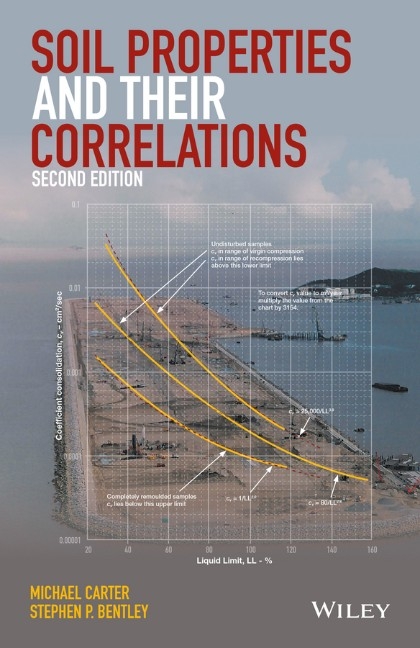
Soil Properties and their Correlations (eBook)
John Wiley & Sons (Verlag)
978-1-119-13089-5 (ISBN)
An essential guide to improving preliminary geotechnical analysis and design from limited data
Soil Properties and their Correlations, Second Edition provides a summary of commonly-used soil engineering properties and gives a wide range of correlations between the various properties, presented in the context of how they will be used in geotechnical design.
The book is divided into 11 chapters: Commonly-measured properties; Grading and plasticity; Density; Permeability, Consolidation and settlement; Shear strength; California bearing ratio; Shrinkage and swelling characteristics; Frost susceptibility; Susceptibility to combustion; and Soil-structure interfaces. In addition, there are two appendices: Soil classification systems; and Sampling methods.
This new, more comprehensive, edition provides material that would be of practical assistance to those faced with the problem of having to estimate soil behaviour from little or no laboratory test data.
Key features:
- Soil properties explained in practical terms.
- A large number of correlations between different soil properties.
- A valuable aid for assessing design values of properties.
- Clear statements on practical limitations and accuracy.
An invaluable source of reference for experienced professionals working on geotechnical design, it will also give students and early-career engineers an in-depth appreciation of the appropriate use of each property and the pitfalls to avoid.
Mike Carter is a civil and geotechnical engineer whose experience ranges from the practical, including site-based supervision of construction work, to the analytical, including the preparation of geotechnical design manuals and computer-based methods for consulting engineers. He has worked both in the UK and overseas; for consulting engineers, a contractor, a specialist site investigation contractor and as a university lecturer. In terms of engineering complexity, projects he has worked on have varied from the basic, such rural roads in East Africa and India, to the large and complex, such as the construction of an artificial island for Macau International Airport. He has also been involved in the analysis and rectification of numerous earthworks failures and has worked as a lecturer and trainer in the UK, Indonesia and Sri Lanka. He is the author of three books on geotechnical engineering.
Dr Bentley is an Engineering Geologist. During his long academic career at Cardiff University he has acted as a consultant to many large UK companies including the Department of the Environment (UK). He has also been retained as a consultant to the Departments of Public Works in Brunei and Saudi Arabia. He has supervised 12 PhD and over 60 MSc students; most of the PhD research topics were collaborative with industry. He has published 110 technical papers. Highlights of his research work include the first edition of the textbook 'Correlation of Soil Properties' which was adopted by many consultancy firms as a standard reference book. Also the visualisation software, 'STRATA', which was successfully commercialised and sold into over 100 companies in 12 countries worldwide.
An essential guide to improving preliminary geotechnical analysis and design from limited data Soil Properties and their Correlations, Second Edition provides a summary of commonly-used soil engineering properties and gives a wide range of correlations between the various properties, presented in the context of how they will be used in geotechnical design. The book is divided into 11 chapters: Commonly-measured properties; Grading and plasticity; Density; Permeability, Consolidation and settlement; Shear strength; California bearing ratio; Shrinkage and swelling characteristics; Frost susceptibility; Susceptibility to combustion; and Soil-structure interfaces. In addition, there are two appendices: Soil classification systems; and Sampling methods. This new, more comprehensive, edition provides material that would be of practical assistance to those faced with the problem of having to estimate soil behaviour from little or no laboratory test data. Key features: Soil properties explained in practical terms. A large number of correlations between different soil properties. A valuable aid for assessing design values of properties. Clear statements on practical limitations and accuracy. An invaluable source of reference for experienced professionals working on geotechnical design, it will also give students and early-career engineers an in-depth appreciation of the appropriate use of each property and the pitfalls to avoid.
Mike Carter is a civil and geotechnical engineer whose experience ranges from the practical, including site-based supervision of construction work, to the analytical, including the preparation of geotechnical design manuals and computer-based methods for consulting engineers. He has worked both in the UK and overseas; for consulting engineers, a contractor, a specialist site investigation contractor and as a university lecturer. In terms of engineering complexity, projects he has worked on have varied from the basic, such rural roads in East Africa and India, to the large and complex, such as the construction of an artificial island for Macau International Airport. He has also been involved in the analysis and rectification of numerous earthworks failures and has worked as a lecturer and trainer in the UK, Indonesia and Sri Lanka. He is the author of three books on geotechnical engineering. Dr Bentley is an Engineering Geologist. During his long academic career at Cardiff University he has acted as a consultant to many large UK companies including the Department of the Environment (UK). He has also been retained as a consultant to the Departments of Public Works in Brunei and Saudi Arabia. He has supervised 12 PhD and over 60 MSc students; most of the PhD research topics were collaborative with industry. He has published 110 technical papers. Highlights of his research work include the first edition of the textbook 'Correlation of Soil Properties' which was adopted by many consultancy firms as a standard reference book. Also the visualisation software, 'STRATA', which was successfully commercialised and sold into over 100 companies in 12 countries worldwide.
Preface
Acknowledgement
1 Commonly-measured properties
2 Grading and plasticity
3 Density
4 Permeability
5 Consolidation & settlement
6 Shear strength
7 California bearing ratio
8 Shrinkage and swelling characteristics
9 Frost susceptibility
10 Susceptibility to combustion
11 Soil-structure interfaces
APPENDIX-A
APPENDIX-B
Index
List of Symbols
| Symbol | Name of variable | Typical units (SI)* |
| α | A scaling factor for estimating footing settlements from plate bearing test results. | D |
| α | A factor for estimating values of coefficient of volume compressibility from static cone test results. | D |
| α | Adhesion factor, for pile calculations. | D |
| α | A factor used to estimate the pull‐out resistance of a soil reinforcement grid. | D |
| Δp | A distance above or below the A‐line on a standard plasticity chart. | % |
| θ | Angle of a plane, from the direction of maximum principle stress, on which stresses act. | Degrees |
| μ | Viscosity of permeant for general seepage calculations. | kN.s/m2 |
| ν | Poisson's ratio. | D |
| π | Ratio of the circumference of a circle to its diameter (≈3.14159). | D |
| ρ | Settlement. | m, mm |
| σ | Direct stress. | kPa (kN/m2) |
| σ' | Effective direct stress. | kPa (kN/m2) |
| σ1, σ2, σ3 | Maximum, intermediate and minimum principal stresses. | kPa (kN/m2) |
| σn | Effective earth pressure, used in soil nail calculations. | kPa (kN/m2) |
| σv, σ'v | Vertical stress, or overburden pressure, in total and effective stress terms, respectively. | kPa (kN/m2) |
| τ | Shear stress. | kPa (kN/m2) |
| γ | Bulk density of soil. | kN/m3 |
| γd | Dry density of soil. | kN/m3 |
| γdmax | Maximum dry density, for relative density calculations. | kN/m3 |
| γdmin | Minimum dry density, for relative density calculations. | kN/m3 |
| γp | Density of permeant for general seepage equation. | kN/m4 |
| γsub | Submerged density of soil. | kN/m3 |
| γw | Density of water. | kN/m3 |
| ϕ | Angle of shearing resistance (general, or in total stress terms). | Degrees |
| ϕ' | Effective stress angle of shearing resistance. | Degrees |
| ϕd | Drained angle of shearing resistance. | Degrees |
| ϕr | Residual angle of shearing resistance (general). | Degrees |
| a | Air voids content of soil. | % |
| a | Component of influence factor Ic for estimating settlements of footings on sands. | D |
| A | Area (nominal) of soil water flow. | m2 |
| A | A correction factor for rod energy ratio in the standard penetration test. | D |
| A | Percentage passing a 2.4 mm sieve, used in the calculation of suitability index. | % |
| A | A constant used in the estimation of swelling potential from plasticity index. | D |
| Ac | Activity value (of a clay). | D |
| Ap | End area of penetration cone in a 1standard penetration test. | mm2 |
| As | End area of penetration cone in a dynamic probe. | mm2 |
| av | Coefficient of compressibility. (See also mv, coefficient of volume compressibility.) | m2/MN |
| b | Component of influence factor Ic for estimating settlements of footings on sands. | D |
| B | Footing width. | m |
| B | A constant used in the estimation of swelling potential from plasticity index. | D |
| c | Shape factor in general seepage calculations. | D |
| c | Cohesion. | kPa (kN/m2) |
| C | Percentage finer than 0.002 mm, used in the calculation of activity for a clay. | D |
| c' | Effective stress cohesion. | kPa (kN/m2) |
| C1 | Constant used in Hazen's formula to estimate the coefficient of permeability. | D |
| CBR | California Bearing Ratio. | % |
| Cc | Coefficient of curvature (coefficient of grading). | D |
| Cc, Cr | Compression index, recompression index, respectively. | D |
| cd | Drained cohesion. | kPa (kN/m2) |
| CI | Consistency index. | % |
| CN | Correction factor for overburden pressure, applied to SPT N‐values. | D |
| cu | Undrained cohesion, shear strength. | kPa (kN/m2) |
| Cu | Coefficient of uniformity. | D |
| cv | Coefficient of consolidation. | cm2/s, m2/year |
| Cα | Secondary compression index. | (log10 time)–1 |
| Cαε , C' | Modified secondary compression index (sometimes referred to simply as the secondary compression index). | (log10 time)–1 |
| d | Maximum length of drainage path in consolidation calculations. | m |
| D | Depth of foundation (when calculating allowable bearing pressures on sands). | m |
| D10 | The 10% particle size, also called the effective size. | mm (or μm) |
| D30, D60 | The 30% and 60% particle sizes, respectively. | mm (or μm) |
| Dn | The particle size at which n% of the material is finer. See also D10, D30, D60. | mm (or μm) |
| Dr | Relative density (of granular soils). | D |
| Ds | An effective particle size for permeability estimates, usually taken as D10. | mm |
| e | Voids ratio. | D |
| e | The natural number, approximately 2.718. | D |
| E | Young's modulus (also called the elastic modulus). | kPa, MPa |
| e1, e2 | Initial and final voids ratios in consolidation testing. | D |
| Ed | Deformation modulus (also called the constrained modulus). | kPa, MPa |
| emax | Maximum voids ratio, for relative density calculations. | D |
| emin | Minimum voids ratio, for relative density calculations. | D |
| ERr | Rod energy ratio in standard penetration test. | D |
| F | The percentage passing the 75 μm sieve, used in the calculation of AASHTO classification group index. | % |
| fl, fs, ft | Shape, layer thicknes and time factors, respectively, for estimating settlements of footings on sands. | D |
| Fp | Drop distance of monkey (falling hammer) in a dynamic probe. | mm |
| Fs | Drop distance of monkey (falling hammer) in a standard penetration test. | mm |
| G | Shear modulus. | kPa, MPa |
| Gs | Specific gravity of soil solids | D |
| h | Thickness of specimen in consolidation testing. | mm |
| H | Thickness of a compressible layer in consolidation testing. | m |
| i | Hydraulic gradient in soil water flow. | D |
| Ic | Influence factor for estimation of settlements of footings on... |
| Erscheint lt. Verlag | 20.7.2016 |
|---|---|
| Sprache | englisch |
| Themenwelt | Technik ► Bauwesen |
| Technik ► Maschinenbau | |
| Schlagworte | Bauingenieur- u. Bauwesen • Bodenkunde • Bodenkunde, Geoarchäologie • Bodenkunde, Geoarchäologie • Civil Engineering • Civil Engineering & Construction • earth sciences • Engineering application • Engineering Theory • Erdbau • Erd- u. Grundbau • Geotechnical Engineering • geotechnical examples • Geowissenschaften • Grundbau • Grundbau / Geotechnik • Soil (Civil Engineering) • Soil Constructions & Geotechnics • soil property • Soil Science & Geoarchaeology • Soil Structure Interaction |
| ISBN-10 | 1-119-13089-1 / 1119130891 |
| ISBN-13 | 978-1-119-13089-5 / 9781119130895 |
| Informationen gemäß Produktsicherheitsverordnung (GPSR) | |
| Haben Sie eine Frage zum Produkt? |
 EPUB (Adobe DRM)
Kopierschutz: Adobe-DRM
Adobe-DRM ist ein Kopierschutz, der das eBook vor Mißbrauch schützen soll. Dabei wird das eBook bereits beim Download auf Ihre persönliche Adobe-ID autorisiert. Lesen können Sie das eBook dann nur auf den Geräten, welche ebenfalls auf Ihre Adobe-ID registriert sind.
Details zum Adobe-DRM
Dateiformat: EPUB (Electronic Publication)
EPUB ist ein offener Standard für eBooks und eignet sich besonders zur Darstellung von Belletristik und Sachbüchern. Der Fließtext wird dynamisch an die Display- und Schriftgröße angepasst. Auch für mobile Lesegeräte ist EPUB daher gut geeignet.
Systemvoraussetzungen:
PC/Mac: Mit einem PC oder Mac können Sie dieses eBook lesen. Sie benötigen eine
eReader: Dieses eBook kann mit (fast) allen eBook-Readern gelesen werden. Mit dem amazon-Kindle ist es aber nicht kompatibel.
Smartphone/Tablet: Egal ob Apple oder Android, dieses eBook können Sie lesen. Sie benötigen eine
Geräteliste und zusätzliche Hinweise
Buying eBooks from abroad
For tax law reasons we can sell eBooks just within Germany and Switzerland. Regrettably we cannot fulfill eBook-orders from other countries.
aus dem Bereich