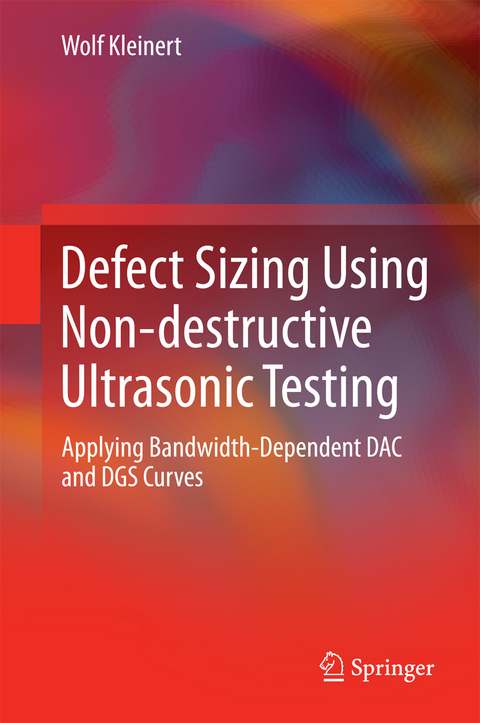
Defect Sizing Using Non-destructive Ultrasonic Testing (eBook)
XVIII, 118 Seiten
Springer International Publishing (Verlag)
978-3-319-32836-2 (ISBN)
Wolf Kleinert started his career in ultrasonic material testing in the year 1982 at the Krautkrämer Company in Cologne, Germany. He had a plurality of managerial assignments in Product-, Marketing- and Sales-Management, Intellectual Property Management as well as General Management. He was responsible for the Application Laboratory and heavily involved in the development of new probe technologies. End of 2014 Wolf retired after nearly 33 years in ultrasonic material testing.
Wolf Kleinert started his career in ultrasonic material testing in the year 1982 at the Krautkrämer Company in Cologne, Germany. He had a plurality of managerial assignments in Product-, Marketing- and Sales-Management, Intellectual Property Management as well as General Management. He was responsible for the Application Laboratory and heavily involved in the development of new probe technologies. End of 2014 Wolf retired after nearly 33 years in ultrasonic material testing.
Preface 5
Acknowledgments 6
Contents 7
List of Figures 10
List of Tables 14
1 Introduction 16
1.1 Distance Amplitude Correction Curve 17
1.2 Distance-Gain-Size Method (DGS) 18
1.3 Key Differences: DAC Versus DGS 19
1.4 Foresight to This Book 20
References 20
2 State of the Art: DAC and DGS 21
2.1 Distance Amplitude Curve 21
2.2 Distance--Gain--Size Method 22
2.2.1 EN ISO 16811:2012 23
2.2.2 DGS Evaluation 23
References 33
3 DGS Deviations Using Angle Beam Probes 34
3.1 Sound Fields 36
3.2 A Manufacturer-Independent Issue 38
3.3 The Beginning of a New Probe Technology 39
References 40
4 The New Probe Technology, Single Element Probes 41
4.1 Design Principle 41
4.2 Calculation Method 43
4.2.1 The Fastest Path 44
4.2.2 Included Angle 46
4.2.3 Time of Flight 46
4.2.4 Angle in the Test Material 47
4.2.5 Angles in the Wedge of the Probe 47
4.2.6 Transducer Coordinates 48
4.2.7 Calculation Summary 49
4.3 Necessary Adaptations 50
4.3.1 Phase Shift 50
4.3.2 Corrected Angle of Incidence 53
4.3.3 Area Correction 54
4.4 Single Element Probes 54
4.5 Rotational Symmetry 56
4.5.1 Measurement of the Sound Fields 56
4.6 Advantage of the New Probe Technology 57
References 57
5 New Probe Technology, Phased Array Probes 58
5.1 Delay Laws 60
5.2 DGS Accuracy 60
5.3 Sound Exit Points 61
References 63
6 New Probe Technology, Curved Coupling Surfaces 64
6.1 Fastest Path 65
6.2 Angles 67
6.3 Transducer Coordinates 68
6.4 Example: Solid Axle 69
6.5 Delay Laws 71
References 74
7 Bandwidth-Dependent DGS Diagrams 75
7.1 Single Frequency Ultrasound 75
7.1.1 Near Field Length 79
7.2 Multi-frequency Ultrasound 81
7.2.1 Near Field Length 81
7.2.2 Back Wall Echo Curve 84
7.2.3 ERS Curves 84
References 89
8 Applying Bandwidth-Dependent DGS Diagrams 90
8.1 Results Using Phased Array Angle Beam Probes 91
References 93
9 Bandwidth-Dependent DAC Curves 94
9.1 Calculating Bandwidth-Dependent DAC Curves 94
9.2 Applying the Bandwidth-Dependent DAC Curves 97
9.2.1 Using a Reference Echo from a Calibration Standard 97
9.2.2 Using One Single Side-Drilled Hole as Reference 100
9.2.3 Recording a DAC Curve for One Single Angle 101
9.2.4 Pros and Cons 105
References 107
10 Convert SDH into FBH and Vice Versa 108
10.1 SDH or FBH? 111
References 112
11 Frequency-Dependent Sound Attenuation 113
Reference 116
Appendix 117
Further Readings 123
Index 125
| Erscheint lt. Verlag | 6.5.2016 |
|---|---|
| Zusatzinfo | XVIII, 118 p. 90 illus., 83 illus. in color. |
| Verlagsort | Cham |
| Sprache | englisch |
| Themenwelt | Technik ► Bauwesen |
| Technik ► Maschinenbau | |
| Wirtschaft | |
| Schlagworte | Distance Amplitude Correction • Distance Gain Size • Non-destructing Testing • Reflector Sizing • Standardized Sizing Methods • ultrasonic testing |
| ISBN-10 | 3-319-32836-0 / 3319328360 |
| ISBN-13 | 978-3-319-32836-2 / 9783319328362 |
| Informationen gemäß Produktsicherheitsverordnung (GPSR) | |
| Haben Sie eine Frage zum Produkt? |
 PDF (Wasserzeichen)
DRM: Digitales Wasserzeichen
Dieses eBook enthält ein digitales Wasserzeichen und ist damit für Sie personalisiert. Bei einer missbräuchlichen Weitergabe des eBooks an Dritte ist eine Rückverfolgung an die Quelle möglich.
Dateiformat: PDF (Portable Document Format)
Mit einem festen Seitenlayout eignet sich die PDF besonders für Fachbücher mit Spalten, Tabellen und Abbildungen. Eine PDF kann auf fast allen Geräten angezeigt werden, ist aber für kleine Displays (Smartphone, eReader) nur eingeschränkt geeignet.
Systemvoraussetzungen:
PC/Mac: Mit einem PC oder Mac können Sie dieses eBook lesen. Sie benötigen dafür einen PDF-Viewer - z.B. den Adobe Reader oder Adobe Digital Editions.
eReader: Dieses eBook kann mit (fast) allen eBook-Readern gelesen werden. Mit dem amazon-Kindle ist es aber nicht kompatibel.
Smartphone/Tablet: Egal ob Apple oder Android, dieses eBook können Sie lesen. Sie benötigen dafür einen PDF-Viewer - z.B. die kostenlose Adobe Digital Editions-App.
Buying eBooks from abroad
For tax law reasons we can sell eBooks just within Germany and Switzerland. Regrettably we cannot fulfill eBook-orders from other countries.
aus dem Bereich