Construction Technology (eBook)
John Wiley & Sons (Verlag)
978-1-119-02498-9 (ISBN)
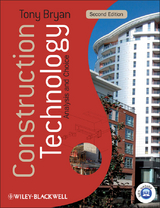
The book takes as its theme the process of choice: what the expert has to know and how he/she might think through the decisions to be made about the design, production, maintenance and disposal of buildings.
It is written with the conviction that by focusing on the process of choice, the range of theory and knowledge that is useful to practice becomes explicit, making the link between knowledge and practice, and between understanding and experience.
The new edition has been updated throughout with extensive additions to Chapter13: Manufacture and Assembly and to Chapter 15: Sustainability. An entire new section has been added, covering all the main elements of commercial construction.
Students will find here explanations of how environments, structural behaviour, production know-how, cost and social concerns such as sustainability can be taken into account in the choice of construction. They will also gain a clear understanding of the construction details and specifications adopted for both housing and commercial buildings in the UK at the beginning of the 21st century.
- Provides a framework to think through proposed solutions
- Sets the choice of solution in both time and place, and in the context of sustainability
- Focuses on key questions: will the proposal fail; and can it be built?
- Considers a building's response to loading, environmental conditions and time
- Looks at the production process as manufacture and assembly
Book website at www.wiley.com/go/bryanconstructiontech2e
Contains nearly 200 fully referenced, clear line drawings to download for free, as well as suggested learning activities for lecturers to incorporate into their teaching programmes.
Tony Bryan is a Principal Lecturer in Construction Technology in the Faculty of Environment and Technology, University of the West of England.
The second edition of Construction Technology: Analysis and Choice has been expanded to include commercial buildings. This now covers, in a single textbook, all the basic forms of construction studied on professional courses. The book takes as its theme the process of choice: what the expert has to know and how he/she might think through the decisions to be made about the design, production, maintenance and disposal of buildings. It is written with the conviction that by focusing on the process of choice, the range of theory and knowledge that is useful to practice becomes explicit, making the link between knowledge and practice, and between understanding and experience. The new edition has been updated throughout with extensive additions to Chapter13: Manufacture and Assembly and to Chapter 15: Sustainability. An entire new section has been added, covering all the main elements of commercial construction. Students will find here explanations of how environments, structural behaviour, production know-how, cost and social concerns such as sustainability can be taken into account in the choice of construction. They will also gain a clear understanding of the construction details and specifications adopted for both housing and commercial buildings in the UK at the beginning of the 21st century. Provides a framework to think through proposed solutions Sets the choice of solution in both time and place, and in the context of sustainability Focuses on key questions: will the proposal fail; and can it be built? Considers a building s response to loading, environmental conditions and time Looks at the production process as manufacture and assembly Book website at www.wiley.com/go/bryanconstructiontech2e Contains nearly 200 fully referenced, clear line drawings to download for free, as well as suggested learning activities for lecturers to incorporate into their teaching programmes.
Tony Bryan is a Principal Lecturer in Construction Technology in the Faculty of Environment and Technology, University of the West of England.
Preface 10
PART 1 ANALYSIS 12
1 The Framework for Understanding 14
Process and knowledge 14
The initial suggestion 15
Carrying out the evaluation 15
Physical and social context 16
The basis of analysis 17
Knowledge needed for choice 18
Summary 19
2 Building Purpose and Performance 20
Activities, space and construction 20
Introduction to performance requirements 20
Environmental impact and sustainability 28
Summary 28
3 Common Forms – Specific Solutions 29
General and constructed forms 29
The emergence of general building forms 29
Uncertainty and risk 33
Summary 34
4 Construction Variables 35
The variables of construction – the outcome of choice 35
Choosing materials 36
Choosing shape 38
Choosing size 38
Spatial relationships 43
Joints and fixings 43
Summary 46
5 Defining Conditions 48
Physical and social conditions 48
Activity and construction-modifying environments 49
The dynamics of the system 49
Choice of interior elements of the building 53
Inside the construction itself 53
Summary 54
6 The Resource Base 55
Introduction 55
Materials – the primary resource 55
Knowledge and skill – the human resource 56
Production equipment – the technological resource 57
Money – the enabling resource 58
Summary 59
7 Design Concept 60
Linking design to construction choice – flows and transfers 60
Concept design – broad options 61
Physical performance and appearance – commodity, firmness and delight 61
Function of the whole, function of the parts 62
Summary 63
8 Appearance 64
Visualising attributes and response 64
Space and context 64
Physical space for the construction 66
The approach to analysis 67
Summary 67
9 Analysis of Physical Behaviour 68
Visualising conditions and response 68
Function and performance – a technical aim 68
Preventing failure – a technical objective 68
The role of observation and science in the analysis 69
The approach to analysis 70
Summary 70
10 Physical Behaviour Creating Environments 71
Aspects of environment 71
The building as a system 71
The dry environment 76
The warm environment 83
The light environment 89
The acoustic environment 93
The clean environment 97
The safe environment 99
The private environment 107
Summary 108
11 Physical Behaviour Under Load 109
Forces, external and internal 109
Basic structural members 111
Curving (and folding) structural members 115
Structural connections 116
Grid members – pin-jointed frames 118
Building structures – wind stability 119
Stress–strain and the choice of material 121
Structural analysis and design 122
Movements and structural behaviour 123
Stresses in the ground 123
The major structural forms 125
Summary 128
12 Physical Behaviour Over Time 130
Reliability: renewal, maintenance, repair and disposal 130
Basis of analysis 131
Soiling and cleaning 131
Durability of materials 132
Movements in components 135
Ground movement, settlement and subsidence 138
Movement and detailing 139
Wear of components 140
Summary 140
13 Manufacture and Assembly 141
Realisation of performance 141
Visualising stages and sequence 141
Analysis of operations, methods and resources 144
Materials and labour 146
Production equipment 147
Production options 152
Knowledge and expertise for the analysis of the process 159
Summary 160
14 Cost 161
Cost and value 161
Cost and price 162
Cost and time frames 162
Cost and cost data 163
Summary 165
15 Sustainability – Social Concern 166
Two major forces 166
Sustainability 167
Established influences and new concerns 167
Responding to the sustainability agenda 169
Buildings as systems 172
Renewable energy sources 179
Water and waste 181
Materials choice and detailing 183
Planning and design concepts 184
Emerging technologies 184
Summary 185
PART 2 CHOICE – HOUSECONSTRUCTION 188
16 Applying the Framework to Housing 190
The need for an integrated approach 190
The basis of the case study 191
Summary 193
17 Floors 194
Upper floors 194
General forms for upper floors 194
Timber-joisted upper floors 195
Ground floors 202
Suspended ground floors 203
Ground-supported slab floors 206
Services and other elements 208
Site influences on choice of ground floors 208
Production operations for ground floors 209
The final choice 210
Summary 210
18 Roofs 212
Pitch and span 212
Other functions 212
Pitched roofs 213
Flat roofs 229
Summary 230
19 Walls 232
Wall types by function 232
General forms 232
Walls in the case study 235
Masonry cavity external walls 235
Openings in the external wall 244
Doors and windows – the components in the openings 247
The panel frame option 249
Party (separating) walls 252
Partition walls 253
Summary 254
20 Foundations 255
Basic function 255
Site investigation 257
Foundation design 258
The strip foundation 258
Foundations for poor surface conditions 261
Economics of foundations 265
Basements 265
Summary 265
21 Services 267
Introduction 267
Analysis of services systems 268
Hot and cold water 268
Heating systems 274
Drainage 278
Electrical systems 284
Summary 290
PART 3 CHOICE – COMMERCIAL CONSTRUCTION 292
22 Applying the Framework to Commercial Buildings 294
The story so far 294
The way forward 296
The technological mix 298
Summary 300
23 Common Forms and Emerging Technologies 301
Introduction 301
UK commercial building through the twentieth century 302
Summary 309
24 Interface Design 310
Introduction 310
The enclosure–services interface 311
The enclosure–structure interface 313
The structure–services interface 316
Summary 317
25 Structural Skeletal Frames 318
Materials development and structural options 318
Reinforced concrete – performance 326
In situ reinforced concrete frames – production 328
Precast concrete frames – production 340
Structural steel – performance 341
Structural steel – fabrication and construction 344
Structure choice and overall design 348
Summary 349
26 Roof Structures 351
Introduction 351
Variety of structural form 352
Broad options 353
Construction details 359
Summary 363
27 Loadbearing Structural Walls 364
Broad options 364
Multi-storey construction 365
Single-storey industrial construction 370
Summary 374
28 Structure Below Ground 375
Introduction 375
Foundation design 375
Foundation types 377
Soil improvement 383
Basements 384
Large area industrial concrete ground floors 391
Summary 395
29 External Enclosure to Structural Frames 396
Introduction 396
External walls 396
Cavity brickwork 401
Cladding panels 403
Curtain walling 407
Facing materials 408
Lightweight cladding 414
Structural glazing 415
Roof construction 417
Summary 422
30 Internal Enclosure 423
Performance 423
Applied finishes 424
Component systems 425
Summary 432
31 Services – Scope and Space 433
Introduction 433
Scope 433
Space 435
Environmental services 435
Public health services 440
Power supply 443
Security 444
Operational services 446
The need for coordination 447
Production sequence and contract time 448
Cost of services systems 449
Summary 449
32 Guide to Further Reading 451
What this book provides 451
Sources of information – authority, validity and relevance 451
Finding information 454
Using information – corroboration, confirmation and risk 455
Summary 455
Index 456
| Erscheint lt. Verlag | 14.9.2015 |
|---|---|
| Sprache | englisch |
| Themenwelt | Technik ► Bauwesen |
| Schlagworte | Base • Basis • Bauausführung • Bauausführung • Bauingenieur- u. Bauwesen • Choice • Civil Engineering & Construction • Common • Conditions • Construction • Dynamics • Elements • Emergence • Evaluation • forms • Framework • General • Interior • Introduction • Knowledge • Outcome • performance requirements • resource • Solutions • System • technological • Variables |
| ISBN-10 | 1-119-02498-6 / 1119024986 |
| ISBN-13 | 978-1-119-02498-9 / 9781119024989 |
| Informationen gemäß Produktsicherheitsverordnung (GPSR) | |
| Haben Sie eine Frage zum Produkt? |
 PDF (Adobe DRM)
Kopierschutz: Adobe-DRM
Adobe-DRM ist ein Kopierschutz, der das eBook vor Mißbrauch schützen soll. Dabei wird das eBook bereits beim Download auf Ihre persönliche Adobe-ID autorisiert. Lesen können Sie das eBook dann nur auf den Geräten, welche ebenfalls auf Ihre Adobe-ID registriert sind.
Details zum Adobe-DRM
Dateiformat: PDF (Portable Document Format)
Mit einem festen Seitenlayout eignet sich die PDF besonders für Fachbücher mit Spalten, Tabellen und Abbildungen. Eine PDF kann auf fast allen Geräten angezeigt werden, ist aber für kleine Displays (Smartphone, eReader) nur eingeschränkt geeignet.
Systemvoraussetzungen:
PC/Mac: Mit einem PC oder Mac können Sie dieses eBook lesen. Sie benötigen eine
eReader: Dieses eBook kann mit (fast) allen eBook-Readern gelesen werden. Mit dem amazon-Kindle ist es aber nicht kompatibel.
Smartphone/Tablet: Egal ob Apple oder Android, dieses eBook können Sie lesen. Sie benötigen eine
Geräteliste und zusätzliche Hinweise
Buying eBooks from abroad
For tax law reasons we can sell eBooks just within Germany and Switzerland. Regrettably we cannot fulfill eBook-orders from other countries.
aus dem Bereich