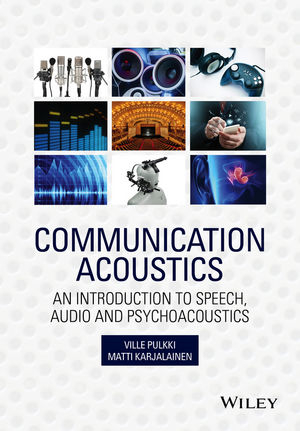
Communication Acoustics (eBook)
John Wiley & Sons (Verlag)
978-1-118-86658-0 (ISBN)
This book facilitates the reader's understanding and development of speech and audio techniques based on our knowledge of the auditory perceptual mechanisms by introducing the physical, signal-processing and psychophysical background to communication acoustics. It then provides a detailed explanation of sound technologies where a human listener is involved, including audio and speech techniques, sound quality measurement, hearing aids and audiology.
Key features:
- Explains perceptually-based audio: the authors take a detailed but accessible engineering perspective on sound and hearing with a focus on the human place in the audio communications signal chain, from psychoacoustics and audiology to optimizing digital signal processing for human listening.
- Presents a wide overview of speech, from the human production of speech sounds and basics of phonetics to major speech technologies, recognition and synthesis of speech and methods for speech quality evaluation.
- Includes MATLAB examples that serve as an excellent basis for the reader's own investigations into communication acoustics interaction schemes which intuitively combine touch, vision and voice for lifelike interactions.
Ville Pulkki, Department of Signal Processing and Acoustics, University of Aalto, Finland
Professor Pulkki is currently affiliated to the Department of Signal Processing and Acoustics at the University of Aalto, Finland where he leads the Spatial Sound Research Group. He is an AES Fellow. Professor Pulkki was General Chair of the AES 45th International Conference on Applications of Time-Frequency Processing in Audio (2012), and he is Associate Technical Editor of the Journal of the Audio Engineering Society.
Matti Karjalainen, Department of Signal Processing and Acoustics, University of Aalto, Finland
Professor Karjalainen was previously Head of the Laboratory of Acoustics and Audio Signal Processing at Helsinki University of Technology which now forms part of the Department of Signal Processing and Acoustics at the University of Aalto, Finland. Professor Karjalainen had long term cooperation with companies such as Nokia and loudspeaker manufacturer Genelec. For his scientific and educational merits in audio signal processing, he received the Audio Engineering Society Fellowship in 1999, the AES Silver Medal in 2006, and the IEEE Fellowship in 2009. He published over 350 scientific and technical publications. Professor Karjalainen passed away in May 2010.
In communication acoustics, the communication channel consists of a sound source, a channel (acoustic and/or electric) and finally the receiver: the human auditory system, a complex and intricate system that shapes the way sound is heard. Thus, when developing techniques in communication acoustics, such as in speech, audio and aided hearing, it is important to understand the time frequency space resolution of hearing. This book facilitates the reader s understanding and development of speech and audio techniques based on our knowledge of the auditory perceptual mechanisms by introducing the physical, signal-processing and psychophysical background to communication acoustics. It then provides a detailed explanation of sound technologies where a human listener is involved, including audio and speech techniques, sound quality measurement, hearing aids and audiology. Key features: Explains perceptually-based audio: the authors take a detailed but accessible engineering perspective on sound and hearing with a focus on the human place in the audio communications signal chain, from psychoacoustics and audiology to optimizing digital signal processing for human listening. Presents a wide overview of speech, from the human production of speech sounds and basics of phonetics to major speech technologies, recognition and synthesis of speech and methods for speech quality evaluation. Includes MATLAB examples that serve as an excellent basis for the reader s own investigations into communication acoustics interaction schemes which intuitively combine touch, vision and voice for lifelike interactions.
Ville Pulkki, Department of Signal Processing and Acoustics, University of Aalto, Finland Professor Pulkki is currently affiliated to the Department of Signal Processing and Acoustics at the University of Aalto, Finland where he leads the Spatial Sound Research Group. He is an AES Fellow. Professor Pulkki was General Chair of the AES 45th International Conference on Applications of Time-Frequency Processing in Audio (2012), and he is Associate Technical Editor of the Journal of the Audio Engineering Society. Matti Karjalainen, Department of Signal Processing and Acoustics, University of Aalto, Finland Professor Karjalainen was previously Head of the Laboratory of Acoustics and Audio Signal Processing at Helsinki University of Technology which now forms part of the Department of Signal Processing and Acoustics at the University of Aalto, Finland. Professor Karjalainen had long term cooperation with companies such as Nokia and loudspeaker manufacturer Genelec. For his scientific and educational merits in audio signal processing, he received the Audio Engineering Society Fellowship in 1999, the AES Silver Medal in 2006, and the IEEE Fellowship in 2009. He published over 350 scientific and technical publications. Professor Karjalainen passed away in May 2010.
| Erscheint lt. Verlag | 10.11.2014 |
|---|---|
| Sprache | englisch |
| Themenwelt | Naturwissenschaften ► Physik / Astronomie |
| Technik ► Elektrotechnik / Energietechnik | |
| Technik ► Nachrichtentechnik | |
| Schlagworte | acoustics • Audio • Audio & Speech Processing & Broadcasting • audiology • Audio-, Sprachverarbeitung u. Ãbertragung • Audio-, Sprachverarbeitung u. Übertragung • auditory model • Electrical & Electronics Engineering • Elektrotechnik u. Elektronik • hearing • Hearing aid • Physics • Physics of Acoustics • Physik • Physik des Schalls • psychoacoustics • Signal Processing • Signalverarbeitung • sound quality • sound reproduction • Speech |
| ISBN-10 | 1-118-86658-4 / 1118866584 |
| ISBN-13 | 978-1-118-86658-0 / 9781118866580 |
| Informationen gemäß Produktsicherheitsverordnung (GPSR) | |
| Haben Sie eine Frage zum Produkt? |
 PDF (Adobe DRM)
Kopierschutz: Adobe-DRM
Adobe-DRM ist ein Kopierschutz, der das eBook vor Mißbrauch schützen soll. Dabei wird das eBook bereits beim Download auf Ihre persönliche Adobe-ID autorisiert. Lesen können Sie das eBook dann nur auf den Geräten, welche ebenfalls auf Ihre Adobe-ID registriert sind.
Details zum Adobe-DRM
Dateiformat: PDF (Portable Document Format)
Mit einem festen Seitenlayout eignet sich die PDF besonders für Fachbücher mit Spalten, Tabellen und Abbildungen. Eine PDF kann auf fast allen Geräten angezeigt werden, ist aber für kleine Displays (Smartphone, eReader) nur eingeschränkt geeignet.
Systemvoraussetzungen:
PC/Mac: Mit einem PC oder Mac können Sie dieses eBook lesen. Sie benötigen eine
eReader: Dieses eBook kann mit (fast) allen eBook-Readern gelesen werden. Mit dem amazon-Kindle ist es aber nicht kompatibel.
Smartphone/Tablet: Egal ob Apple oder Android, dieses eBook können Sie lesen. Sie benötigen eine
Geräteliste und zusätzliche Hinweise
Buying eBooks from abroad
For tax law reasons we can sell eBooks just within Germany and Switzerland. Regrettably we cannot fulfill eBook-orders from other countries.
aus dem Bereich