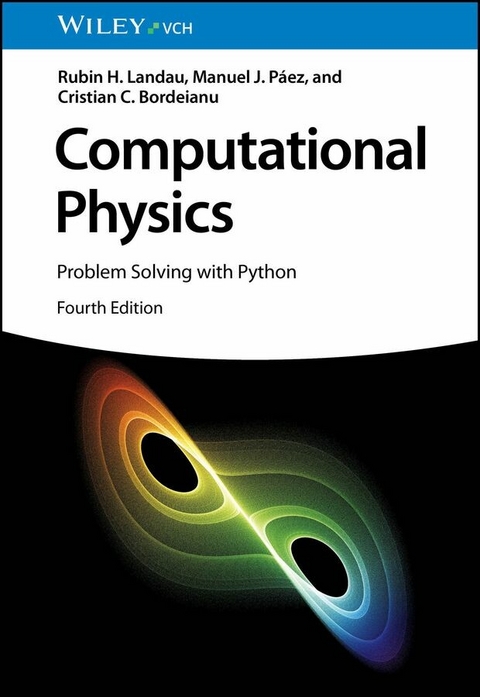
Computational Physics (eBook)
588 Seiten
Wiley-VCH GmbH (Verlag)
978-3-527-84332-9 (ISBN)
The classic in the field for more than 25 years, now with increased emphasis on data science and new chapters on quantum computing, machine learning (AI), and general relativity
Computational physics combines physics, applied mathematics, and computer science in a cutting-edge multidisciplinary approach to solving realistic physical problems. It has become integral to modern physics research because of its capacity to bridge the gap between mathematical theory and real-world system behavior.
Computational Physics provides the reader with the essential knowledge to understand computational tools and mathematical methods well enough to be successful. Its philosophy is rooted in 'learning by doing', assisted by many sample programs in the popular Python programming language. The first third of the book lays the fundamentals of scientific computing, including programming basics, stable algorithms for differentiation and integration, and matrix computing. The latter two-thirds of the textbook cover more advanced topics such linear and nonlinear differential equations, chaos and fractals, Fourier analysis, nonlinear dynamics, and finite difference and finite elements methods. A particular focus in on the applications of these methods for solving realistic physical problems.
Readers of the fourth edition of Computational Physics will also find:
- An exceptionally broad range of topics, from simple matrix manipulations to intricate computations in nonlinear dynamics
- A whole suite of supplementary material: Python programs, Jupyter notebooks and videos
Computational Physics is ideal for students in physics, engineering, materials science, and any subjects drawing on applied physics.
Rubin H. Landau, PhD, is Professor Emeritus in the Department of Physics at Oregon State University, Corvallis, Oregon, USA. In his long and distinguished research career he has been instrumental in the development of computational physics as a defined subject, and founded both the Computational Physics Degree Program and the Northwest Alliance for Computational Science and Engineering.
Manuel J. Páez, PhD, is a Professor in the Department of Physics at the University of Antioquia in Medellin, Colombia. He teaches courses in both physics and programming, and he and Professor Landau have collaborated on pathbreaking computational physics investigations.
Cristian C. Bordeianu, PhD, taught Physics and Computer Science at the Military College 'Stefan cel Mare,' Campulung Moldovenesc, Romania.
Rubin H. Landau is Professor Emeritus in the Department of Physics at Oregon State University in Corvallis. He has been teaching courses in computational physics for over 25 years, was a founder of the Computational Physics Degree Program and the Northwest Alliance for Computational Science and Engineering, and has been using computers in theoretical physics research ever since graduate school. He is author of more than 90 refereed publications and has also authored books on Quantum Mechanics, Workstations and Supercomputers, the first two editions of Computational Physics, and a First Course in Scientific Computing. Manuel J. Páez is a professor in the Department of Physics at the University of Antioquia in Medellín, Colombia. He has been teaching courses in Modern Physics, Nuclear Physics, Computational Physics, Mathematical Physics as well as programming in Fortran, Pascal and C languages. He and Professor Landau have conducted pioneering computational investigations in the interactions of mesons and nucleons with nuclei. Cristian C. Bordeianu taught Physics and Computer Science at the Military College "Stefan cel Mare" in Câmpulung Moldovenesc, Romania.
Preface
PART I. BASICS
Introduction
Software Basics
Errors & Uncertainties
Monte Carlo Simulations
Differentiation & Integration
Trial-and-Error Searching & Data Fitting
Matrix Computing and N-D Searching
Differential Equations & Nonlinear Oscillations
PART II. DATA SCIENCE
Fourier Analyses
Wavelet & Principal Components Analysis
Neural Networks & Machine Learning
Quantum Computing
PART III. APPLICATIONS
ODE Applications; Eigenvalues, Scattering, Trajectories
Fractals & Statistical Growth Models
Nonlinear Population Dynamics
Nonlinear Dynamics of Continuous Systems
Thermodynamics Simulations & Fenyman Path Integrals
Molecular Dynamics Simulations
General Relativity
Integral Equations
PART IV. PDE APPLICATIONS
PDE Review, Electrostatics & Relaxation
Heat Flow & Leapfrogging
String & Membrane Waves
Quantum Wave Packets & EM Waves
Shock & Soliton Waves
Fluid Hydrodynamics
Finite Element Electrostatics
Appendices
Index
| Erscheint lt. Verlag | 14.3.2024 |
|---|---|
| Sprache | englisch |
| Themenwelt | Naturwissenschaften ► Physik / Astronomie |
| Schlagworte | Applied mathematics • Artificial Intelligence • chaos and fractals • Chemie • Chemistry • Computational Chemistry & Molecular Modeling • Computational Chemistry u. Molecular Modeling • Computer Science • Differentiation • finite difference methods • finite elements • fourier analysis • General relativity • Informatik • Integration • Künstliche Intelligenz • machine learning • Mathematical & Computational Physics • Mathematische Physik • Nonlinear Dynamics • Physics • Physik • Python • Python (Programmiersprache) • Realistic physics • Rechnerunterstützung • Statistik |
| ISBN-10 | 3-527-84332-9 / 3527843329 |
| ISBN-13 | 978-3-527-84332-9 / 9783527843329 |
| Informationen gemäß Produktsicherheitsverordnung (GPSR) | |
| Haben Sie eine Frage zum Produkt? |
 PDF (Adobe DRM)
Kopierschutz: Adobe-DRM
Adobe-DRM ist ein Kopierschutz, der das eBook vor Mißbrauch schützen soll. Dabei wird das eBook bereits beim Download auf Ihre persönliche Adobe-ID autorisiert. Lesen können Sie das eBook dann nur auf den Geräten, welche ebenfalls auf Ihre Adobe-ID registriert sind.
Details zum Adobe-DRM
Dateiformat: PDF (Portable Document Format)
Mit einem festen Seitenlayout eignet sich die PDF besonders für Fachbücher mit Spalten, Tabellen und Abbildungen. Eine PDF kann auf fast allen Geräten angezeigt werden, ist aber für kleine Displays (Smartphone, eReader) nur eingeschränkt geeignet.
Systemvoraussetzungen:
PC/Mac: Mit einem PC oder Mac können Sie dieses eBook lesen. Sie benötigen eine
eReader: Dieses eBook kann mit (fast) allen eBook-Readern gelesen werden. Mit dem amazon-Kindle ist es aber nicht kompatibel.
Smartphone/Tablet: Egal ob Apple oder Android, dieses eBook können Sie lesen. Sie benötigen eine
Geräteliste und zusätzliche Hinweise
Buying eBooks from abroad
For tax law reasons we can sell eBooks just within Germany and Switzerland. Regrettably we cannot fulfill eBook-orders from other countries.
aus dem Bereich