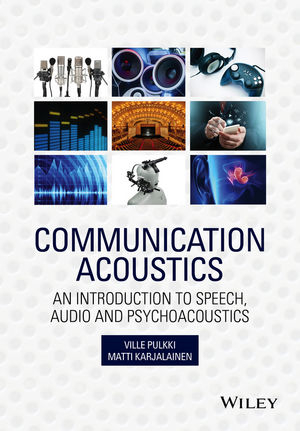
Communication Acoustics (eBook)
John Wiley & Sons (Verlag)
978-1-118-86655-9 (ISBN)
This book facilitates the reader's understanding and development of speech and audio techniques based on our knowledge of the auditory perceptual mechanisms by introducing the physical, signal-processing and psychophysical background to communication acoustics. It then provides a detailed explanation of sound technologies where a human listener is involved, including audio and speech techniques, sound quality measurement, hearing aids and audiology.
Key features:
- Explains perceptually-based audio: the authors take a detailed but accessible engineering perspective on sound and hearing with a focus on the human place in the audio communications signal chain, from psychoacoustics and audiology to optimizing digital signal processing for human listening.
- Presents a wide overview of speech, from the human production of speech sounds and basics of phonetics to major speech technologies, recognition and synthesis of speech and methods for speech quality evaluation.
- Includes MATLAB examples that serve as an excellent basis for the reader's own investigations into communication acoustics interaction schemes which intuitively combine touch, vision and voice for lifelike interactions.
Ville Pulkki, Department of Signal Processing and Acoustics, University of Aalto, Finland
Professor Pulkki is currently affiliated to the Department of Signal Processing and Acoustics at the University of Aalto, Finland where he leads the Spatial Sound Research Group. He is an AES Fellow. Professor Pulkki was General Chair of the AES 45th International Conference on Applications of Time-Frequency Processing in Audio (2012), and he is Associate Technical Editor of the Journal of the Audio Engineering Society.
Matti Karjalainen, Department of Signal Processing and Acoustics, University of Aalto, Finland
Professor Karjalainen was previously Head of the Laboratory of Acoustics and Audio Signal Processing at Helsinki University of Technology which now forms part of the Department of Signal Processing and Acoustics at the University of Aalto, Finland. Professor Karjalainen had long term cooperation with companies such as Nokia and loudspeaker manufacturer Genelec. For his scientific and educational merits in audio signal processing, he received the Audio Engineering Society Fellowship in 1999, the AES Silver Medal in 2006, and the IEEE Fellowship in 2009. He published over 350 scientific and technical publications. Professor Karjalainen passed away in May 2010.
Ville Pulkki, Department of Signal Processing and Acoustics, University of Aalto, Finland Professor Pulkki is currently affiliated to the Department of Signal Processing and Acoustics at the University of Aalto, Finland where he leads the Spatial Sound Research Group. He is an AES Fellow. Professor Pulkki was General Chair of the AES 45th International Conference on Applications of Time-Frequency Processing in Audio (2012), and he is Associate Technical Editor of the Journal of the Audio Engineering Society. Matti Karjalainen, Department of Signal Processing and Acoustics, University of Aalto, Finland Professor Karjalainen was previously Head of the Laboratory of Acoustics and Audio Signal Processing at Helsinki University of Technology which now forms part of the Department of Signal Processing and Acoustics at the University of Aalto, Finland. Professor Karjalainen had long term cooperation with companies such as Nokia and loudspeaker manufacturer Genelec. For his scientific and educational merits in audio signal processing, he received the Audio Engineering Society Fellowship in 1999, the AES Silver Medal in 2006, and the IEEE Fellowship in 2009. He published over 350 scientific and technical publications. Professor Karjalainen passed away in May 2010.
Introduction
Efficient use of sensory functions and communication has been one of the most important factors in the evolution and survival of animals in nature. Especially for the highest forms of evolution, vision and hearing are the two main modalities to support this view in a complementary way. Visual information, based on the laws of optics, reflects the environment in a geometrically appropriate and reliable manner, while auditory sensing and perception, based on the laws of acoustics, are less dependent on physical constraints such as obstacles between an observer and objects to be perceived. Vision often dominates audition, especially if an object is clearly visible or moving, while hearing may capture important information even when there are no perceivable visual events. Sensory integration, i.e., fusion of information from different modalities into a coherent percept, is characteristic of living species. Only when senses provide conflicting cues must they compete for contribution to the final percept.
Two main ways of utilizing the auditory sense are to sense orientation in the environment and for communication between subjects. The former activity can be found among early phases of animal evolution. As an example, the sound events shown in Figure I.1 bring information to the subject about the surroundings. The sounds caused by the shoes of the horse imply the type of terrain, the wind sounds bring information about the weather, and the sounds caused by animals, even from visually obscure locations, report their presence, action, and location. Any of the sounds may reach conscious attention and may startle the subject, with resulting reactions.
Figure I.1 Environmental orientation; a situation where information from external objects is carried by sound. The listener can both localize the sound sources and also decipher the cause of the sound.
Species with highly advanced and specialized hearing abilities have evolved, for example the echolocating bat. This animal sends chirps - frequency sweeps - and receives their reflections from surrounding objects. Auditory analysis of the echoes enables the bat to construct an image-like representation of its environment for navigation, even in fast flying. Many animals have a very sensitive, accurate, or specialized auditory system. The hearing system is important as an early warning indicator of dangerous situations or as an aid for hunting.
Sound is an excellent means for communication. Uttering of sounds is an easy way to warn others or to express the internal state of the subject, such as emotions, action plans, etc. Gestures and facial expressions are useful only when there are no limitations for visual communication. Sound can, in favourable conditions, carry relatively far and propagate around a visually opaque object. One of the major disadvantages of sounds and voice is that they do not leave a permanent physical trace like a footprint in sand. Thus, animals are not able to use sounds as message records to transfer sound-based information in time.
Orientation and communication by sound are activities inherent to human beings as well. Orientation is often instinctive, without conscious attention. We receive continuously a multitude of sound information, but most of these data remain outside of our consciousness. Sounds that are unexpected or otherwise in the focus of attention can be analysed and memorized in more detail over long periods of time. If a sound is annoying, disturbing, or just so loud that it can be harmful to the hearing of a subject, it is called noise.
The human being has evolved into a being with more advanced communication abilities than other living beings. Voice production evolved towards speech and spoken language. Prerequisites for this were the development of organs for speech production and the auditory ability to analyse complex voice signals that carry linguistic and conceptual information and knowledge. Only later did man discover systematic ways to store linguistic information in written form. Even today there are spoken languages without a corresponding written language.
Speech is a fast and flexible way of expressing conceptually structured information, emotions, and intentions, as illustrated in Figure I.2. A spoken message consists of linguistic and non-linguistic information. Linguistic information is built of basic units (phonemes) and their combinations (words, phrases, sentences). Non-linguistic features, such as speaker identity and pitch - expressing emotions, are an integral part of speech and may even change the interpretation of linguistic content. Speech contains a lot of redundancy that is, multiple ways of coding the same information in order to function properly in adverse acoustic environments, and it is not dependent on the visibility of the speaker. A fundamental requirement for successful communication is a common code – a common language or dialect and a common conceptual model of the world.
Figure I.2 Speech communication in different situations between subjects or from the presenters to the audience. The acoustic waves carry the information either directly from the presenter to the listener or through an audio system.
Humans have developed another important type of communication by sound: music. It is not primarily for conveying linguistic and conceptual information but rather for evoking aesthetic and emotional experiences, as in Figure I.3. Music may, however, also carry strong symbolic meanings between subjects that share common musical associations to experiences and events in their cultural or social life.
Figure I.3 Musical communication with electronic sound reinforcement. The audience responds acoustically to the band by clapping hands and with their voices.
Human beings were not satisfied with the limitations of acoustic communication where a long distance was a problem and no physical trace of sound was left to convey a message in time. The first sound-recording devices were based on mechanical principles. Only through discoveries in electricity and electronics did the techniques of recording and long-distance communication of sound and voice become everyday utilities. The first devices to extend the communication range were the telephone and the radio, as shown in Figure I.4. Acoustic waves were converted to corresponding electrical signals by a microphone. Weak signals from a microphone were strengthened using electronic amplifiers. By compensating for losses in telephone lines by amplification, it became possible to transmit speech over any distance. The radio was invented for wireless broadcasting over a long range from a transmitter.
Figure I.4 Speech communication through a technical transmission channel.
Mechanical cutting using sound waveforms enabled the first recording and playback by the phonograph and the record player. Electronic amplification improved the quality of sound and made it louder. A step forward was the tape recorder, in which the only remaining mechanical function was moving the magnetic tape. Finally, digital signal processing and computers have enabled storage of sound as bits on digital media, even without any moving parts. Digital documents are, in principle, perfect, in the sense that they can be copied and stored infinitely without any loss of information. Digital signal processing further enabled digital audio and speech processing to store and transmit signals economically using audio and speech coding, where the number of bits needed is reduced by an order of magnitude. In spite of rapid digitalization, the interface to humans still remains non-digital. Analogue components are needed: microphones and amplifiers to capture sound; amplifiers together with loudspeakers or headphones for sound reproduction, to make signals audible and loud enough.
Two very recent major steps in communications are the Internet, which is a data network to provide all forms of digital information, and the cellular wireless networks for mobile communications. Both of them enable, especially when they are integrated, access to new formats of multimedia, including sound and voice in their most advanced forms. Wireless networks allow such communication in most parts of the world, anytime, for a majority of people.
Early in the history of sound reproduction, one of the goals was to create a realistic spatial impression. Two-channel stereo was adopted in the 1960s to provide a better sound image and a more natural sound colour perception with two ears than was possible with monophonic reproduction that is, with a single channel. Different multi-channel systems with or without elevated loudspeakers have been proposed, and nowadays a wide variety of systems is available for spatial sound reproduction. Advanced techniques for headphone listening are also available.
Generally, digital audio means all methods of sound recording, processing, synthesis, or reproduction where digital signal processing and digital processors are utilized. Perceptually-based audio techniques take into account the human resolution of different attributes in sound perception, such as in frequency, time, or space. These techniques are utilized when there are some limitations in the audio communication channel, such as the transmission bandwidth and latency, characteristics of microphones and loudspeakers, and when the spatial composition of the...
| Erscheint lt. Verlag | 30.4.2015 |
|---|---|
| Sprache | englisch |
| Themenwelt | Naturwissenschaften ► Physik / Astronomie |
| Technik ► Elektrotechnik / Energietechnik | |
| Technik ► Nachrichtentechnik | |
| Schlagworte | acoustics • Audio • Audio & Speech Processing & Broadcasting • audiology • Audio-, Sprachverarbeitung u. Ãbertragung • Audio-, Sprachverarbeitung u. Übertragung • auditory model • Electrical & Electronics Engineering • Elektrotechnik u. Elektronik • hearing • Hearing aid • Physics • Physics of Acoustics • Physik • Physik des Schalls • psychoacoustics • Signal Processing • Signalverarbeitung • sound quality • sound reproduction • Speech |
| ISBN-10 | 1-118-86655-X / 111886655X |
| ISBN-13 | 978-1-118-86655-9 / 9781118866559 |
| Informationen gemäß Produktsicherheitsverordnung (GPSR) | |
| Haben Sie eine Frage zum Produkt? |
 EPUB (Adobe DRM)
Kopierschutz: Adobe-DRM
Adobe-DRM ist ein Kopierschutz, der das eBook vor Mißbrauch schützen soll. Dabei wird das eBook bereits beim Download auf Ihre persönliche Adobe-ID autorisiert. Lesen können Sie das eBook dann nur auf den Geräten, welche ebenfalls auf Ihre Adobe-ID registriert sind.
Details zum Adobe-DRM
Dateiformat: EPUB (Electronic Publication)
EPUB ist ein offener Standard für eBooks und eignet sich besonders zur Darstellung von Belletristik und Sachbüchern. Der Fließtext wird dynamisch an die Display- und Schriftgröße angepasst. Auch für mobile Lesegeräte ist EPUB daher gut geeignet.
Systemvoraussetzungen:
PC/Mac: Mit einem PC oder Mac können Sie dieses eBook lesen. Sie benötigen eine
eReader: Dieses eBook kann mit (fast) allen eBook-Readern gelesen werden. Mit dem amazon-Kindle ist es aber nicht kompatibel.
Smartphone/Tablet: Egal ob Apple oder Android, dieses eBook können Sie lesen. Sie benötigen eine
Geräteliste und zusätzliche Hinweise
Buying eBooks from abroad
For tax law reasons we can sell eBooks just within Germany and Switzerland. Regrettably we cannot fulfill eBook-orders from other countries.
aus dem Bereich