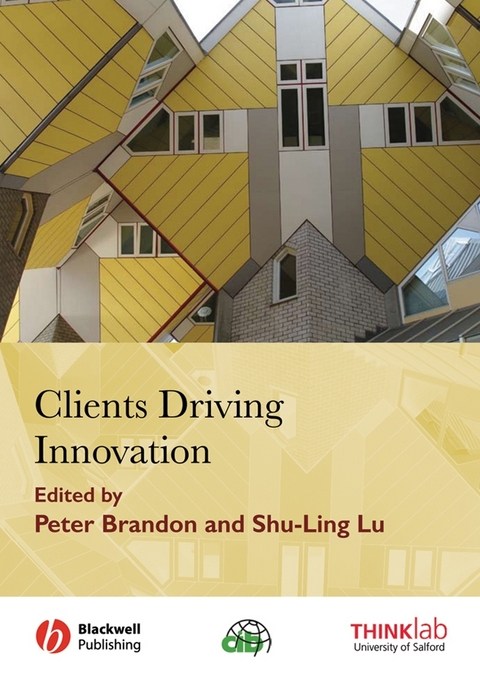
Clients Driving Innovation (eBook)
296 Seiten
John Wiley & Sons (Verlag)
978-1-4443-0135-9 (ISBN)
lack of successful innovation compared to other major industries.
The question of why the industry has not been seen to be innovative
has created concern among many involved with construction and
property. The driving concern is where the motivation for this
innovation should come from. Although construction clients have
made an impact in this area, the industry itself seems divided as
to whether, when and where clients should drive the innovation
process.
Clients Driving Innovation brings together an
international group of researchers and practitioners to investigate
the role of clients in construction innovation. Written in three
parts, it covers the context for innovation driven by clients, the
client impact on the innovation process and how new ideas can be
pushed through into practice. Numerous case studies illustrate the
role clients can play and the key issues that need to be
addressed.
With increasing interest in the contribution clients can make to
construction innovation, Clients Driving Innovation will be
essential reading for construction management researchers, major
construction contractors and clients and government policy
makers.
Professor Peter Brandon is Director of Salford University 'Think Lab' and Director of Strategic Programmes, School of the Built Environment, University of Salford. Dr Shu-Ling Lu is a Research Fellow in the School of the Built Environment, University of Salford.
ACKNOWLEDGMENTS.
PREFACE - Peter Brandon.
PART I THE CONTEXT FOR INNOVATION .
What is the Broader Context within which ClientsOperate?.
Chapter 1 A global agenda for revaluing construction: theclient's role - Peter Barrett.
Chapter 2 Revaluing construction: implications for theconstruction process - Graham M Winch.
Chapter 3 Is the client really part of the team? A contemporarypolicy perspective on Latham / Egan - John Hobson and KennethTreadaway.
What is the Position of Clients within the DevelopmentProcess?.
Chapter 4 Enabling clients to be professional - RogerCourtney.
Chapter 5 Challenging the illusion of the all powerfulclients' role in driving innovation - Martin Sexton, CarlAbbott and Shu-Ling Lu.
Chapter 6 Reifying the client in construction managementresearch? Alternative perspectives on a complex construct - MikeBresnen.
Chapter 7 A proposed taxonomy for construction clients -Patricia Tzortzopoulos, Mike Kagioglou and Kenneth Treadaway.
What are the Client's Roles and Responsibilities inDriving Innovation?.
Chapter 8 Clients' roles and contributions to innovationsin the construction industry: when giants learn to dance - CharlesEgbu.
Chapter 9 Setting the game plan: the role of clients inconstruction innovation and diffusion - Kristian Widén, BrianAtkin and Leif Hommen.
Chapter 10 Clients as innovation drivers in large engineeringprojects - Roger Miller.
Chapter 11 Knowing differently, innovating together? Exploringthe dynamics of knowledge creation across boundaries inclients' design teams - Patrick S. W. Fong.
Chapter 12 The role of the client in the innovation processes ofsmall construction professional service firms - Shu-Ling Lu.
Chapter 13 Client-oriented contractor innovation - JanBröchner.
What are the Appropriate Tools and Barriers to theImplementation of Innovation Practices?.
Chapter 14 Driving innovation in construction: a conceptualmodel of client leadership behaviour - Mohammed F. Dulaimi.
Chapter 15 Critical actions by clients for effective developmentand implementation of construction innovations - E. Sarah Slaughterand William L. Cate.
PART II THE INNOVATION PROCESS .
Chapter 16 Overcoming resistance to innovation: the integrationchampion in construction - Andreas Hartmann.
Chapter 17 Client-driven innovation through arequirements-oriented project process - John M. Kamara.
Chapter 18 Knowledge management supports clients drivinginnovation: two case studies - Marja Naaranoja, PäiviHaapalainen and Heikki Lonka.
Chapter 19 Implementing innovations in infrastructures for thebuilt environment: the role of project developers, customers andusers - Marcela Miozzo and Nuno Gil.
PART III MOVING IDEAS INTO PRACTICE .
What are the Policy Issues in Moving Ideas intoPractice?.
Chapter 20 Client driven performance improvement strategies forthe construction industry: development and implementationchallenges - Aminah Robinson Fayek, Jeff H. Rankin and ErnieTromposch.
Chapter 21 Public policy, clients and the construction industry- Eileen Fairhurst.
Chapter 22 Value for money versus complexity: a battle of giantsin the public sector? - Erica Dyson.
How do Clients Move Ideas into Practice?.
Chapter 23 The role of the professional client in leadingchange: a case study of Stanhope plc - Colin Gray.
Chapter 24 Customer focus: time, the enemy of desire - acontractor developer perspective - Chris Woods.
Chapter 25 The role of the client in building site innovations -Frédéric Bougrain.
Chapter 26 A complex systems approach to customer co-innovation:a financial services case study - Robert Kay
"An outstanding collection that will be both a guide for students
and a stimulus to scholars. Elizabeth Radcliffe and her
distinguished contributors cast fresh and clarifying light on each
of the many topics they address."
- Kenneth Winkler, Yale University
"Elizabeth Radcliffe has achieved a remarkable feat of editorial
organization. This will be a major reference resource for those who
want to see the main directions in which Hume studies are currently
heading. Topics are well chosen. Contributors range from some of
our most distinguished senior scholars to talented recruits from
the rising generation."
- M.A. Stewart, University of Aberdeen
| Erscheint lt. Verlag | 26.1.2009 |
|---|---|
| Sprache | englisch |
| Themenwelt | Technik ► Bauwesen |
| Schlagworte | Baubetrieb • Bauingenieur- u. Bauwesen • Civil Engineering & Construction • Construction Management |
| ISBN-10 | 1-4443-0135-7 / 1444301357 |
| ISBN-13 | 978-1-4443-0135-9 / 9781444301359 |
| Informationen gemäß Produktsicherheitsverordnung (GPSR) | |
| Haben Sie eine Frage zum Produkt? |
 PDF (Adobe DRM)
Kopierschutz: Adobe-DRM
Adobe-DRM ist ein Kopierschutz, der das eBook vor Mißbrauch schützen soll. Dabei wird das eBook bereits beim Download auf Ihre persönliche Adobe-ID autorisiert. Lesen können Sie das eBook dann nur auf den Geräten, welche ebenfalls auf Ihre Adobe-ID registriert sind.
Details zum Adobe-DRM
Dateiformat: PDF (Portable Document Format)
Mit einem festen Seitenlayout eignet sich die PDF besonders für Fachbücher mit Spalten, Tabellen und Abbildungen. Eine PDF kann auf fast allen Geräten angezeigt werden, ist aber für kleine Displays (Smartphone, eReader) nur eingeschränkt geeignet.
Systemvoraussetzungen:
PC/Mac: Mit einem PC oder Mac können Sie dieses eBook lesen. Sie benötigen eine
eReader: Dieses eBook kann mit (fast) allen eBook-Readern gelesen werden. Mit dem amazon-Kindle ist es aber nicht kompatibel.
Smartphone/Tablet: Egal ob Apple oder Android, dieses eBook können Sie lesen. Sie benötigen eine
Geräteliste und zusätzliche Hinweise
Buying eBooks from abroad
For tax law reasons we can sell eBooks just within Germany and Switzerland. Regrettably we cannot fulfill eBook-orders from other countries.
aus dem Bereich