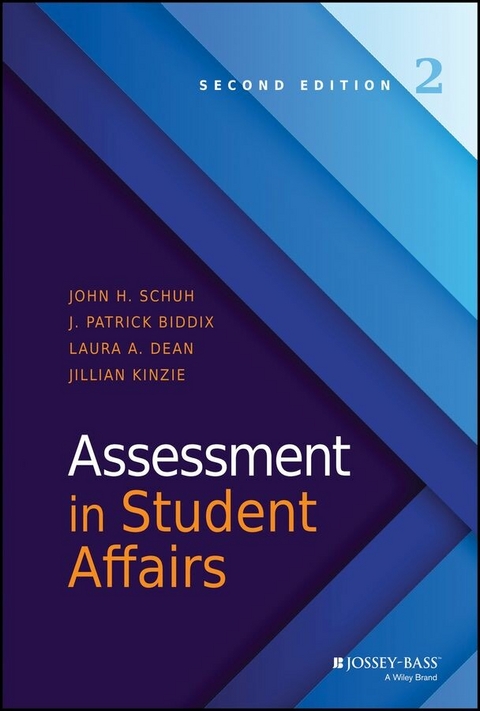
Assessment in Student Affairs (eBook)
John Wiley & Sons (Verlag)
978-1-119-05108-4 (ISBN)

Assessment in Student Affairs, Second Edition offers a contemporary look at the foundational elements and practical application of assessment in student affairs. Higher education administration is increasingly called upon to demonstrate organizational effectiveness and engage in continuous improvement based on information generated through systematic inquiry. This book provides a thorough primer on all stages of the assessment process. From planning to reporting and beyond, you'll find valuable assessment strategies to help you produce meaningful information and improve your program. Combining and updating the thoroughness and practicality of Assessment in Student Affairs and Assessment Practice in Student Affairs, this new edition covers design of assessment projects, ethical practice, student learning outcomes, data collection and analysis methods, report writing, and strategies to implement change based on assessment results. Case studies demonstrate real-world application to help you clearly see how these ideas are used effectively every day, and end-of-chapter discussion questions stimulate deeper investigation and further thinking about the ideas discussed. The instructor resources will help you seamlessly integrate this new resource into existing graduate-level courses.
Student affairs administrators understand the importance of assessment, but many can benefit from additional direction when it comes to designing and implementing evaluations that produce truly useful information. This book provides field-tested approaches to assessment, giving you a comprehensive how-to manual for demonstrating-and improving-the work you do every day.
- Build your own assessment to demonstrate organizational effectiveness
- Utilize quantitative and qualitative techniques and data
- Identify metrics and methods for measuring student learning
- Report and implement assessment findings effectively
Accountability and effectiveness are the hallmarks of higher education administration today, and they are becoming the metrics by which programs and services are evaluated. Strong assessment skills have never been more important. Assessment in Student Affairs gives you the knowledge base and skill set you need to shine a spotlight on what you and your organization are able to achieve.
A practical, comprehensive manual for assessment design and implementation Assessment in Student Affairs, Second Edition offers a contemporary look at the foundational elements and practical application of assessment in student affairs. Higher education administration is increasingly called upon to demonstrate organizational effectiveness and engage in continuous improvement based on information generated through systematic inquiry. This book provides a thorough primer on all stages of the assessment process. From planning to reporting and beyond, you'll find valuable assessment strategies to help you produce meaningful information and improve your program. Combining and updating the thoroughness and practicality of Assessment in Student Affairs and Assessment Practice in Student Affairs, this new edition covers design of assessment projects, ethical practice, student learning outcomes, data collection and analysis methods, report writing, and strategies to implement change based on assessment results. Case studies demonstrate real-world application to help you clearly see how these ideas are used effectively every day, and end-of-chapter discussion questions stimulate deeper investigation and further thinking about the ideas discussed. The instructor resources will help you seamlessly integrate this new resource into existing graduate-level courses. Student affairs administrators understand the importance of assessment, but many can benefit from additional direction when it comes to designing and implementing evaluations that produce truly useful information. This book provides field-tested approaches to assessment, giving you a comprehensive how-to manual for demonstrating and improving the work you do every day. Build your own assessment to demonstrate organizational effectiveness Utilize quantitative and qualitative techniques and data Identify metrics and methods for measuring student learning Report and implement assessment findings effectively Accountability and effectiveness are the hallmarks of higher education administration today, and they are becoming the metrics by which programs and services are evaluated. Strong assessment skills have never been more important. Assessment in Student Affairs gives you the knowledge base and skill set you need to shine a spotlight on what you and your organization are able to achieve.
JOHN H. SCHUH is director of the Emerging Leaders Academy and is distinguished professor emeritus at Iowa State University. He is the author of Assessment Methods for Student Affairs, from Jossey-Bass. J. PATRICK BIDDIX is associate professor of higher education at the University of Tennessee. He teaches graduate courses in assessment, research design, and methodology in student affairs. LAURA A. DEAN is professor in college student affairs administration at the University of Georgia. She is also past-president of the Council for the Advancement of Standards in Higher Education (CAS). JILLIAN KINZIE is associate director of the Center for Postsecondary Research and the NSSE Institute at Indiana University. She is the coauthor of Using Evidence of Student Learning to Improve Higher Education and Student Success in College: Creating Conditions That Matter, both from Jossey-Bass.
Preface
About the Authors
Chapter 1: Understanding the Contemporary Assessment Environment
Chapter 2: Designing and Planning an Assessment Project
Chapter 3: Framing Assessment with the Highest Ethical Standards
Chapter 4: Measuring Individual Student Learning and Growth
Chapter 5: Program Outcomes and Program Review
Chapter 6: Facilitating Data Collection and Management
Chapter 7: Using Qualitative Techniques in Conducting Assessments
Chapter 8: Using Quantitative Techniques in Conducting Assessments
Chapter 9: Developing and Selecting instruments
Chapter 10: Assessing Student Campus Environments
Chapter 11: Assessing Quality through Comparisons
Chapter 12: Getting Assessment Projects Started and Ensuring Sustainability
Chapter 13: Reporting Assessment Results and Bringing about Change
Chapter 14: Developing a Culture of Assessment
Chapter 15: Taking a Look at Assessment in the Future: A Look Into Our Crystal Ball
Appendix: Designing and Implementing an Assessment Project
Index
| Erscheint lt. Verlag | 27.4.2016 |
|---|---|
| Sprache | englisch |
| Themenwelt | Geisteswissenschaften |
| Sozialwissenschaften ► Pädagogik ► Bildungstheorie | |
| Sozialwissenschaften ► Pädagogik ► Erwachsenenbildung | |
| Schlagworte | assessing higher education • Assessment in Student Affairs • Bildungswesen • demonstrating student affairs effectiveness • Education • Higher Education Administration • Hochschule • Hochschulen / Dienstleistungen f. Studenten • Jillian Kinzie • John H. Schuh • J. Patrick Biddix • Laura Dean • measuring student learning • planning student affairs assessment • student affairs administration • Student Affairs & Development (Higher Education) • student affairs assessment basics • student affairs assessment design • student affairs assessment implementation • student affairs assessment methods • student affairs assessment metrics • student affairs assessment strategies • student affairs data analysis • student affairs effectiveness • student affairs evaluation • understanding student affairs |
| ISBN-10 | 1-119-05108-8 / 1119051088 |
| ISBN-13 | 978-1-119-05108-4 / 9781119051084 |
| Informationen gemäß Produktsicherheitsverordnung (GPSR) | |
| Haben Sie eine Frage zum Produkt? |
 PDF (Adobe DRM)
Kopierschutz: Adobe-DRM
Adobe-DRM ist ein Kopierschutz, der das eBook vor Mißbrauch schützen soll. Dabei wird das eBook bereits beim Download auf Ihre persönliche Adobe-ID autorisiert. Lesen können Sie das eBook dann nur auf den Geräten, welche ebenfalls auf Ihre Adobe-ID registriert sind.
Details zum Adobe-DRM
Dateiformat: PDF (Portable Document Format)
Mit einem festen Seitenlayout eignet sich die PDF besonders für Fachbücher mit Spalten, Tabellen und Abbildungen. Eine PDF kann auf fast allen Geräten angezeigt werden, ist aber für kleine Displays (Smartphone, eReader) nur eingeschränkt geeignet.
Systemvoraussetzungen:
PC/Mac: Mit einem PC oder Mac können Sie dieses eBook lesen. Sie benötigen eine
eReader: Dieses eBook kann mit (fast) allen eBook-Readern gelesen werden. Mit dem amazon-Kindle ist es aber nicht kompatibel.
Smartphone/Tablet: Egal ob Apple oder Android, dieses eBook können Sie lesen. Sie benötigen eine
Geräteliste und zusätzliche Hinweise
Buying eBooks from abroad
For tax law reasons we can sell eBooks just within Germany and Switzerland. Regrettably we cannot fulfill eBook-orders from other countries.
aus dem Bereich