Assessment in Student Affairs (eBook)
John Wiley & Sons (Verlag)
978-1-119-05116-9 (ISBN)
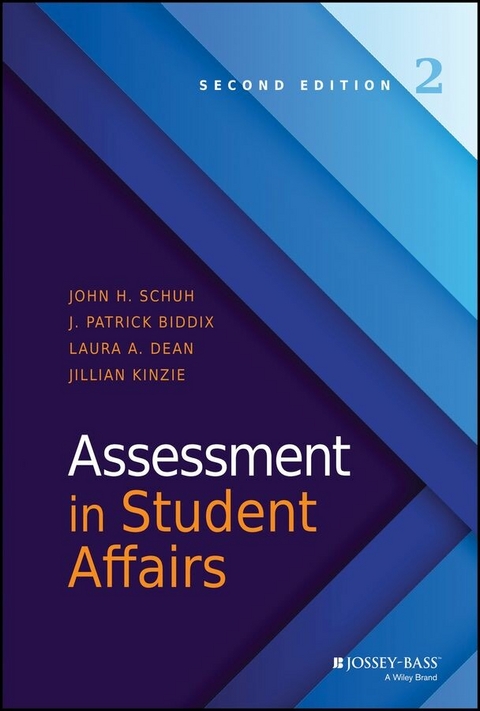
Assessment in Student Affairs, Second Edition offers a contemporary look at the foundational elements and practical application of assessment in student affairs. Higher education administration is increasingly called upon to demonstrate organizational effectiveness and engage in continuous improvement based on information generated through systematic inquiry. This book provides a thorough primer on all stages of the assessment process. From planning to reporting and beyond, you'll find valuable assessment strategies to help you produce meaningful information and improve your program. Combining and updating the thoroughness and practicality of Assessment in Student Affairs and Assessment Practice in Student Affairs, this new edition covers design of assessment projects, ethical practice, student learning outcomes, data collection and analysis methods, report writing, and strategies to implement change based on assessment results. Case studies demonstrate real-world application to help you clearly see how these ideas are used effectively every day, and end-of-chapter discussion questions stimulate deeper investigation and further thinking about the ideas discussed. The instructor resources will help you seamlessly integrate this new resource into existing graduate-level courses.
Student affairs administrators understand the importance of assessment, but many can benefit from additional direction when it comes to designing and implementing evaluations that produce truly useful information. This book provides field-tested approaches to assessment, giving you a comprehensive how-to manual for demonstrating-and improving-the work you do every day.
- Build your own assessment to demonstrate organizational effectiveness
- Utilize quantitative and qualitative techniques and data
- Identify metrics and methods for measuring student learning
- Report and implement assessment findings effectively
Accountability and effectiveness are the hallmarks of higher education administration today, and they are becoming the metrics by which programs and services are evaluated. Strong assessment skills have never been more important. Assessment in Student Affairs gives you the knowledge base and skill set you need to shine a spotlight on what you and your organization are able to achieve.
A practical, comprehensive manual for assessment design and implementation Assessment in Student Affairs, Second Edition offers a contemporary look at the foundational elements and practical application of assessment in student affairs. Higher education administration is increasingly called upon to demonstrate organizational effectiveness and engage in continuous improvement based on information generated through systematic inquiry. This book provides a thorough primer on all stages of the assessment process. From planning to reporting and beyond, you'll find valuable assessment strategies to help you produce meaningful information and improve your program. Combining and updating the thoroughness and practicality of Assessment in Student Affairs and Assessment Practice in Student Affairs, this new edition covers design of assessment projects, ethical practice, student learning outcomes, data collection and analysis methods, report writing, and strategies to implement change based on assessment results. Case studies demonstrate real-world application to help you clearly see how these ideas are used effectively every day, and end-of-chapter discussion questions stimulate deeper investigation and further thinking about the ideas discussed. The instructor resources will help you seamlessly integrate this new resource into existing graduate-level courses. Student affairs administrators understand the importance of assessment, but many can benefit from additional direction when it comes to designing and implementing evaluations that produce truly useful information. This book provides field-tested approaches to assessment, giving you a comprehensive how-to manual for demonstrating and improving the work you do every day. Build your own assessment to demonstrate organizational effectiveness Utilize quantitative and qualitative techniques and data Identify metrics and methods for measuring student learning Report and implement assessment findings effectively Accountability and effectiveness are the hallmarks of higher education administration today, and they are becoming the metrics by which programs and services are evaluated. Strong assessment skills have never been more important. Assessment in Student Affairs gives you the knowledge base and skill set you need to shine a spotlight on what you and your organization are able to achieve.
JOHN H. SCHUH is director of the Emerging Leaders Academy and is distinguished professor emeritus at Iowa State University. He is the author of Assessment Methods for Student Affairs, from Jossey-Bass. J. PATRICK BIDDIX is associate professor of higher education at the University of Tennessee. He teaches graduate courses in assessment, research design, and methodology in student affairs. LAURA A. DEAN is professor in college student affairs administration at the University of Georgia. She is also past-president of the Council for the Advancement of Standards in Higher Education (CAS). JILLIAN KINZIE is associate director of the Center for Postsecondary Research and the NSSE Institute at Indiana University. She is the coauthor of Using Evidence of Student Learning to Improve Higher Education and Student Success in College: Creating Conditions That Matter, both from Jossey-Bass.
Preface
About the Authors
Chapter 1: Understanding the Contemporary Assessment Environment
Chapter 2: Designing and Planning an Assessment Project
Chapter 3: Framing Assessment with the Highest Ethical Standards
Chapter 4: Measuring Individual Student Learning and Growth
Chapter 5: Program Outcomes and Program Review
Chapter 6: Facilitating Data Collection and Management
Chapter 7: Using Qualitative Techniques in Conducting Assessments
Chapter 8: Using Quantitative Techniques in Conducting Assessments
Chapter 9: Developing and Selecting instruments
Chapter 10: Assessing Student Campus Environments
Chapter 11: Assessing Quality through Comparisons
Chapter 12: Getting Assessment Projects Started and Ensuring Sustainability
Chapter 13: Reporting Assessment Results and Bringing about Change
Chapter 14: Developing a Culture of Assessment
Chapter 15: Taking a Look at Assessment in the Future: A Look Into Our Crystal Ball
Appendix: Designing and Implementing an Assessment Project
Index
PREFACE
Another book on assessment in student affairs? Hasn't this topic been covered in its entirety? These are legitimate questions that any prospective reader could raise about another book being published on assessment in student affairs. In fact, we, as authors, have written numerous pieces on assessment in student affairs that in many respects trace the development of the art and science of assessment in student affairs over the past 25 years. While it is very difficult to identify a contemporary book on student affairs practice that does not address topics related to assessment, such has not always been the case, as we will affirm in this volume.
Assessment in student affairs has evolved over the past several decades to the point where we believe that assessment is in the process of being institutionalized as a part of student affairs practice. But assessment still is not as common as we think it should be, and we hope that over the next couple of years assessment will become a part of routine student affairs practice, similar to staff selection, for example, in residence life. Moreover, as we point out in Chapter 1, assessment, evaluation, and research have not been differentiated clearly in the student affairs literature until fairly recently (see Suskie, 2009), and while these activities have clearly different purposes, they were used synonymously for years, incorrectly in our opinion. So, this book will try to add to the clarity of the definition of assessment and provide a myriad of examples of assessment projects.
Not only has assessment been differentiated from evaluation and research in the past several decades, the purposes of assessment have become sharper. We can thank Ewell (2009) for his elegantly written piece that discusses the tensions related to the accountability and improvement dimensions of assessment. Virtually all assessment projects fit into one of these two categories, and in some cases assessment projects can fit into both of them. Contemporary thinking about the purposes of assessment is more streamlined and fits projects neatly into one purpose or the other, or both.
The technical side of conducting assessments has evolved over the past number of years, and while we believe that predicting where technological improvements will take us in the future is difficult, we are confident that new technologies will be developed in the future. Our experience takes us back to, in effect, distributing questionnaires by hand, collecting them, copying responses onto coding sheets, transferring the data to Hollerith cards, having them analyzed by mainframe computers, and making sense of the results, in effect, by hand. This approach, while effective in its day, was incredibly time consuming and is the assessment equivalent of making long distance telephone calls by dialing “0” and asking the operator to place the call. In this book we offer what we think are contemporary approaches to the practice of assessment by using current technology that is widely available.
In this volume we also look at other aspects of assessment that are evolving continuously, such as protecting the rights of participants, developing a culture of assessment in student affairs, differentiating between individual and group assessment projects, identifying strategies for getting assessment projects started, and reporting results. This book is much more than an update of the first edition. Rather, in identifying the concepts for this book, we started from scratch and identified those topics that in our opinion will be of great practical value for our readers. In short, we have overhauled the topic of assessment and developed what we trust our readers will find is a fresh look at very important topics covered under the umbrella of assessment in student affairs.
Finally, we thought it would make sense for a book to be written with the graduate student and young professional in mind. Curricula in student affairs preparation programs, in our view, ought to have a course on assessment as the CAS standards indicate. Our view is that this volume could be used as the primary textbook for such a course. With that in mind the reader will find case studies, scenarios, and discussion questions throughout the book.
General Purpose of the Book
As the previous paragraph suggests, this book has been designed as a text for a course on assessment in student affairs. We also think that this book can be used for staff development purposes for student affairs educators and others who are interested in assessing the potency of services, programs, and learning experiences as related to student growth and development. All of the authors have offered courses, workshops, and seminars and done consulting related to assessment in student affairs. Our view is that the existing literature is valuable in providing important information about assessment for graduate students preparing for careers as student affairs educators, but we also believe that a book especially tailored for a graduate course or staff development has great utility. With that in mind we have developed this book with the purpose to provide a primer on topics that provide a foundation for students preparing for careers as student affairs educators or those staff who seek more information to inform their practice as they work with college students.
Intended Audiences
Our primary audience for this book consists of those who are preparing for careers as student affairs educators or those who work with college students and seek more information about the extent to which students learn and grow from the experiences they offer. We trust that graduate students will have a course on assessment in student affairs in their curriculum. Accordingly, this book can be used as the primary text for such a course. If an assessment course is not part of the prescribed curriculum, this book can be used for an independent study of assessment in student affairs. Because of the cases and discussion questions, our opinion is that the book will lend itself well to a formal course or an independent study.
We also realize that a number of people come to careers in ways other than through student affairs graduate programs. Included in this career path, for example, are academic advisors, career counselors, recreation coordinators, and so on. Though their career path may be outside that of those with graduate degrees in student affairs education, they are not absolved from assessment activities. Consequently, they could choose to use this book to provide a foundation for their work in assessment as student affairs educators through staff development activities offered by their institution or through independent reading on their own.
Still others enter student affairs education by switching from faculty roles or perhaps from outside higher education. They, too, have an obligation to participate and perhaps lead an ongoing program of assessment in student affairs. Included in this set of professionals are those who lead learning centers, coordinate retention programs, or serve in executive roles with student affairs being included in their portfolios. This book can provide them with background information as they work with staff in developing assessment projects.
Beyond staff in student affairs, others may have an interest in issues related to accountability and improvement in higher education. Those who serve on regional accrediting committees or governing boards, or who advise legislators or other policy groups, might find this volume useful. Our view is that oversight of higher education will continue to tighten in the future, and this volume can provide those providing such oversight with a foundation for the questions they should be asking.
How to Use the Book
While this book does not have to be used in a linear sense, meaning that one's reading should start with Chapter 1, then following with Chapter 2, 3, and so on, ultimately finishing with the last chapter, we think that might be the best approach. Our assumption is that most readers will not know a great deal about assessment, and even may not have thought about it much before beginning to read this book. The chapters are designed to build on each other with information from the early chapters providing a foundation for those that follow. So, our recommendation is that readers start with the first chapter and then follow through the rest of the book sequentially.
This book, however, is not designed to be read in isolation. That is, we have provided two features that are designed to provide a basis for group discussions and perhaps group projects. One of the features is the introduction of a case study or scenarios that can be used to apply and illustrate the elements of the chapter. The other is a set of questions found at the end of each chapter designed to stimulate discussion about its contents. The questions are designed to prompt in-class discussion, for small group work outside of class, or for reflection and contemplation by those who are reading the book outside a group exercise. Most important, the cases and the discussion questions are designed to make active learning very much a part of the experiences of those who read the book.
If the book is used for staff development in a student affairs unit, the same principles apply. That is, the cases can be used to illustrate the content of the chapter and the questions at the end of the chapter are designed to stimulate discussion and further thinking about the topic of the chapter.
We provide foundational information about assessment in Chapter 1 by differentiating between assessment, evaluation,...
| Erscheint lt. Verlag | 27.4.2016 |
|---|---|
| Sprache | englisch |
| Themenwelt | Geisteswissenschaften |
| Sozialwissenschaften ► Pädagogik ► Bildungstheorie | |
| Sozialwissenschaften ► Pädagogik ► Erwachsenenbildung | |
| Schlagworte | assessing higher education • Assessment in Student Affairs • Bildungswesen • demonstrating student affairs effectiveness • Education • Higher Education Administration • Hochschule • Hochschulen / Dienstleistungen f. Studenten • Jillian Kinzie • John H. Schuh • J. Patrick Biddix • Laura Dean • measuring student learning • planning student affairs assessment • student affairs administration • Student Affairs & Development (Higher Education) • student affairs assessment basics • student affairs assessment design • student affairs assessment implementation • student affairs assessment methods • student affairs assessment metrics • student affairs assessment strategies • student affairs data analysis • student affairs effectiveness • student affairs evaluation • understanding student affairs |
| ISBN-10 | 1-119-05116-9 / 1119051169 |
| ISBN-13 | 978-1-119-05116-9 / 9781119051169 |
| Informationen gemäß Produktsicherheitsverordnung (GPSR) | |
| Haben Sie eine Frage zum Produkt? |
 EPUB (Adobe DRM)
Kopierschutz: Adobe-DRM
Adobe-DRM ist ein Kopierschutz, der das eBook vor Mißbrauch schützen soll. Dabei wird das eBook bereits beim Download auf Ihre persönliche Adobe-ID autorisiert. Lesen können Sie das eBook dann nur auf den Geräten, welche ebenfalls auf Ihre Adobe-ID registriert sind.
Details zum Adobe-DRM
Dateiformat: EPUB (Electronic Publication)
EPUB ist ein offener Standard für eBooks und eignet sich besonders zur Darstellung von Belletristik und Sachbüchern. Der Fließtext wird dynamisch an die Display- und Schriftgröße angepasst. Auch für mobile Lesegeräte ist EPUB daher gut geeignet.
Systemvoraussetzungen:
PC/Mac: Mit einem PC oder Mac können Sie dieses eBook lesen. Sie benötigen eine
eReader: Dieses eBook kann mit (fast) allen eBook-Readern gelesen werden. Mit dem amazon-Kindle ist es aber nicht kompatibel.
Smartphone/Tablet: Egal ob Apple oder Android, dieses eBook können Sie lesen. Sie benötigen eine
Geräteliste und zusätzliche Hinweise
Buying eBooks from abroad
For tax law reasons we can sell eBooks just within Germany and Switzerland. Regrettably we cannot fulfill eBook-orders from other countries.
aus dem Bereich