


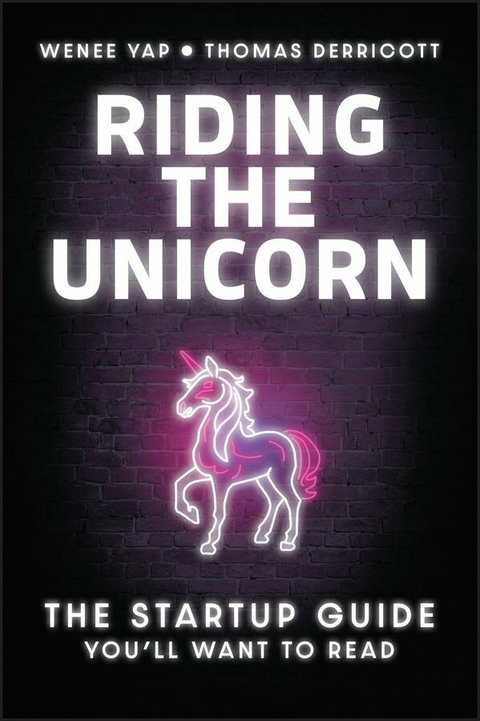
Riding the Unicorn (eBook)
327 Seiten
Wiley (Verlag)
978-1-394-36770-2 (ISBN)
The Legends are True. The Unicorn is out there.
Think unicorns - those billion-dollar startups as rare as their mythical namesakes - are just Silicon Valley fairytales? Think again. After interviewing some of Australia and New Zealand's innovation rockstars, Wenee Yap and Thomas Derricott have cracked the code on what makes a startup a unicorn. Riding the Unicorn skips the dry business theory and instead gives you battle-tested strategies from startup legends, wrapped up in stories that'll keep you hooked from page one. You'll get the unvarnished truth about what it really takes to launch, scale and - if you're lucky - sell your way to startup glory.
You'll learn how to build your own unicorn, systematically moving through six stages that guide you from idea to product development to company growth to exit.
You'll also find:
- Valuable insights from the minds of startup royalty, including Tim Fung of Airtasker and Pasha Rayan of Forage
- Research-backed tactics for success, delivered through stories so good you'll forget you're learning
- Straight-talking advice that works whether you're a fresh grad with big dreams or a seasoned entrepreneur ready to bet on yourself
Whether you're in tech, education, creative industries or anywhere in between, Riding the Unicorn isn't just a book; it's your guide for taming your next billion-dollar idea. Time to saddle up and start your journey from side hustle to success story.
WENEE YAP and THOMAS DERRICOTT are successful entrepreneurs with over 20 years' combined experience in the Australian startup ecosystem. Wenee is the founder of Survive Law-which grew to Australia's highest traffic online community of law students before its acquisition and Thomas is an award-winning journalist and early employee of multiple startups.
The Legends are True. The Unicorn is out there. Think unicorns those billion-dollar startups as rare as their mythical namesakes are just Silicon Valley fairytales? Think again. After interviewing some of Australia and New Zealand's innovation rockstars, Wenee Yap and Thomas Derricott have cracked the code on what makes a startup a unicorn. Riding the Unicorn skips the dry business theory and instead gives you battle-tested strategies from startup legends, wrapped up in stories that'll keep you hooked from page one. You'll get the unvarnished truth about what it really takes to launch, scale and if you're lucky sell your way to startup glory. You'll learn how to build your own unicorn, systematically moving through six stages that guide you from idea to product development to company growth to exit. You'll also find: Valuable insights from the minds of startup royalty, including Tim Fung of Airtasker and Pasha Rayan of Forage Research-backed tactics for success, delivered through stories so good you'll forget you're learning Straight-talking advice that works whether you're a fresh grad with big dreams or a seasoned entrepreneur ready to bet on yourself Whether you're in tech, education, creative industries or anywhere in between, Riding the Unicorn isn't just a book; it's your guide for taming your next billion-dollar idea. Time to saddle up and start your journey from side hustle to success story.
INTRODUCTION
The legends are true — the unicorn is out there.
If you're looking for a business mentor, you can't do much better than The Very Hungry Caterpillar.
Yes, this book is off to a strange start, but bear with us for a minute. He's a caterpillar. He's small. He makes some smart decisions, and he grows larger. He does some things he shouldn't do, but he learns from his mistakes. His journey isn't one without issue, but by the final page, he has morphed into something beyond his wildest dreams. Should you have been lucky enough to read his story as a child, you likely didn't realise its entrepreneurial merit. Even so, we're confident in saying The Very Hungry Caterpillar — and many works like it — stoked that urge you're feeling right now.
Within this book, you'll find exclusive access to some of Australia's most successful founders, leaders and venture capitalists (VC). You'll hear from those who have reached the finish line, and those who are still running the race. Teachings, research and business best practices will abound from across the globe. But more than anything, this book is a Rosetta Stone. It seeks to unearth and translate the lessons you've learned from your hungry caterpillars, your favourite bands, your after-school specials and Saturday morning cartoons. And, so you know we're not talking out of our hats, we'll cross-section each insight against various leading CEOs’ lived experiences.
Perhaps you're keen to launch your own business, but you're not sure where to begin. Maybe you're curious about these mystery ventures that always seem to report multimillion-dollar raises. Perhaps you already have your own business, and you'd like to learn what you can apply to your own hustle. Whatever the case, without knowing it, you've been preparing for this next step your entire life. Every song, story and fable you've ingested has readied you for this moment. We're just here to give you a well-researched nudge.
This isn't the first book about startups and business, and it sure won't be the last. But hopefully, it will be the one you actually want to read.
What does a unicorn have to do with business, and why should I care?
White horse. Pointy horn protruding from its head. Features in countless myths, Blade Runner and the Harry Potter series. Same page, yes? Good. Now, how did the concept become a byword for a successful startup?
‘Unicorn’ first appeared in this context in a 2013 TechCrunch article by Aileen Lee, founder of seed-stage fund Cowboy Ventures. In the article, Lee used the word to describe scalable businesses — or startups — that reach a valuation of $1 billion.
By her calculations, only 0.07 of venture-funded software startups from the 2000s reached such a valuation. Between 2003 and 2013, that equated to an average of four per year. As such, Lee reckoned that these startups were as rare and precious as the mythical creatures that bore their name. In the same article, startups like Facebook — which exceeded a value of $100 billion — enjoyed the mantle of ‘super unicorn’.
We don't know what went through Lee's head when she first used ‘unicorn’ in this context. Perhaps she was a Mean Girls fan, and she wanted to make her own version of ‘fetch’ happen. Maybe she just loved unicorns, and wanted to see the horned myth receive its due. Whatever the reason, startup life would never be the same.
Why is Oceania the right climate for unicorns?
Looking at Lee's reasoning (and the startup scene in general), you might feel that the unicorn concept is very … American.
And if you do, your gut has aligned with the market. In 2022, of the world's top-10 privately owned unicorns, five were US-owned and operated. By contrast, Australia and New Zealand looked lonely, with only one Aussie startup — Canva — making the list. At a glance, then, you'd be forgiven for thinking unicorns hadn't taken to the trans-Tasman landscape.
However, while Silicon Valley often hogs the spotlight, there's a lot to like in our corner of the world. In fact, venture capitalist Kylie Frazer regards Australia as one of the most capital efficient places in the world to find a unicorn. What she means is that it's an easy place to start a business — indeed, by global rankings, we're one of the easiest places in the world.
Having said that, we're arguably one of the hardest places to grow a business, because we aren't a cash-rich innovation hub like Silicon Valley, Shenzhen or Singapore. These locations nurture new ideas by allowing venture capital, government investment and a business-friendly regulatory environment to converge — with staggering success. By contrast, our capital and regulatory frameworks are still playing catch-up.
So what can we take from this? That whatever survives in some of the world's southernmost nations might be a little remarkable.
Sure enough, ANZ has a storied history of innovation — one that spans beyond Vegemite and the Bungy Jump. The bionic ear, the egg beater, polymer bank notes, the jet boat, wifi technology, tank-bred tuna, kite surfing and the black box flight recorder — all of these inventions call New Zealand and Australia home. In fact, the depth of our countries’ ingenuity is only outstripped by their breadth.
In 2003, a Sydney-based company called Where 2 Technologies began to explore the idea of digital mapping; by the end of 2004, the founders had sold the startup to Google, and Google Maps was born. Two years later, a world-first cervical cancer vaccine created by two researchers in Brisbane was approved for widespread use; since then, it has protected millions of women from the second-highest cause of female cancer mortality. Around the same time, organic gardeners the world over were living by the tenets of permaculture — a nature-led, chemical-free approach to farming, community and resource management. It was two Aussies who nurtured the idea to life in 1970s Tasmania.
Cross the ditch to Aotearoa and you'll find similar stories. In 1994, a pair of Kiwis forever changed the relationship between humans and hills when they invented the ZORB. A plastic, transparent orb designed to cushion its users within, the ZORB lets its users tumble down hilltops in comfort. ‘Zorb’ has since become a verb, and footage of people beach-balling down inclines has become a common sight online.
Let's just hope zorb-ers don't crash into any electric fences; they were invented in New Zealand nearly 60 years earlier, to the relief of livestock farmers the world over. Speaking of farmers, Kiwi inventors also gifted them with a non-lethal means of sedating rowdy animals. Not content with inventing the disposable hypodermic syringe, New Zealand vet and pharmacist Colin Murdoch also created the tranquiliser gun. As a byproduct, he irrevocably changed the action movie genre. Don't want your hero to die in a firefight? Simply hit them with a tranquiliser gun and they'll live to fight another day.
As you see, our nations’ new ideas don't only present as lines of code or iPhone updates. They exist everywhere, from garage work benches, to chemist shelves. If you look at our countries’ great inventors, you'll see doctors, hippies, tradies, scientists and sailors. Whatever colour your unicorn may be, it can thrive across our borders.
In fact, New Zealand founder Nick Whitehouse thinks our constraints are our advantages. He should know: his legal AI startup, McCarthyFinch, exited in a record three-and-a-half years through an acquisition. In the parlance of finance, this meant his deal size went from around $3000 per deal before acquisition to $400 000 on his first deal post-acquisition. How? McCarthyFinch was acquired by US legaltech Onit, giving its market-leading AI massive credibility in the vast North American market.
‘Constraint is the mother of all invention,’ Whitehouse said to us. ‘Constraint creates creativity. In Australia and New Zealand, people don’t think casually about startups because they need a job to pay the bills; there’s not enough funding here to fail at something in three months, then fail into something else. The risk for us is much higher. So, the people you attract to startups are way more engaged on the mission — they’re more loyal and passionate — because they’re putting far more at risk.’
Unlike the multimillion-dollar cheques their American peers might receive, McCarthyFinch kickstarted with $2.5 million in pre-seed funding from law firm MinterEllison and New Zealand VC Goat Ventures. Comparatively speaking, it’s not a lot of money to fail, or succeed, but it’s a huge amount in the New Zealand start-up scene, especially pre-seed.
‘The cash situation here is actually an advantage and disadvantage,’ said Whitehouse. ‘It's an advantage because you have to be way, way more tactical with what you do. In New Zealand and Australia, if you blow through a million dollars, that's it. You're dead and you're not getting another...
| Erscheint lt. Verlag | 24.10.2025 |
|---|---|
| Sprache | englisch |
| Themenwelt | Sachbuch/Ratgeber ► Beruf / Finanzen / Recht / Wirtschaft |
| Wirtschaft ► Betriebswirtschaft / Management | |
| Schlagworte | acquisition • angel investor • Business Growth • business ideas • Elevator Pitch • Entrepreneurship • finding investors • Fortune 500 • Funding • growing a startup • Hiring talent • investors • IPO • Merger • MVP • prospectus • Scaling a Startup • seed funding • series funding • side hustles • side hustle strategies • Small Business • starting a business • Startup advice • startup exit strategy • Startup Funding • startup growth • startup handbook • startup manual • startup scaling strategy • startup strategies • startup tips • USP • Valuation • Venture Capital |
| ISBN-10 | 1-394-36770-8 / 1394367708 |
| ISBN-13 | 978-1-394-36770-2 / 9781394367702 |
| Informationen gemäß Produktsicherheitsverordnung (GPSR) | |
| Haben Sie eine Frage zum Produkt? |
 EPUB (Adobe DRM)
Kopierschutz: Adobe-DRM
Adobe-DRM ist ein Kopierschutz, der das eBook vor Mißbrauch schützen soll. Dabei wird das eBook bereits beim Download auf Ihre persönliche Adobe-ID autorisiert. Lesen können Sie das eBook dann nur auf den Geräten, welche ebenfalls auf Ihre Adobe-ID registriert sind.
Details zum Adobe-DRM
Dateiformat: EPUB (Electronic Publication)
EPUB ist ein offener Standard für eBooks und eignet sich besonders zur Darstellung von Belletristik und Sachbüchern. Der Fließtext wird dynamisch an die Display- und Schriftgröße angepasst. Auch für mobile Lesegeräte ist EPUB daher gut geeignet.
Systemvoraussetzungen:
PC/Mac: Mit einem PC oder Mac können Sie dieses eBook lesen. Sie benötigen eine
eReader: Dieses eBook kann mit (fast) allen eBook-Readern gelesen werden. Mit dem amazon-Kindle ist es aber nicht kompatibel.
Smartphone/Tablet: Egal ob Apple oder Android, dieses eBook können Sie lesen. Sie benötigen eine
Geräteliste und zusätzliche Hinweise
Buying eBooks from abroad
For tax law reasons we can sell eBooks just within Germany and Switzerland. Regrettably we cannot fulfill eBook-orders from other countries.
aus dem Bereich


