


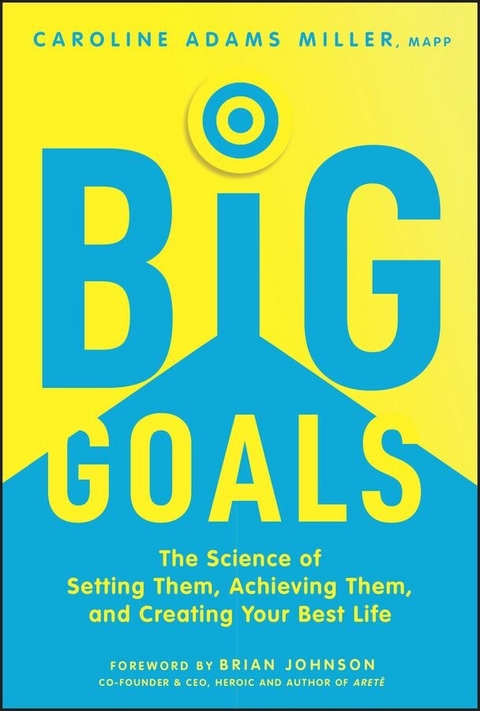
Big Goals (eBook)
288 Seiten
Wiley (Verlag)
978-1-394-27332-4 (ISBN)
Everything you need to make your goals a reality
Big Goals: The Science of Setting Them, Achieving Them, and Creating Your Best Life delves deeply into effective goal setting practices for both personal growth and corporate excellence, empowering individuals across all ages to pursue their ambitions with a newfound sense of confidence and mastery. Readers of this book will gain a nuanced understanding of the little-known science of goal setting, with practical tools and unique worksheets to use on their goal-achieving journey.
The insight in this book is powered by 15 years of exciting findings of positive psychology, along with Caroline Adams Miller's extensive experience as an executive coach. In this book, readers will learn about:
- The newest science on mindset, grit, Artificial Intelligence, resilience, and gender perspectives
- Miller's novel BRIDGE methodology, which addresses the 'how' between the assignment of Objectives and Key Results (OKRs) and Key Performance Indicators (KPIs)
- Locke and Latham's Goal Setting Theory (GST) and why it has been proven to work so well
No matter whether you're scared to start, sick of failure, or somewhere in between, Big Goals explains the new approach you need to more confidently and effectively move forward towards achieving your goals in your personal and professional life.
CAROLINE ADAMS MILLER is best known for her groundbreaking work on goal setting, grit, happiness, and success for over three decades. She wrote the first evidence-based mass market guide to goal setting that combined the science of success with the science of well-being, Creating Your Best Life.
Unlock the Secret to Achieving Your Biggest Goals No matter where you are in your journey hesitant to begin, frustrated by failure, or striving for even greater success Big Goals offers a proven roadmap to turn your ambitions into reality. Drawing on 15 years of cutting-edge positive psychology research and Caroline Adams Miller s extensive coaching expertise, this book equips you with practical tools, unique worksheets, and actionable strategies to take charge of your personal growth and professional success. If you ve struggled with setting or reaching your goals, the problem isn t your ambition it s your approach. Big Goals introduces a fresh, science-backed framework to help you overcome obstacles, stay motivated, and achieve results that truly matter. Through the pages of Big Goals, you ll discover: How to use positive psychology practices to build grit, resilience, and a winning mindset. The BRIDGE methodology (Brainstorming, Relationships, Investments, Decisions, Grit, and Excellence) to clarify your goals and maintain momentum. How to integrate Goal Setting Theory (GST) for smarter task management, effective feedback, and consistent performance improvements. Packed with practical advice and real-world insights, Big Goals will inspire you to dream bigger and work smarter whether you re aiming for personal transformation, career advancement, or organizational success.
Introduction
“How many of you set big goals?” I always ask this question whenever I’m working with students at Wharton’s Executive Education program, in global corporate settings, or delivering keynotes that span industries ranging from law to gaming. Almost everyone raises their hand.
“How many of you use Locke and Latham’s goal setting theory to help you achieve those goals?” In response to that question, I’ve rarely seen more than two hands, if that, go up in a room.
I’m no longer surprised.
In 2005, I considered myself a goal setting expert and was working as an executive coach, speaker, and author helping others map out change in their lives and organizations. As a credentialed graduate of one of the top coach training programs in the world, I owned and had read every popular book I could find on goal setting and success. My professional certification from the International Coach Federation required that my client work include accurate goal setting processes that incorporated progress metrics and accountability. It helped that as the grandniece of Olympic gold, silver, and bronze medalists, I took the job of helping people to become their best selves and accomplish their hardest goals very seriously. I was trained, certified, and well-read on the topic. What could possibly be missing from my approach?
The answer is everything.
I Knew Nothing About Accurate Goal Setting
The scales about my lack of real knowledge around goals fell from my eyes in October 2005 when my homework in the Masters of Applied Positive Psychology (MAPP) program at the University of Pennsylvania included a research paper by Edwin Locke and Gary Latham, co-founders of goal setting theory (GST). I remember saying aloud in wonderment, “There’s such a thing as goal setting theory that’s based on research? There’s a real science to achieving goals that I’ve never heard of or been taught?”
The moment I found out that GST was one of the most robust, evidence-based theories on motivation and that there were hundreds, if not thousands, of studies proving its efficacy and replicating findings that had been accumulating since 1960, I arranged to have the entire handbook of their theory loaned to me by Drexel University, which I promptly copied, one page at a time. I felt like I’d just been given the keys to the kingdom, and I was determined to learn as much as I could so that I could pass it along to clients and others who wanted to know the most effective, proven ways to accomplish their goals, too.
I subsequently discarded every book I had once revered on how to achieve success by such motivational authors as Steven Covey and Brian Tracy. None of them had a shred of evidence or science referenced in their writings, and there were zero sources cited. Furthermore, none of them mentioned GST or Locke and Latham, the two individuals who were clearly the foremost authorities in the world on the topic. As my year in the MAPP program progressed, I continued to learn about how to thrive, succeed, and maximize one’s chances of achieving meaningful goals with concepts like self-regulation, emotional contagion, self-efficacy, priming, character strengths, and resilience – relevant research that had mostly been kept hidden in the Ivory Towers of academia where people like me in the “real world” couldn’t access or use it.
After consulting with my mentor, Dr. Martin Seligman, the “father of Positive Psychology” and the creator of the MAPP program, we agreed that my Capstone project would be a start toward rectifying this problem. I wove together what I learned that year along with reams of other science on motivation, change, and well-being into a manuscript that ultimately became the world’s first evidence-based guide to goal accomplishment for the mass market, and the first to map the brand-new research linking the science of happiness with the science of success. Creating Your Best Life (Sterling) hit the market in early 2009 in multiple languages, instantly becoming a classic among athletes, leaders in organizations, executive coaches, adults in midlife transition, and students crafting their future paths. It was reissued in 2021, and I was especially honored to see it continuing to ride the top of recommended reading lists as a top goal setting pick throughout the coronavirus pandemic, a period when many people started to question their career and life choices and seek a framework to create positive change for themselves.
The Science Remains Unknown
Fifteen years after Creating Your Best Life debuted, I feel more urgency than ever about the need to educate the world about the science of goal accomplishment, but in a shorter and more streamlined way. That is the book you are holding in your hands. I wrote it so that anyone from a manager in a Silicon Valley company to a middle school student can quickly grasp the concepts of goal setting science, walk through the steps from start to finish, and stand a good chance of becoming successful, or, at the very least, understanding what they need to do to make things happen for them and not to them.
My executive coaching clients are now exclusively CEOs who run organizations that are putting people in space, renovating outdoor environments, and disrupting educational, artistic, and financial industries. I still find that I’m the first person to ever teach them goal setting theory, which they then use to overhaul their company’s approach to change. Most fly to my strategy offsite center in Rehoboth Beach, Delaware from all over the world once or twice a year to do in-depth strategy sessions so that they and their employees can benefit from having leaders who know the difference between learning goals and performance goals (Locke and Latham’s definitions of these goals, not how some popular websites define them). Starting this annual process correctly reduces disengagement, enhances curiosity, results in greater success, and avoids the perils of what I call “goals gone wild” – situations in which performance and learning goals are reversed, often resulting in failure, a company’s reputation loss, and even death in the worst cases.
Faux Excellence and Diseases of Despair
In the past decade, anxiety, depression, and suicide have continued to rise among teens and young adults. COVID-19 and the forced separation of children from their friends through remote learning only accelerated these trends and added to the mental health problems that had been brewing for years. Part of those challenges came from the society that Generation X had created for their children. When I wrote Getting Grit (2017) I covered the rise in the “Self-Esteem Parenting” movement which began in the 1990s and preached that making children happy at all costs and giving them what they wanted without struggle would raise their self-confidence and result in a positive work ethic. Neither happened. Instead, it gave rise to the “everyone is a winner” mentality and rampant grade inflation that continue to this day.
A December 2023 report by Ray C. Fair, an economics professor at Yale, said that close to 80% of Yale University students received A’s for their work, numbers matched by Harvard and other private schools. Public schools trail only slightly in overall GPA averages. University officials feel powerless to change the relentless upward trajectory of faux excellence, which spiked sharply during the pandemic, and which they say is exerting even more pressure on students, not less. Amanda Claybaugh, dean of Harvard’s undergraduate education, explained, “Students feel the need to distinguish themselves outside the classroom because they are essentially indistinguishable inside the classroom. Extracurriculars, which should be stress relieving, become stress producing.”
Throughout childhood, Millennials were often not exposed by schools, sports teams, or society to traditional exemplars of high achievement or expectations to do hard things that required resilience, willpower, or curiosity. Gatekeepers didn’t want to discourage or stress them, and competition was considered by many authority figures to be unfair.
Is it any wonder that a generation raised on limited expectations of excellence might find themselves ill-equipped to handle experiences of disappointment, relationship rejection, and honest performance reviews in the workplace? When we believe people are too fragile to deal with stress and live in a world filled with images of Instagram perfection and YouTube moments of fame that they have no idea how to achieve, it’s no wonder they might become depressed or anxious when staring at their future. A lifetime of getting automatic accolades for standard efforts and accumulating participation trophies simply for being on any team in a soccer league has left many unable – or unwilling – to turn their own dreams into reality. They need a new approach and tools to help them bridge their current position to a more empowered future.
Rates of depression and anxiety among US adolescents were mostly constant during the 2,000s, but many studies show that those numbers rose by more than 50% from 2010 to 2019, which coincides with the arrival and spread of the smartphone in 2008. Gallup notes that screen time among teens has skyrocketed, with 4.8 hours a day mostly going toward social media apps like TikTok, Instagram, and Snapchat, with girls...
| Erscheint lt. Verlag | 19.11.2024 |
|---|---|
| Sprache | englisch |
| Themenwelt | Sachbuch/Ratgeber ► Beruf / Finanzen / Recht / Wirtschaft |
| Wirtschaft ► Betriebswirtschaft / Management | |
| Schlagworte | Brian Johnson Heroic • Business Coaching • corporate achievement • Executive Development • Goal Psychology • Goal Setting • Goal Setting Theory • KPIs • OKRs • Personal development • personal goals • Personal Growth • positive psychology • Professional goals • Self Help |
| ISBN-10 | 1-394-27332-0 / 1394273320 |
| ISBN-13 | 978-1-394-27332-4 / 9781394273324 |
| Informationen gemäß Produktsicherheitsverordnung (GPSR) | |
| Haben Sie eine Frage zum Produkt? |
 EPUB (Adobe DRM)
Kopierschutz: Adobe-DRM
Adobe-DRM ist ein Kopierschutz, der das eBook vor Mißbrauch schützen soll. Dabei wird das eBook bereits beim Download auf Ihre persönliche Adobe-ID autorisiert. Lesen können Sie das eBook dann nur auf den Geräten, welche ebenfalls auf Ihre Adobe-ID registriert sind.
Details zum Adobe-DRM
Dateiformat: EPUB (Electronic Publication)
EPUB ist ein offener Standard für eBooks und eignet sich besonders zur Darstellung von Belletristik und Sachbüchern. Der Fließtext wird dynamisch an die Display- und Schriftgröße angepasst. Auch für mobile Lesegeräte ist EPUB daher gut geeignet.
Systemvoraussetzungen:
PC/Mac: Mit einem PC oder Mac können Sie dieses eBook lesen. Sie benötigen eine
eReader: Dieses eBook kann mit (fast) allen eBook-Readern gelesen werden. Mit dem amazon-Kindle ist es aber nicht kompatibel.
Smartphone/Tablet: Egal ob Apple oder Android, dieses eBook können Sie lesen. Sie benötigen eine
Geräteliste und zusätzliche Hinweise
Buying eBooks from abroad
For tax law reasons we can sell eBooks just within Germany and Switzerland. Regrettably we cannot fulfill eBook-orders from other countries.
aus dem Bereich


