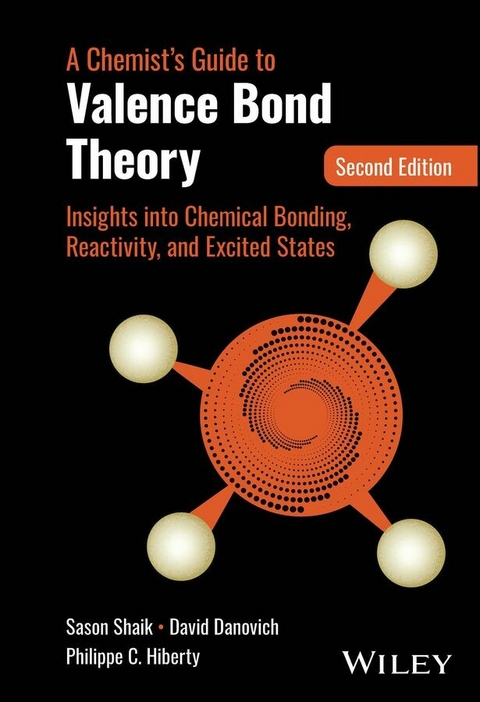
A Chemist's Guide to Valence Bond Theory (eBook)
676 Seiten
Wiley (Verlag)
978-1-394-23881-1 (ISBN)
Updated resource on theoretical aspects and applications of valence bond methods to chemical calculations
A Chemist's Guide to Valence Bond Theory explains how to use valence bond theory to think concisely and rigorously and how to use VB computations. It familiarizes the reader with the various VB-based computational tools and methods available today and their use for a given chemical problem and provides samples of inputs/outputs that instruct the reader on how to interpret the results. The book also covers the theoretical basis of Valence Bond (VB) theory and its applications to chemistry in the ground- and excited-states. Applications discussed in the book include sets of exercises and corresponding answers on bonding problems, organic reactions, inorganic/organometallic reactions, and bioinorganic/ biochemical reactions.
This Second Edition contains a new chapter on chemical bonds which includes sections on covalent, ionic, and charge-shift bonds as well as triplet bond pairs, a new chapter on the Breathing-Orbital VB method with its application to molecular excited states, and several new sections discussing recent developments such as DFT-based methods and solvent effects via the Polarizable Continuum Model (PCM).
A Chemist's Guide to Valence Bond Theory includes information on:
- Writing and representing valence bond wave functions, overlaps between determinants, and valence bond formalism using the exact Hamiltonian
- Generating a set of valence bond structures and mapping a molecular orbital-configuration interaction wave function into a valence bond wave function
- The alleged 'failures' of valence bond theory, such as the triplet ground state of dioxygen, and whether or not these failures are 'real'
- Spin Hamiltonian valence bond theory and its applications to organic radicals, diradicals, and polyradicals
A Chemist's Guide to Valence Bond Theory is an essential reference on the subject for chemists who are not necessarily experts on theory but have some background in quantum chemistry. The text is also appropriate for upper undergraduate and graduate students in advanced courses on valence bond theory.
Sason Shaik is a Saerree K. and Louis P. Fiedler Emeritus Professor of Chemistry at the Hebrew University. He has developed a number of new paradigms and concepts using valence bond theory and participated in the initiation of various valence bond methods.
David Danovich is a senior computational chemist at the Institute of Chemistry in the Hebrew University, and an expert on VB calculations
Philippe C. Hiberty is an Emeritus Director of Research at the Centre National de la Recherche Scientifique in the Université Paris-Saclay. He has developed the Breathing-Orbital VB method.
1
A Brief Story of Valence Bond Theory, its Rivalry with Molecular Orbital Theory, its Demise, and Resurgence
The new quantum mechanics of Heisenberg and Schrödinger provided chemistry with two general theories, one called valence bond theory (VBT) and the other molecular orbital theory (MOT). The two theories were developed at about the same time, but have quickly diverged into rival schools that have competed, sometimes fervently, on charting the mental map and epistemology of chemistry. In brief, until the mid‐1950s VBT had dominated chemistry, and then MOT took over while VBT fell into disrepute and was almost completely abandoned. The more recent period from the 1980s onward marked a comeback of VBT, which has since then been enjoying a renaissance both in the qualitative application of the theory and in the development of new methods for its computer implementation (1). One of the great merits of VBT is its pictorially intuitive wave function that is expressed as a linear combination of chemically meaningful structures. It is this feature that has made VBT so popular in the 1930s–1950s, and it is the same feature that underlies its temporary demise and ultimate resurgence. This newly edited monograph therefore constitutes an attempt to guide the chemist in the use of VBT, to highlight its insight into chemical problems, and some of its state‐of‐the‐art methodologies.
Unfortunately, VB is still considered by some researchers as an obsolete theory. This however is strictly wrong. As such, we thought it would be instructive to begin with a short historical account of VBT, its rivalry against the alternative MOT, its downfall, and the reasons for the past victory of MO and the current resurgence of VBT. Part of this review is based on material from the fascinating historical accounts of Servos (2) and Brush (3, 4). Other parts are not official historical accounts, but rational analyses of historical events; in some sense, we are reconstructing history in a manner that reflects our own opinions and the feedback we received from colleagues, as well as ideas formed during the writing of the “conversation” that two of us have published with Roald Hoffmann (5).
1.1 ROOTS OF VB THEORY
The roots of VBT in chemistry can be traced back to the famous paper of Lewis “The Atom and the Molecule” (6), which introduces the notions of electron‐pair bonding and the octet rule (initially called the rule of eight) (6). Lewis was seeking an understanding of weak and strong electrolytes in solution (2). This interest led him to formulate the concept of the chemical bond as an intrinsic property of the molecule that varies between the covalent (shared‐pair) and ionic extremes. In this chapter, Lewis uses his knowledge that almost all known stable compounds had an even number of electrons, as the rationale that led him to the notion of electron pairing as a mechanism of bonding. This and the fact that helium was found by Moseley to possess only two electrons made it clear to Lewis that electron pairing was more fundamental than the octet rule; the latter rule was an upper bound for the number of electron pairs that can surround an atom (6). In the same paper, Lewis invents an ingenious symbol for electron pairing, the colon (e.g., H:H), which enabled him to draw electronic structures for a great variety of molecules involving single, double, and triple bonds. This article predated new quantum mechanics by 11 years and it constitutes the first effective formulation of bonding in terms of the covalent–ionic classification, which is still being taught today. This theory has formed the basis for the subsequent construction and generalization of VBT. The idea eventually had its greatest impact through the work of Langmuir, who articulated the Lewis model, applied it across the periodic table, and invented catchy terms like the octet rule and the covalent bond (7). From then onward, the notion of electron pairing as a mechanism of bonding became widespread and initiated the “electronic structure revolution” in chemistry (8).
The overwhelming chemical support of Lewis's idea presented an exciting agenda for research directed at understanding the mechanism by which an electron pair could constitute a bond. This, however, remained a mystery until 1927 when Heitler and London went to Zurich to work with Schrödinger. In the summer of the same year, they published their seminal paper, “Interaction Between Neutral Atoms and Homopolar Binding” (9, 10). Here they showed that the bonding in dihydrogen (H2) originates in the quantum mechanical “resonance” interaction that is contributed as the two electrons are allowed to exchange their positions between the two atoms. This wave function and the notion of resonance were based on the work of Heisenberg (11), who showed earlier that, since electrons are indistinguishable particles, then for a two‐electron system, with two quantum numbers n and m, there exist two wave functions that are linear combinations of the two possibilities of arranging these electrons, as shown in Equations 1.1a and 1.1b.
As demonstrated by Heisenberg, the mixing of [ϕn(1)ϕm(2)] and [ϕn(2)ϕm(1)] led to a new energy term that caused a splitting between the two wave functions ΨA and ΨB. He called this term “resonance” using a classical analogy of two oscillators that, by virtue of possessing the same frequency, form a resonating situation with characteristic exchange energy.
In modern terms, the bonding in H2 can be accounted for by the wave function drawn in 1, in Scheme 1.1. This wave function is a superposition of two covalent situations in which, in the first form (a) one electron has a spin‐up (α spin), while the other has a spin‐down (β spin), and vice versa in the second form (b). Thus, the bonding in H2 arises due to the quantum mechanical “resonance” interaction between the two patterns of spin arrangement that are required in order to form a singlet electron pair. This “resonance energy” accounted for most of the total bond energy of the molecule, and thereby projected that the wave function in 1, which is referred to henceforth as the HL wave function, can describe the chemical bonding in a satisfactory manner. This “resonance origin” of the bonding was a remarkable feat of the new quantum theory, since until then it was not obvious how two neutral species could be at all bonded.
Scheme 1.1 Valence bond representations of H2, an A–B bond, O2 and a MOT diagram for a 2e-bond.
In the winter of 1928, London extended the HL wave function and drew the general principles of covalent bonding in terms of the resonance interaction between the forms that allow the interchange of the spin‐paired electrons between the two atoms (10, 12). In both treatments (9, 12) the authors considered ionic structures for homopolar bonds but discarded their mixing as being too small. In London's paper, there is also a consideration of ionic (so‐called polar) bonding. In essence, the HL theory was a quantum mechanical version of Lewis's electron‐pair theory. Thus, even though Heitler and London did their work independently and were perhaps unaware of the Lewis model, the HL wave function still precisely described the shared‐pair bond of Lewis. In fact, in his letter to Lewis (8), and in his landmark paper (13), Pauling points out that the HL and London treatments are “entirely equivalent to G.N. Lewis's successful theory of shared electron pair …”. Thus, although the final formulation of the chemical bond has a physicist's dress, the origin is clearly the chemical theory of Lewis.
The HL wave function formed a basis for the version of VBT that later became very popular, and was behind some of the failings to be attributed to VBT. In 1929, Slater presented his determinant‐based method (14). In 1931, he generalized the HL model to n‐electrons by expressing the total wave function as a product of n/2 bond wave functions of the HL type (15). In 1932, Rumer (16) showed how to write down the entire possible bond pairing schemes for n‐electrons and avoid linear dependencies among the forms in order to obtain canonical structures. We will refer hereafter to the kind of theory that considers only covalent structures as HLVB. Further refinements of the new theory of bonding (17) during 1928–1933 were mostly quantitative, focusing on the improvement of the exponents of the atomic orbitals by Wang (18) and on the inclusion of polarization functions and ionic terms by Rosen and Weinbaum (19, 20).
The success of the HL model and its relation to Lewis's model posed a wonderful opportunity for the young Pauling and Slater to construct a general quantum chemical theory for polyatomic molecules. In the same year (1931), they both published a few seminal papers in which they developed the notion of hybridization, the covalent–ionic superposition, and the resonating benzene picture (1521–24). Especially effective were those of Pauling's papers that linked the new theory to the...
| Erscheint lt. Verlag | 5.1.2026 |
|---|---|
| Sprache | englisch |
| Themenwelt | Naturwissenschaften ► Chemie ► Physikalische Chemie |
| Schlagworte | Breathing-Orbital VB • Charge-Shift Bonds • covalent bonds • DFT-based methods • ionic Bonds • Molecular Excited States • organic reactions • organometallic reactions • origins of energy barriers • Polarizable Continuum Model (PCM) • Triplet Bond Pairs |
| ISBN-10 | 1-394-23881-9 / 1394238819 |
| ISBN-13 | 978-1-394-23881-1 / 9781394238811 |
| Informationen gemäß Produktsicherheitsverordnung (GPSR) | |
| Haben Sie eine Frage zum Produkt? |
 EPUB (Adobe DRM)
Kopierschutz: Adobe-DRM
Adobe-DRM ist ein Kopierschutz, der das eBook vor Mißbrauch schützen soll. Dabei wird das eBook bereits beim Download auf Ihre persönliche Adobe-ID autorisiert. Lesen können Sie das eBook dann nur auf den Geräten, welche ebenfalls auf Ihre Adobe-ID registriert sind.
Details zum Adobe-DRM
Dateiformat: EPUB (Electronic Publication)
EPUB ist ein offener Standard für eBooks und eignet sich besonders zur Darstellung von Belletristik und Sachbüchern. Der Fließtext wird dynamisch an die Display- und Schriftgröße angepasst. Auch für mobile Lesegeräte ist EPUB daher gut geeignet.
Systemvoraussetzungen:
PC/Mac: Mit einem PC oder Mac können Sie dieses eBook lesen. Sie benötigen eine
eReader: Dieses eBook kann mit (fast) allen eBook-Readern gelesen werden. Mit dem amazon-Kindle ist es aber nicht kompatibel.
Smartphone/Tablet: Egal ob Apple oder Android, dieses eBook können Sie lesen. Sie benötigen eine
Geräteliste und zusätzliche Hinweise
Buying eBooks from abroad
For tax law reasons we can sell eBooks just within Germany and Switzerland. Regrettably we cannot fulfill eBook-orders from other countries.
aus dem Bereich